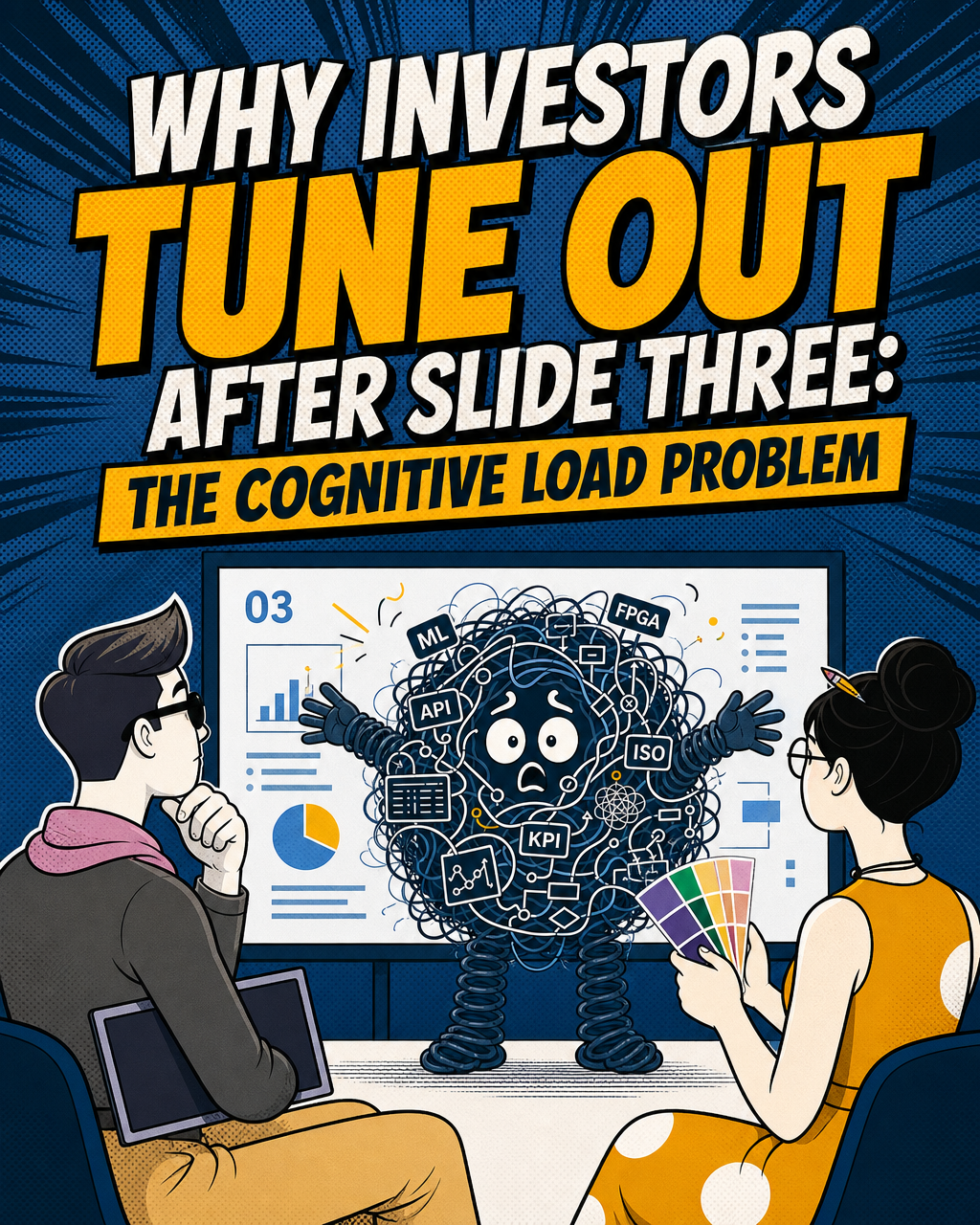
Why Investors Tune Out After Slide Three: The Cognitive Load Problem




Most deep tech founders assume they lose the room because their technology is too advanced. The room lost them earlier than that, and for a simpler reason.
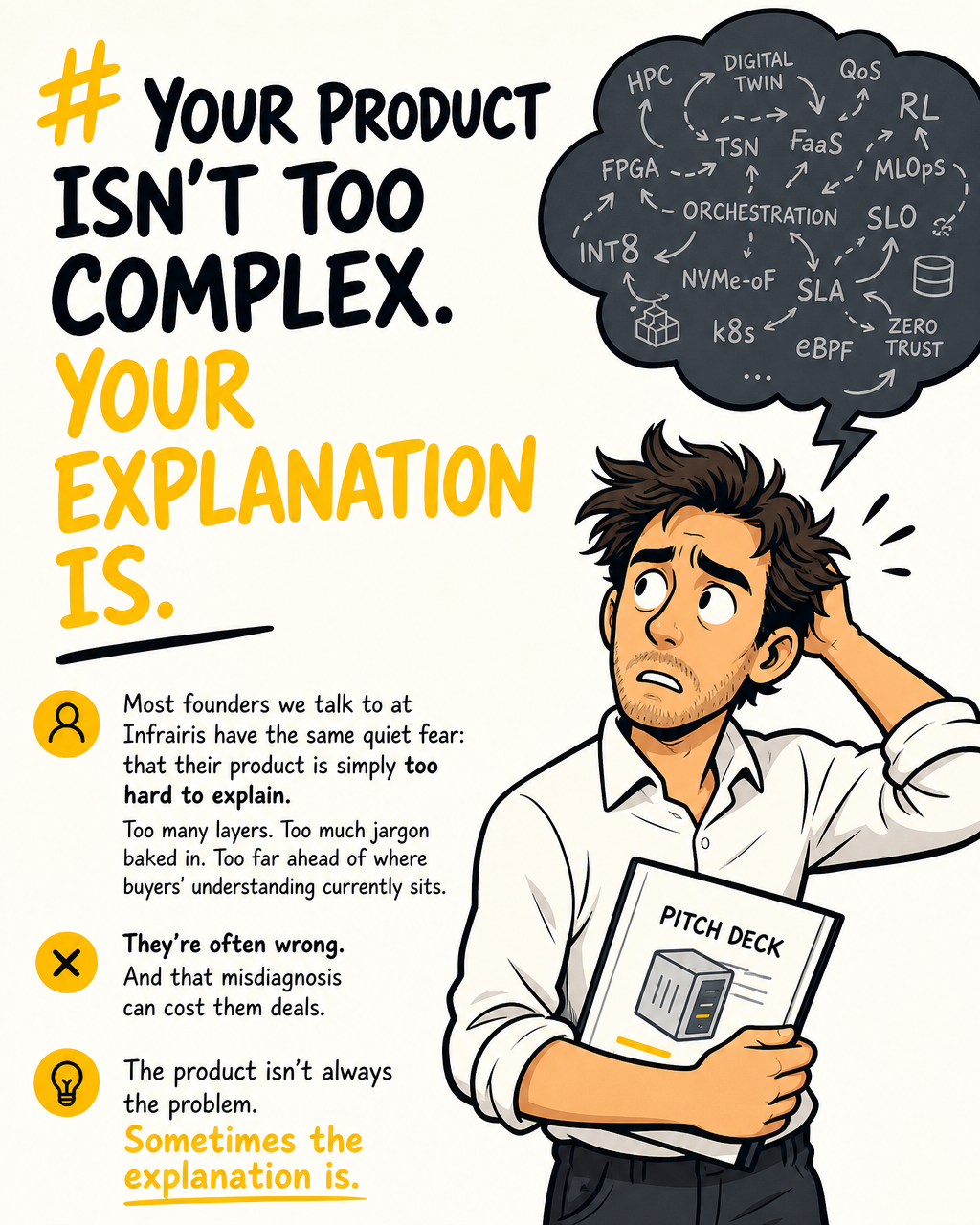
The problem isn't your product. It's the cognitive architecture of how your pitch is structured, and it's costing you rooms you should be winning.
The decision is already made before the technical merit registers
Investors are not evaluating your product with the focused, patient attention of a due diligence reviewer. They're pattern-matching at speed across a portfolio of inbound opportunities that grows every quarter.
DocSend (now part of Dropbox) has published annual pitch deck reports showing that investors spend roughly two to three minutes reviewing a startup deck on average — a number that varies by stage and deal type. The core finding is consistent: total review time is short, and it is not growing.
Investor review time appears to have declined in recent years, likely driven by factors including higher inbound volume and a growing supply of AI-generated decks — though the precise causes are difficult to isolate from available data.
Behavioural science adds an uncomfortable detail: research on first impressions, including Ambady and Rosenthal's work on thin-slicing, suggests that people form impressions rapidly and then tend to use subsequent information to confirm rather than revise that initial judgment. For deep tech founders, this means the go/no-go decision is frequently made before a single technical claim has been processed.
The first three slides decide everything. Some pitch deck analyses suggest that investors who decide not to read further make that call within the first three slides. If your deck opens with a technology overview, a company history, or a market map before establishing a clear human problem, you've already lost a segment of your audience.
The remaining slides become confirmation of a prior judgment, not the basis for a new one.
Working memory has a hard ceiling, and most deep tech pitches blow straight through it
Here's the underlying cognitive mechanism that explains why slide-three exits happen.
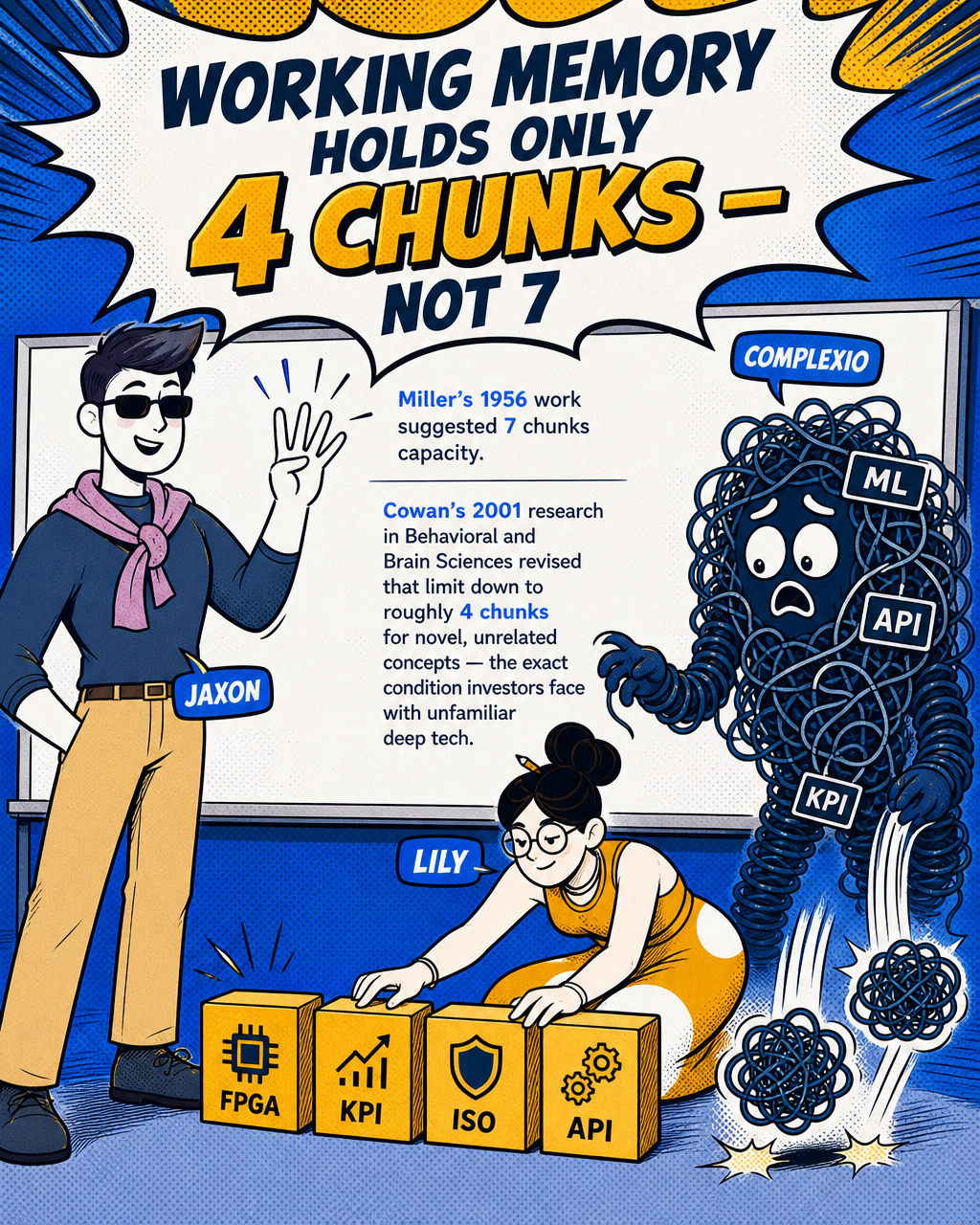
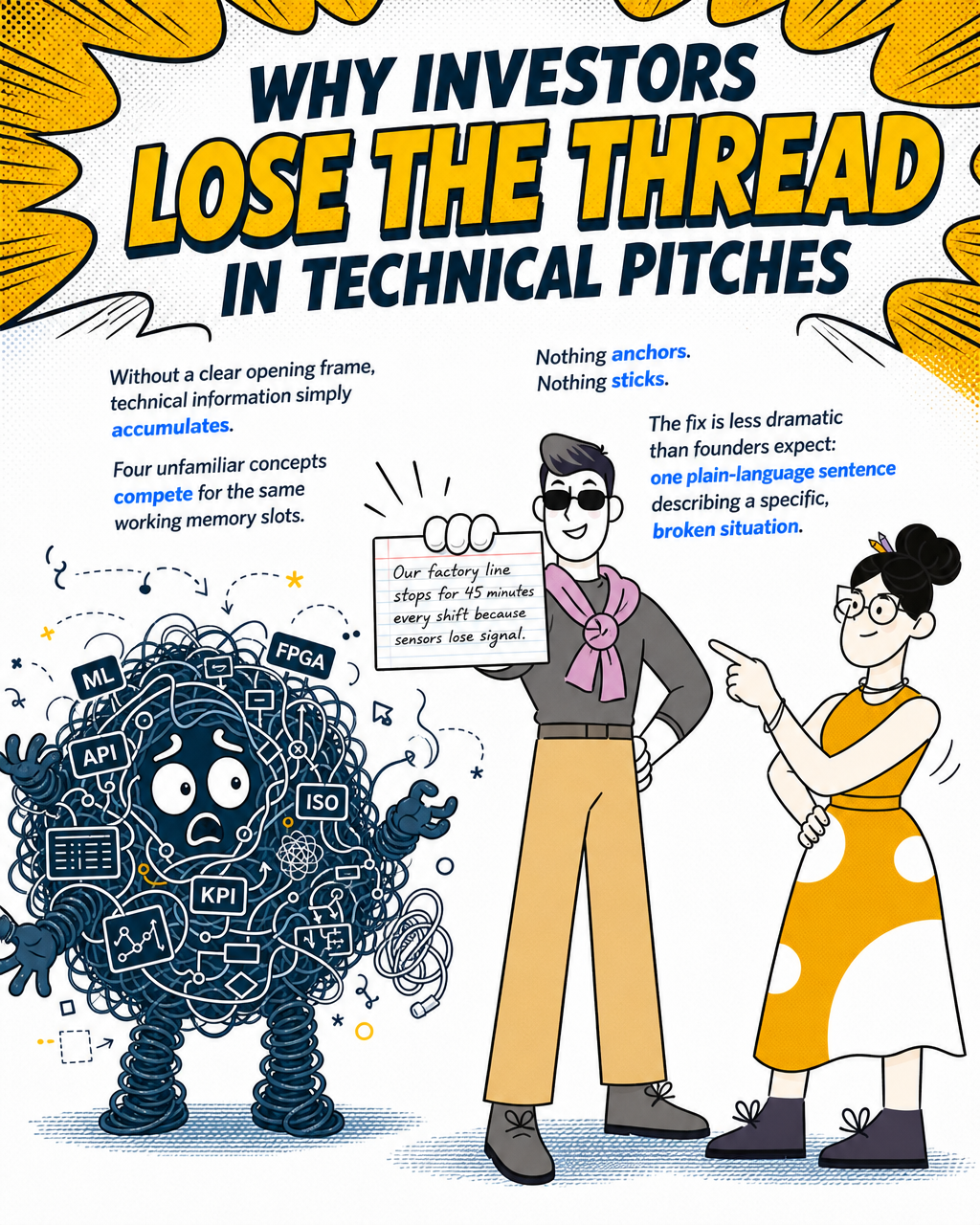
Human working memory, the mental workspace where we hold and process new information, has a capacity limit. Miller's original 1956 work on channel capacity suggested seven chunks, plus or minus two. More recent research, including Nelson Cowan's work published in Behavioral and Brain Sciences in 2001, places the functional limit for novel, unrelated concepts closer to four chunks. That's the raw capacity when prior knowledge can't group or consolidate the incoming information.
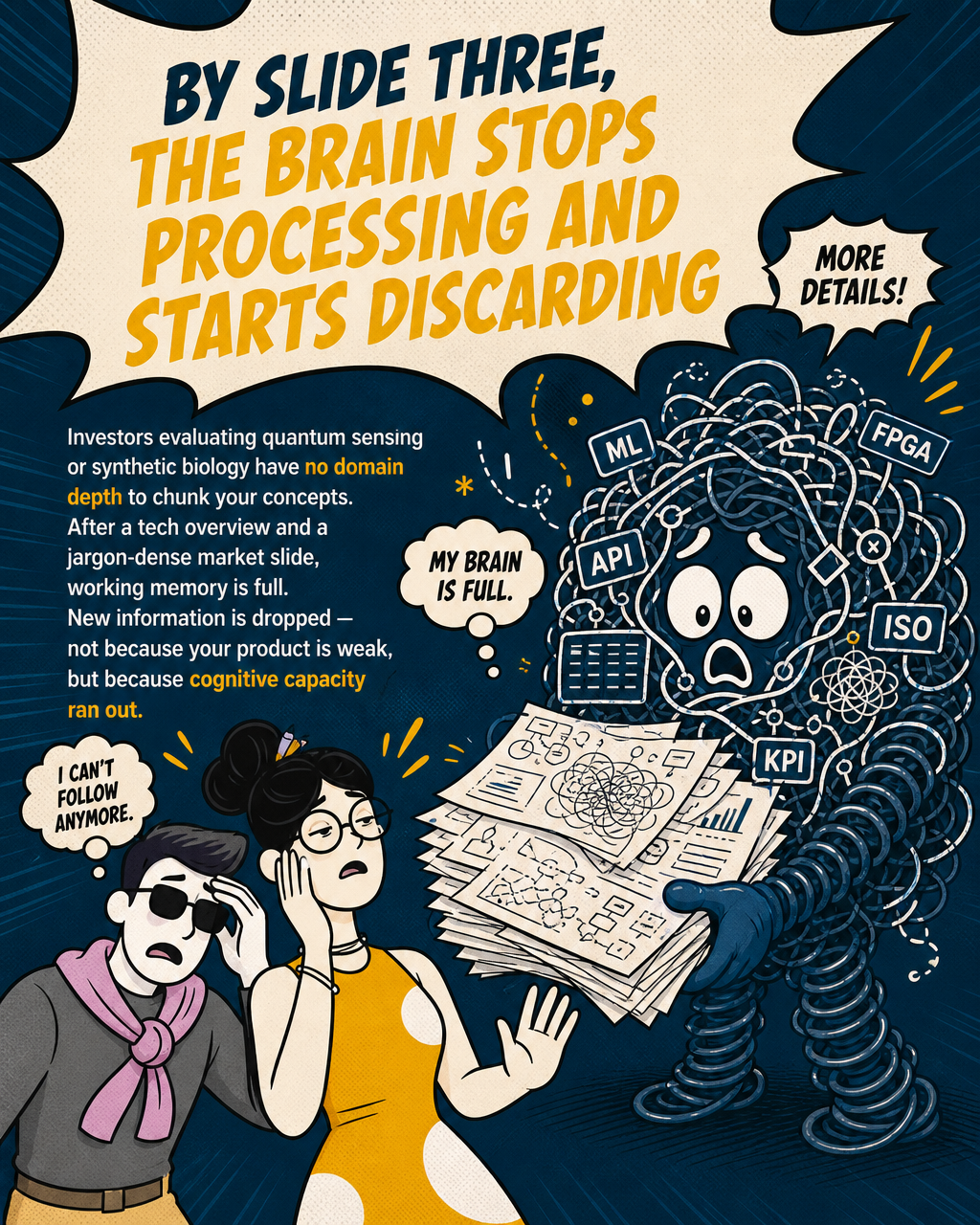
For an investor evaluating a quantum sensing company, a synthetic biology platform, or a regulatory compliance AI, everything on your first three slides is novel. They can't chunk it against prior experience because they don't have the domain depth you do. That means every unfamiliar concept they encounter costs them a slot in working memory.
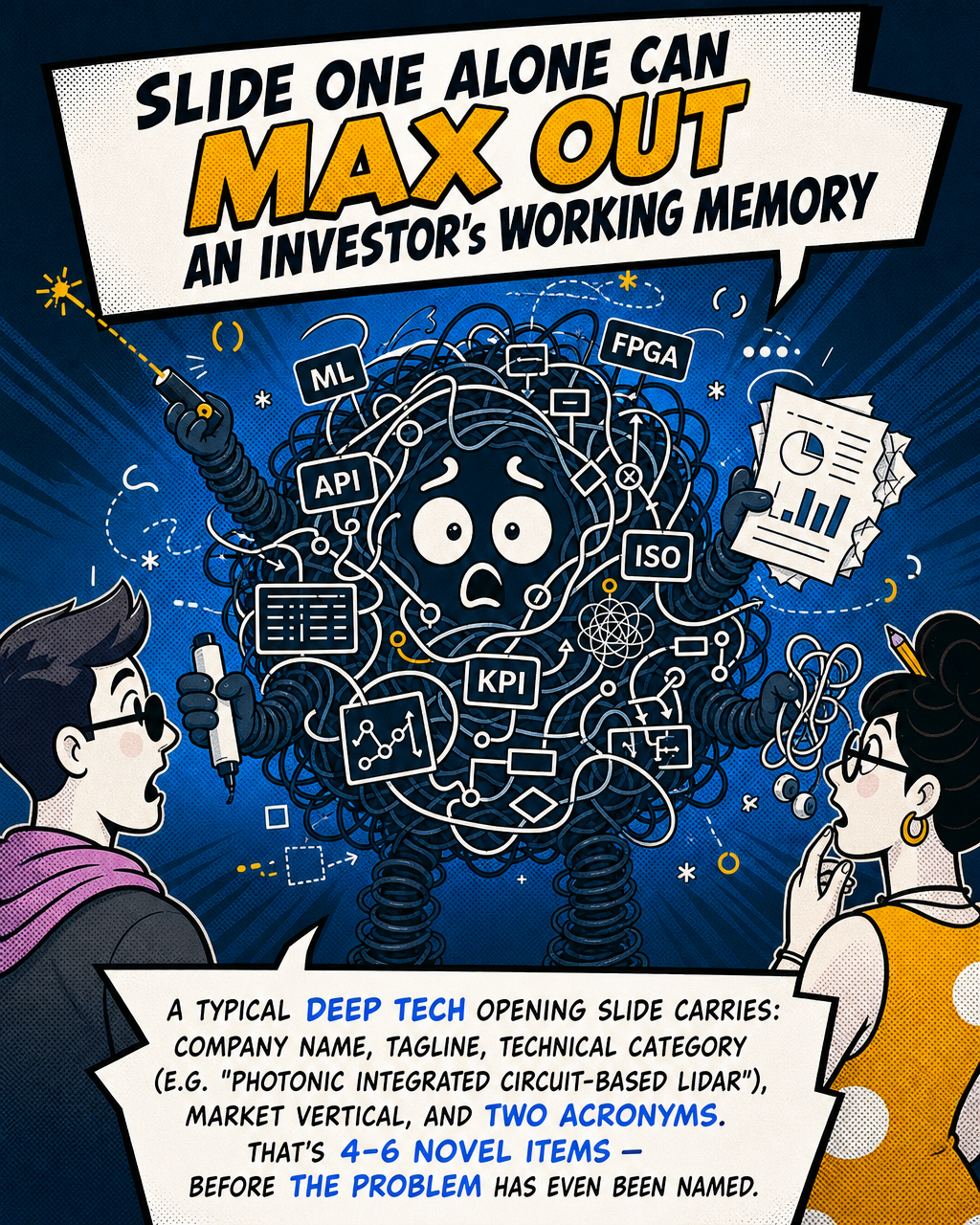
A typical deep tech pitch deck slide one often carries: company name, tagline, the technical category (e.g., "photonic integrated circuit-based LiDAR"), the market vertical, and an acronym or two. That's four to six new items before anyone has said a word about what problem is being solved or who has it.
By slide three, after a technology overview and a market sizing slide dense with category jargon, working memory is full. New information stops being processed and starts being discarded. The investor isn't disengaged because your product is unimpressive. They're disengaged because their brain has run out of room.
Cognitive overload research is unambiguous on what happens next: attention decreases, information retention drops, and decision-making becomes harder. Every slide that requires cognitive work — dense text, unexplained jargon, complex unlabelled charts — consumes attention that your strongest evidence should be occupying.
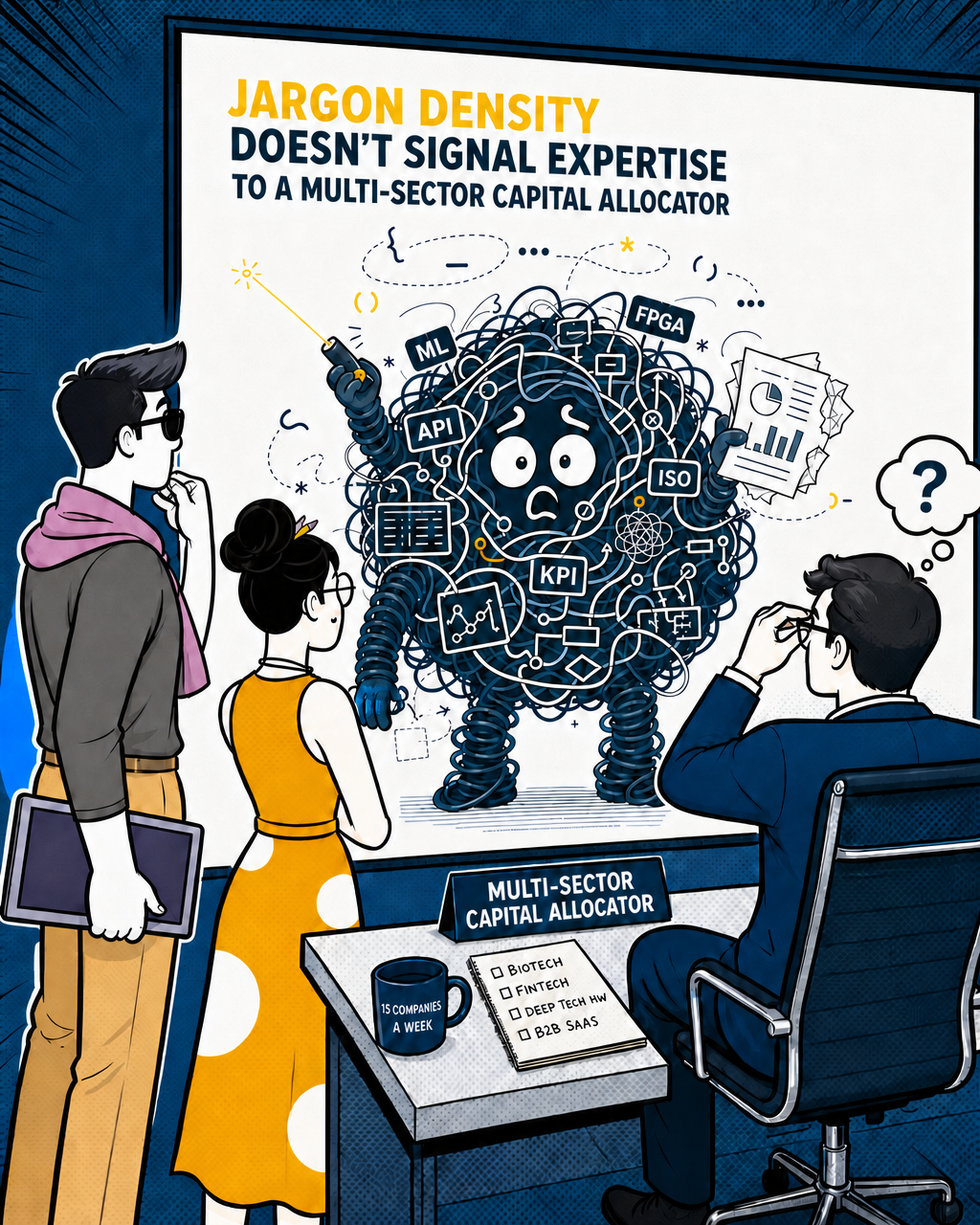
Jargon density doesn't signal expertise to a multi-sector capital allocator
Founders often believe that precise technical language demonstrates credibility. For audiences who share the knowledge base, it does. But most investors, and many enterprise buyers, are not in that audience.
A venture capital partner evaluating fifteen companies a week across biotech, fintech, deep tech hardware, and B2B SaaS is a multi-sector capital allocator, not a domain specialist. When your pitch deck opens with terms they don't recognise at reading speed, those terms don't register as expertise. They register as noise.
Visual clutter and jargon density create the same cognitive result: working memory fills with undifferentiated input, pattern-matching fails, and attention exits. Investors scan, they don't read word for word. Your slides need scannable structure, clear headlines, and a narrative that works even before the fine print is absorbed.
The irony is that the more technically precise your language, the more it can undermine comprehension for the people whose comprehension matters most to your raise.
This doesn't mean dumbing down the science. It means building a clear conceptual scaffold before you load the technical weight onto it.
The curse of knowledge: why experts skip the steps non-specialists need
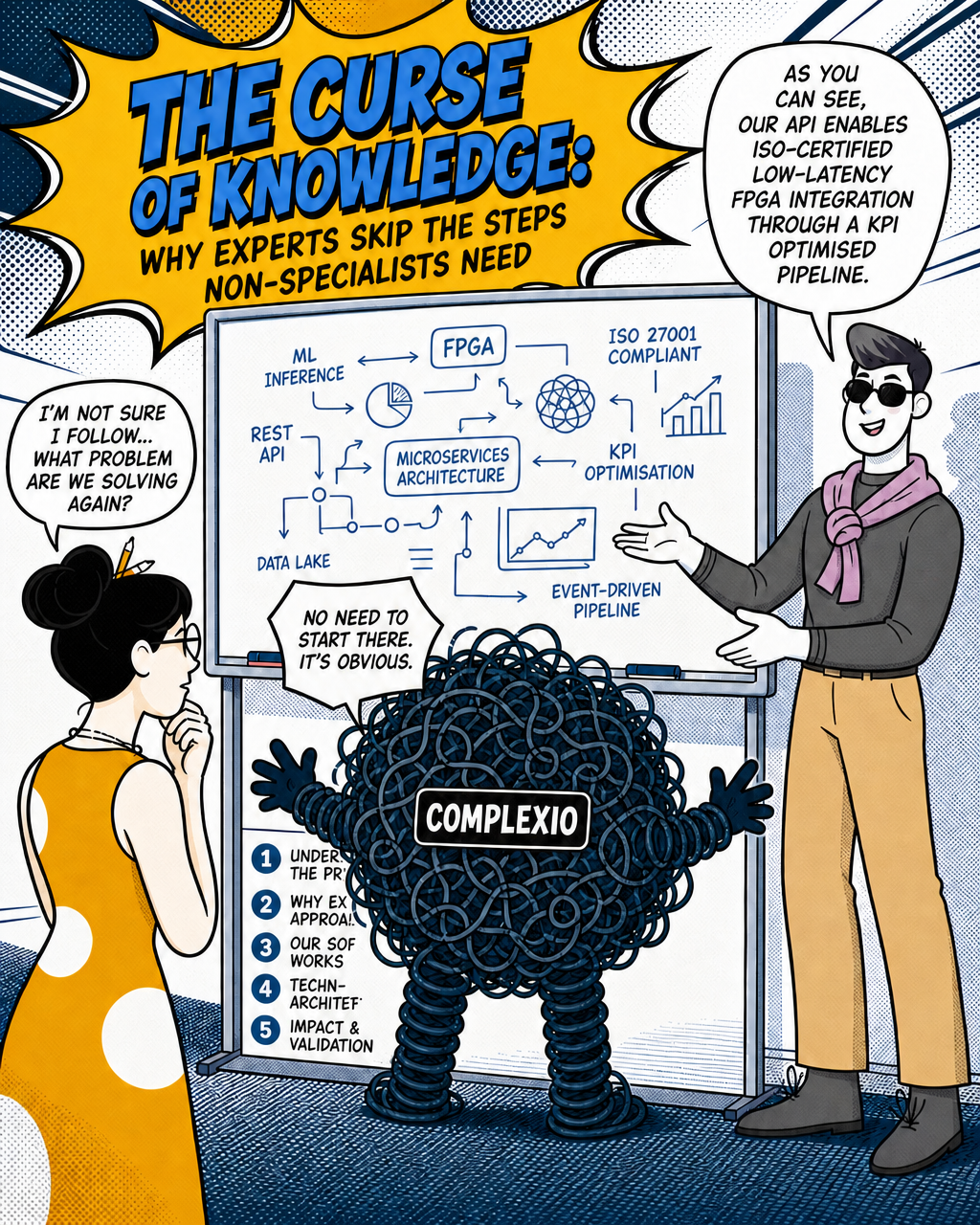
There's a well-documented cognitive bias at the root of this problem. The term "curse of knowledge" was coined in 1989 by economists Colin Camerer, George Loewenstein, and Martin Weber in an economics experiment context, and was later popularised as a broader cognitive bias concept by Chip and Dan Heath in their 2006 book Made to Stick.
The curse of knowledge describes how individuals, once they know something, tend to assume other people share that knowledge — including key terms, concepts, and background context. As Chip and Dan Heath have noted, once we know something, it's genuinely difficult to imagine what it was like not to know it. The knowledge has cursed us. We can't readily recreate our listener's state of mind.
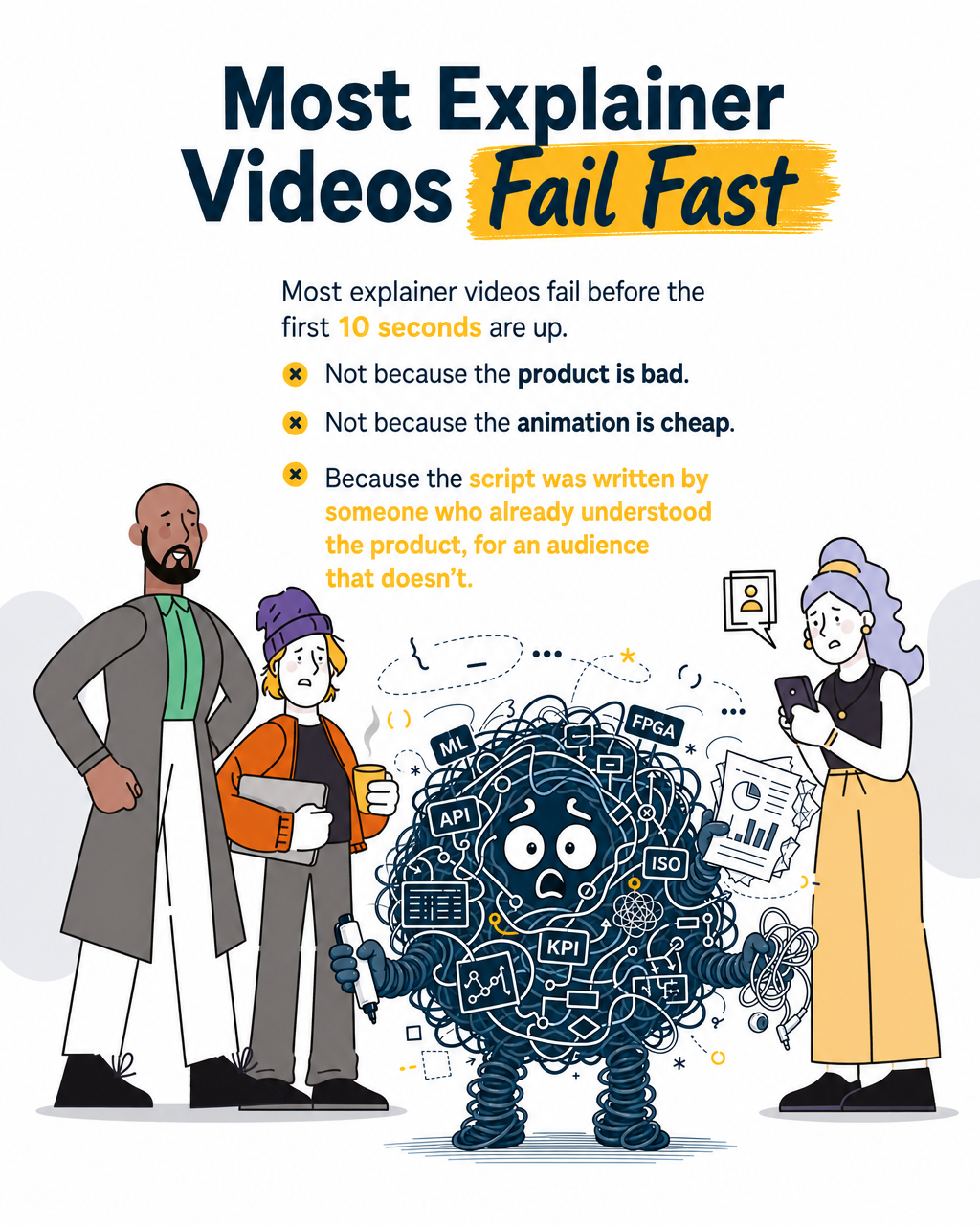
For deep tech founders, this plays out in a specific and consistent pattern. You've spent years building a product at the frontier of your domain. The conceptual scaffolding, the problem framing, the mechanism by which your technology creates value, all of this is so deeply embedded in your thinking that you've stopped perceiving it as knowledge someone else might not have.
So you skip it. Not deliberately. You skip it because from where you stand, it's obvious.
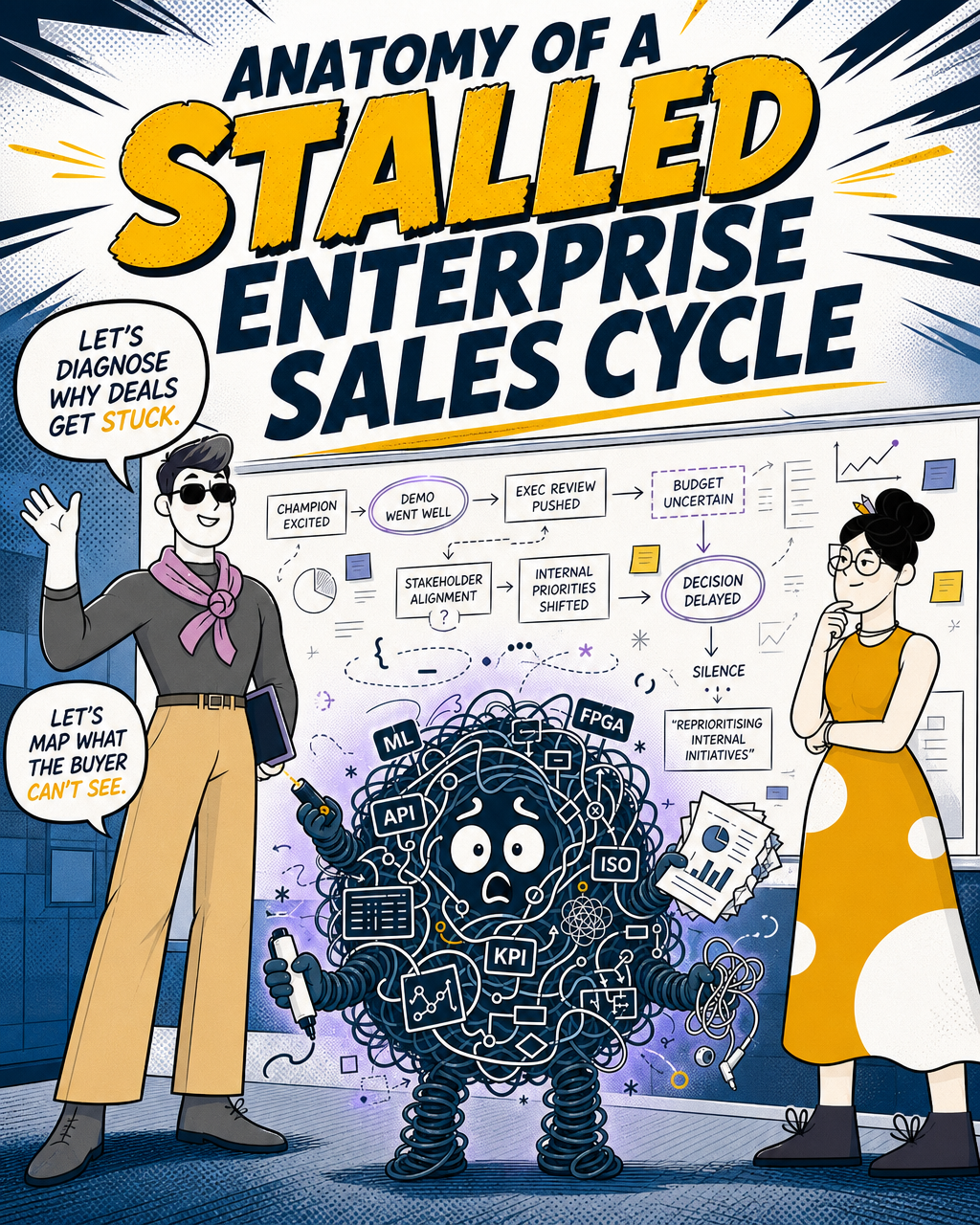
The investor doesn't have that scaffold. They hear your solution before they've understood the problem. They see the technical architecture before they've grasped why the current approach fails. And the logical chain that seems self-evident to you has gaps in it that are wide enough to lose a room.
Critically, the curse of knowledge is a difficult bias to correct. Research suggests it doesn't reduce simply by being told about it. The mental reorganisation required to genuinely recreate a beginner's perspective on a topic you know deeply is real work, and most founders have never been given a structured process for doing it.
A one-sentence problem statement changes the entire cognitive equation
The structural fix is less dramatic than founders often expect.
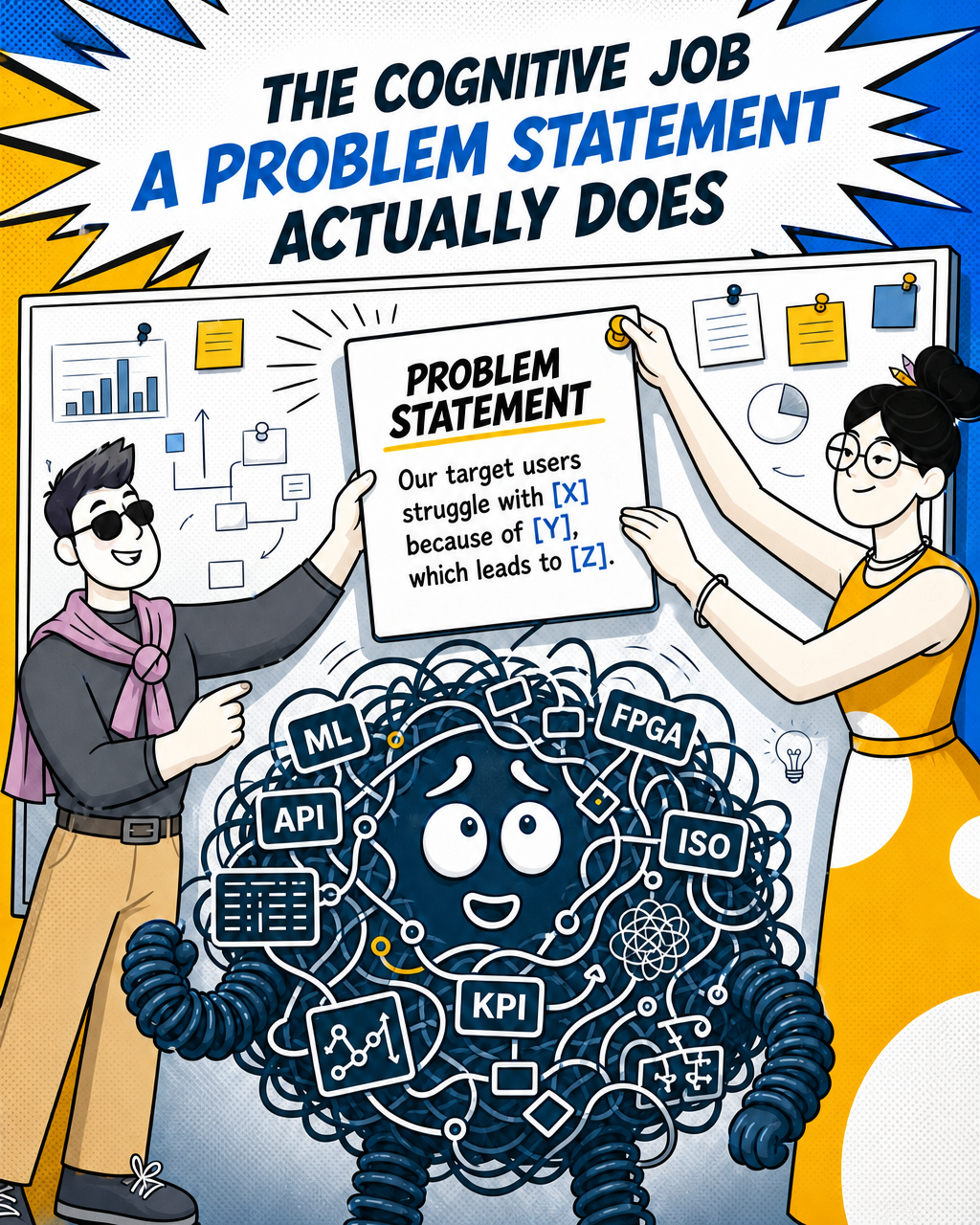
Pitches that open with a single plain-language problem statement tend to hold attention longer, regardless of how complex the underlying technology is. Not a market size slide. Not a technology category label. One sentence that describes a specific, recognisable human or business situation that is currently broken.
Here's why this works at the cognitive level.
A clear problem statement gives the investor a mental frame before any technical information lands. It's the scaffold that allows subsequent concepts to be organised rather than simply accumulated. Instead of four unfamiliar items competing for working memory slots, there's one clear anchor, and everything that follows can attach to it.
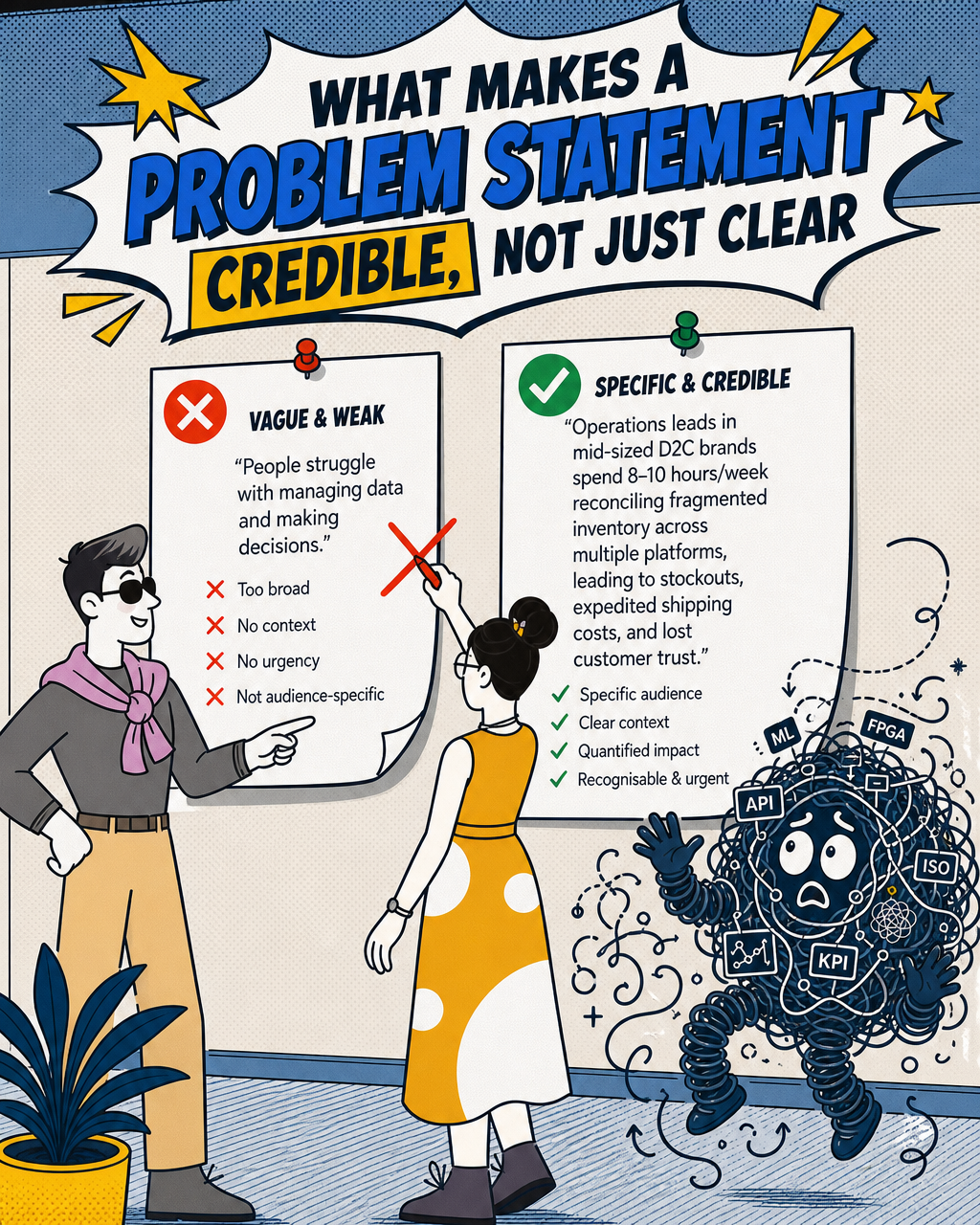
A compelling problem slide should make the problem feel specific, urgent, and recognisable to a clearly defined audience. Vague or generic problem statements weaken credibility. Specific, grounded ones demonstrate that the founder understands the market through lived experience or direct research, not just theoretical framing.
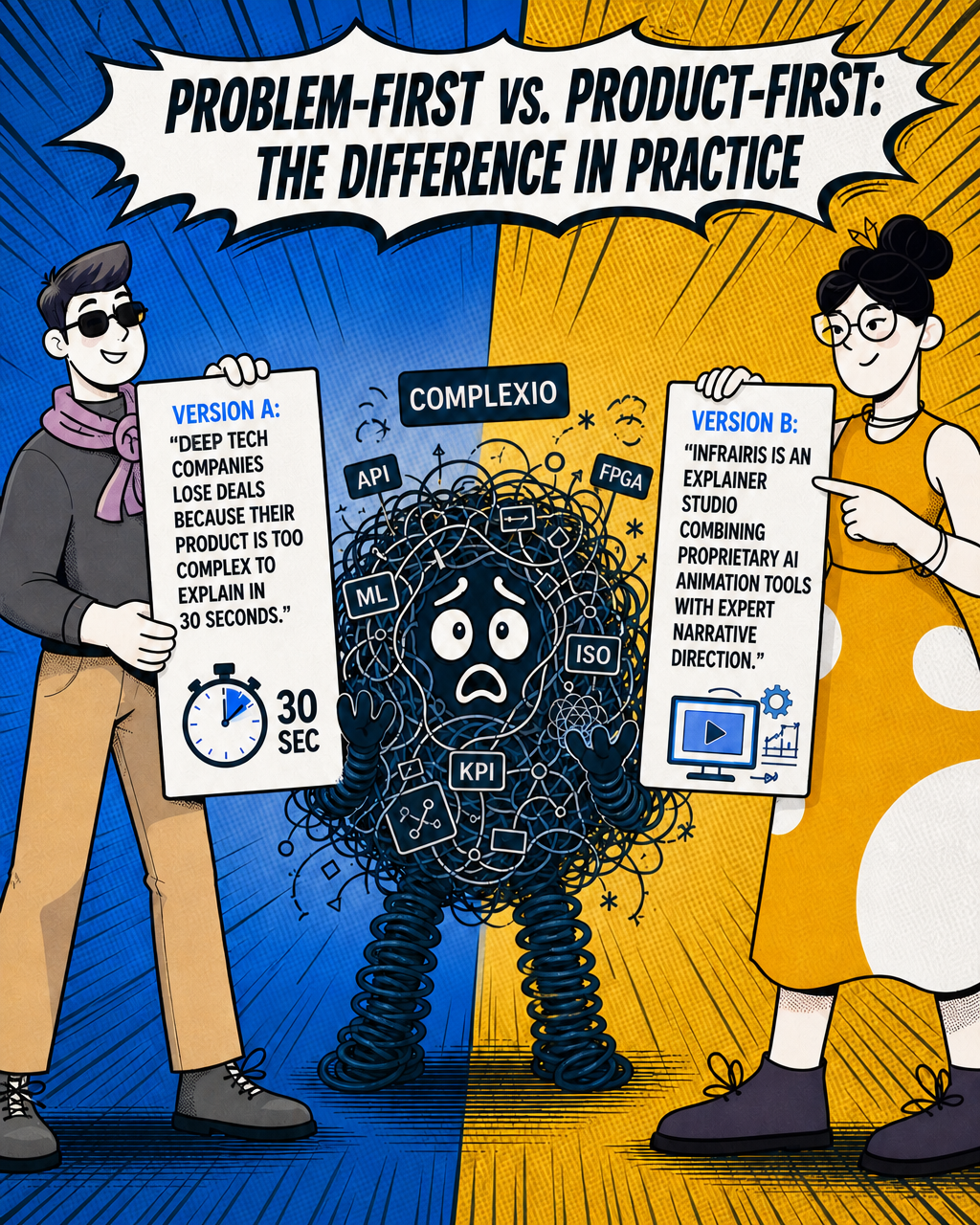
The difference in practice looks like this:
Version A (common): "Infrairis is an explainer studio combining proprietary AI animation tools with expert narrative direction to deliver 60-90 second explainer videos at unprecedented speed and price."
Version B (problem-first): "Deep tech companies lose deals and funding rounds because their product is too complex to explain in 30 seconds, and generic video agencies don't understand the technology."
Version B has no more technical sophistication than Version A. But it gives the investor a specific problem to hold. Everything that follows — the solution, the mechanism, the proof — can now attach to something already sitting in working memory.
A strong narrative arc moves from problem to solution to market to execution. The opening move is making the investor feel the problem before they ever see the solution. Once that frame is set, technical depth becomes a strength rather than a cognitive burden.
What this means practically for your pitch deck
This isn't about stripping technical depth from your materials. It's about sequencing.
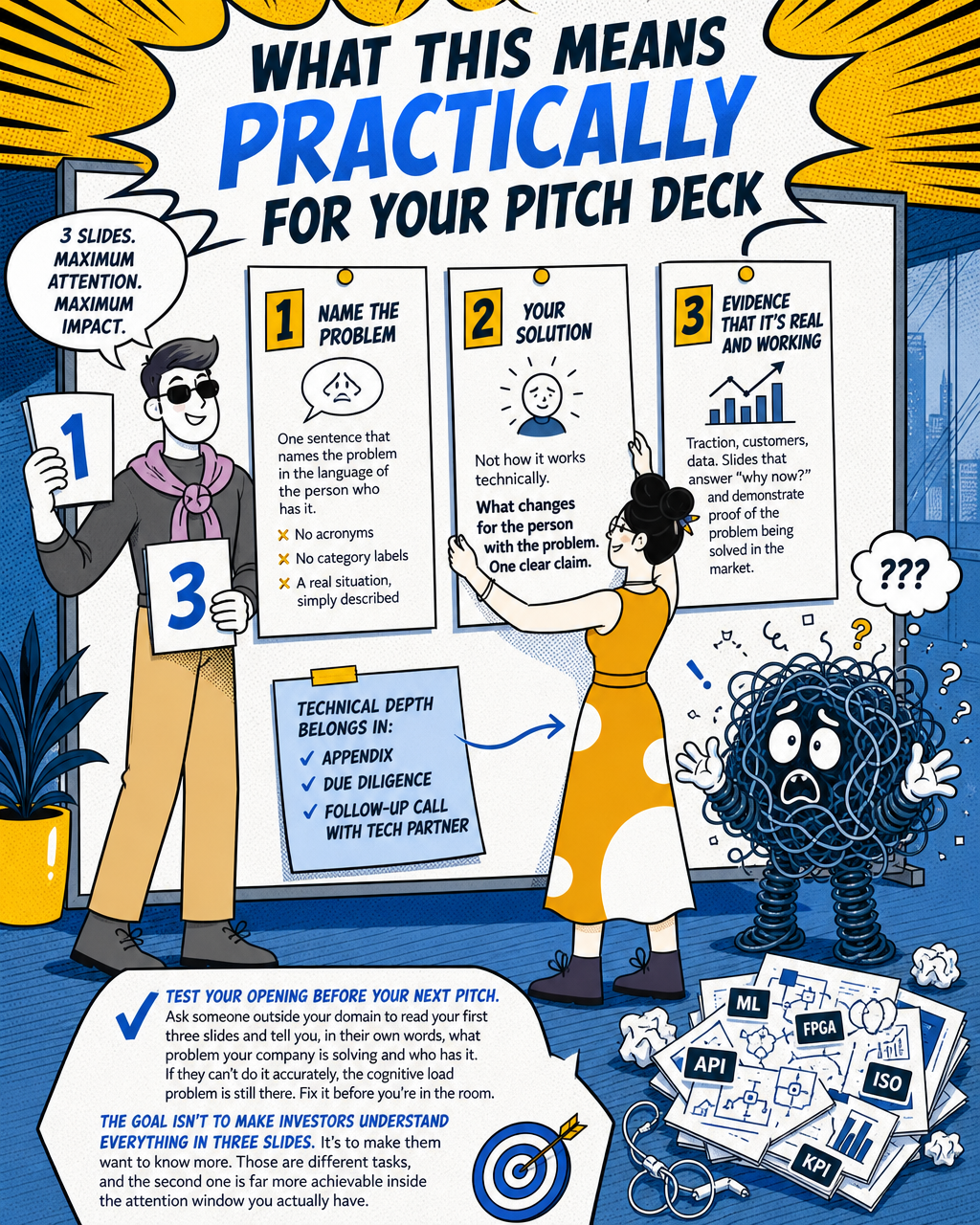
A few structural changes account for most of the attention difference:
Slide one: One sentence that names the problem in the language of the person who has it, not the language of the person solving it. No acronyms. No category labels. A real situation, simply described.
Slide two: Your solution. Not how it works technically. What changes for the person with the problem. One clear claim.
Slide three: The evidence that this is real and working. Traction, customers, data. DocSend's slide-level data has indicated that traction and financials slides tend to attract the highest investor reading times — slides that answer "why now?" and demonstrate proof of the problem being solved in the market are structurally well-positioned to do the same.
Technical depth belongs in the appendix, the due diligence materials, and the follow-up call with the technical partner. Not in the first three slides.
Test your opening before your next pitch. Ask someone outside your domain to read your first three slides and tell you, in their own words, what problem your company is solving and who has it. If they can't do it accurately, the cognitive load problem is still there. Fix it before you're in the room.
The goal isn't to make investors understand everything in three slides. It's to make them want to know more. Those are different tasks, and the second one is far more achievable inside the attention window you actually have.
The 60-second version of your pitch matters more than your deck
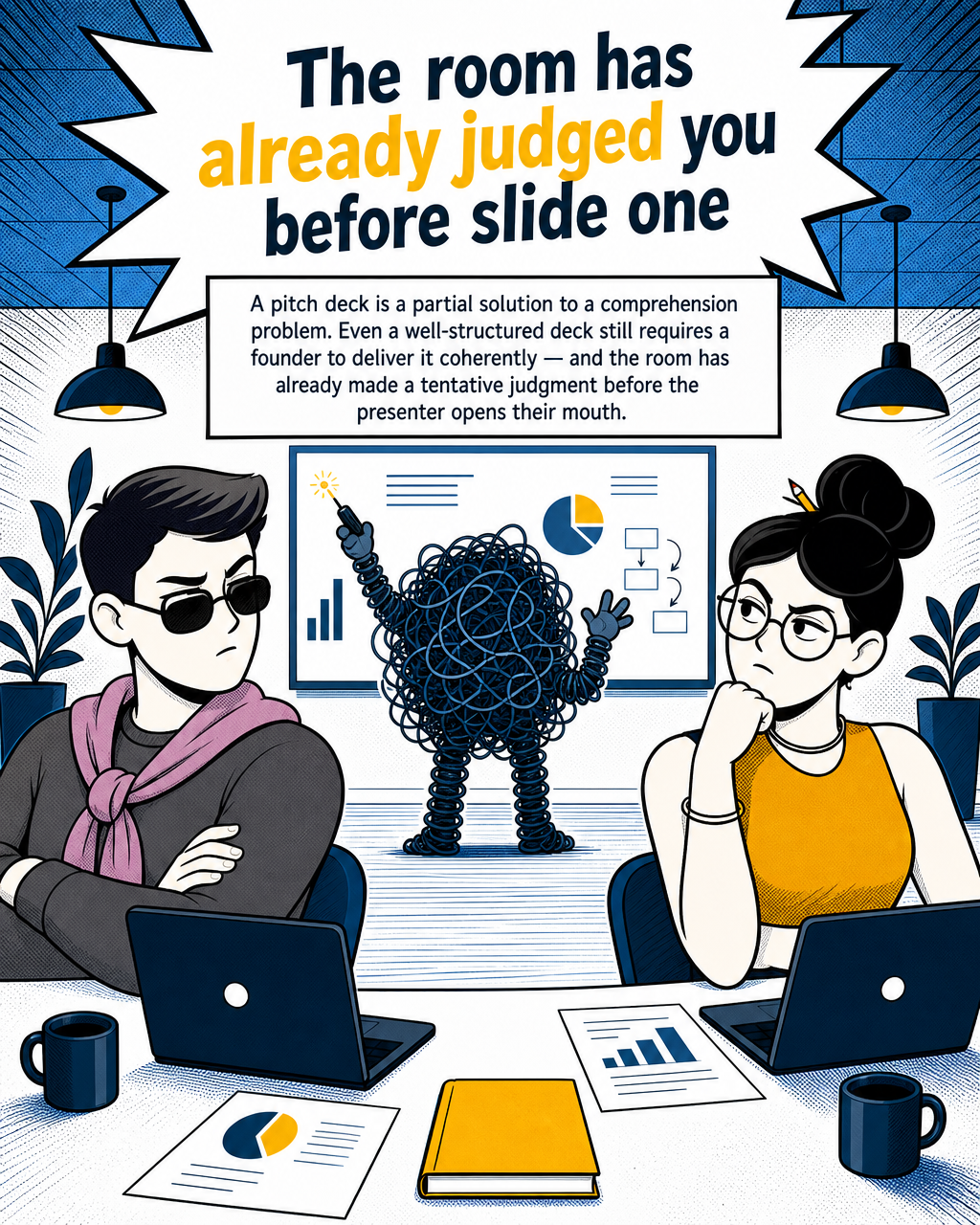
A pitch deck is a partial solution to a comprehension problem. Even a well-structured deck still requires a founder to deliver it coherently, and the room has already made a tentative judgment before the presenter opens their mouth.
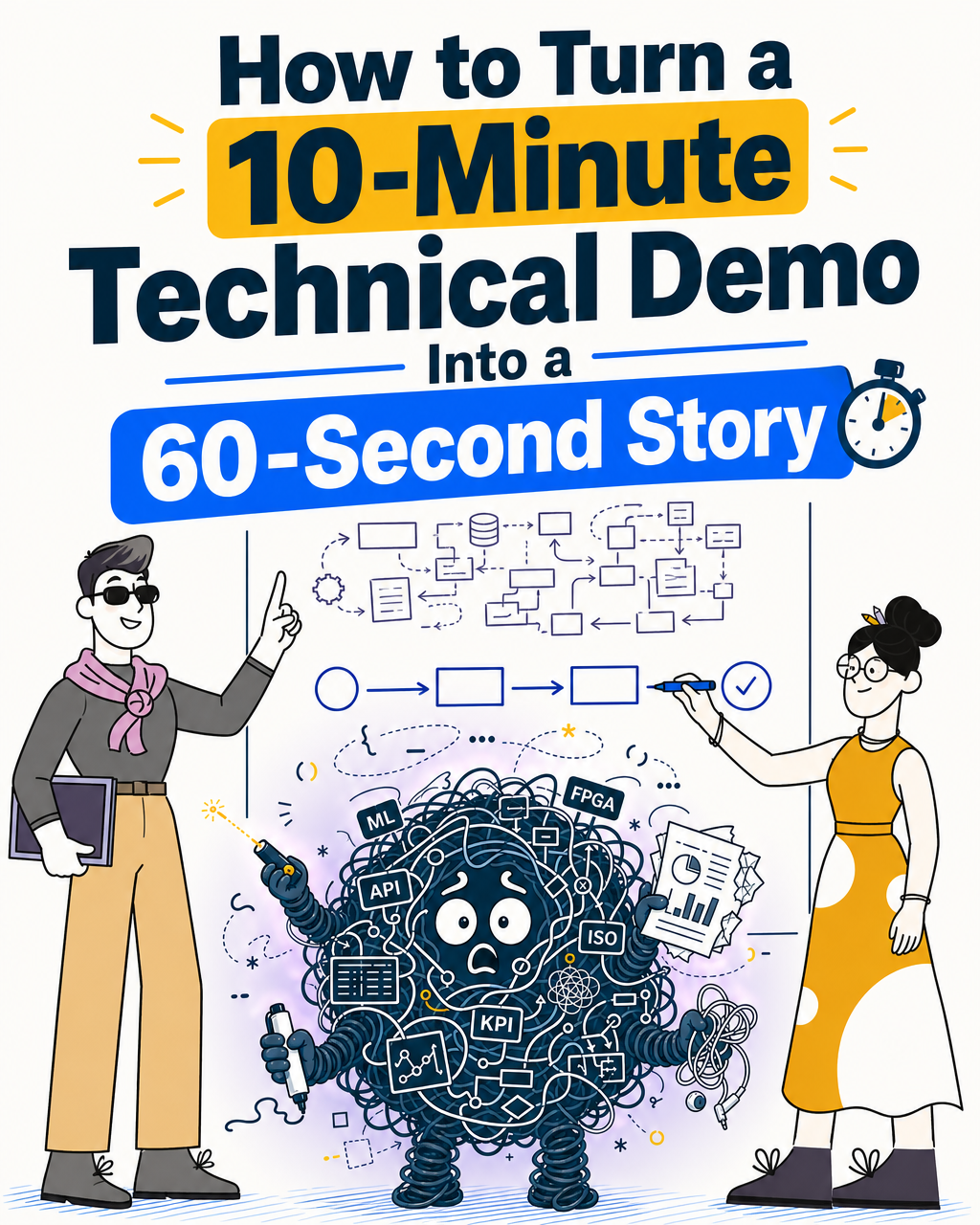
A common trait among companies that consistently get second meetings is that they can explain what they do and why it matters in under 90 seconds, in plain language, before any slides appear. That 90-second explanation is doing the cognitive scaffolding work before the deck ever loads.
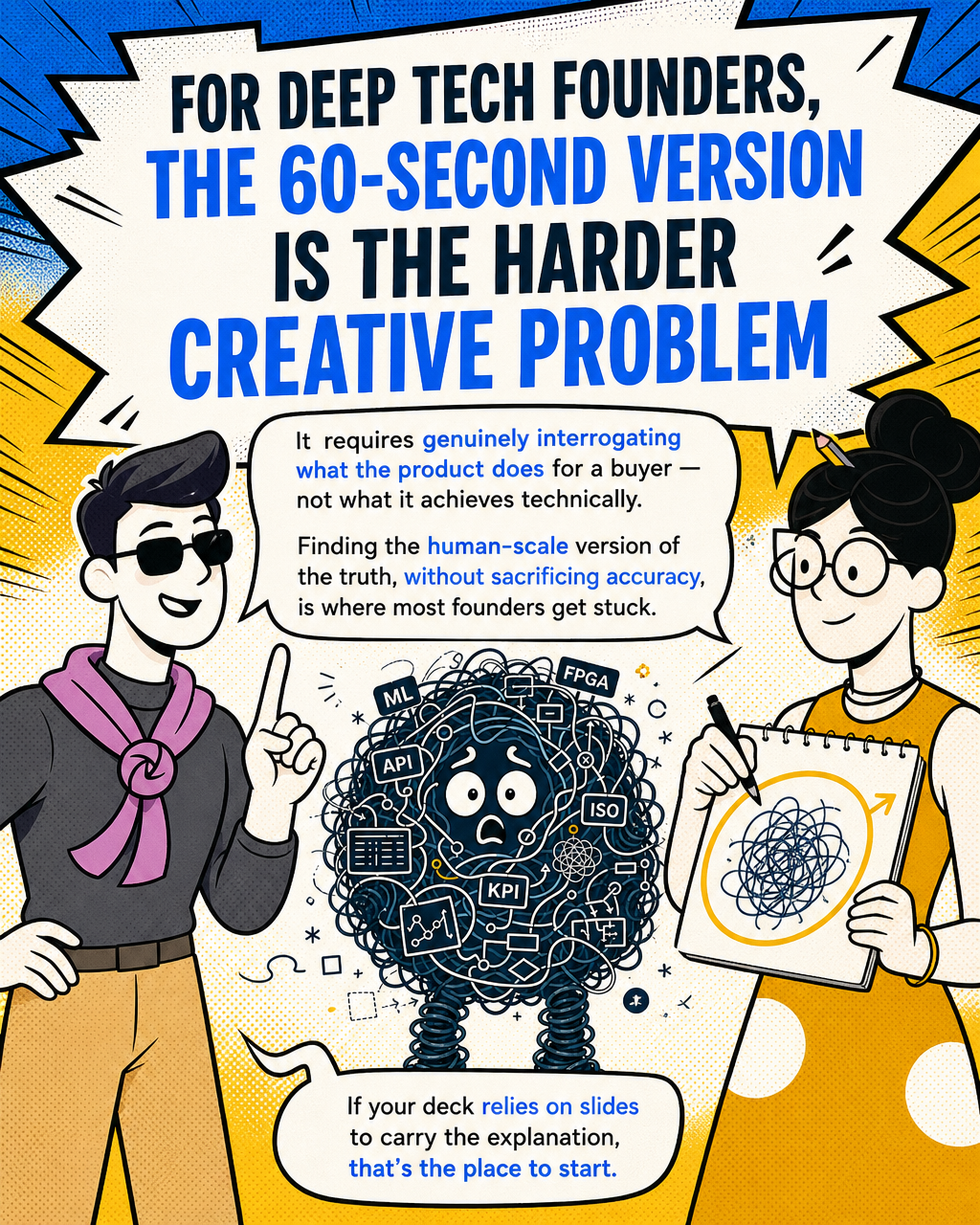
For most deep tech founders, building that explanation is the harder creative problem. It requires genuinely interrogating what the product does for a buyer, not what it achieves technically. It requires finding the human-scale version of the truth without sacrificing accuracy.
If your current deck relies on the slides to carry the explanation, that's the place to start.
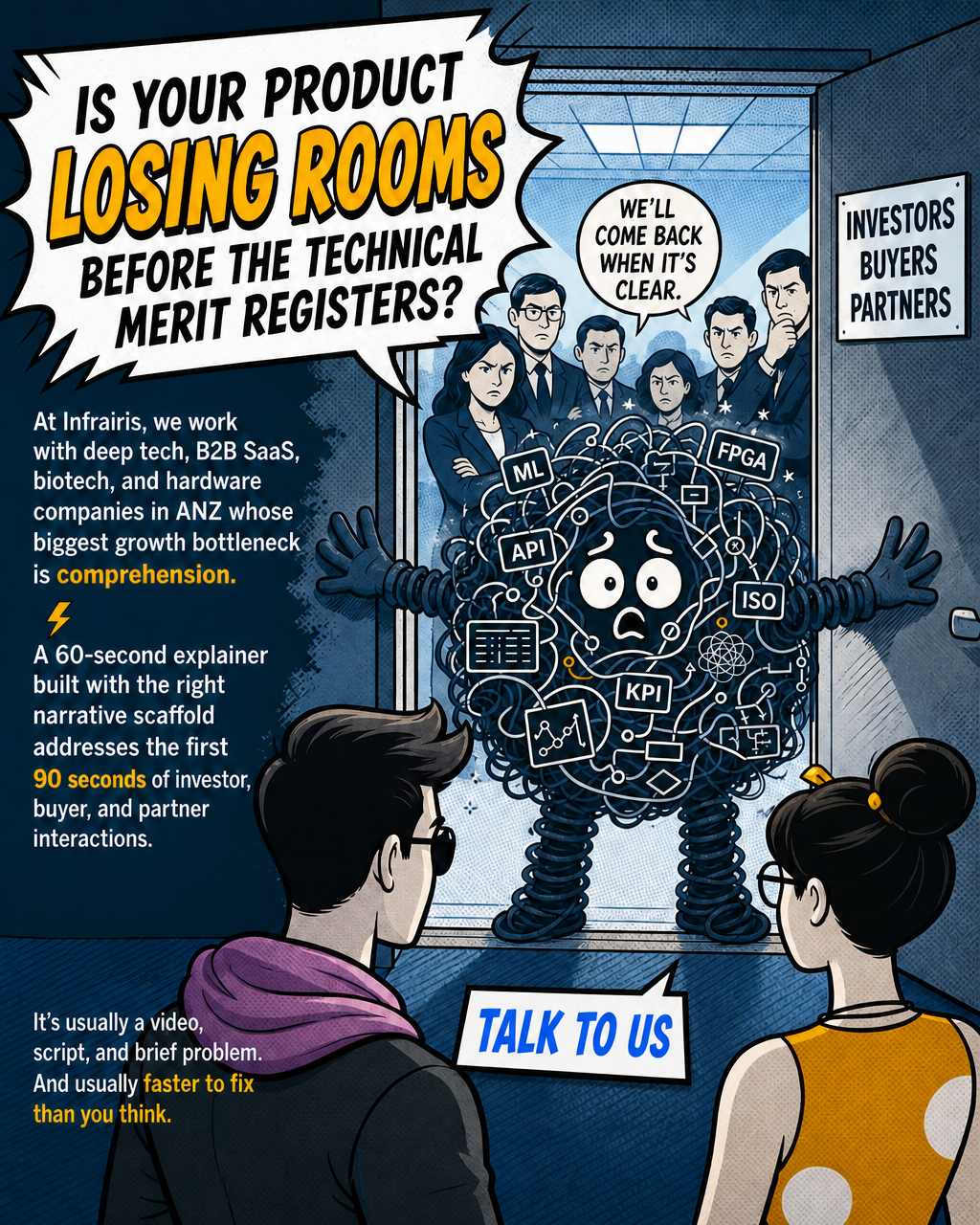
At Infrairis, we work with deep tech, B2B SaaS, biotech, and hardware companies in ANZ whose biggest growth bottleneck is comprehension. If your product loses rooms before the technical merit registers, a 60-second explainer built with the right narrative scaffold is one way to address the first 90 seconds of investor, buyer, and partner interactions.
Talk to us about your explainer — we'll tell you honestly whether it's a video problem, a script problem, or a brief problem. Usually it's all three, and usually they're fixable faster than you think.

Infrairis
Your complex product. In 60 seconds. Clearly.
Your complex product. In 60 seconds. Clearly.
Learn more about Infrairis and get started today.
Visit Infrairis