How to Turn a 10-Minute Technical Demo Into a 60-Second Story

You've done this demo a hundred times. You know it cold. You open with the architecture diagram, walk through the integration layer, explain the data pipeline, show the dashboard, and by minute seven the room is nodding politely.
In my experience, that nod often means they lost the thread somewhere around minute three.
This is the specific problem nobody warns you about when you're building a technical product solo: the same depth that makes your product genuinely good is what makes it genuinely hard to sell. You don't have a product problem. You have a compression problem.
A 10-minute walkthrough can become a 60-second story that non-technical buyers actually understand. Here's how.
Start where the buyer already is, not where your product begins
Most technical demos open with the product. The buyer hasn't agreed to care about it yet.
The first 10 seconds of your 60-second story should describe a situation your buyer has already lived. Not a feature. Not a capability. A feeling they've had, probably recently, probably more than once.
Here's what that looks like in practice.
Before: "Our platform uses a bi-directional API sync to connect your CRM and billing system in real time."
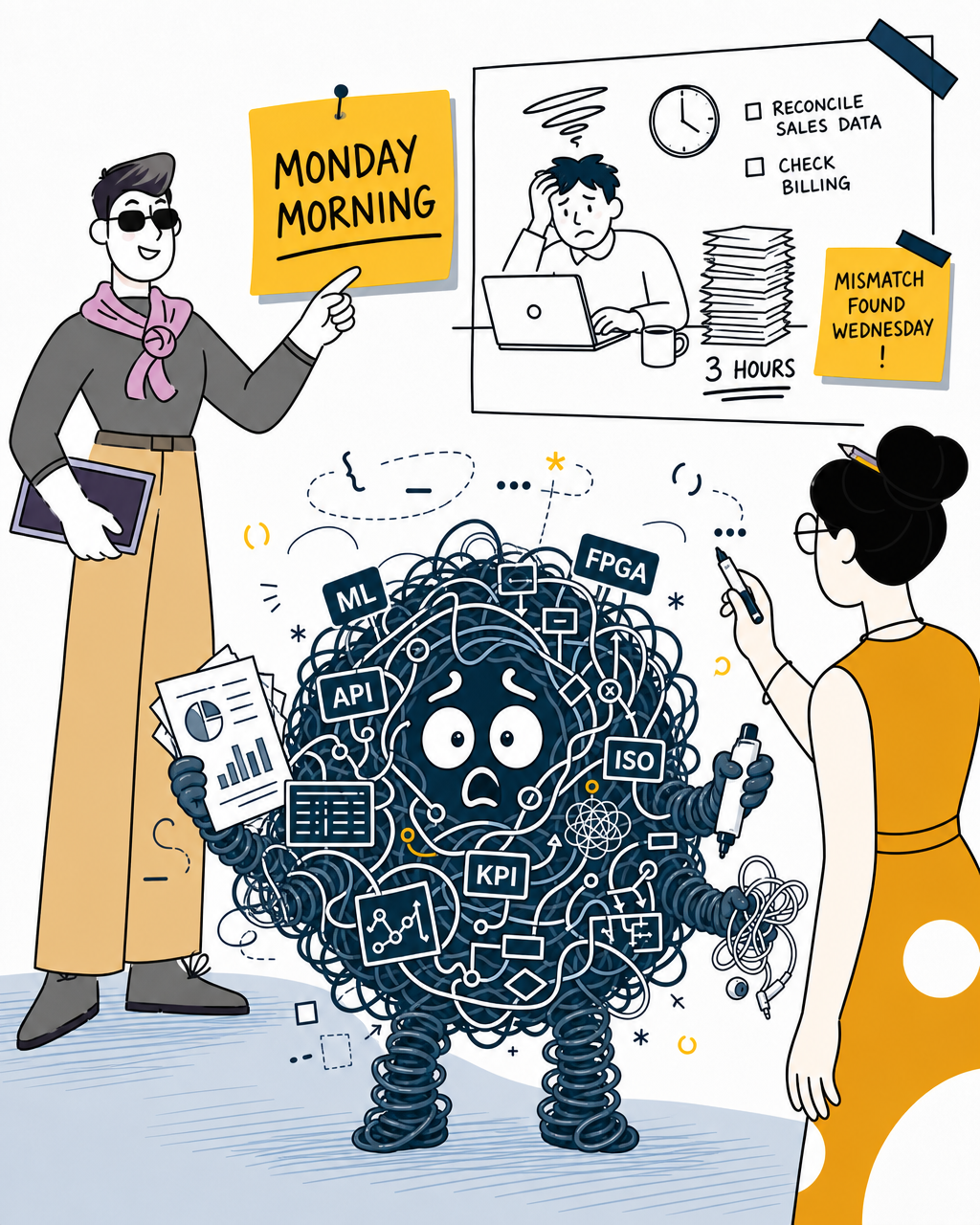
After: "Every Monday, your finance team manually reconciles your sales data with your billing system. It takes three hours. Someone always finds a mismatch on Wednesday."
Same product. Completely different opening. The second version doesn't describe what your software does — it describes a morning your buyer has already had. They don't need to understand what an API is to feel that pain.
The rule here is simple: open on a wound, not a feature. The buyer's brain lights up the moment they think that's us. Everything you say after that lands on prepared ground.
Use a three-beat arc, not a feature list
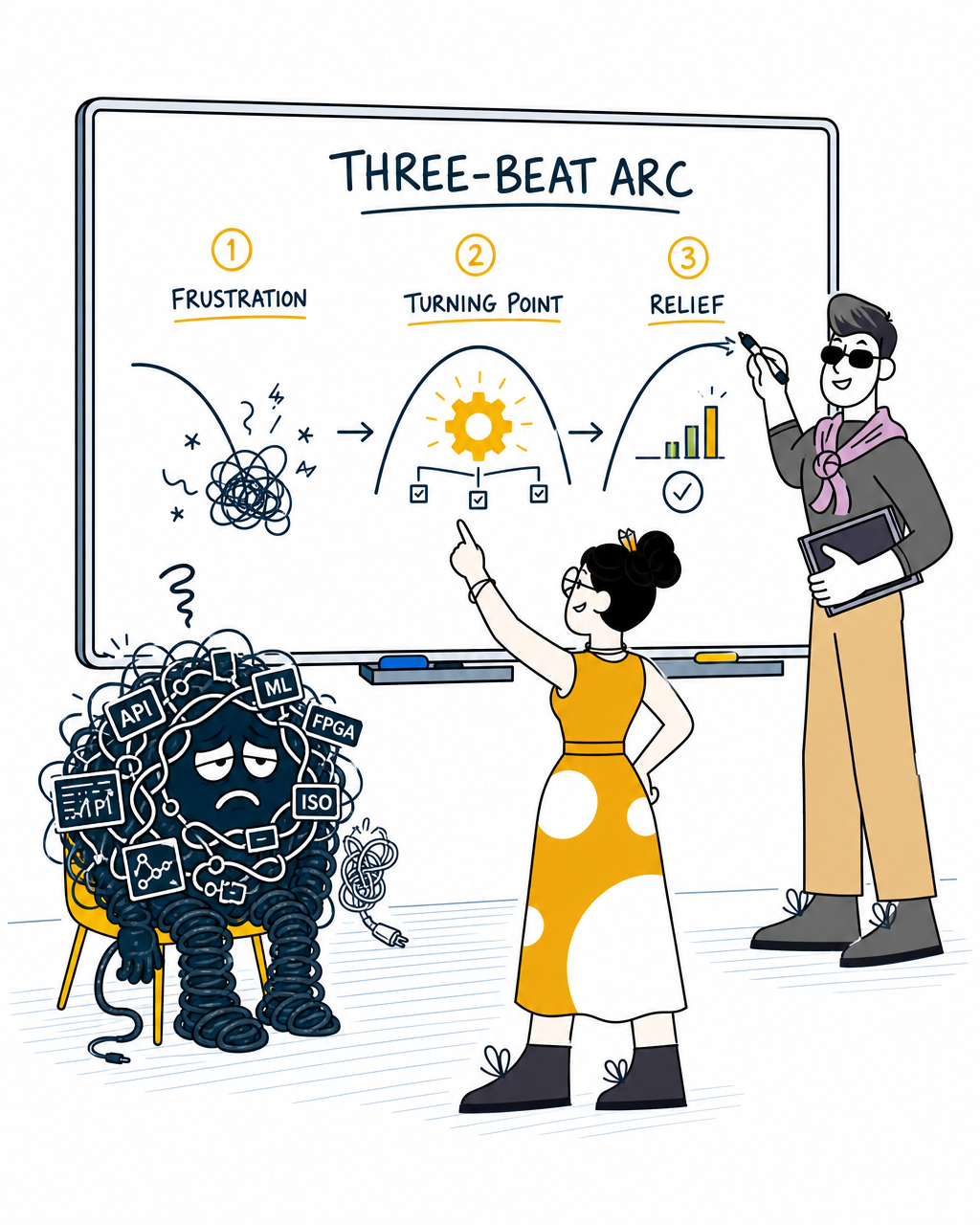
A 60-second story needs a spine. The three beats are: frustration, turning point, relief. That's it. Problem, moment of change, new reality. Most stories that resonate in a sales or pitch context use some version of this structure.
What most technical demos do instead is a feature tour. Feature tours are what you show someone who has already bought. They're not what makes someone want to buy.
Here's the three-beat arc applied to a real product type — say, a solo-built compliance automation tool for small financial advisory firms:
Beat 1 (frustration): "Imagine your compliance team spends weeks each quarter manually pulling audit trails from multiple systems. It's error-prone. It's expensive. And if you get it wrong, the regulator doesn't care why."
Beat 2 (turning point): "The moment you connect your systems to [product], it starts pulling that audit data automatically and formatting it against the exact template your regulator requires."
Beat 3 (relief): "In this scenario, your quarterly audit prep collapses from weeks to hours. Your compliance officer stops dreading the quarter-end. And your clients see a firm that has its reporting together."
Notice that beat two — the turning point — is not a feature announcement. It's the moment your tool acts. Something changes. That's the beat that makes the before and after feel real.
If you can't fit your product into three beats, you're trying to explain too much. Pick one problem, one moment, one outcome. Everything else belongs in the demo.
Swap technical language for outcome language
This is the most mechanical part of the process, and it's the one most technically-minded founders resist hardest.
Outcome language doesn't dumb anything down. It translates technical truth into human-scale consequences. There's a difference.
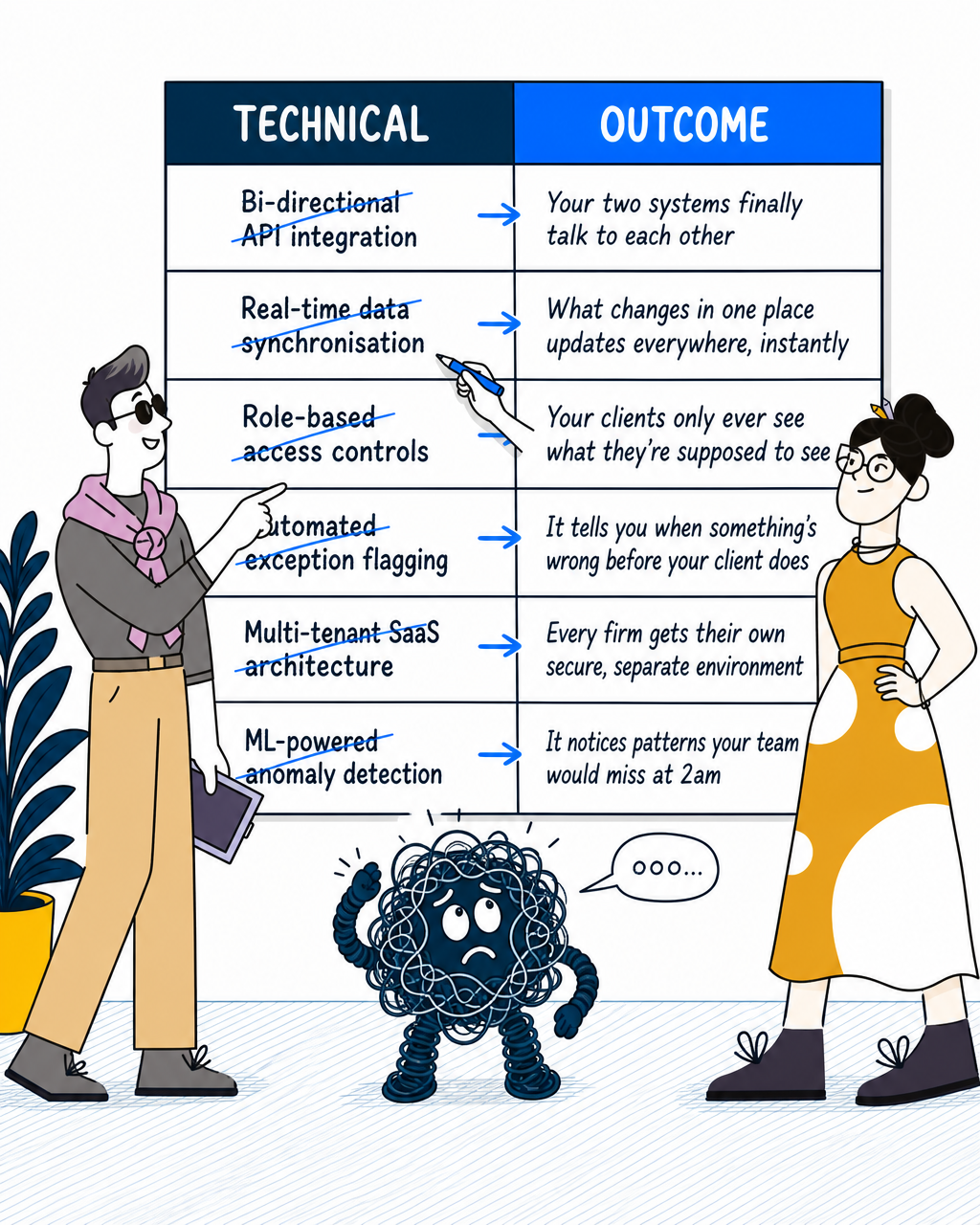
Here are some direct swaps worth working through:
| Technical | Outcome |
|---|---|
| "Bi-directional API integration" | "Your two systems finally talk to each other" |
| "Real-time data synchronisation" | "What changes in one place updates everywhere, instantly" |
| "Role-based access controls" | "Your clients only ever see what they're supposed to see" |
| "Automated exception flagging" | "It tells you when something's wrong before your client does" |
| "Multi-tenant SaaS architecture" | "Every firm gets their own secure, separate environment" |
| "ML-powered anomaly detection" | "It notices patterns your team would miss at 2am" |
The test is simple: read the technical version to someone who doesn't work in your industry. If they can't explain it back in their own words without asking a follow-up question, you haven't translated it yet.
This doesn't mean you hide the technical architecture. It means you don't lead with it. The technical depth lives in your full demo, your documentation, your due diligence materials. The 60-second story earns the right to that depth by first making the buyer want it.
Find the one moment that makes the product visually obvious
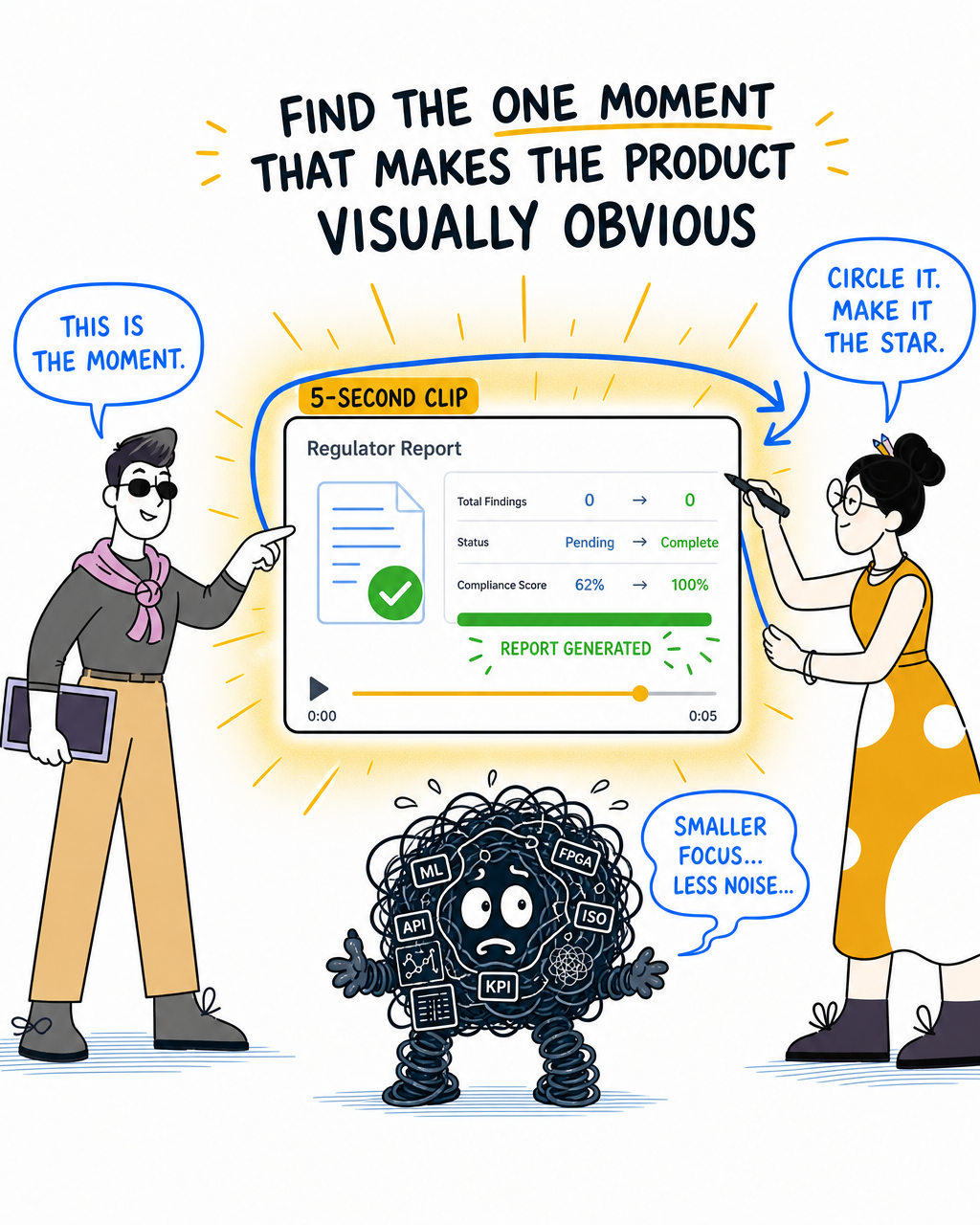
Every product, no matter how abstract, has one moment in the full demo where something clicks. A number changes. A dashboard populates. A report generates. A status turns green. That moment — the single most visual or visceral thing your product does — is the centerpiece of your 60-second story.
Your job is to identify it and build everything else around it.
For a compliance tool, it might be watching three weeks of manual work collapse into a single button press that generates a pre-formatted regulator report. For a data pipeline product, it might be watching two disconnected datasets merge live on screen. For an AI workflow tool, it might be a task queue draining itself.
Whatever that moment is for your product, ask yourself: if someone watched only this five-second clip, would they understand what just happened and why it matters?
If the answer is yes, that's your centerpiece. Everything before it in your 60-second story is setup. Everything after it is consequence.
If the answer is no, the moment probably isn't visual enough yet. Most technical products have their "aha moment" buried under context the founder assumes the viewer has. Strip the context. Find the action. Show the result.
End on a consequence, not a capability
Most technical pitches end with a capability summary. "So that's how the integration works, and here you can see the reporting module."
That's an ending for a user manual.
A 60-second story ends with a consequence. Something concrete that changes in the buyer's day, quarter, or team when your product is working.
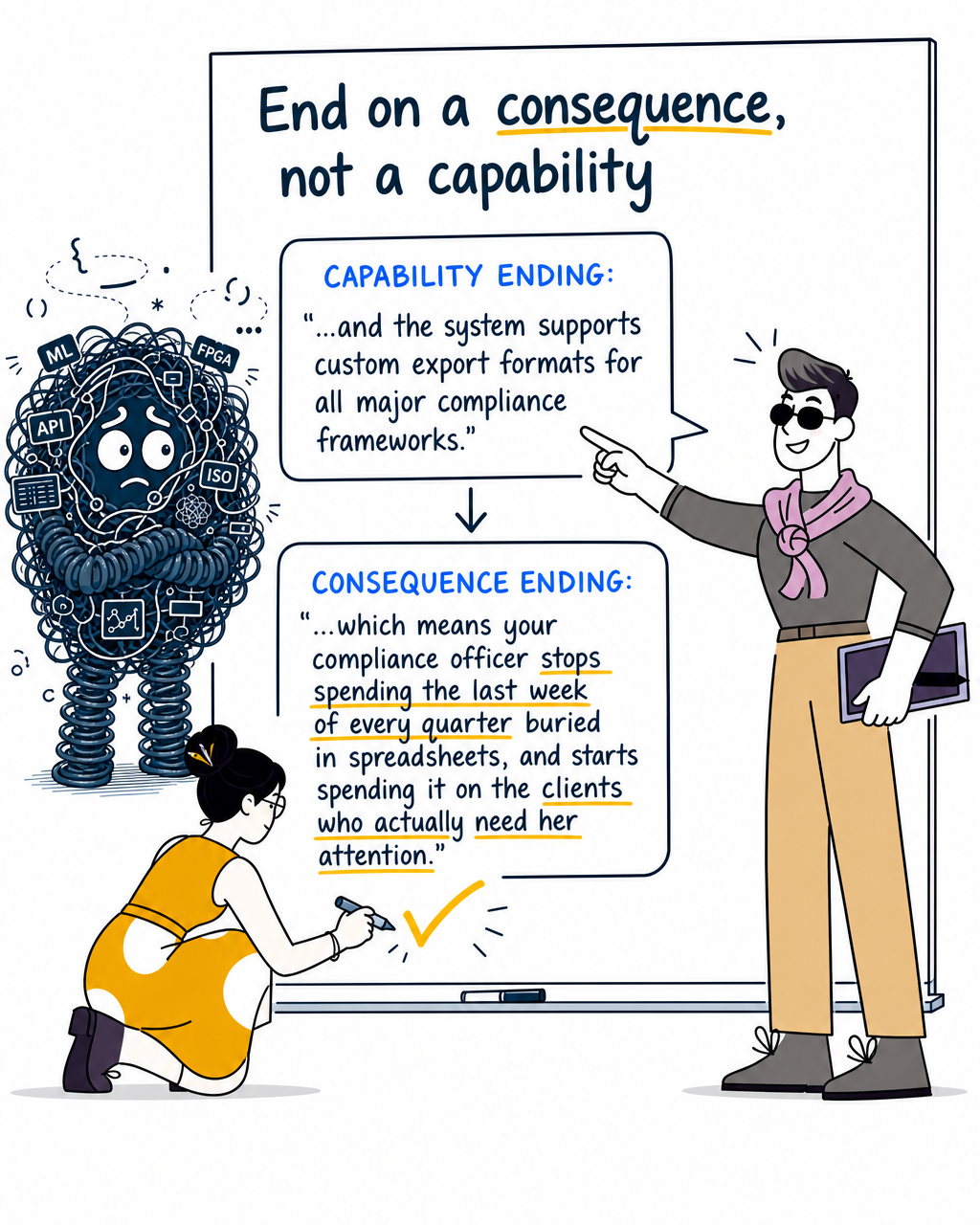
Capability ending: "...and the system supports custom export formats for all major compliance frameworks."
Consequence ending: "...which means your compliance officer stops spending the last week of every quarter buried in spreadsheets, and starts spending it on the clients who actually need her attention."
The consequence ending works because it answers the question every buyer is quietly asking throughout your whole pitch: what changes for me? They're not buying software. They're buying the version of their work life where that specific painful thing is gone.
Be specific. "Saves time" is a capability. "Your finance team gets their Monday mornings back" is a consequence. "Reduces compliance risk" is a capability. "Your next audit prep takes hours instead of weeks" is a consequence.
Specificity is what makes consequences feel real rather than promotional.
Putting it together: a 60-second script template
Here's the skeleton. Fill in the brackets with your product's actual language:
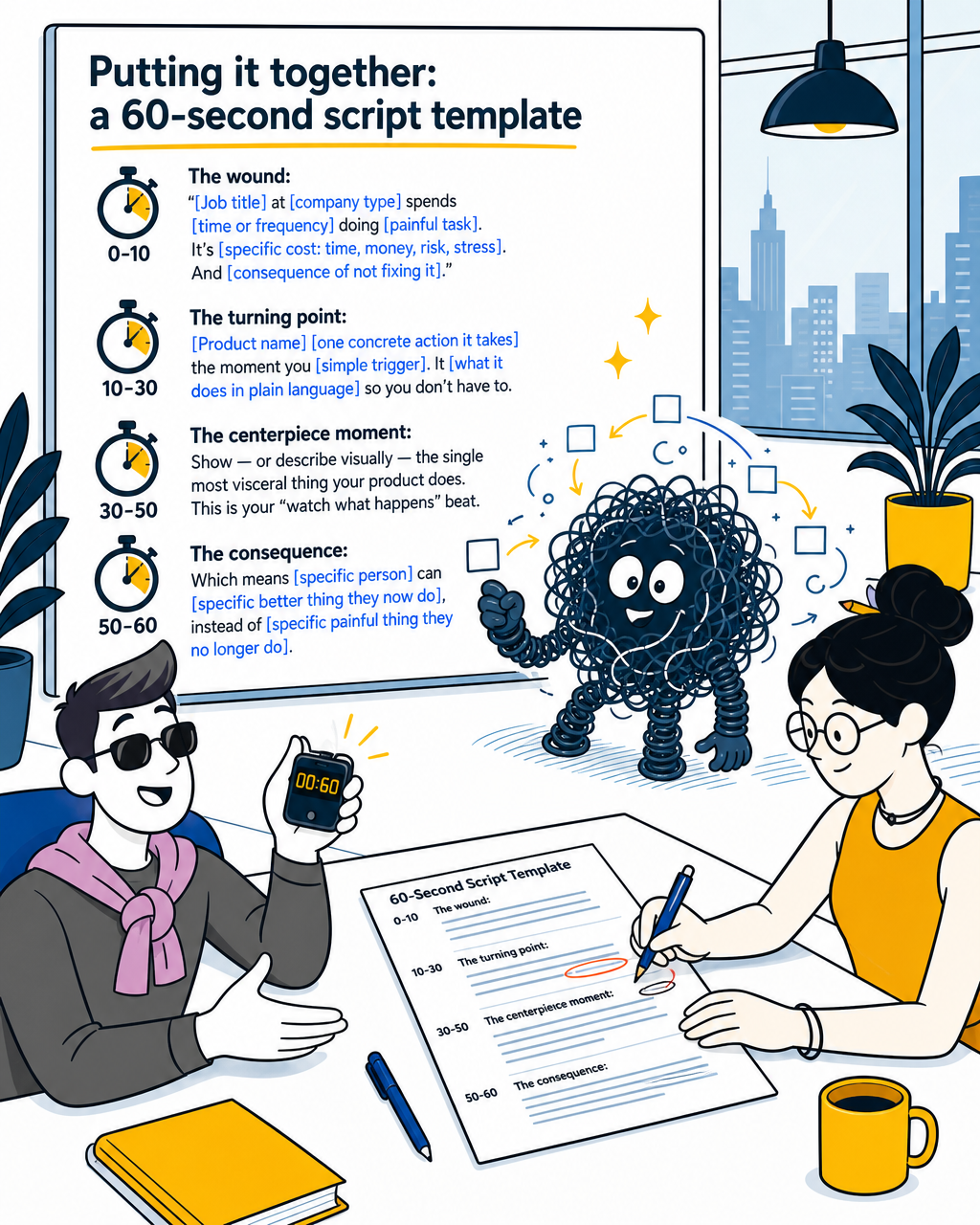
Seconds 0-10 (the wound): "[Job title] at [company type] spends [time or frequency] doing [painful task]. It's [specific cost: time, money, risk, stress]. And [consequence of not fixing it]."
Seconds 10-30 (the turning point): "[Product name] [one concrete action it takes] the moment you [simple trigger]. It [what it does in plain language] so you don't have to."
Seconds 30-50 (the centerpiece moment): Show — or describe visually — the single most visceral thing your product does. This is your "watch what happens" beat.
Seconds 50-60 (the consequence): "Which means [specific person] can [specific better thing they now do], instead of [specific painful thing they no longer do]."
That's the whole structure. Roughly 100–200 words depending on how you fill in the blanks and your delivery style. Read it aloud. Aim for 60 seconds; 75 is the outer limit. If it runs longer than that, cut it until it doesn't.
The compression test
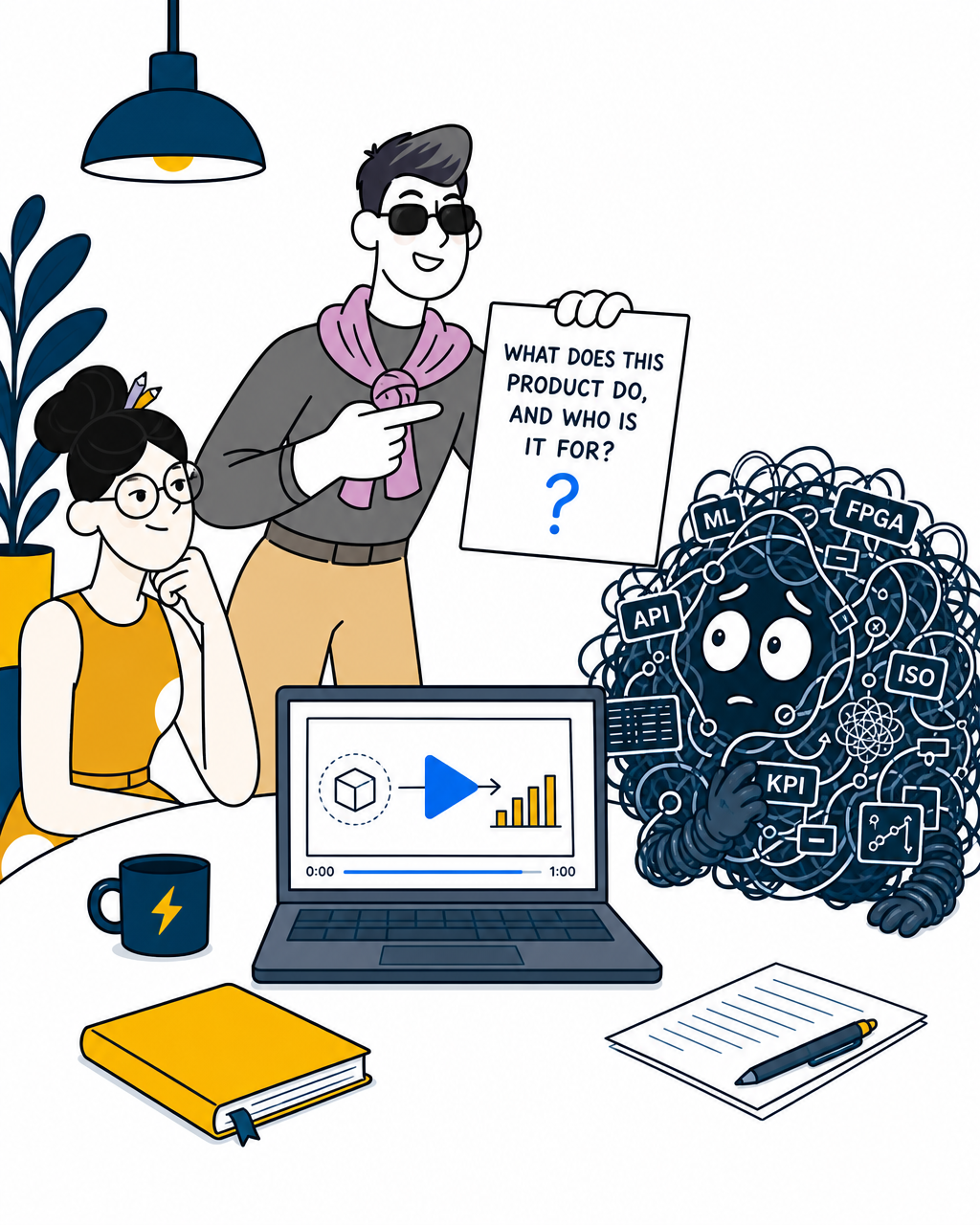
Before you ship your 60-second story anywhere, run one test. Send it to someone who has never heard of your product — ideally someone in your target buyer's general world but not a technical expert. Ask them one question after watching: "What does this product do, and who is it for?"
If they can answer that accurately without follow-up questions, you're done. If they can't, the story isn't clear yet.
This test is brutally useful because it removes all the context you've been carrying for months. You know what every technical term means. Your buyer doesn't. The test tells you exactly where the gap is.
In my experience reviewing these drafts, the turning point beat is where clarity most often breaks down — the technical action your product takes is described in terms that only make sense if you already understand the product. That's the most common place to look first.
One more thing
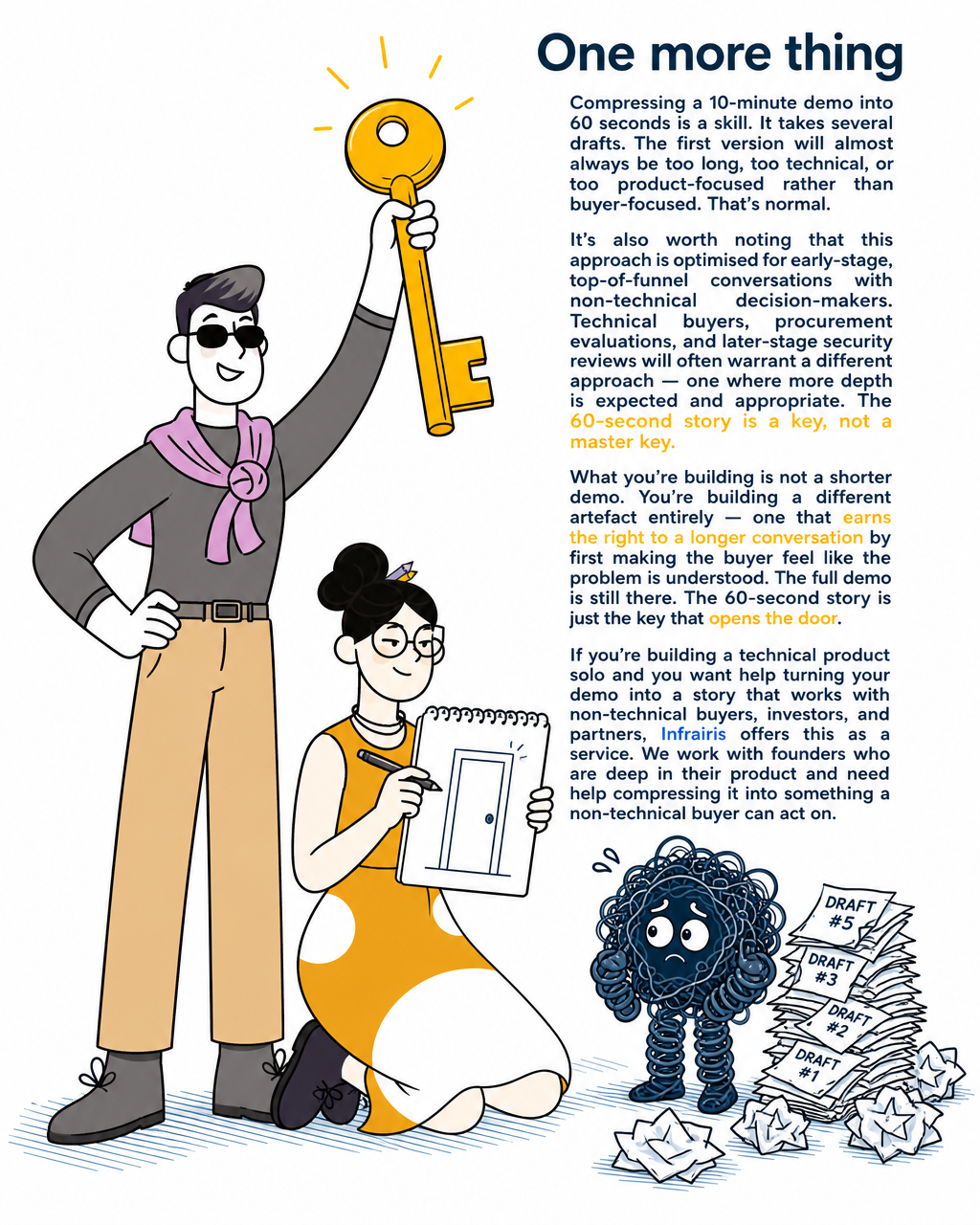
Compressing a 10-minute demo into 60 seconds is a skill. It takes several drafts. The first version will almost always be too long, too technical, or too product-focused rather than buyer-focused. That's normal.
It's also worth noting that this approach is optimised for early-stage, top-of-funnel conversations with non-technical decision-makers. Technical buyers, procurement evaluations, and later-stage security reviews will often warrant a different approach — one where more depth is expected and appropriate. The 60-second story is a key, not a master key.
What you're building is not a shorter demo. You're building a different artefact entirely — one that earns the right to a longer conversation by first making the buyer feel like the problem is understood. The full demo is still there. The 60-second story is just the key that opens the door.
If you're building a technical product solo and you want help turning your demo into a story that works with non-technical buyers, investors, and partners, Infrairis offers this as a service. We work with founders who are deep in their product and need help compressing it into something a non-technical buyer can act on.

Infrairis
Your complex product. In 60 seconds. Clearly.
Your complex product. In 60 seconds. Clearly.
Learn more about Infrairis and get started today.
Visit Infrairis