10 Reasons You Still Need a Human Animator for AI Explainer Videos
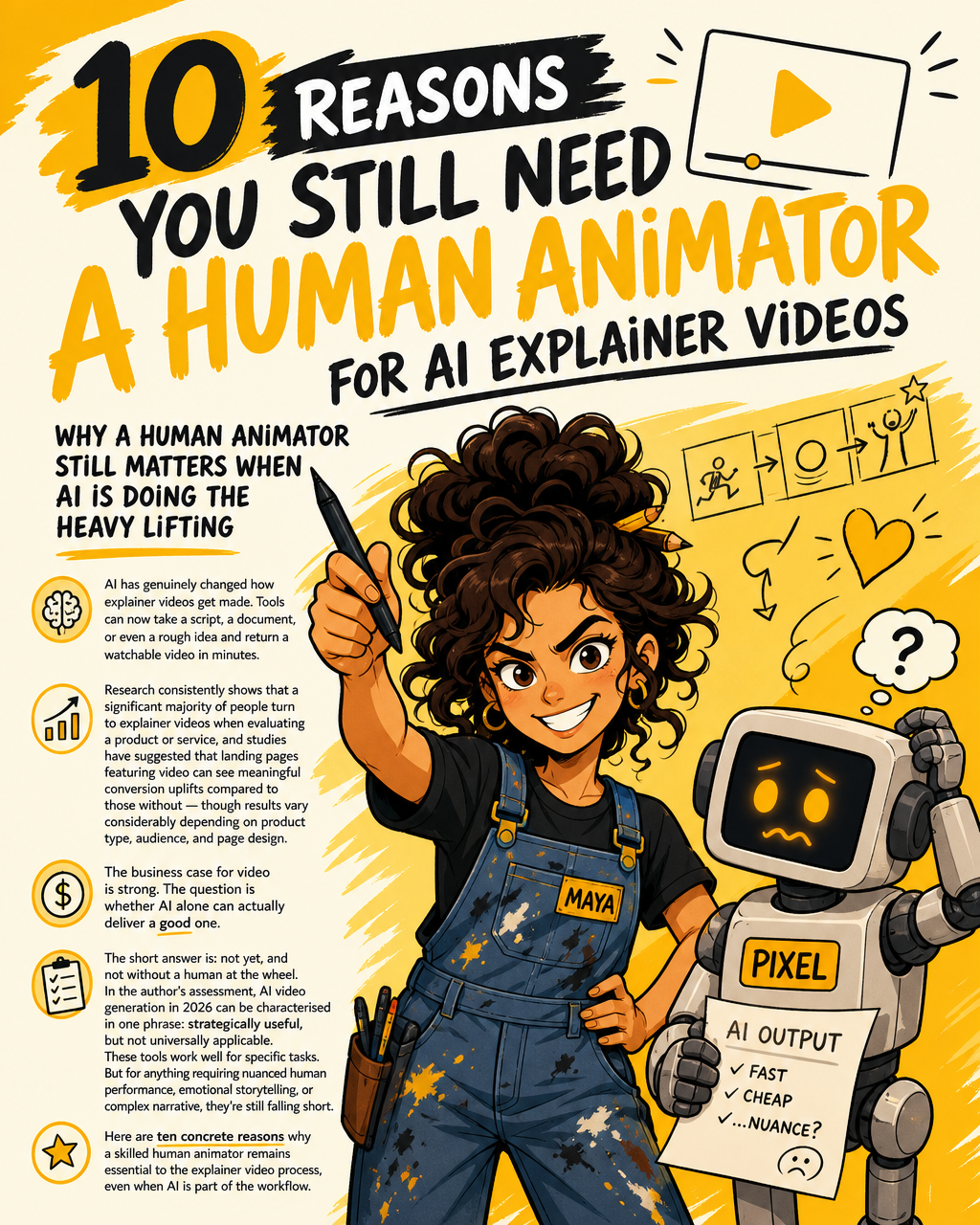

Why a Human Animator Still Matters When AI Is Doing the Heavy Lifting
AI has genuinely changed how explainer videos get made. Tools can now take a script, a document, or even a rough idea and return a watchable video in minutes. Research consistently shows that a significant majority of people turn to explainer videos when evaluating a product or service, and studies have suggested that landing pages featuring video can see meaningful conversion uplifts compared to those without — though results vary considerably depending on product type, audience, and page design. The business case for video is strong. The question is whether AI alone can actually deliver a good one.
The short answer is: not yet, and not without a human at the wheel. In the author's assessment, AI video generation in 2026 can be characterised in one phrase: strategically useful, but not universally applicable. These tools work well for specific tasks. But for anything requiring nuanced human performance, emotional storytelling, or complex narrative, they're still falling short.
Here are ten concrete reasons why a skilled human animator remains essential to the explainer video process, even when AI is part of the workflow.
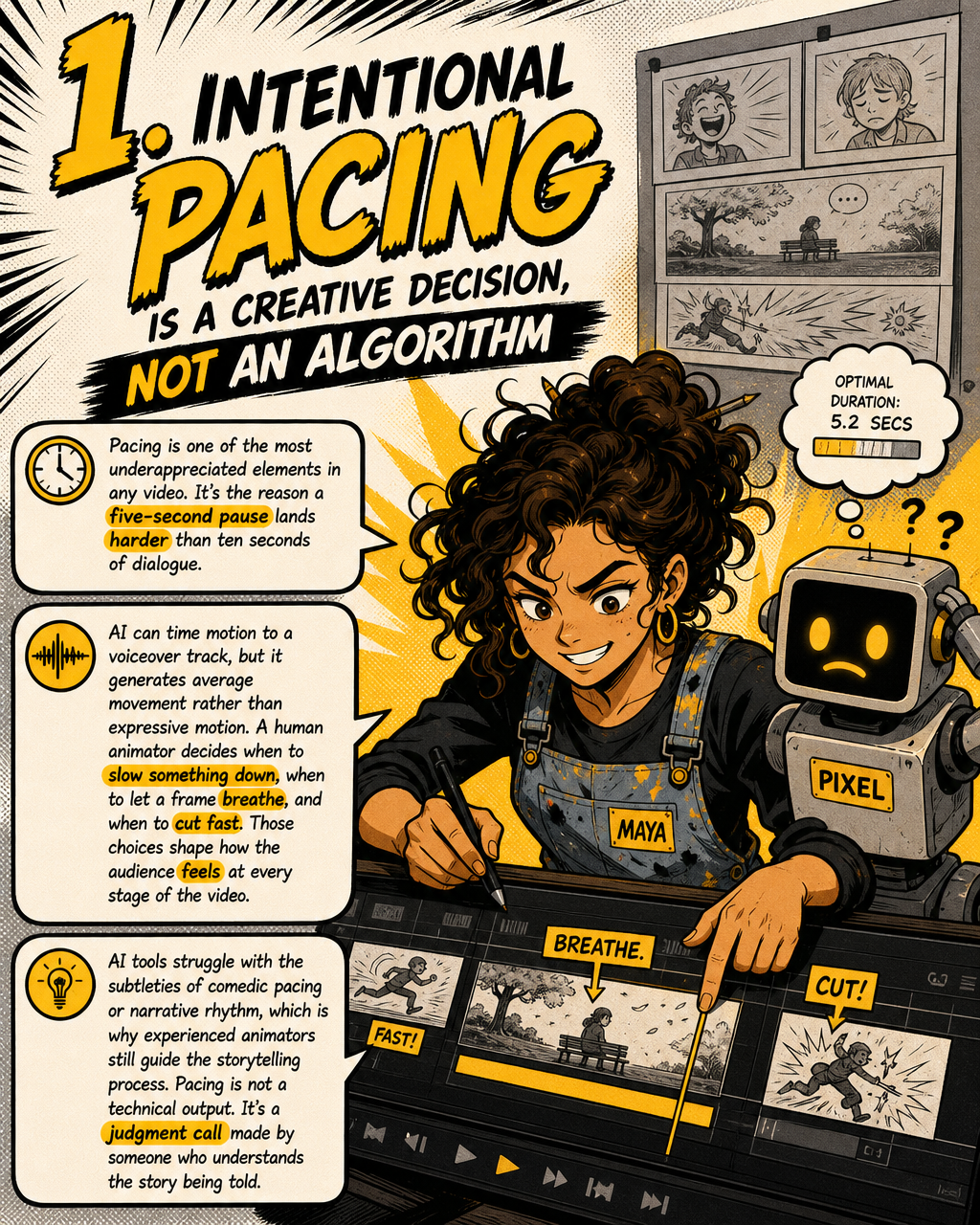
1. Intentional Pacing Is a Creative Decision, Not an Algorithm
Pacing is one of the most underappreciated elements in any video. It's the reason a five-second pause lands harder than ten seconds of dialogue. AI can time motion to a voiceover track, but it generates average movement rather than expressive motion. A human animator decides when to slow something down, when to let a frame breathe, and when to cut fast. Those choices shape how the audience feels at every stage of the video.
AI tools struggle with the subtleties of comedic pacing or narrative rhythm, which is why experienced animators still guide the storytelling process. Pacing is not a technical output. It's a judgment call made by someone who understands the story being told.
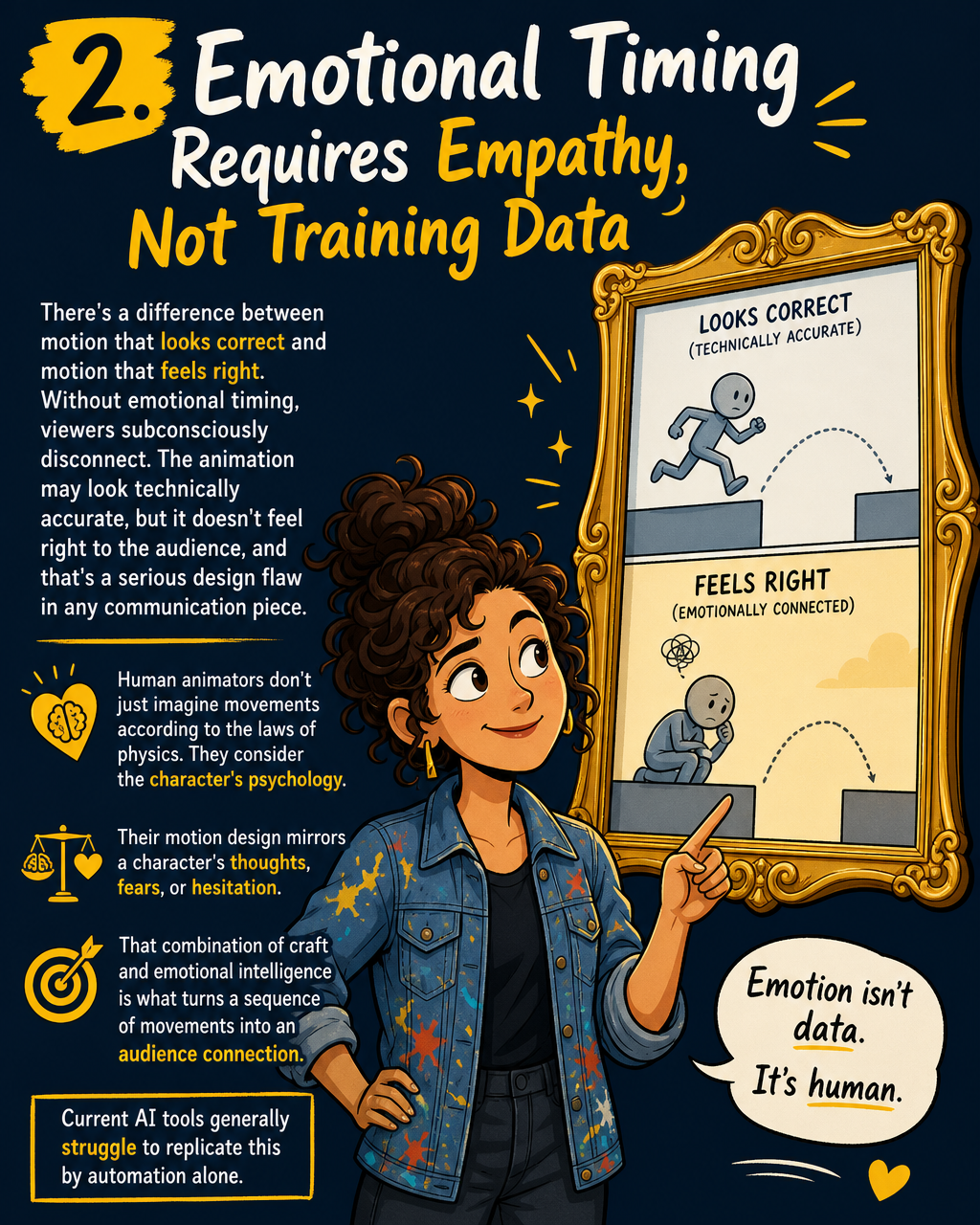
2. Emotional Timing Requires Empathy, Not Training Data
There's a difference between motion that looks correct and motion that feels right. Without emotional timing, viewers subconsciously disconnect. The animation may look technically accurate, but it doesn't feel right to the audience, and that's a serious design flaw in any communication piece.
Human animators don't just imagine movements according to the laws of physics. They consider the character's psychology. Their motion design mirrors a character's thoughts, fears, or hesitation. That combination of craft and emotional intelligence is what turns a sequence of movements into an audience connection. Current AI tools generally struggle to replicate this by automation alone.
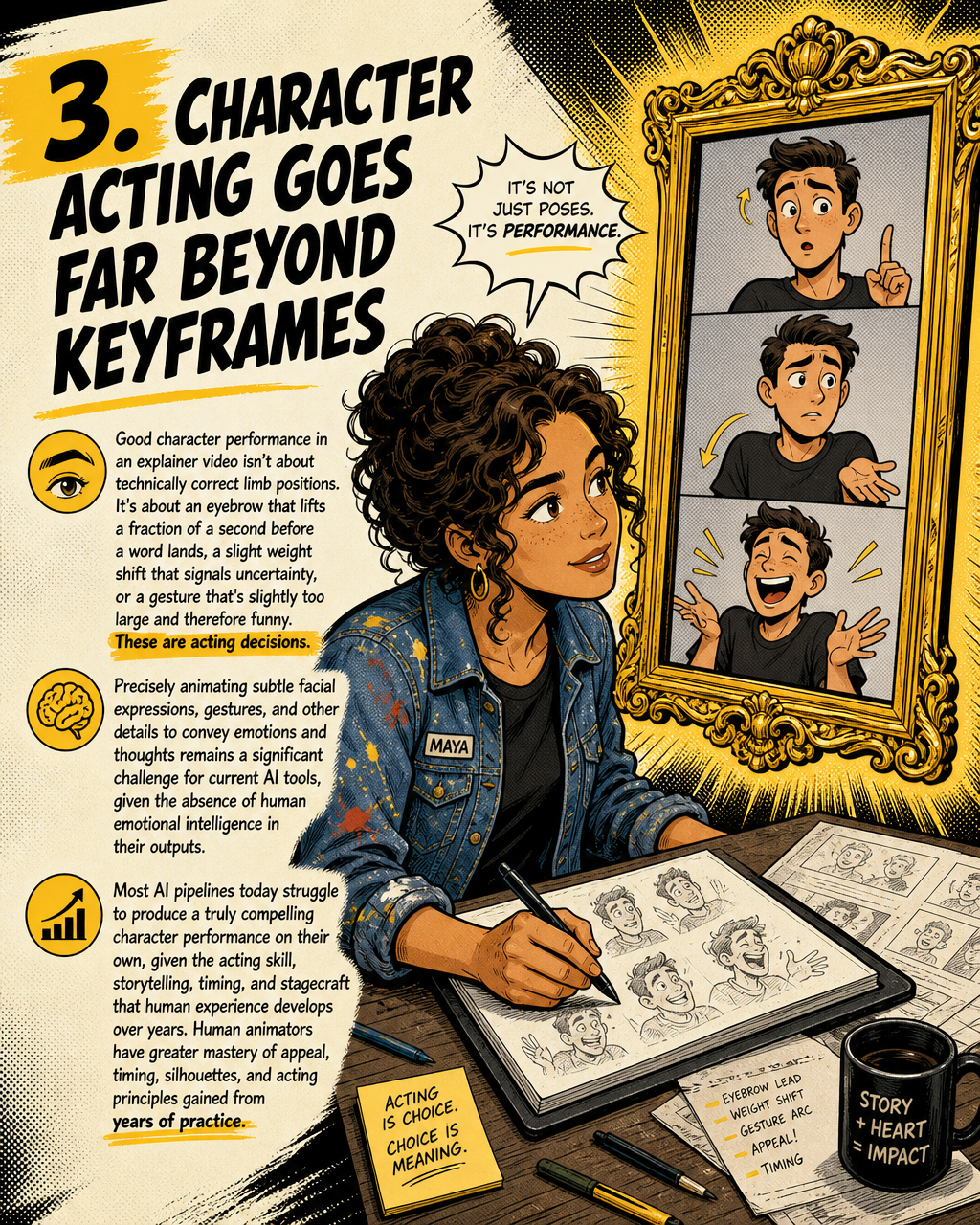
3. Character Acting Goes Far Beyond Keyframes
Good character performance in an explainer video isn't about technically correct limb positions. It's about an eyebrow that lifts a fraction of a second before a word lands, a slight weight shift that signals uncertainty, or a gesture that's slightly too large and therefore funny. These are acting decisions.
Precisely animating subtle facial expressions, gestures, and other details to convey emotions and thoughts remains a significant challenge for current AI tools, given the absence of human emotional intelligence in their outputs. Most AI pipelines today struggle to produce a truly compelling character performance on their own, given the acting skill, storytelling, timing, and stagecraft that human experience develops over years. Human animators have greater mastery of appeal, timing, silhouettes, and acting principles gained from years of practice.
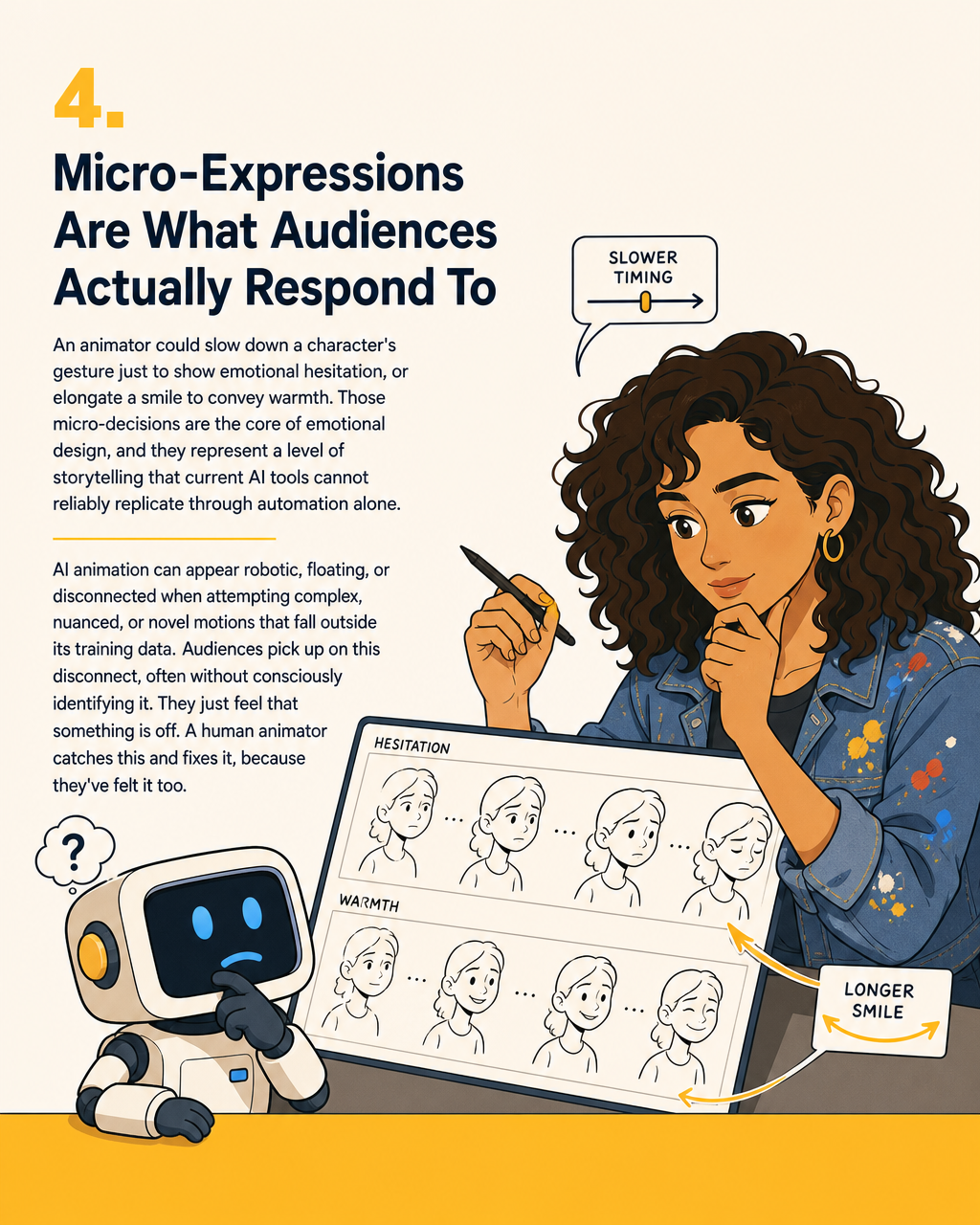
4. Micro-Expressions Are What Audiences Actually Respond To
An animator could slow down a character's gesture just to show emotional hesitation, or elongate a smile to convey warmth. Those micro-decisions are the core of emotional design, and they represent a level of storytelling that current AI tools cannot reliably replicate through automation alone.
AI animation can appear robotic, floating, or disconnected when attempting complex, nuanced, or novel motions that fall outside its training data. Audiences pick up on this disconnect, often without consciously identifying it. They just feel that something is off. A human animator catches this and fixes it, because they've felt it too.
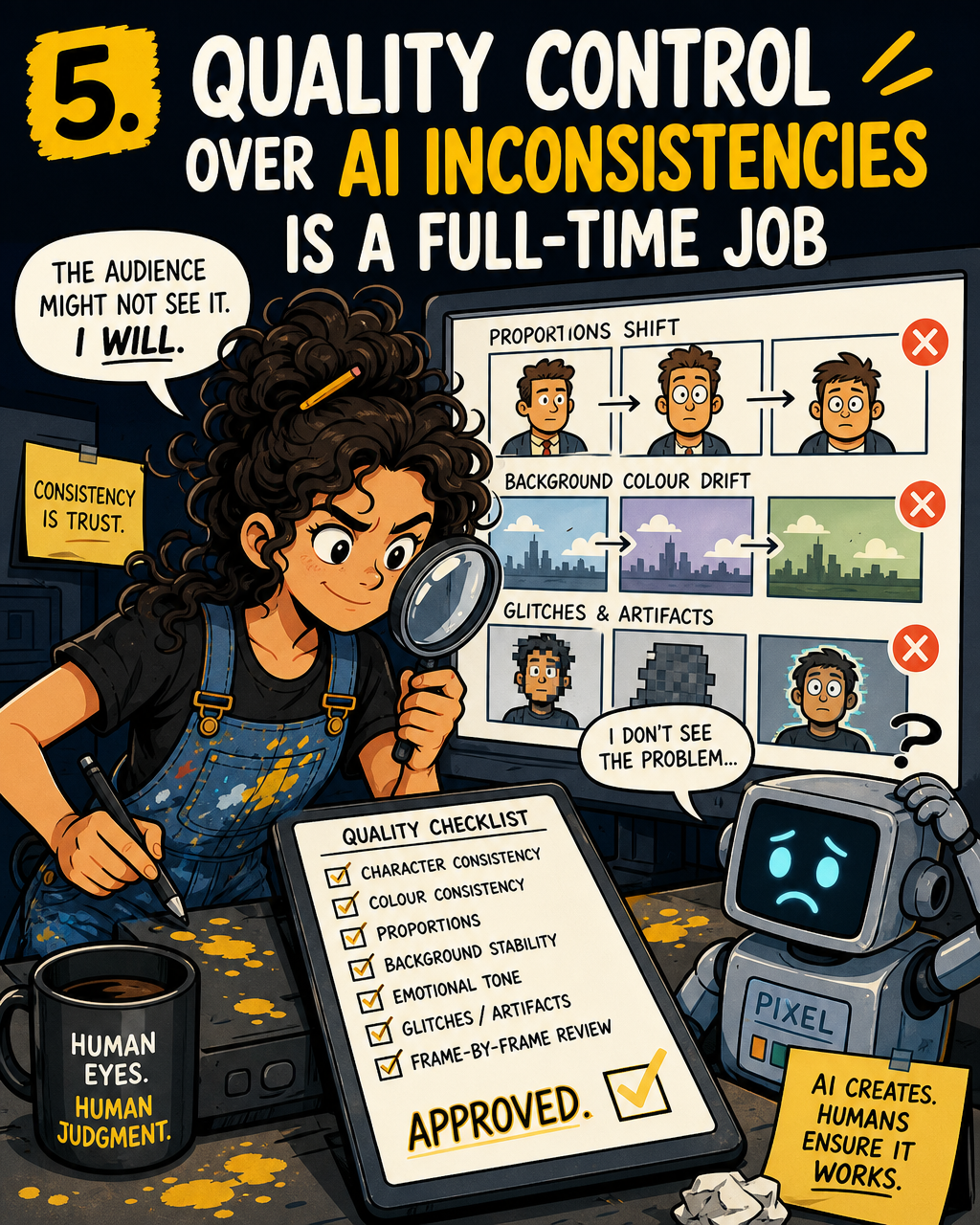
5. Quality Control Over AI Inconsistencies Is a Full-Time Job
AI-generated content frequently produces visual glitches, inconsistency across frames, and a lack of emotional depth. In many professional contexts, consistency in video generation still falls short of the precision required for professional pipelines, making human intervention essential — a working reality reported by a number of studios using these tools, though experiences vary by tool and production context.
In an explainer video, a character whose proportions shift between scenes, or a background that subtly changes colour mid-sequence, will erode viewer trust even if the audience can't name what's wrong. A human animator serves as the quality gatekeeper, reviewing every output and correcting the errors that AI produces without flagging them.
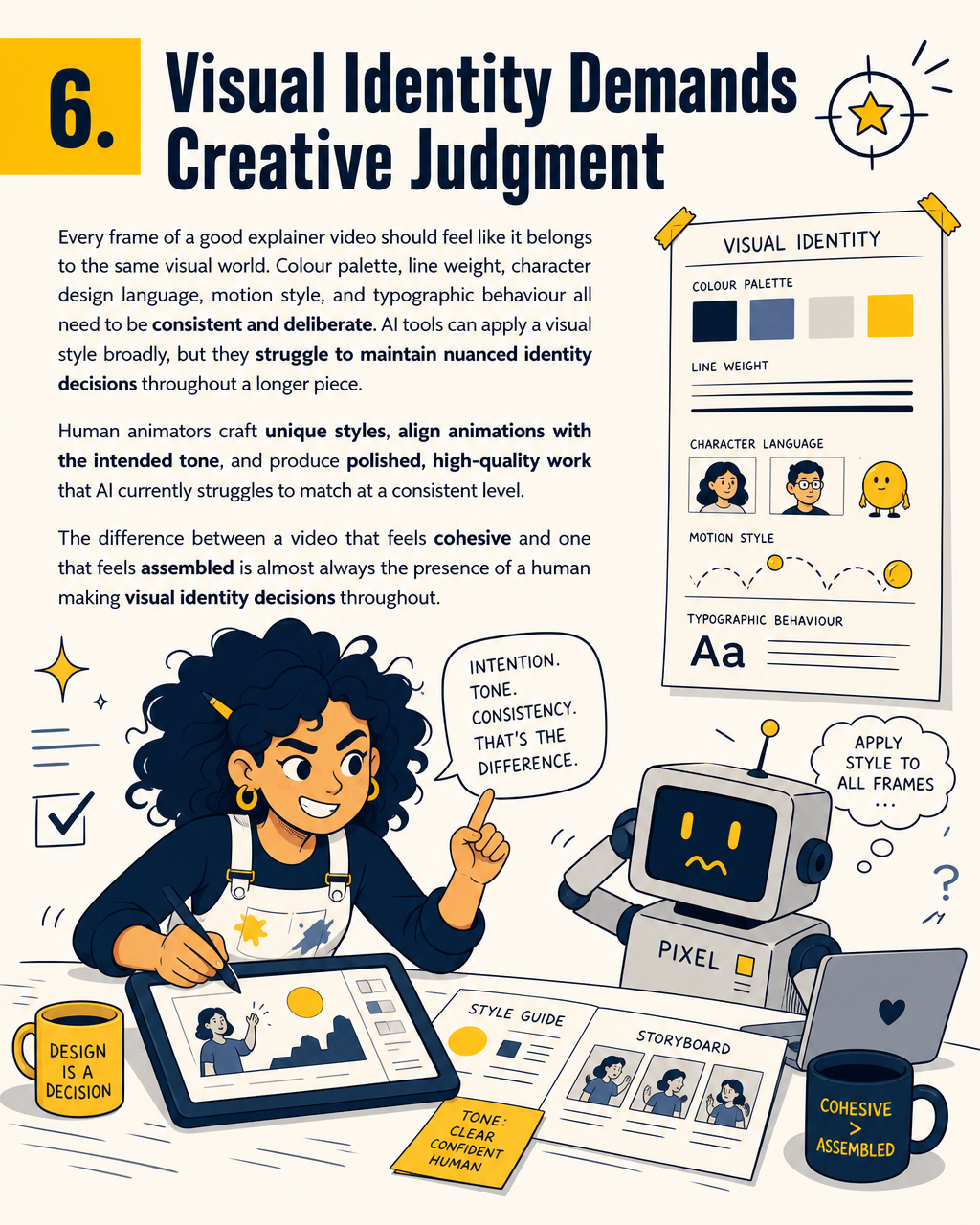
6. Visual Identity Demands Creative Judgment
Every frame of a good explainer video should feel like it belongs to the same visual world. Colour palette, line weight, character design language, motion style, and typographic behaviour all need to be consistent and deliberate. AI tools can apply a visual style broadly, but they struggle to maintain nuanced identity decisions throughout a longer piece.
Human animators craft unique styles, align animations with the intended tone, and produce polished, high-quality work that AI currently struggles to match at a consistent level. The difference between a video that feels cohesive and one that feels assembled is almost always the presence of a human making visual identity decisions throughout.
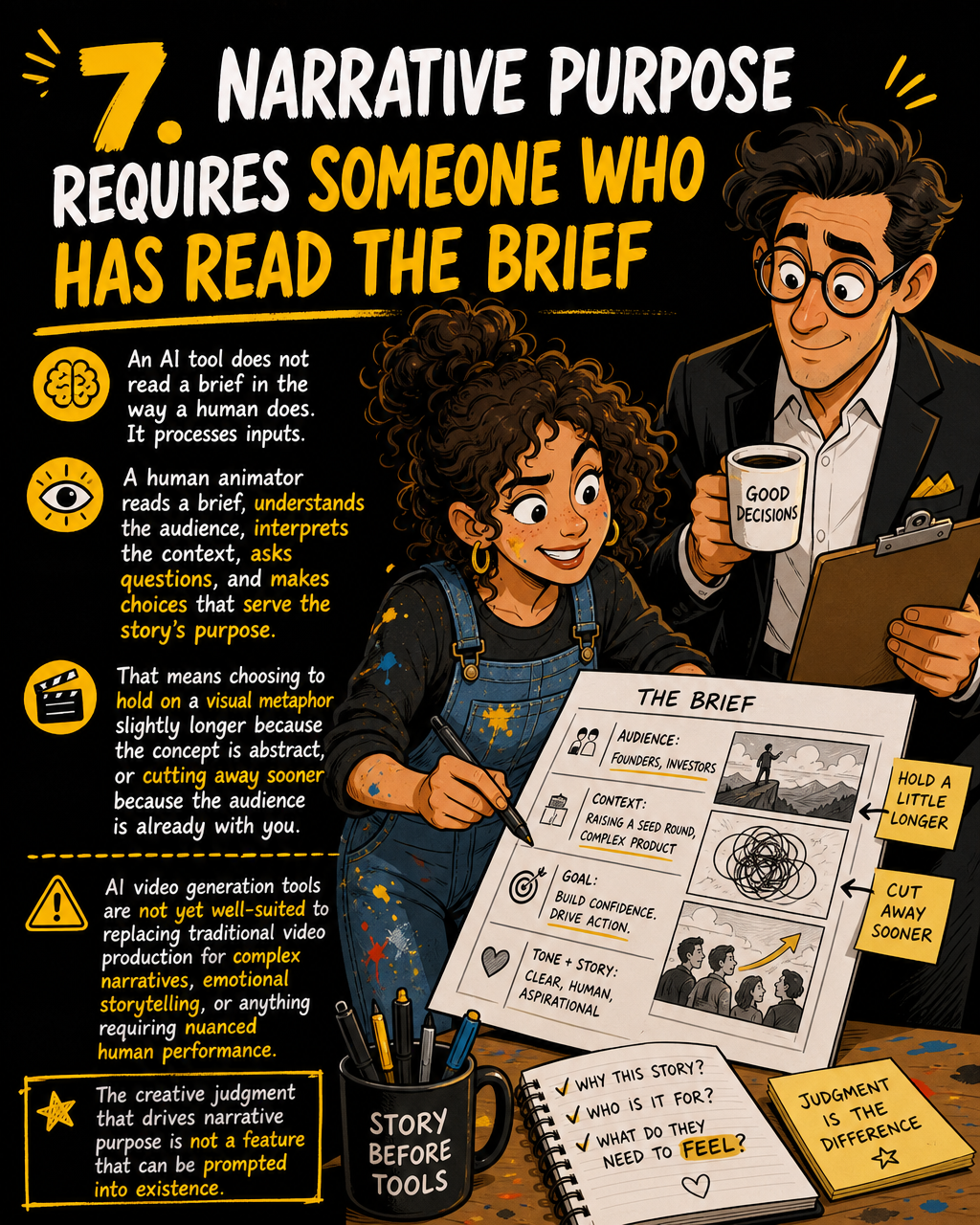
7. Narrative Purpose Requires Someone Who Has Read the Brief
An AI tool does not read a brief in the way a human does. It processes inputs. A human animator reads a brief, understands the audience, interprets the context, asks questions, and makes choices that serve the story's purpose. That means choosing to hold on a visual metaphor slightly longer because the concept is abstract, or cutting away sooner because the audience is already with you.
AI video generation tools are not yet well-suited to replacing traditional video production for complex narratives, emotional storytelling, or anything requiring nuanced human performance. The creative judgment that drives narrative purpose is not a feature that can be prompted into existence.
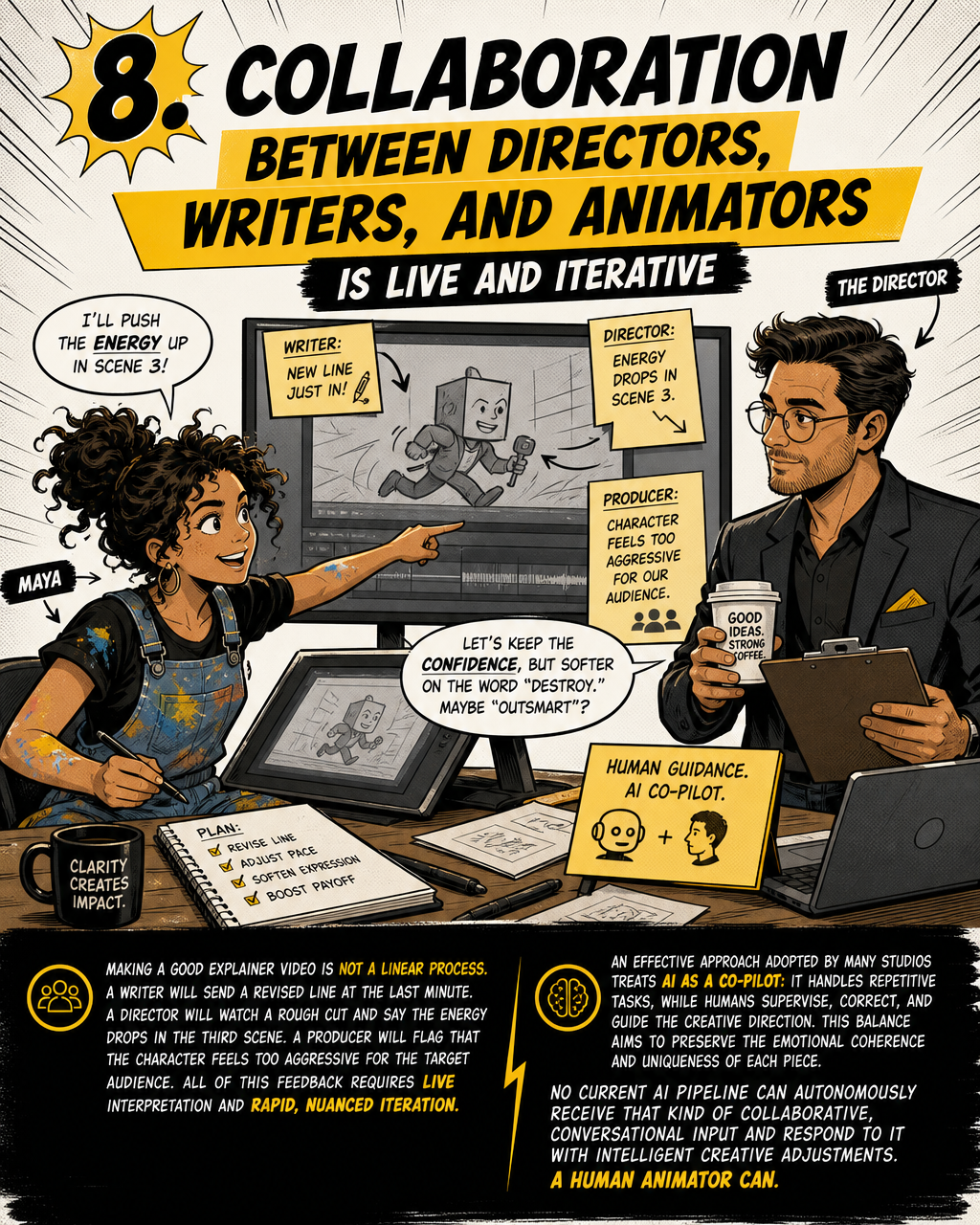
8. Collaboration Between Directors, Writers, and Animators Is Live and Iterative
Making a good explainer video is not a linear process. A writer will send a revised line at the last minute. A director will watch a rough cut and say the energy drops in the third scene. A producer will flag that the character feels too aggressive for the target audience. All of this feedback requires live interpretation and rapid, nuanced iteration.
An effective approach adopted by many studios treats AI as a co-pilot: it handles repetitive tasks, while humans supervise, correct, and guide the creative direction. This balance aims to preserve the emotional coherence and uniqueness of each piece. No current AI pipeline can autonomously receive that kind of collaborative, conversational input and respond to it with intelligent creative adjustments. A human animator can.
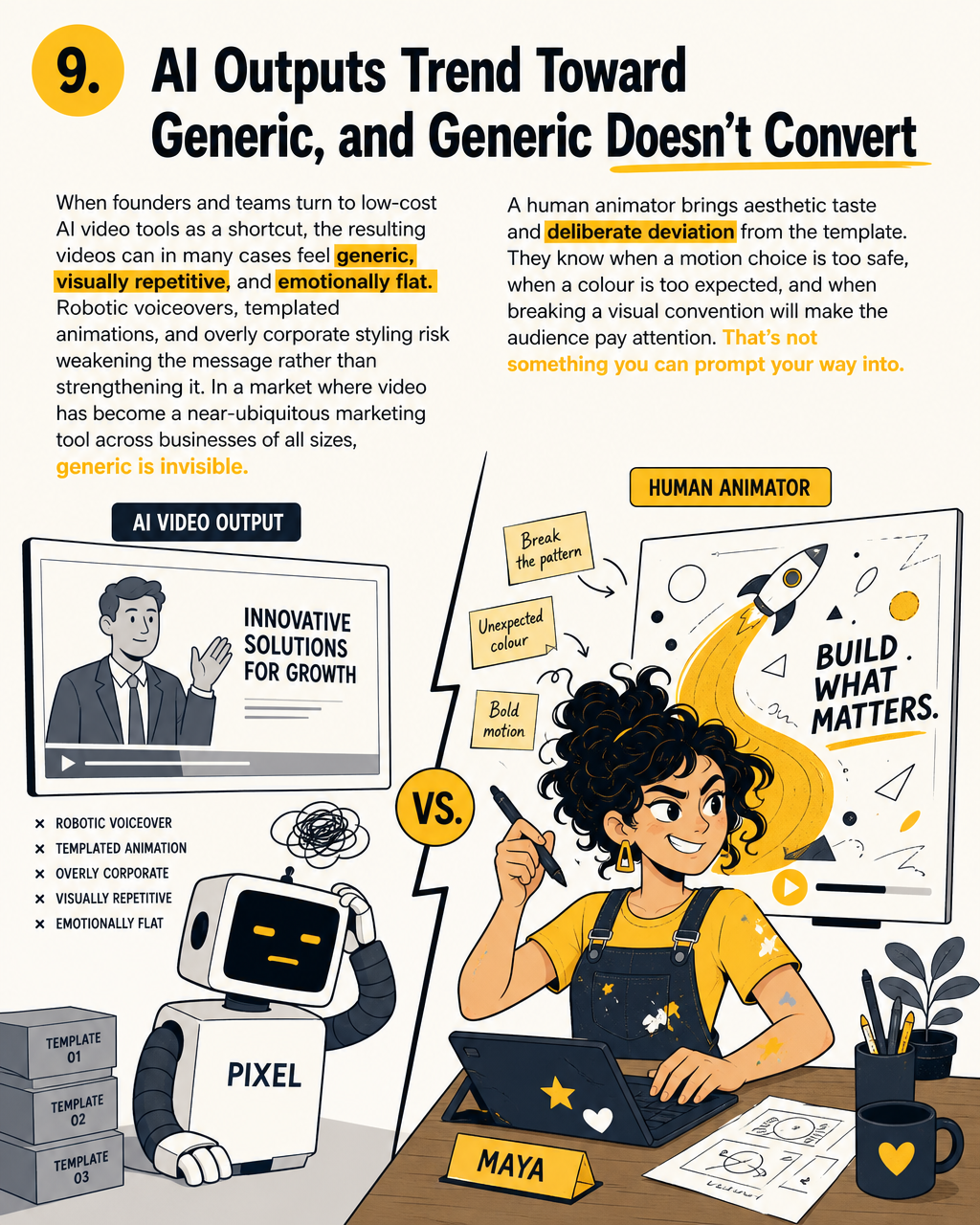
9. AI Outputs Trend Toward Generic, and Generic Doesn't Convert
When founders and teams turn to low-cost AI video tools as a shortcut, the resulting videos can in many cases feel generic, visually repetitive, and emotionally flat. Robotic voiceovers, templated animations, and overly corporate styling risk weakening the message rather than strengthening it. In a market where video has become a near-ubiquitous marketing tool across businesses of all sizes, generic is invisible.
A human animator brings aesthetic taste and deliberate deviation from the template. They know when a motion choice is too safe, when a colour is too expected, and when breaking a visual convention will make the audience pay attention. That's not something you can prompt your way into.
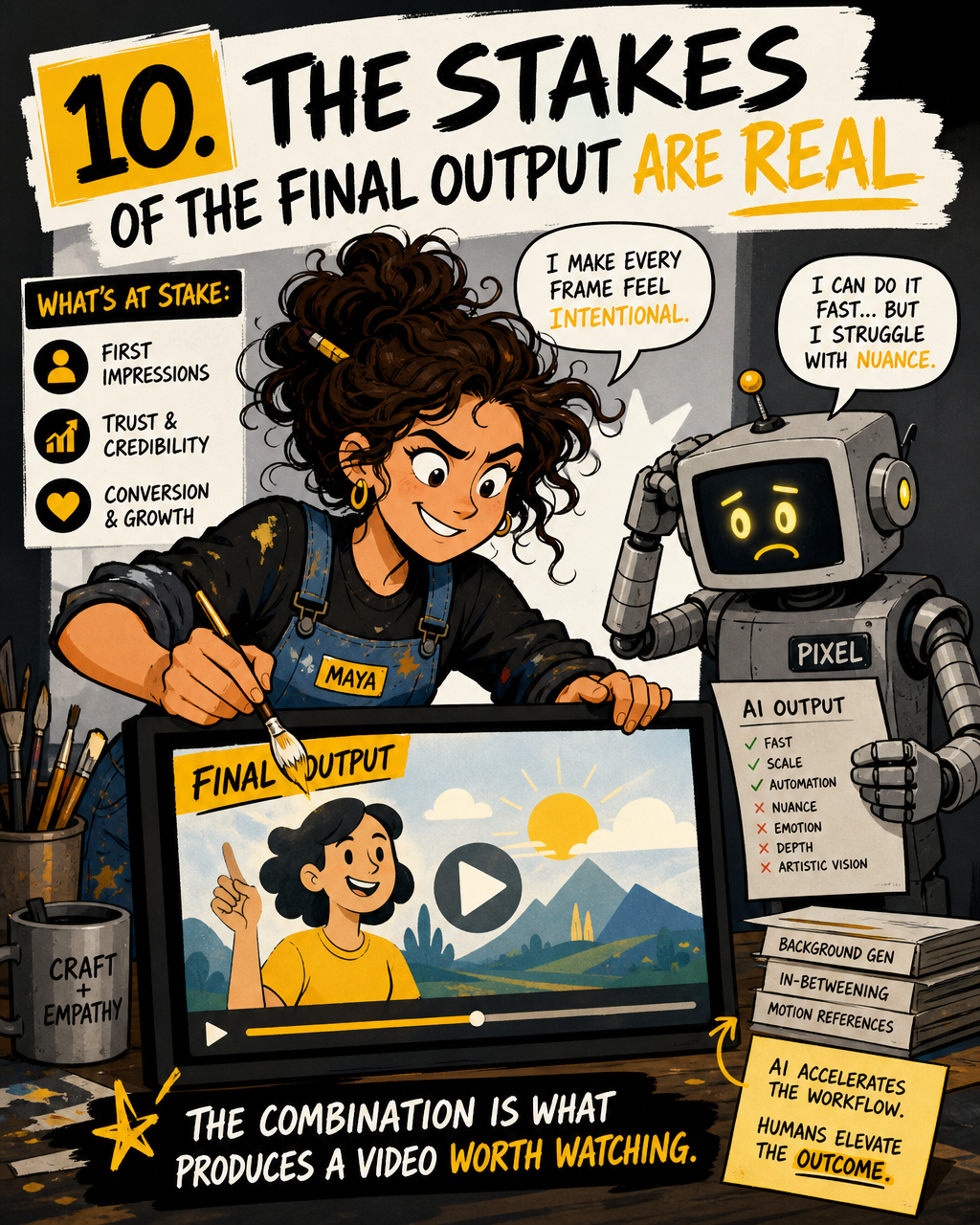
10. The Stakes of the Final Output Are Real
Explainer videos are often the first thing a potential customer, investor, or new hire sees. They carry real stakes. A video that feels off, moves awkwardly, or communicates the wrong emotional tone risks failing to convert — and consumer psychology research suggests that poor first impressions from brand content can undermine audience trust, though the magnitude of that effect will vary by context.
AI brings speed, scale, and automation to the table. Human animators bring emotion, depth, and artistic vision. The most capable studios operating in 2026 are not choosing between these two things. They're using AI to accelerate the parts of the workflow where automation is genuinely helpful — background generation, in-betweening, initial motion references — and relying on human animators to make every frame feel intentional.
That combination is what produces a video worth watching.
What This Means for Your Explainer Video Project
The tools available in 2026 are genuinely impressive, and they're getting better. If your goal is a quick internal explainer, a rough concept test, or a short social clip, AI-only workflows can deliver real value — and for some use cases and budget constraints, they may be entirely appropriate. But for any video where the output is public-facing, brand-critical, or narratively complex, AI output alone is not production-ready for most studios' standards.
It's worth noting that this article argues from the perspective of human-led animation workflows, and reasonable practitioners disagree about where exactly the line falls between what AI can and cannot handle well — a line that is shifting as tools improve.
The animators who appear to be thriving right now, based on practitioner accounts and hiring trends in the field, are those who understand how to work with AI tools: using them to cut down on tedious tasks while directing every meaningful creative decision themselves. That skill set is not being replaced. It's becoming more valuable.
If you're evaluating whether to involve a human animator in your next explainer video project, the question worth asking is not whether you can afford one, but whether the quality and credibility of the final output matters to your goals — and what the cost of falling short of that would be.

Infrairis
Your complex product. In 60 seconds. Clearly.
Your complex product. In 60 seconds. Clearly.
Learn more about Infrairis and get started today.
Visit Infrairis