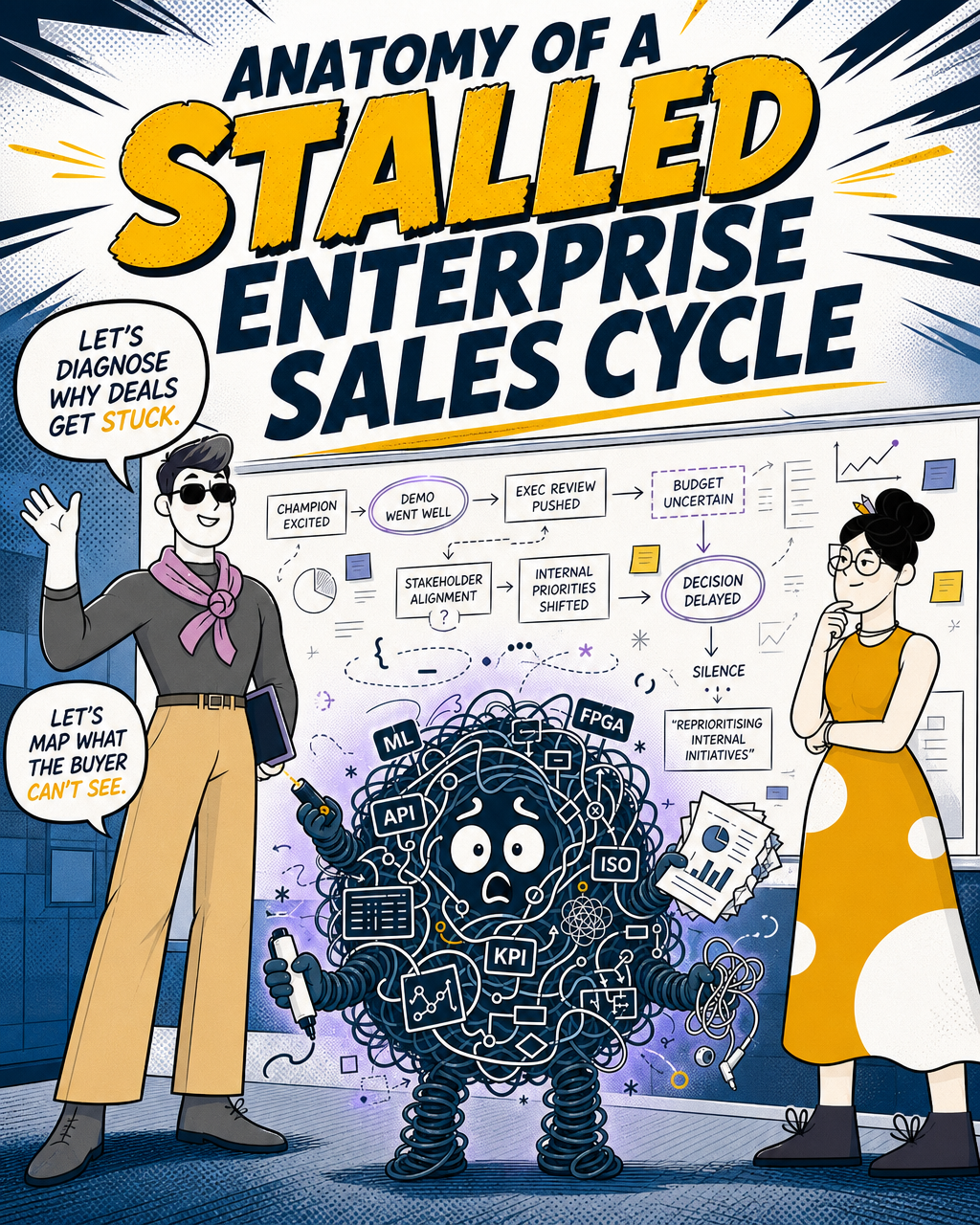
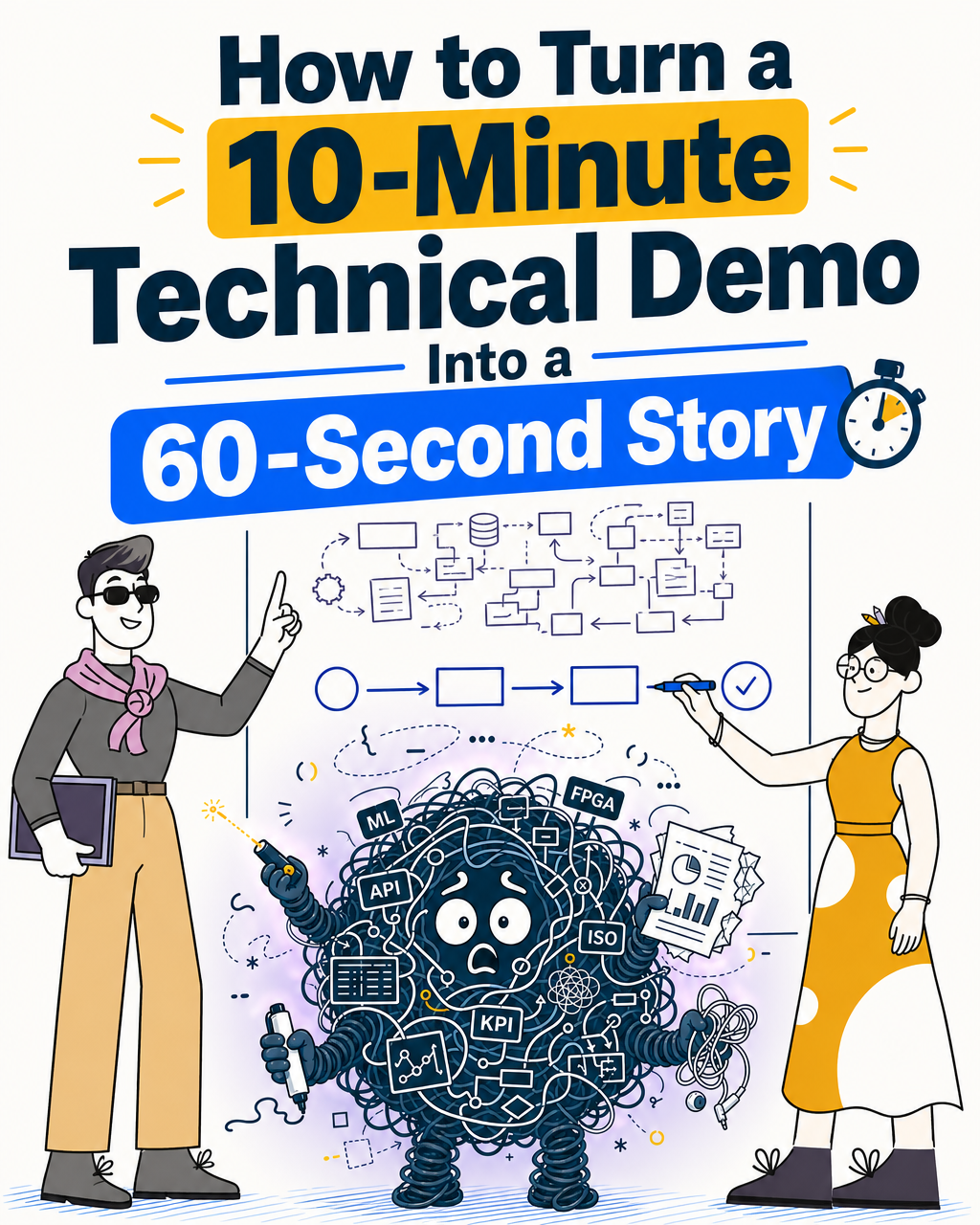
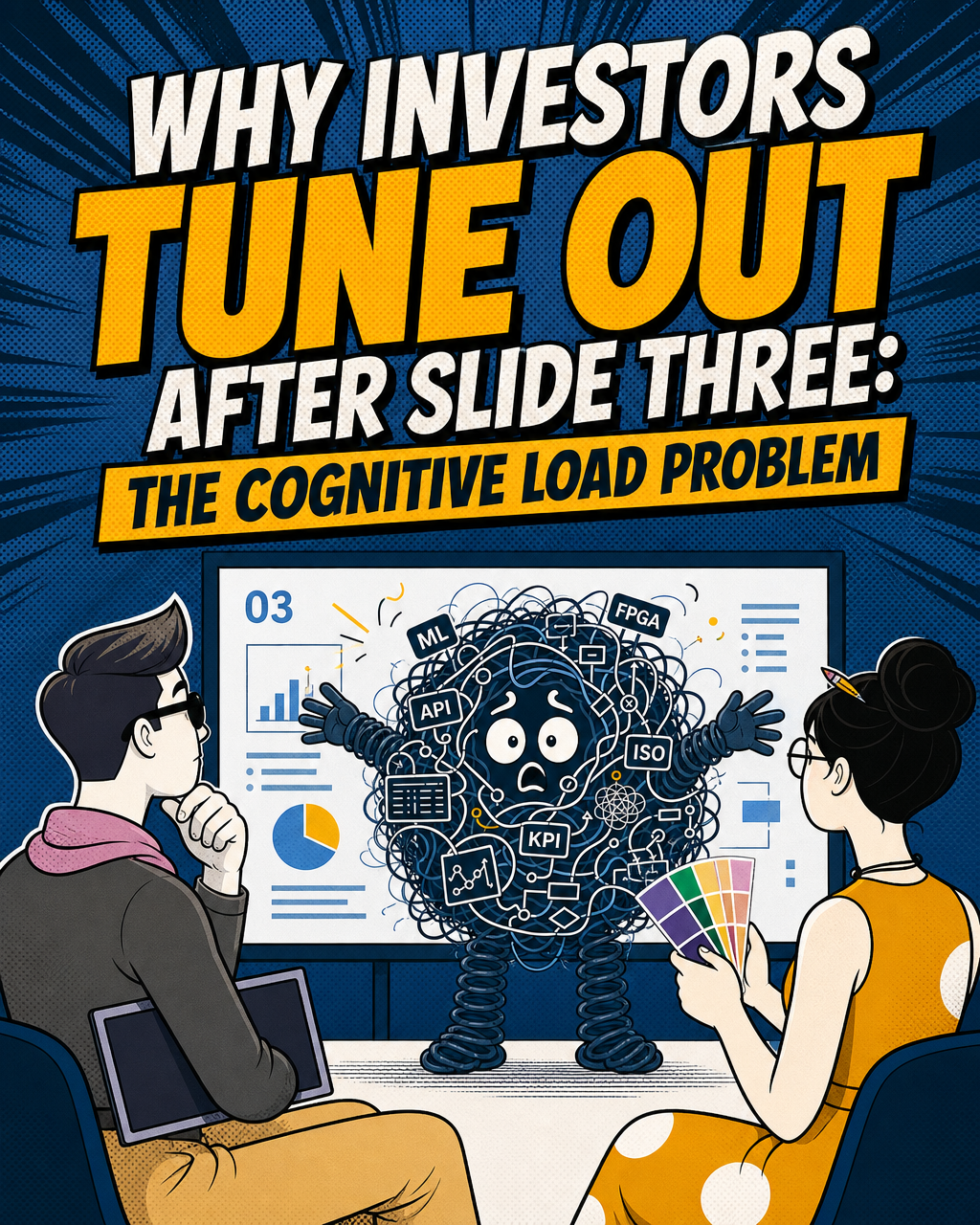
Your Product Isn't Too Complex. Your Explanation Is.
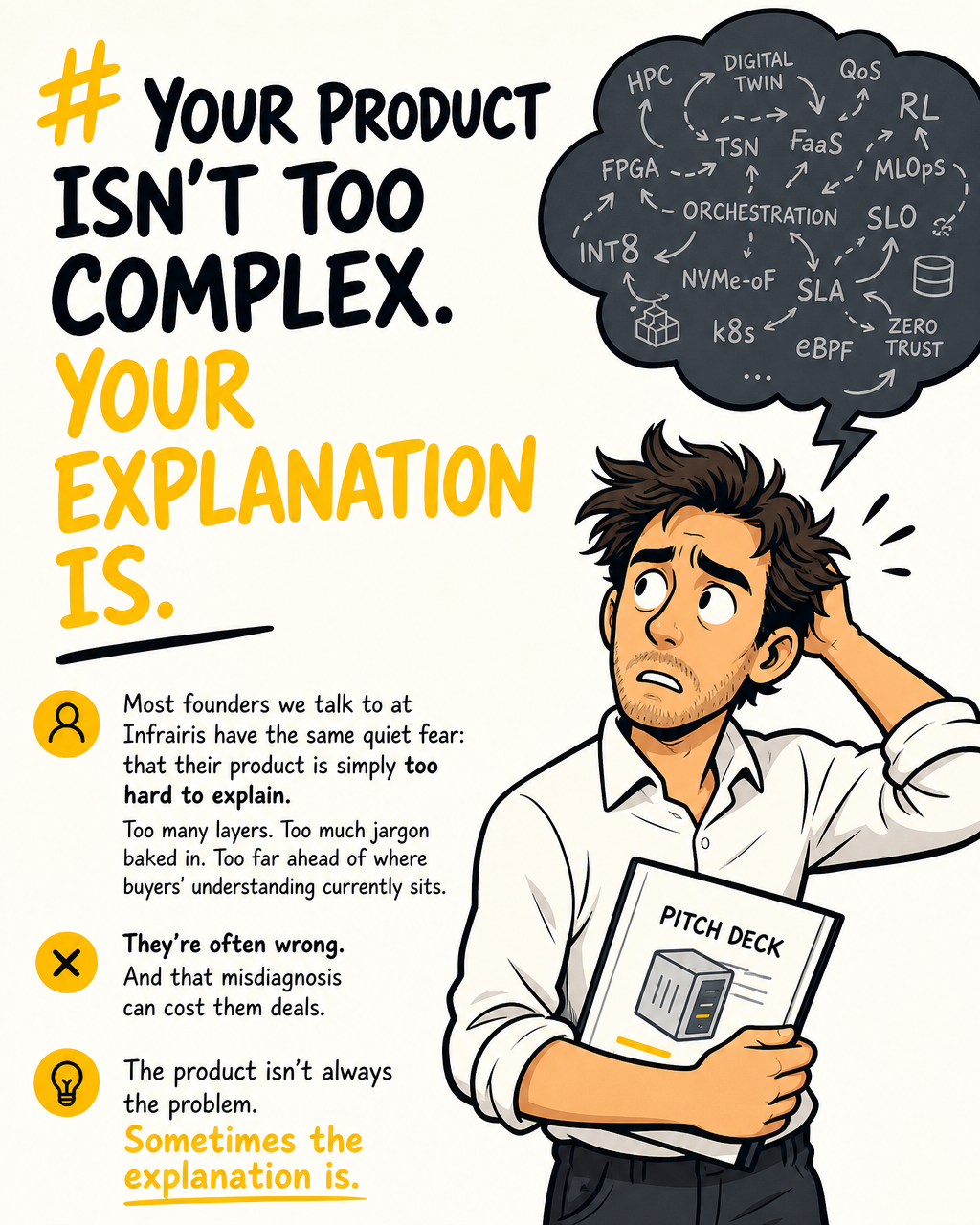


Most founders we talk to at Infrairis have the same quiet fear: that their product is simply too hard to explain. Too many layers. Too much jargon baked in. Too far ahead of where buyers' understanding currently sits.
They're often wrong. And that misdiagnosis can cost them deals.
The product isn't always the problem. Sometimes the explanation is.
The Comprehension Gap Is a Story Problem
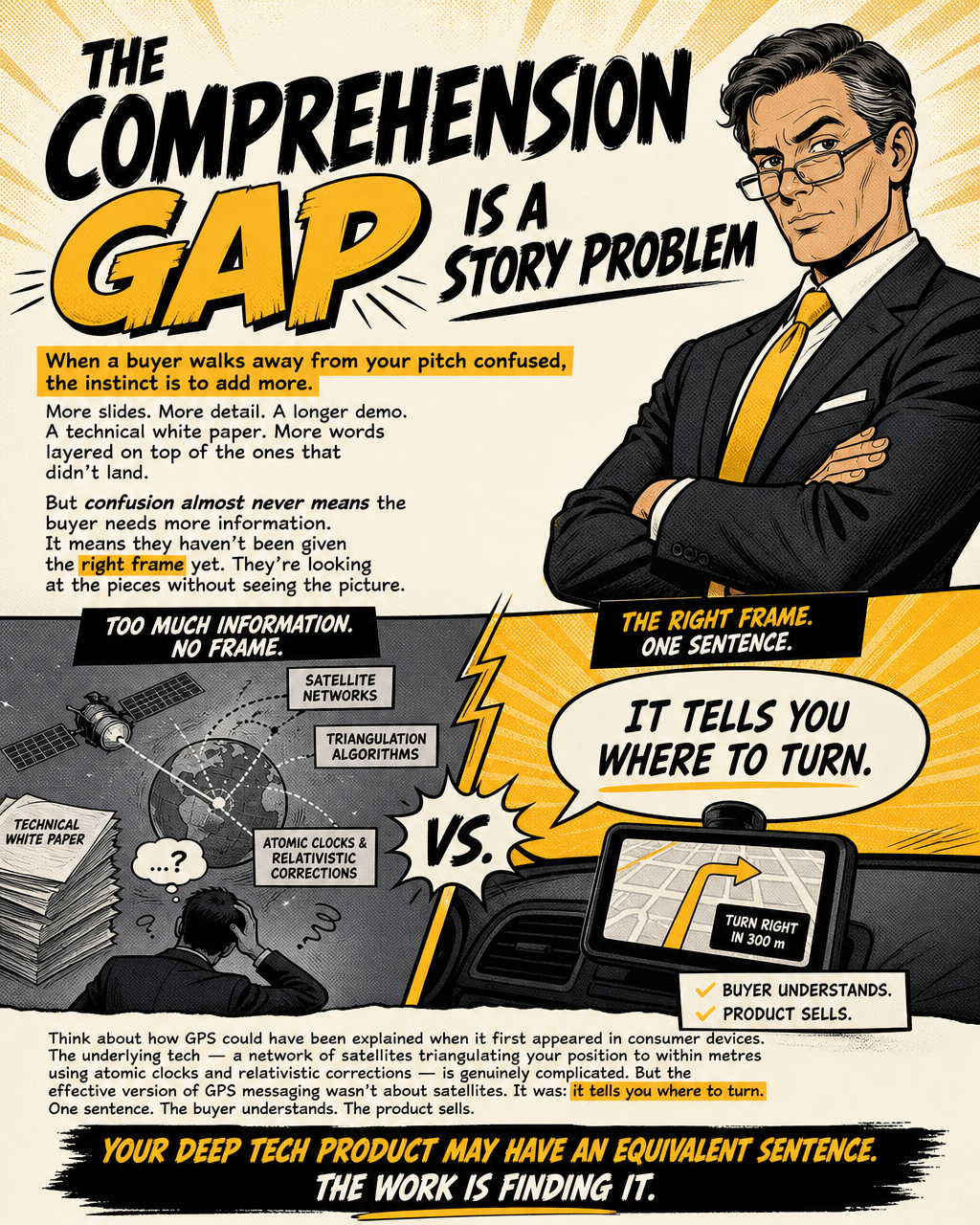
When a buyer walks away from your pitch confused, the instinct is to add more. More slides. More detail. A longer demo. A technical white paper. More words layered on top of the ones that didn't land.
But confusion almost never means the buyer needs more information. It means they haven't been given the right frame yet. They're looking at the pieces without seeing the picture.
Think about how GPS could have been explained when it first appeared in consumer devices. The underlying tech — a network of satellites triangulating your position to within metres using atomic clocks and relativistic corrections — is genuinely complicated. But the effective version of GPS messaging wasn't about satellites. It was: it tells you where to turn. One sentence. The buyer understands. The product sells.
Your deep tech product may have an equivalent sentence. The work is finding it.
The 30-Second Test
Here's a quick diagnostic you can run after any pitch, demo, or sales call. Ask your buyer, casually, to describe back to you in their own words what your product does.
Not what the features are. Not what the architecture looks like. Just: what does it do, and why does it matter?
If they can't do it, the message likely failed. Not the audience.
This isn't about the buyer being unsophisticated. Procurement committees at enterprise companies, superannuation fund managers evaluating deep tech, Series A investors reviewing a high volume of pitches in any given week — none of these people are unsophisticated. They've chosen not to carry your explanation forward because it didn't give them a version they could hold onto.
A useful explainer test: hand the video or the one-pager to someone who doesn't work in your industry. If they can tell you the problem your product solves, and why that problem is painful, in thirty seconds flat — you've found the story. If they look confused or start asking clarifying questions, you haven't found it yet.
Three Reasons Complex Product Explanations Break Down
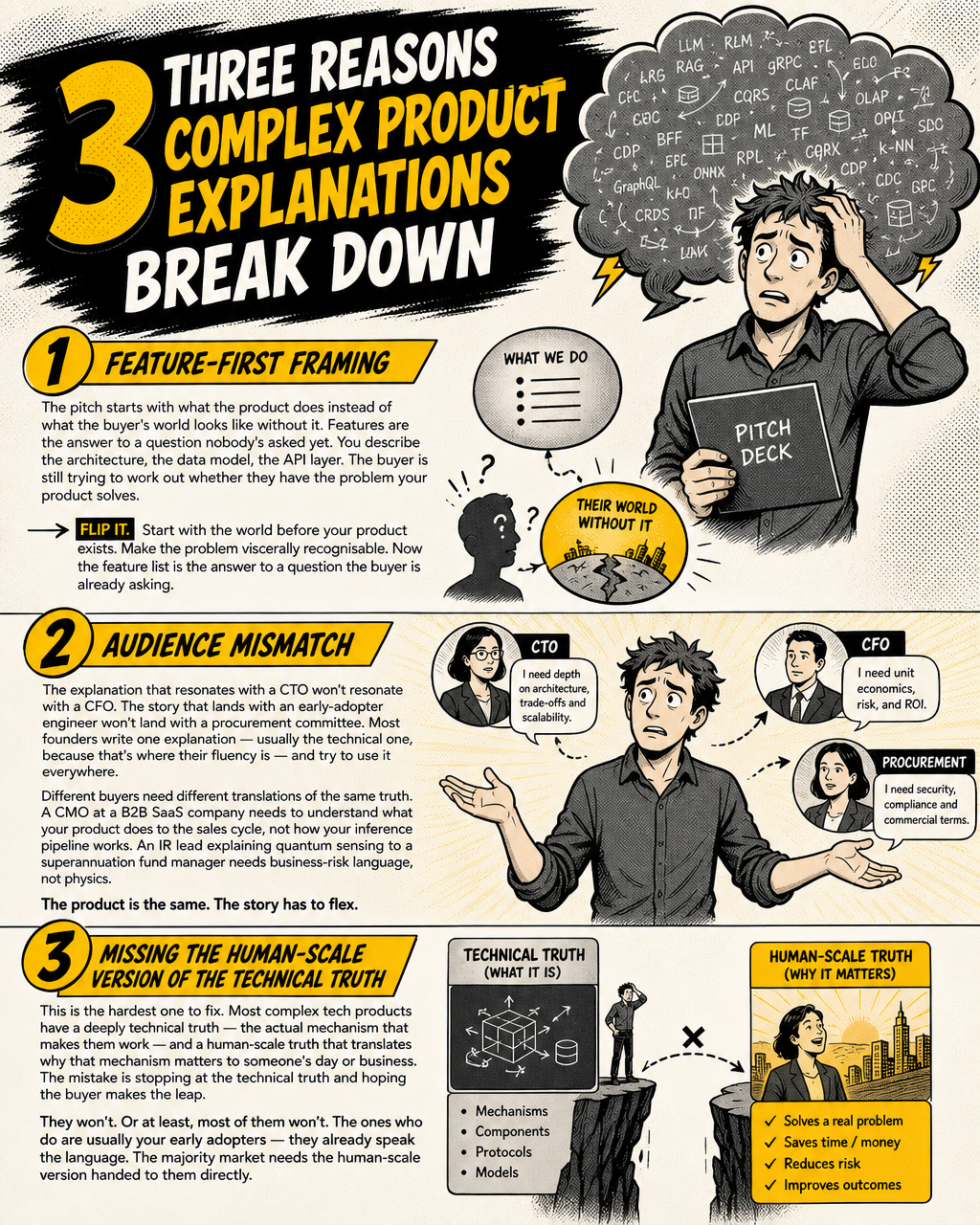
In our experience working across deep tech, B2B SaaS, biotech, regtech, and hardware companies in NZ and AU, three patterns tend to recur — though every product has its own dynamics. They're not about the product. They're about the framing.
1. Feature-first framing
The pitch starts with what the product does instead of what the buyer's world looks like without it. Features are the answer to a question nobody's asked yet. You describe the architecture, the data model, the API layer. The buyer is still trying to work out whether they have the problem your product solves.
Flip it. Start with the world before your product exists. Make the problem viscerally recognisable. Now the feature list is the answer to a question the buyer is already asking.
2. Audience mismatch
The explanation that resonates with a CTO won't resonate with a CFO. The story that lands with an early-adopter engineer won't land with a procurement committee. Most founders write one explanation — usually the technical one, because that's where their fluency is — and try to use it everywhere.
Different buyers need different translations of the same truth. A CMO at a B2B SaaS company needs to understand what your product does to the sales cycle, not how your inference pipeline works. An IR lead explaining quantum sensing to a superannuation fund manager needs business-risk language, not physics.
The product is the same. The story has to flex.
3. Missing the human-scale version of the technical truth
This is the hardest one to fix. Most complex tech products have a deeply technical truth — the actual mechanism that makes them work — and a human-scale truth that translates why that mechanism matters to someone's day or business. The mistake is stopping at the technical truth and hoping the buyer makes the leap.
They won't. Or at least, most of them won't. The ones who do are usually your early adopters — they already speak the language. The majority market needs the human-scale version handed to them directly.
Dumbing Down vs. Translating
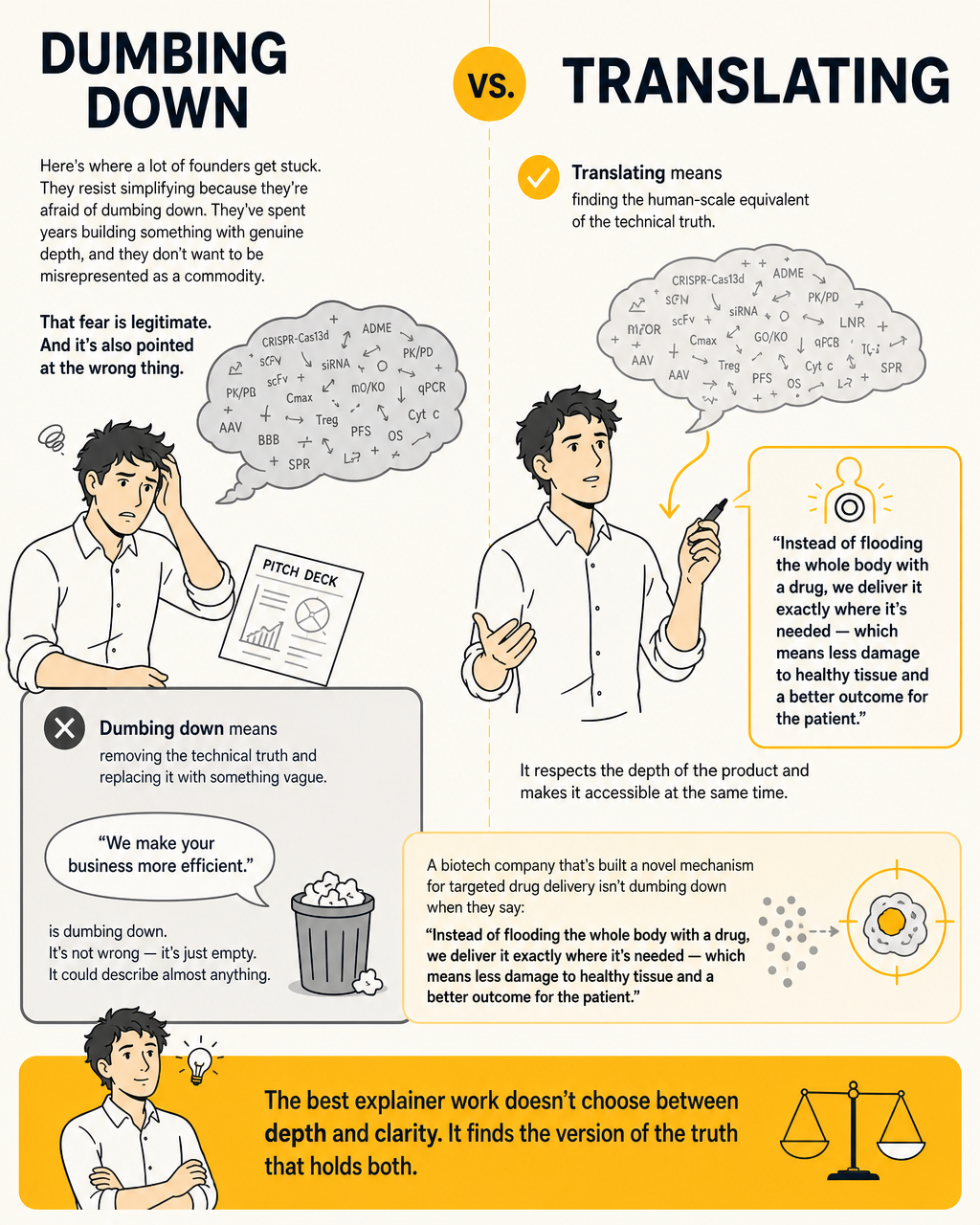
Here's where a lot of founders get stuck. They resist simplifying because they're afraid of dumbing down. They've spent years building something with genuine depth, and they don't want to be misrepresented as a commodity.
That fear is legitimate. And it's also pointed at the wrong thing.
Dumbing down means removing the technical truth and replacing it with something vague. "We make your business more efficient" is dumbing down. It's not wrong — it's just empty. It could describe almost anything.
Translating means finding the human-scale equivalent of the technical truth. It respects the depth of the product and makes it accessible at the same time.
A biotech company that's built a novel mechanism for targeted drug delivery isn't dumbing down when they say: "Instead of flooding the whole body with a drug, we deliver it exactly where it's needed — which means less damage to healthy tissue and a better outcome for the patient." That's the technical truth, expressed in language the buyer can feel.
The best explainer work doesn't choose between depth and clarity. It finds the version of the truth that holds both.
What Translation Actually Requires
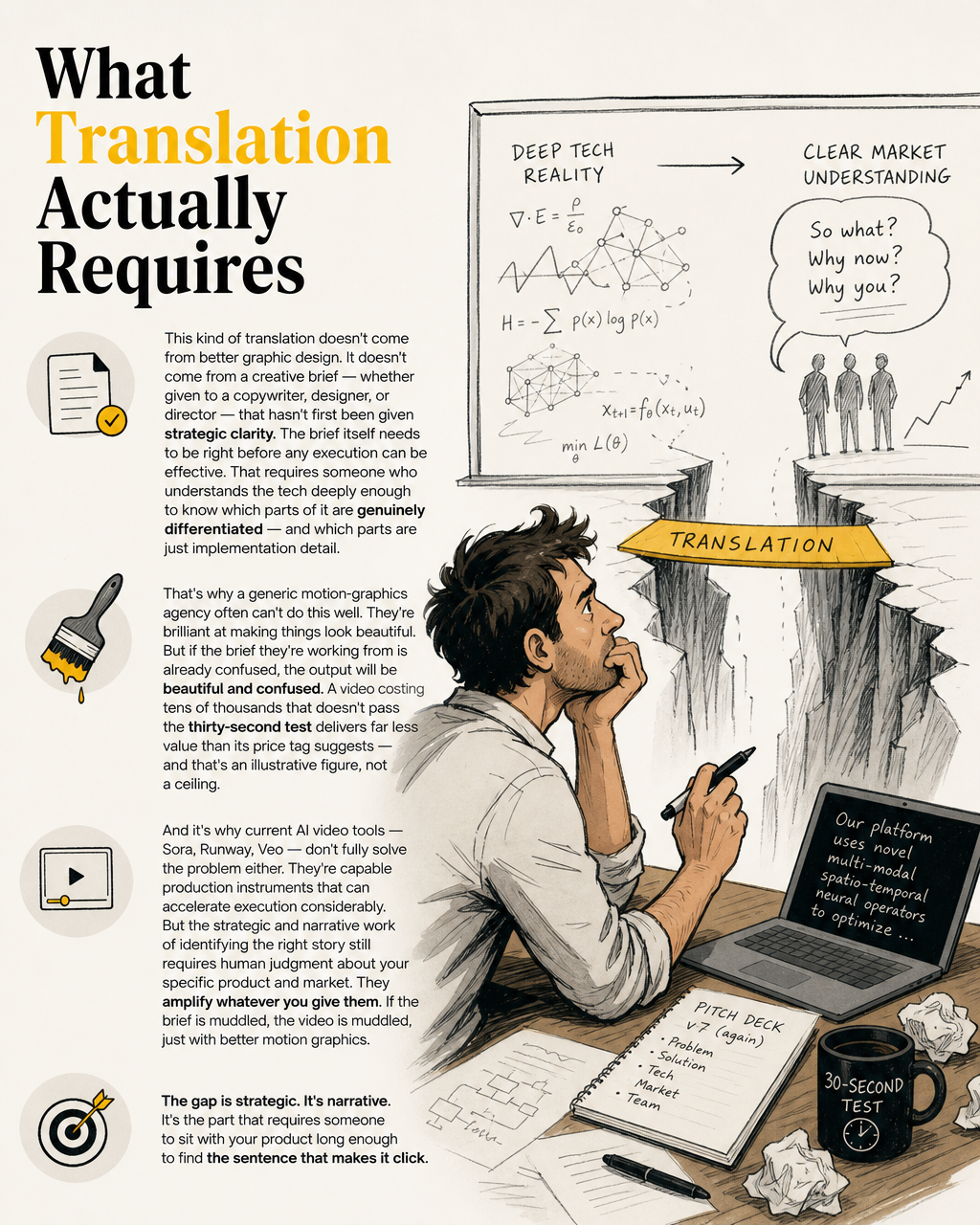
This kind of translation doesn't come from better graphic design. It doesn't come from a creative brief — whether given to a copywriter, designer, or director — that hasn't first been given strategic clarity. The brief itself needs to be right before any execution can be effective. That requires someone who understands the tech deeply enough to know which parts of it are genuinely differentiated — and which parts are just implementation detail.
That's why a generic motion-graphics agency often can't do this well. They're brilliant at making things look beautiful. But if the brief they're working from is already confused, the output will be beautiful and confused. A video costing tens of thousands that doesn't pass the thirty-second test delivers far less value than its price tag suggests — and that's an illustrative figure, not a ceiling.
And it's why current AI video tools — Sora, Runway, Veo — don't fully solve the problem either. They're capable production instruments that can accelerate execution considerably. But the strategic and narrative work of identifying the right story still requires human judgment about your specific product and market. They amplify whatever you give them. If the brief is muddled, the video is muddled, just with better motion graphics.
The gap is strategic. It's narrative. It's the part that requires someone to sit with your product long enough to find the sentence that makes it click.
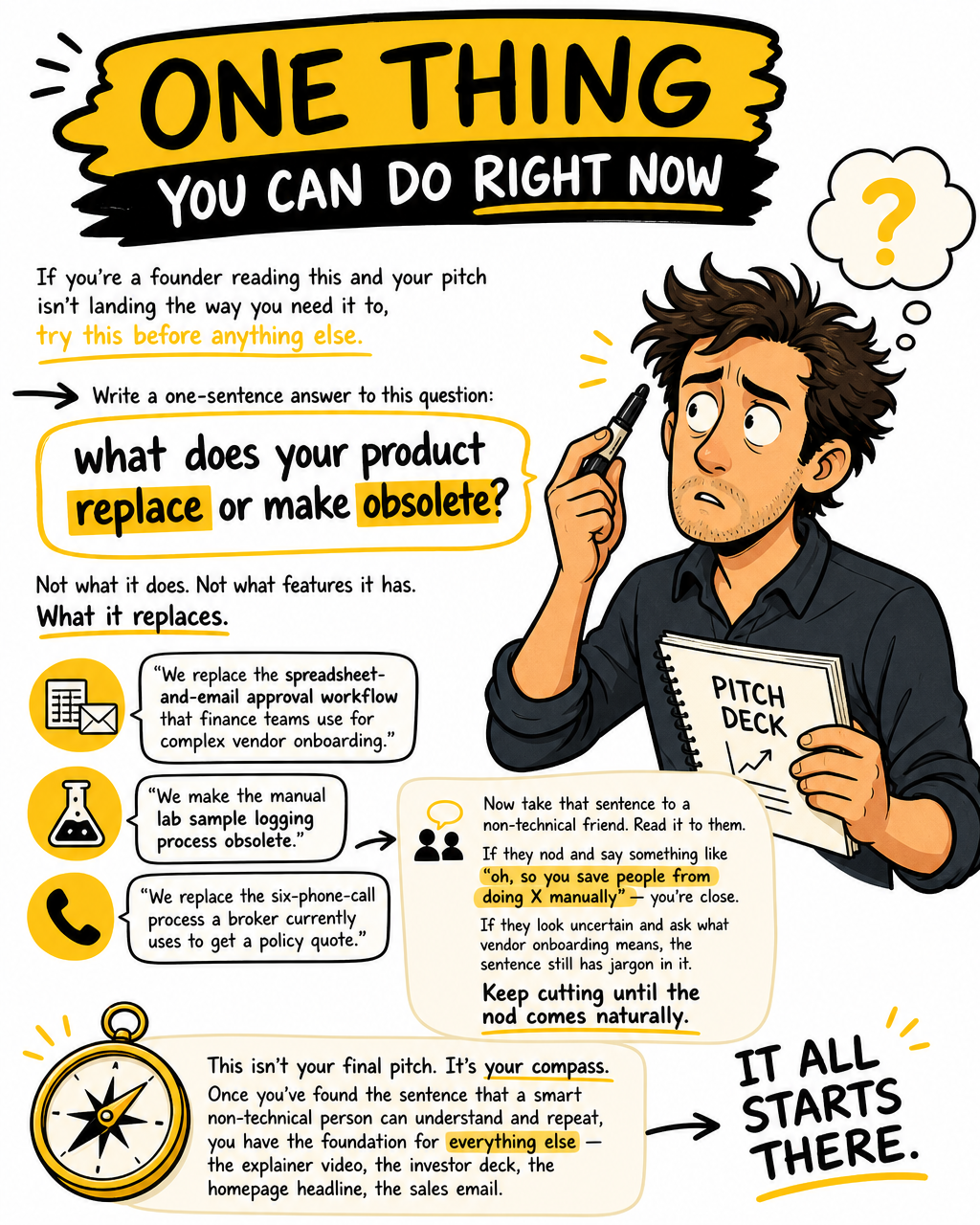
One Thing You Can Do Right Now
If you're a founder reading this and your pitch isn't landing the way you need it to, try this before anything else.
Write a one-sentence answer to this question: what does your product replace or make obsolete?
Not what it does. Not what features it has. What it replaces.
"We replace the spreadsheet-and-email approval workflow that finance teams use for complex vendor onboarding." "We make the manual lab sample logging process obsolete." "We replace the six-phone-call process a broker currently uses to get a policy quote."
Now take that sentence to a non-technical friend. Read it to them. If they nod and say something like "oh, so you save people from doing X manually" — you're close. If they look uncertain and ask what vendor onboarding means, the sentence still has jargon in it.
Keep cutting until the nod comes naturally.
This isn't your final pitch. It's your compass. Once you've found the sentence that a smart non-technical person can understand and repeat, you have the foundation for everything else — the explainer video, the investor deck, the homepage headline, the sales email.
It all starts there.
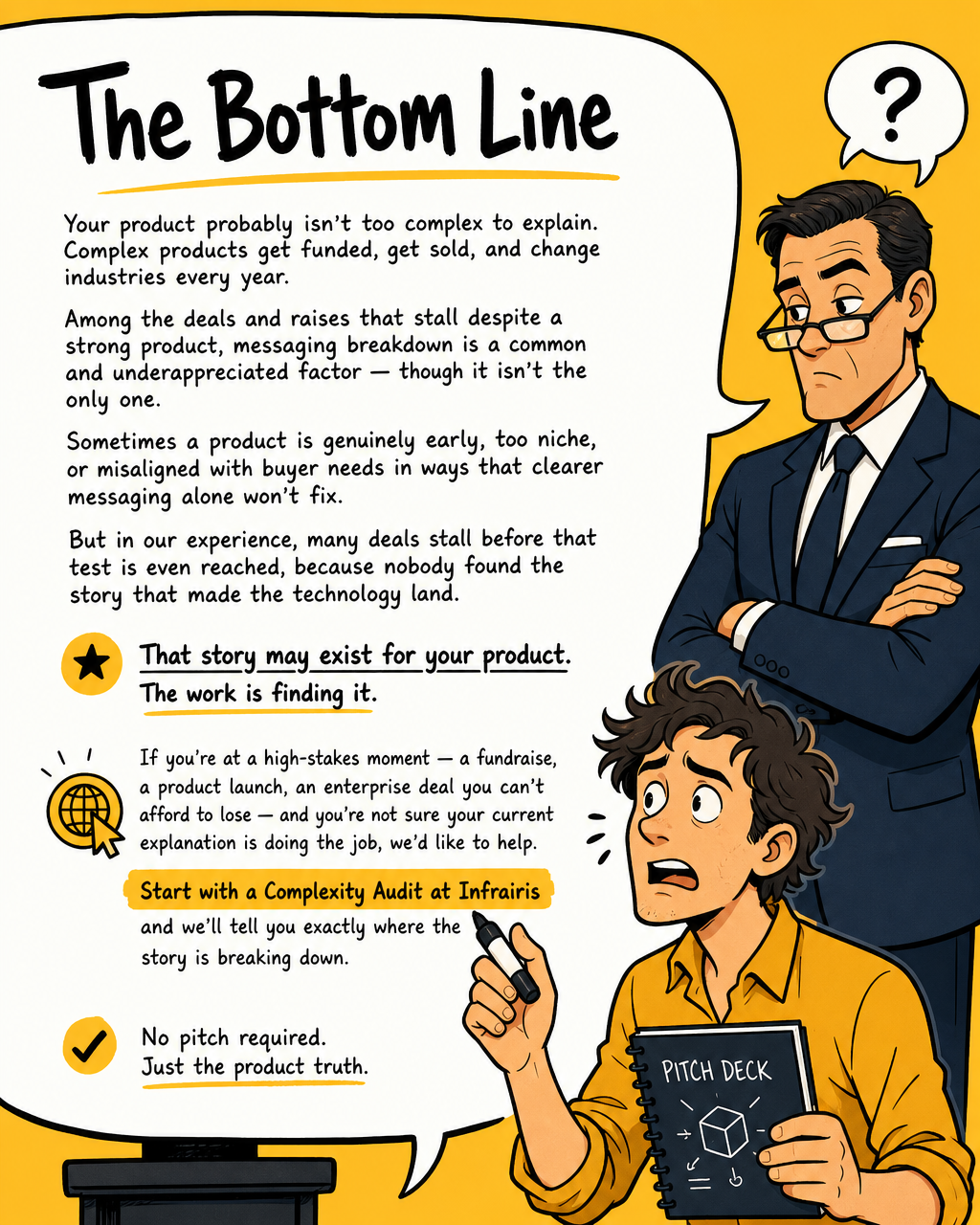
The Bottom Line
Your product probably isn't too complex to explain. Complex products get funded, get sold, and change industries every year. Among the deals and raises that stall despite a strong product, messaging breakdown is a common and underappreciated factor — though it isn't the only one. Sometimes a product is genuinely early, too niche, or misaligned with buyer needs in ways that clearer messaging alone won't fix. But in our experience, many deals stall before that test is even reached, because nobody found the story that made the technology land.
That story may exist for your product. The work is finding it.
If you're at a high-stakes moment — a fundraise, a product launch, an enterprise deal you can't afford to lose — and you're not sure your current explanation is doing the job, we'd like to help. Start with a Complexity Audit at Infrairis and we'll tell you exactly where the story is breaking down.
No pitch required. Just the product truth.

Infrairis
Your complex product. In 60 seconds. Clearly.
Your complex product. In 60 seconds. Clearly.
Learn more about Infrairis and get started today.
Visit Infrairis