Quantum Molecular Simulation, Explained Simply








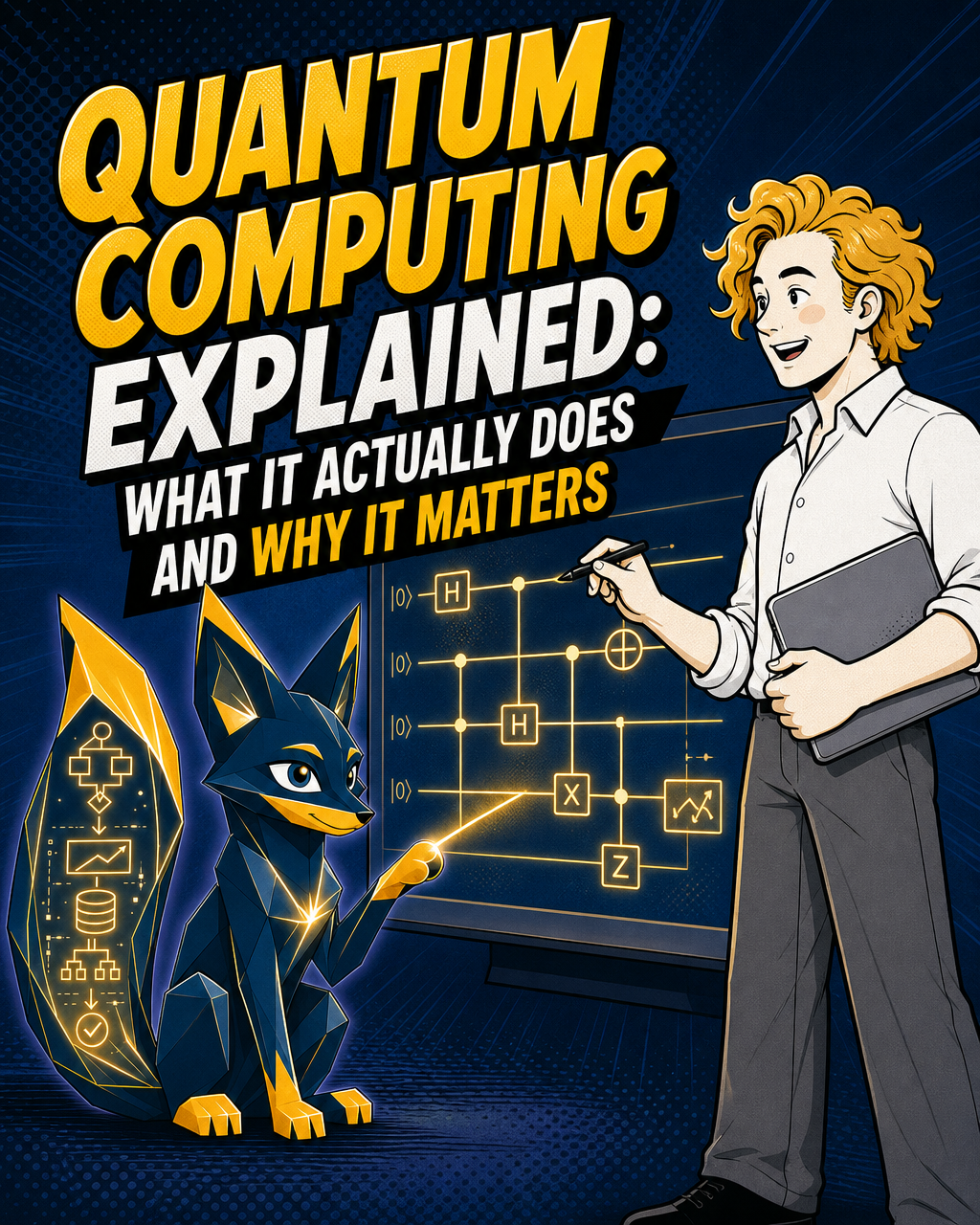
Quantum molecular simulation is one of the clearest examples of why quantum computers matter.
Not because quantum computers are faster at everything. They aren't. Not because they'll replace every high-performance computing cluster. They won't. They matter here because molecules are quantum systems, and classical computers have to work very hard to imitate what nature is already doing.
If you're building, funding, selling, or explaining deep tech, this is the part worth understanding: quantum computers may become unusually good at modelling chemistry because chemistry itself runs on quantum mechanics. That said, classical methods — including machine learning interatomic potentials, tensor network methods, and improved approximate techniques — continue to advance rapidly and may solve many of the same target problems before fault-tolerant quantum hardware arrives. The competitive landscape is genuinely open.
That has consequences for drug discovery, battery design, catalysts, semiconductors, fertiliser production, carbon capture, and any material where the useful behaviour depends on how electrons move.
Let's make it clear.
Why molecules are so hard to simulate
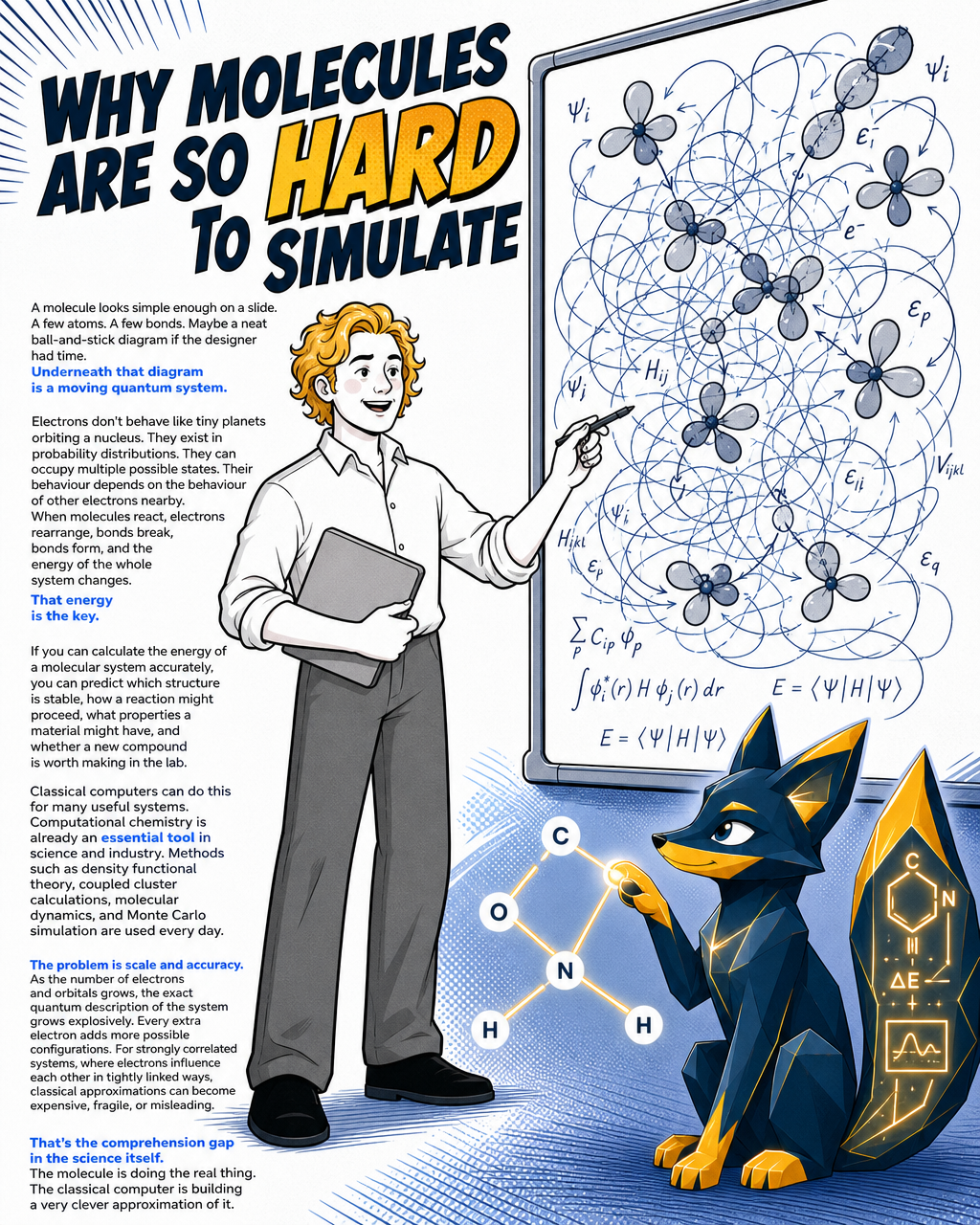
A molecule looks simple enough on a slide. A few atoms. A few bonds. Maybe a neat ball-and-stick diagram if the designer had time.
Underneath that diagram is a moving quantum system.
Electrons don't behave like tiny planets orbiting a nucleus. They exist in probability distributions. They can occupy multiple possible states. Their behaviour depends on the behaviour of other electrons nearby. When molecules react, electrons rearrange, bonds break, bonds form, and the energy of the whole system changes.
That energy is the key.
If you can calculate the energy of a molecular system accurately, you can predict which structure is stable, how a reaction might proceed, what properties a material might have, and whether a new compound is worth making in the lab.
Classical computers can do this for many useful systems. Computational chemistry is already an essential tool in science and industry. Methods such as density functional theory, coupled cluster calculations, molecular dynamics, and Monte Carlo simulation are used every day.
The problem is scale and accuracy.
As the number of electrons and orbitals grows, the exact quantum description of the system grows explosively. Every extra electron adds more possible configurations. For strongly correlated systems, where electrons influence each other in tightly linked ways, classical approximations can become expensive, fragile, or misleading.
That's the comprehension gap in the science itself. The molecule is doing the real thing. The classical computer is building a very clever approximation of it.
Why quantum computers are different
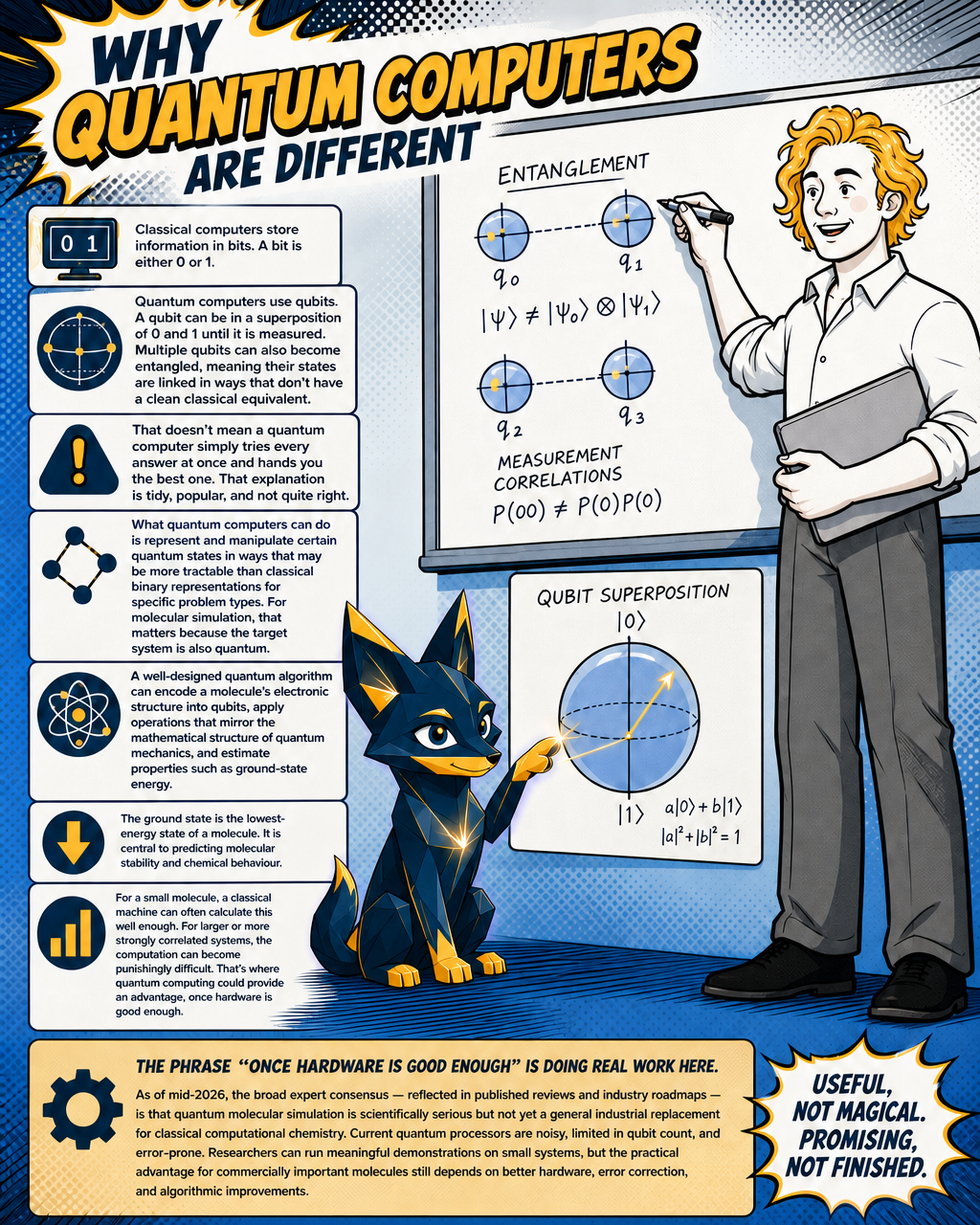
Classical computers store information in bits. A bit is either 0 or 1.
Quantum computers use qubits. A qubit can be in a superposition of 0 and 1 until it is measured. Multiple qubits can also become entangled, meaning their states are linked in ways that don't have a clean classical equivalent.
That doesn't mean a quantum computer simply tries every answer at once and hands you the best one. That explanation is tidy, popular, and not quite right.
What quantum computers can do is represent and manipulate certain quantum states in ways that may be more tractable than classical binary representations for specific problem types. For molecular simulation, that matters because the target system is also quantum.
A well-designed quantum algorithm can encode a molecule's electronic structure into qubits, apply operations that mirror the mathematical structure of quantum mechanics, and estimate properties such as ground-state energy.
The ground state is the lowest-energy state of a molecule. It is central to predicting molecular stability and chemical behaviour.
For a small molecule, a classical machine can often calculate this well enough. For larger or more strongly correlated systems, the computation can become punishingly difficult. That's where quantum computing could provide an advantage, once hardware is good enough.
The phrase "once hardware is good enough" is doing real work here.
As of mid-2026, the broad expert consensus — reflected in published reviews and industry roadmaps — is that quantum molecular simulation is scientifically serious but not yet a general industrial replacement for classical computational chemistry. Current quantum processors are noisy, limited in qubit count, and error-prone. Researchers can run meaningful demonstrations on small systems, but the practical advantage for commercially important molecules still depends on better hardware, error correction, and algorithmic improvements.
Useful, not magical. Promising, not finished.
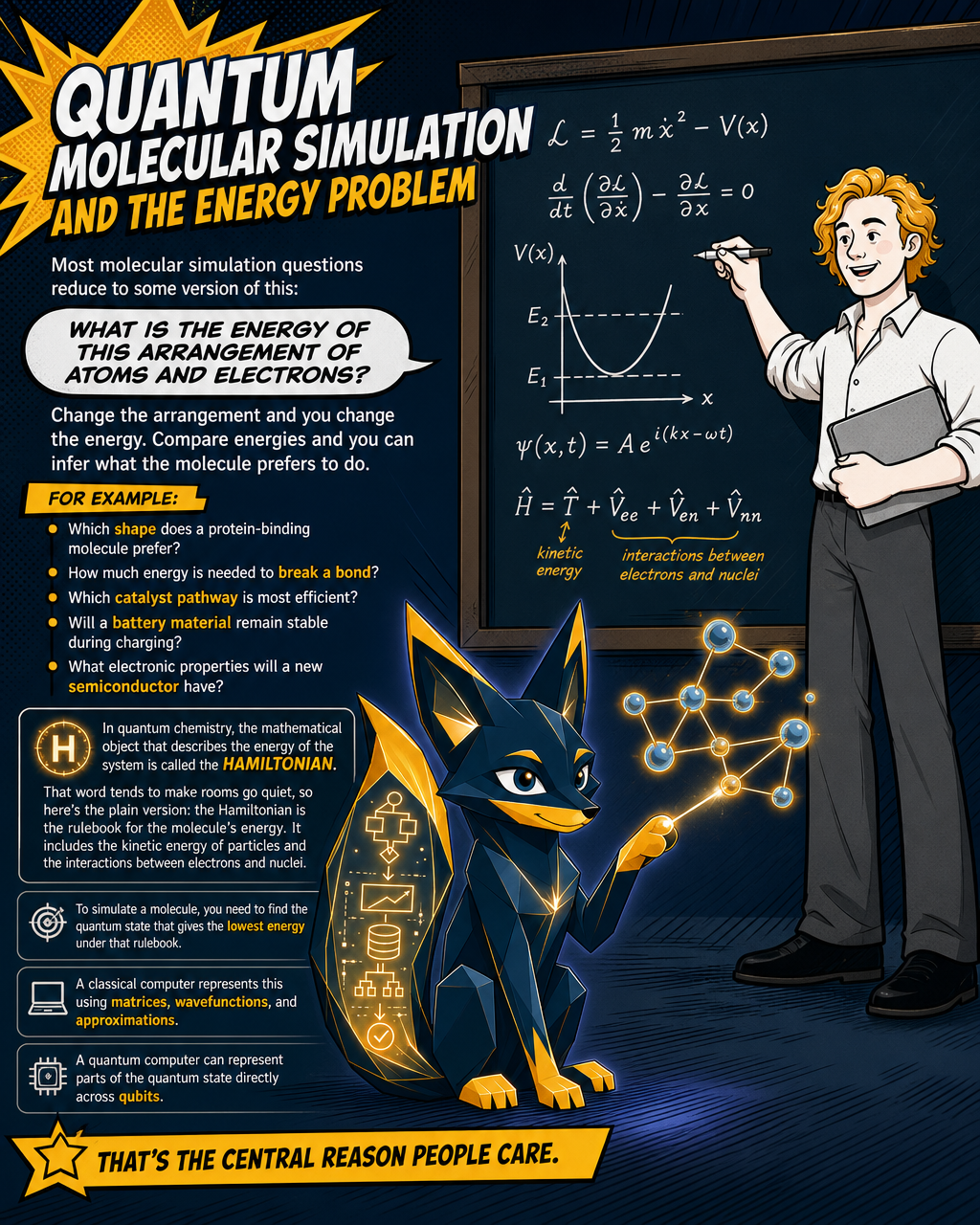
Quantum molecular simulation and the energy problem
Most molecular simulation questions reduce to some version of this:
What is the energy of this arrangement of atoms and electrons?
Change the arrangement and you change the energy. Compare energies and you can infer what the molecule prefers to do.
For example:
- Which shape does a protein-binding molecule prefer?
- How much energy is needed to break a bond?
- Which catalyst pathway is most efficient?
- Will a battery material remain stable during charging?
- What electronic properties will a new semiconductor have?
In quantum chemistry, the mathematical object that describes the energy of the system is called the Hamiltonian.
That word tends to make rooms go quiet, so here's the plain version: the Hamiltonian is the rulebook for the molecule's energy. It includes the kinetic energy of particles and the interactions between electrons and nuclei.
To simulate a molecule, you need to find the quantum state that gives the lowest energy under that rulebook.
A classical computer represents this using matrices, wavefunctions, and approximations. A quantum computer can represent parts of the quantum state directly across qubits.
That's the central reason people care.
The Variational Quantum Eigensolver, without the fog machine
The Variational Quantum Eigensolver, usually shortened to VQE, is one of the most important quantum algorithms for molecular simulation.
It became prominent because it was designed for noisy near-term quantum computers. These are often called NISQ devices, meaning noisy intermediate-scale quantum devices. The name is clunky, but the point is simple: today's quantum computers are useful research instruments, not fault-tolerant industrial engines.
VQE works as a hybrid algorithm. Part of the job is done on a quantum computer. Part is done on a classical computer.
Here's the simplified loop:
- Choose a molecule and translate its electronic structure problem into a qubit-based form.
- Prepare a trial quantum state on the quantum computer.
- Measure the energy of that state.
- Send the result to a classical optimiser.
- The optimiser adjusts the settings of the quantum circuit.
- Run the circuit again.
- Repeat until the measured energy stops improving.
The aim is to find the lowest-energy state, or at least a very good estimate of it.
This is why "variational" appears in the name. The algorithm varies the trial state to minimise energy.
It's not glamorous. It's iterative, careful, and deeply practical.
VQE uses quantum hardware for the task of preparing and measuring quantum states. It is worth noting, however, that VQE's practical advantage over classical methods on current hardware is an active area of debate. Some researchers have shown that classical simulation can replicate or outperform VQE results for system sizes accessible to today's noisy quantum processors. The value of VQE may be better understood as a near-term research tool and proof-of-concept framework rather than a demonstrated source of computational advantage at scale. The classical computer handles the optimisation loop, where it remains very strong.
That makes VQE a bridge between where quantum hardware is now and where researchers hope it will go.
Other quantum algorithms that matter
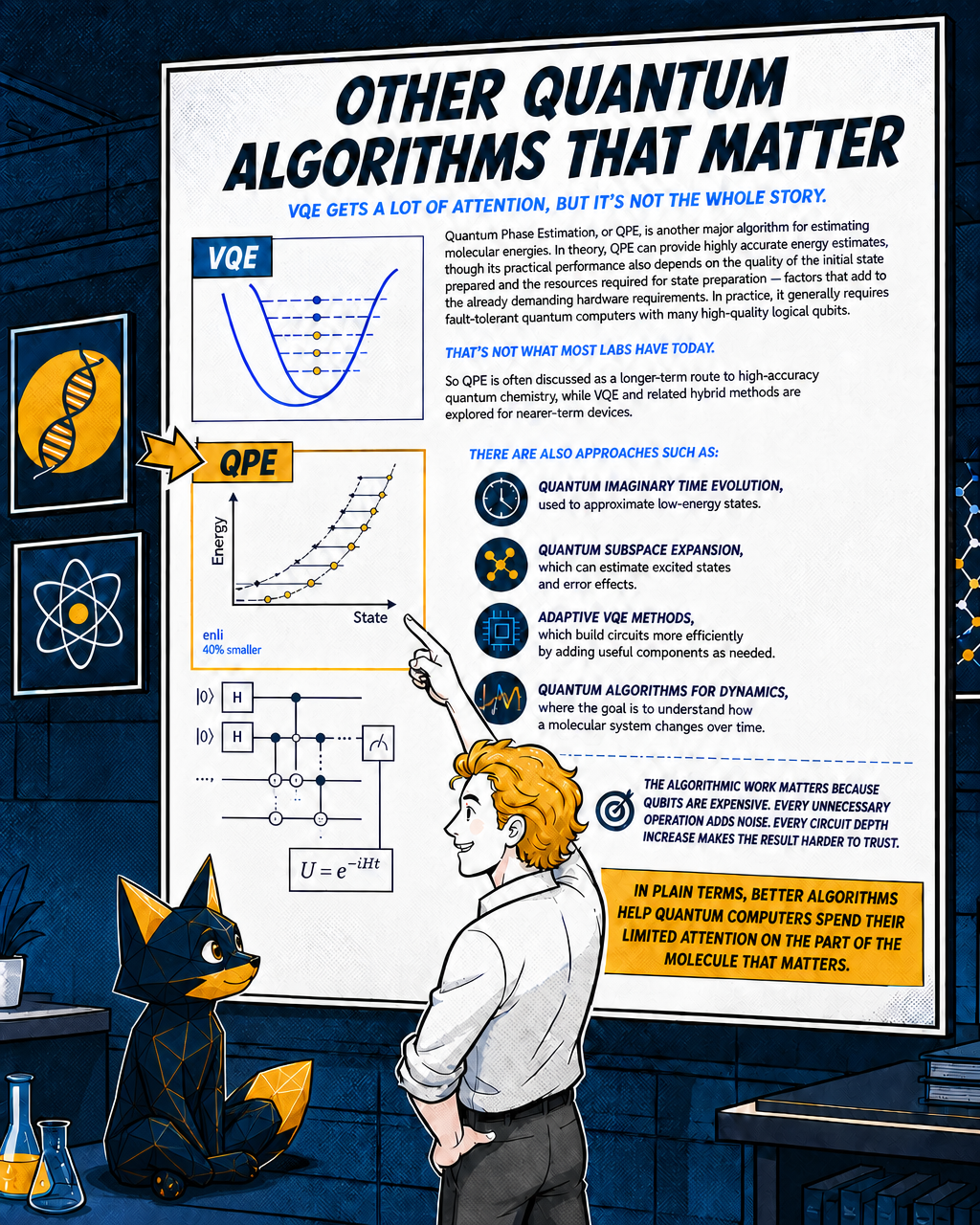
VQE gets a lot of attention, but it's not the whole story.
Quantum Phase Estimation, or QPE, is another major algorithm for estimating molecular energies. In theory, QPE can provide highly accurate energy estimates, though its practical performance also depends on the quality of the initial state prepared and the resources required for state preparation — factors that add to the already demanding hardware requirements. In practice, it generally requires fault-tolerant quantum computers with many high-quality logical qubits.
That's not what most labs have today.
So QPE is often discussed as a longer-term route to high-accuracy quantum chemistry, while VQE and related hybrid methods are explored for nearer-term devices.
There are also approaches such as:
- Quantum imaginary time evolution, used to approximate low-energy states.
- Quantum subspace expansion, which can estimate excited states and error effects.
- Adaptive VQE methods, which build circuits more efficiently by adding useful components as needed.
- Quantum algorithms for dynamics, where the goal is to understand how a molecular system changes over time.
The algorithmic work matters because qubits are expensive. Every unnecessary operation adds noise. Every circuit depth increase makes the result harder to trust.
In plain terms, better algorithms help quantum computers spend their limited attention on the part of the molecule that matters.
Why classical simulation starts to struggle
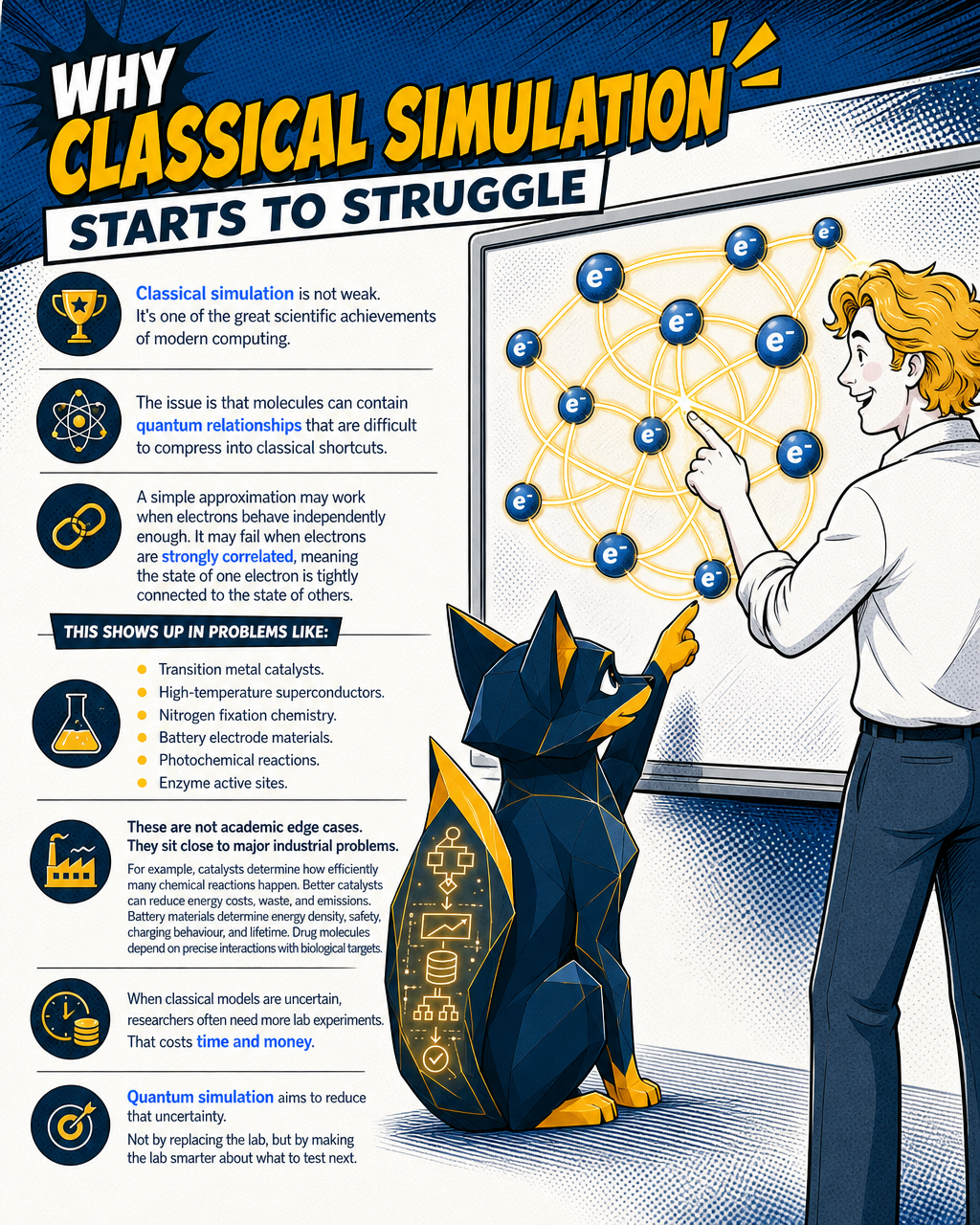
Classical simulation is not weak. It's one of the great scientific achievements of modern computing.
The issue is that molecules can contain quantum relationships that are difficult to compress into classical shortcuts.
A simple approximation may work when electrons behave independently enough. It may fail when electrons are strongly correlated, meaning the state of one electron is tightly connected to the state of others.
This shows up in problems like:
- Transition metal catalysts.
- High-temperature superconductors.
- Nitrogen fixation chemistry.
- Battery electrode materials.
- Photochemical reactions.
- Enzyme active sites.
These are not academic edge cases. They sit close to major industrial problems.
For example, catalysts determine how efficiently many chemical reactions happen. Better catalysts can reduce energy costs, waste, and emissions. Battery materials determine energy density, safety, charging behaviour, and lifetime. Drug molecules depend on precise interactions with biological targets.
When classical models are uncertain, researchers often need more lab experiments. That costs time and money.
Quantum simulation aims to reduce that uncertainty.
Not by replacing the lab, but by making the lab smarter about what to test next.
What "more accurate molecular modelling" really means
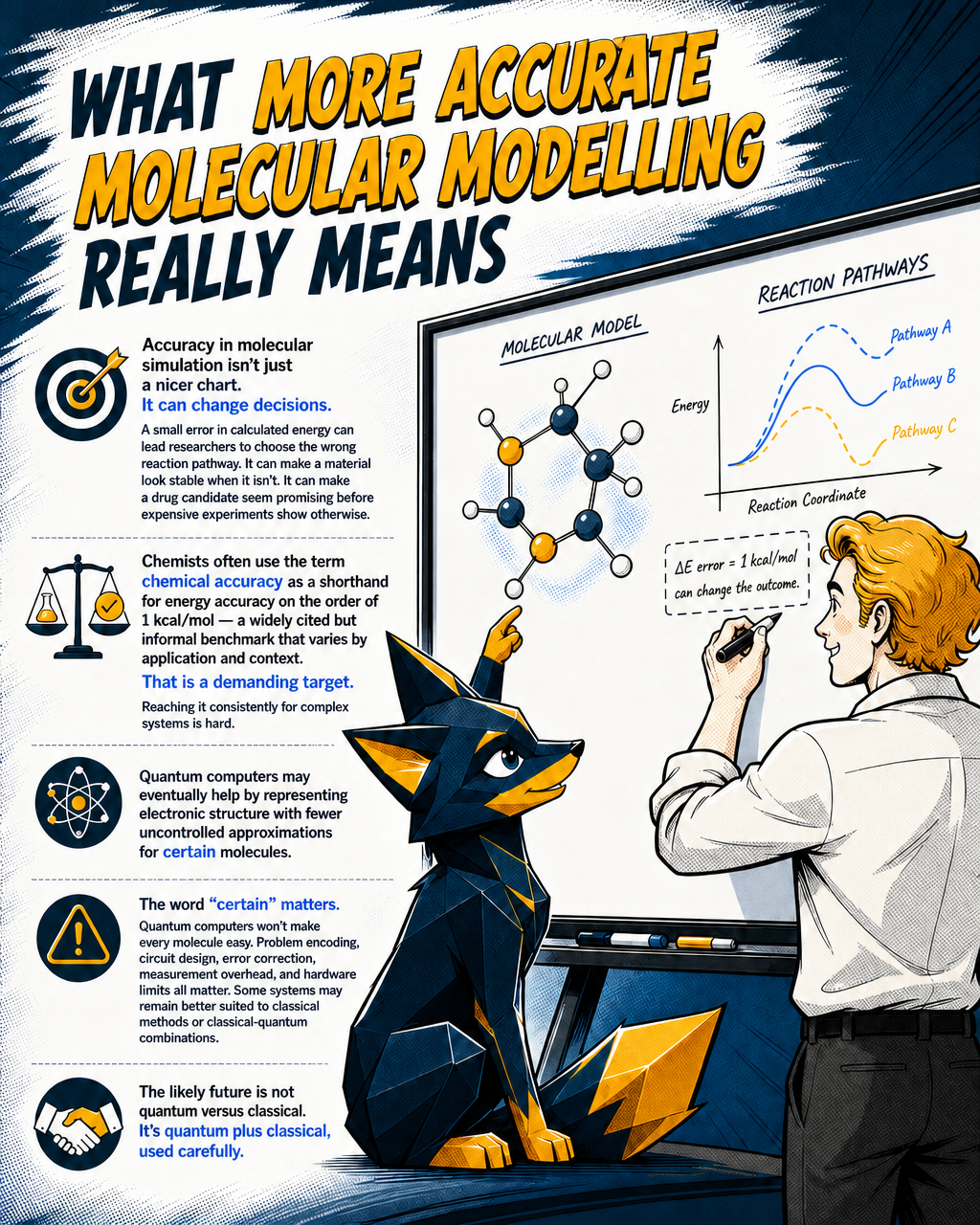
Accuracy in molecular simulation isn't just a nicer chart.
It can change decisions.
A small error in calculated energy can lead researchers to choose the wrong reaction pathway. It can make a material look stable when it isn't. It can make a drug candidate seem promising before expensive experiments show otherwise.
Chemists often use the term chemical accuracy as a shorthand for energy accuracy on the order of 1 kcal/mol — a widely cited but informal benchmark that varies by application and context. That is a demanding target. Reaching it consistently for complex systems is hard.
Quantum computers may eventually help by representing electronic structure with fewer uncontrolled approximations for certain molecules.
The word "certain" matters.
Quantum computers won't make every molecule easy. Problem encoding, circuit design, error correction, measurement overhead, and hardware limits all matter. Some systems may remain better suited to classical methods or classical-quantum combinations.
The likely future is not quantum versus classical. It's quantum plus classical, used carefully.
How quantum computers explore molecular configurations
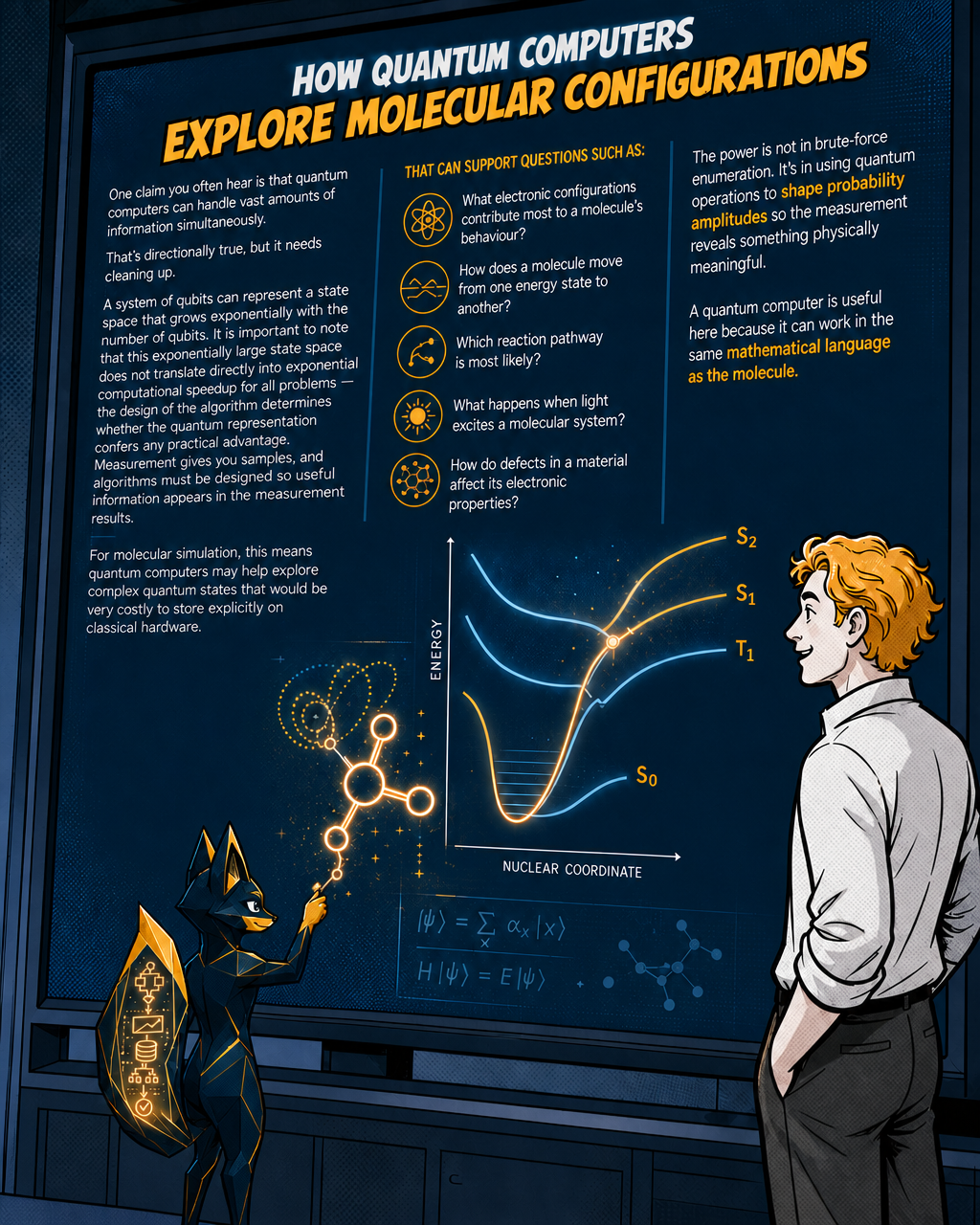
One claim you often hear is that quantum computers can handle vast amounts of information simultaneously.
That's directionally true, but it needs cleaning up.
A system of qubits can represent a state space that grows exponentially with the number of qubits. It is important to note that this exponentially large state space does not translate directly into exponential computational speedup for all problems — the design of the algorithm determines whether the quantum representation confers any practical advantage. Measurement gives you samples, and algorithms must be designed so useful information appears in the measurement results.
For molecular simulation, this means quantum computers may help explore complex quantum states that would be very costly to store explicitly on classical hardware.
That can support questions such as:
- What electronic configurations contribute most to a molecule's behaviour?
- How does a molecule move from one energy state to another?
- Which reaction pathway is most likely?
- What happens when light excites a molecular system?
- How do defects in a material affect its electronic properties?
The power is not in brute-force enumeration. It's in using quantum operations to shape probability amplitudes so the measurement reveals something physically meaningful.
A quantum computer is useful here because it can work in the same mathematical language as the molecule.
Drug discovery, where the promise is real but careful
Drug discovery is one of the most discussed applications of quantum molecular simulation.
The reason is obvious. Developing a new drug is expensive, slow, and full of failure. If better simulation could identify stronger candidates earlier, it could reduce wasted lab work and improve the odds of success.
Quantum computers could help with parts of this process, especially where electronic structure matters deeply.
Examples include:
- Predicting binding energies between small molecules and targets.
- Understanding reaction mechanisms in enzyme active sites.
- Modelling proton transfer, charge transfer, or metal centres.
- Studying excited states relevant to photobiology.
- Improving force fields used in larger molecular dynamics simulations.
But it's important not to oversell it.
Most drug discovery work involves huge biological systems: proteins, membranes, water, ions, and dynamic conformational changes. Simulating all of that directly on a quantum computer is not a near-term task.
The more credible path is targeted use. Quantum methods may improve the hardest electronic-structure components, then feed better parameters or insights into classical workflows.
For a biotech founder, that's the useful framing. Quantum computing may not replace your discovery stack. It may sharpen the parts of the stack where classical approximations are weakest.
New materials, from batteries to catalysts
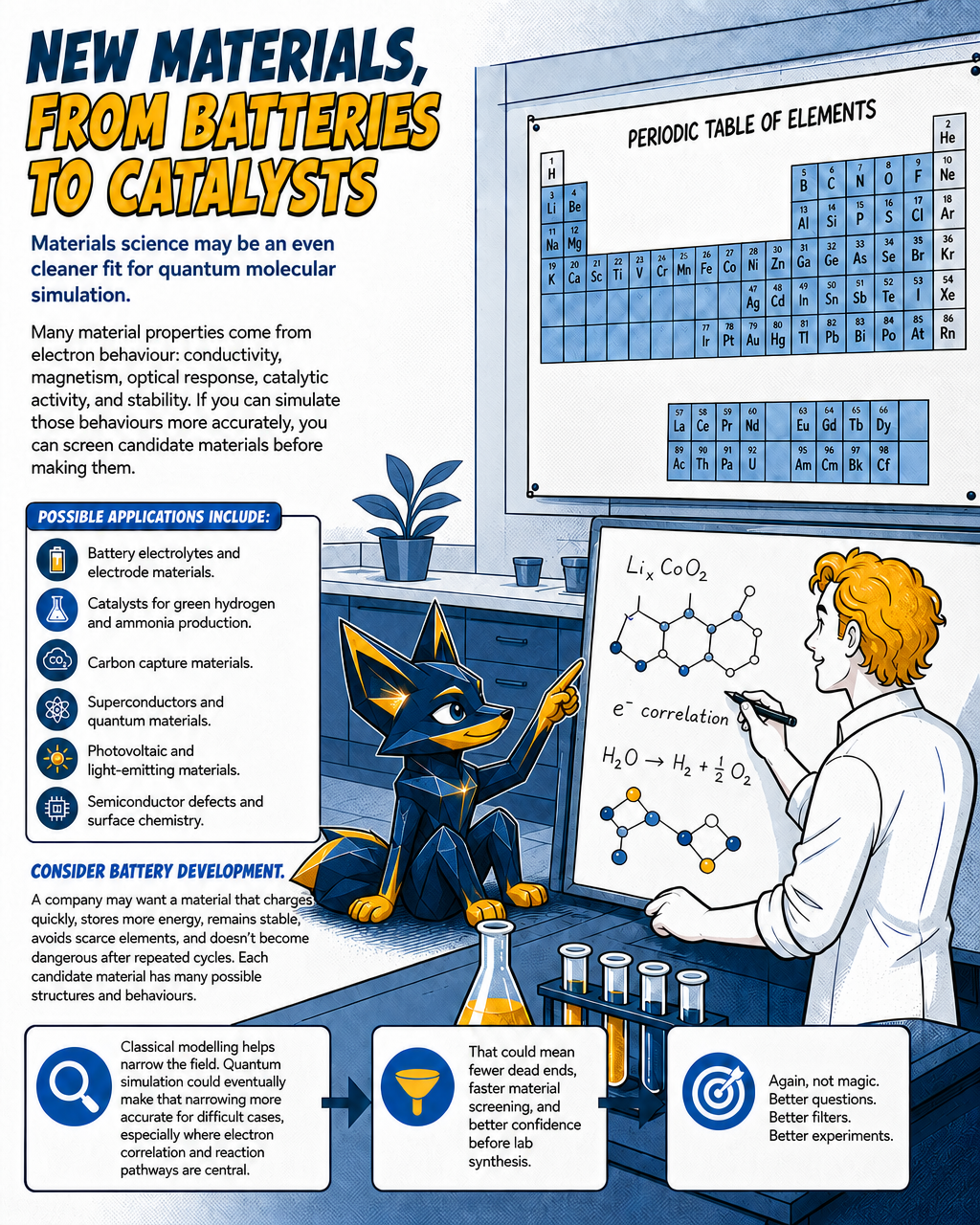
Materials science may be an even cleaner fit for quantum molecular simulation.
Many material properties come from electron behaviour: conductivity, magnetism, optical response, catalytic activity, and stability. If you can simulate those behaviours more accurately, you can screen candidate materials before making them.
Possible applications include:
- Battery electrolytes and electrode materials.
- Catalysts for green hydrogen and ammonia production.
- Carbon capture materials.
- Superconductors and quantum materials.
- Photovoltaic and light-emitting materials.
- Semiconductor defects and surface chemistry.
Consider battery development.
A company may want a material that charges quickly, stores more energy, remains stable, avoids scarce elements, and doesn't become dangerous after repeated cycles. Each candidate material has many possible structures and behaviours.
Classical modelling helps narrow the field. Quantum simulation could eventually make that narrowing more accurate for difficult cases, especially where electron correlation and reaction pathways are central.
That could mean fewer dead ends, faster material screening, and better confidence before lab synthesis.
Again, not magic. Better questions. Better filters. Better experiments.
Why VQE matters for material and molecular design
VQE contributes to molecular simulation because it gives researchers a practical way to ask quantum hardware for energy estimates.
In molecular design, energy estimates are everywhere.
They help answer:
- Is this molecule stable?
- Which molecular geometry is preferred?
- How strong is this interaction?
- Which reaction route has the lowest barrier?
- What happens when electrons are excited?
VQE can be adapted to different molecular Hamiltonians and trial circuit designs. Researchers can tune the ansatz, which is the chosen form of the trial quantum circuit, to better match the chemistry being studied.
That flexibility is useful. It also creates a problem.
A poor ansatz can waste qubits and produce weak results. A good ansatz can make the simulation more efficient and physically meaningful.
This is why VQE research often looks like a craft problem as much as a hardware problem. The algorithm, the chemistry, and the device noise all interact.
The best teams don't just run a generic quantum circuit and hope. They design the simulation around the molecule, the hardware, and the question being asked.
What has been demonstrated so far
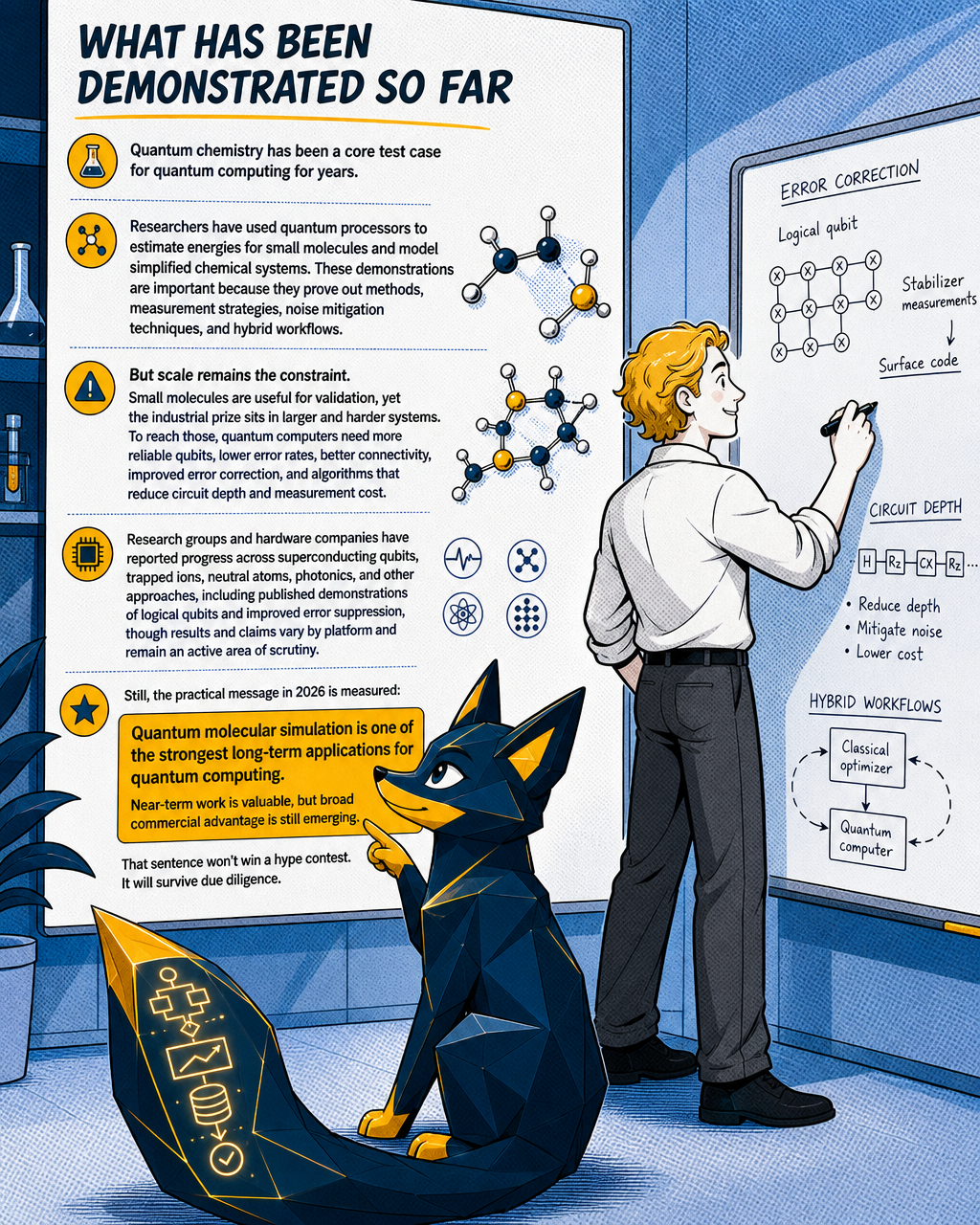
Quantum chemistry has been a core test case for quantum computing for years.
Researchers have used quantum processors to estimate energies for small molecules and model simplified chemical systems. These demonstrations are important because they prove out methods, measurement strategies, noise mitigation techniques, and hybrid workflows.
But scale remains the constraint.
Small molecules are useful for validation, yet the industrial prize sits in larger and harder systems. To reach those, quantum computers need more reliable qubits, lower error rates, better connectivity, improved error correction, and algorithms that reduce circuit depth and measurement cost.
Research groups and hardware companies have reported progress across superconducting qubits, trapped ions, neutral atoms, photonics, and other approaches, including published demonstrations of logical qubits and improved error suppression, though results and claims vary by platform and remain an active area of scrutiny.
Still, the practical message in 2026 is measured:
Quantum molecular simulation is one of the strongest long-term applications for quantum computing. Near-term work is valuable, but broad commercial advantage is still emerging.
That sentence won't win a hype contest. It will survive due diligence.
Why this matters for founders and commercial teams
If you're a founder, CMO, or investor relations lead, you don't need to become a quantum chemist.
You do need to understand the business implication.
Quantum molecular simulation is a way to reduce uncertainty in systems where classical modelling becomes expensive or approximate. That can affect research timelines, capital allocation, technical risk, and product differentiation.
For a biotech company, it might support better candidate selection.
For a materials company, it might shorten the path from hypothesis to lab validation.
For a hardware company, it might improve modelling of surfaces, defects, or device materials.
For an investor, it raises better questions:
- Which part of the workflow actually needs quantum computing?
- What classical baseline is being outperformed?
- Is the advantage about accuracy, speed, cost, or new insight?
- Does the team need a fault-tolerant machine, or can hybrid near-term methods help?
- What evidence shows the simulation improves a real decision?
A simple example: testing a new catalyst
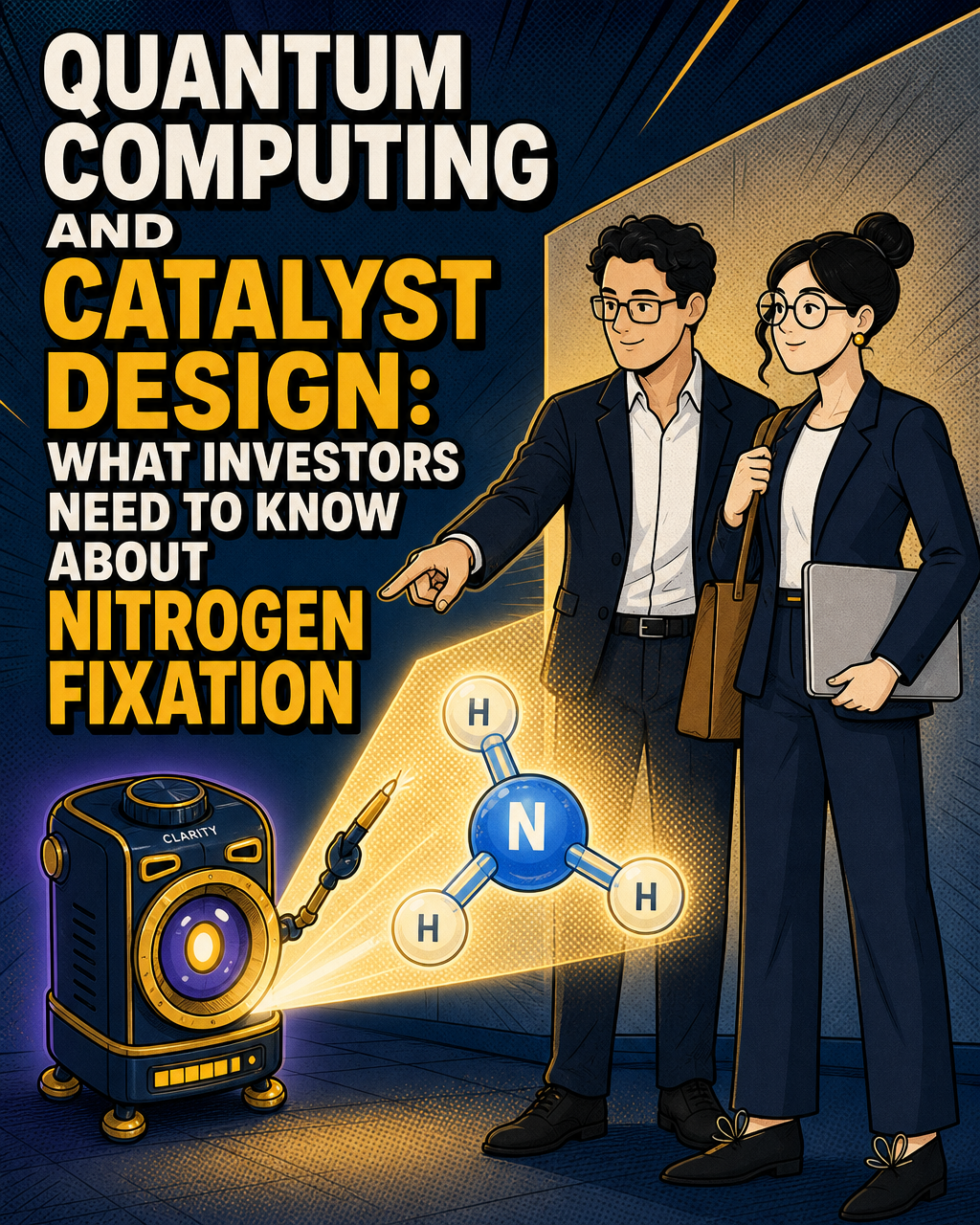
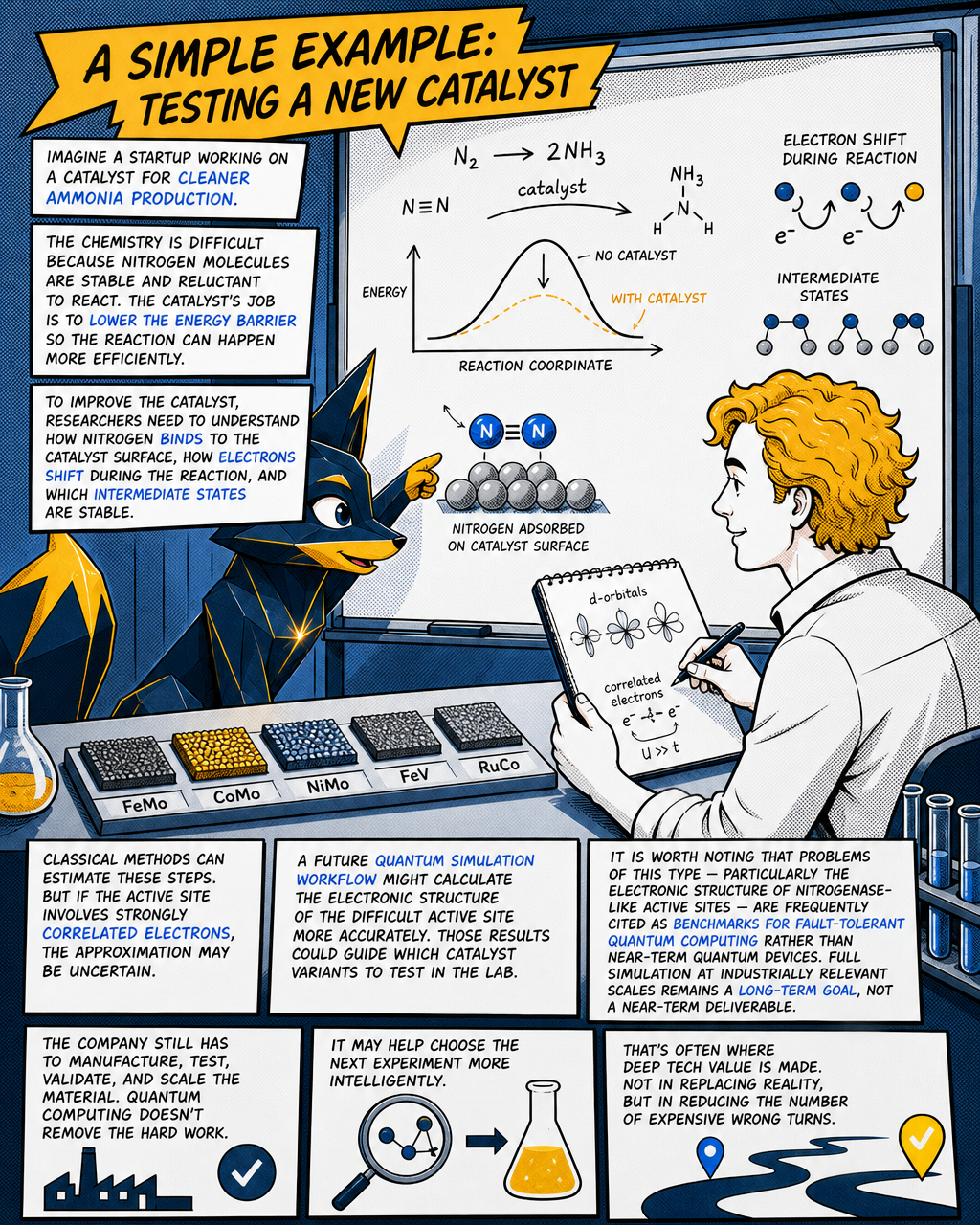
Imagine a startup working on a catalyst for cleaner ammonia production.
The chemistry is difficult because nitrogen molecules are stable and reluctant to react. The catalyst's job is to lower the energy barrier so the reaction can happen more efficiently.
To improve the catalyst, researchers need to understand how nitrogen binds to the catalyst surface, how electrons shift during the reaction, and which intermediate states are stable.
Classical methods can estimate these steps. But if the active site involves strongly correlated electrons, the approximation may be uncertain.
A future quantum simulation workflow might calculate the electronic structure of the difficult active site more accurately. Those results could guide which catalyst variants to test in the lab.
It is worth noting that problems of this type — particularly the electronic structure of nitrogenase-like active sites — are frequently cited as benchmarks for fault-tolerant quantum computing rather than near-term quantum devices. Full simulation at industrially relevant scales remains a long-term goal, not a near-term deliverable.
The company still has to manufacture, test, validate, and scale the material. Quantum computing doesn't remove the hard work.
It may help choose the next experiment more intelligently.
That's often where deep tech value is made. Not in replacing reality, but in reducing the number of expensive wrong turns.
The limits nobody should skip
Any clear explanation of quantum molecular simulation needs the caveats.
First, current hardware is noisy. Noise corrupts quantum states and makes long calculations unreliable.
Second, useful chemistry often requires many qubits. Not just physical qubits, but high-quality logical qubits once error correction is involved.
Third, measurement can be expensive. Estimating molecular energies may require many repeated circuit runs.
Fourth, mapping chemistry problems onto qubits is itself a technical task. Choices such as basis set, encoding method, ansatz, and optimiser affect results.
Fifth, classical methods keep improving. Quantum advantage has to beat a moving target, not a frozen 1990s workstation. This includes not only traditional computational chemistry but also machine learning interatomic potentials, quantum Monte Carlo methods, and tensor network approaches, all of which continue to extend the reach of classical simulation.
This is why serious teams frame quantum molecular simulation as a staged capability.
Near term: research demonstrations, small molecules, hybrid workflows, algorithm development, error mitigation.
Medium term: targeted advantage for specific hard subproblems, especially where classical approximations struggle.
Long term: fault-tolerant quantum chemistry for larger, industrially valuable systems.
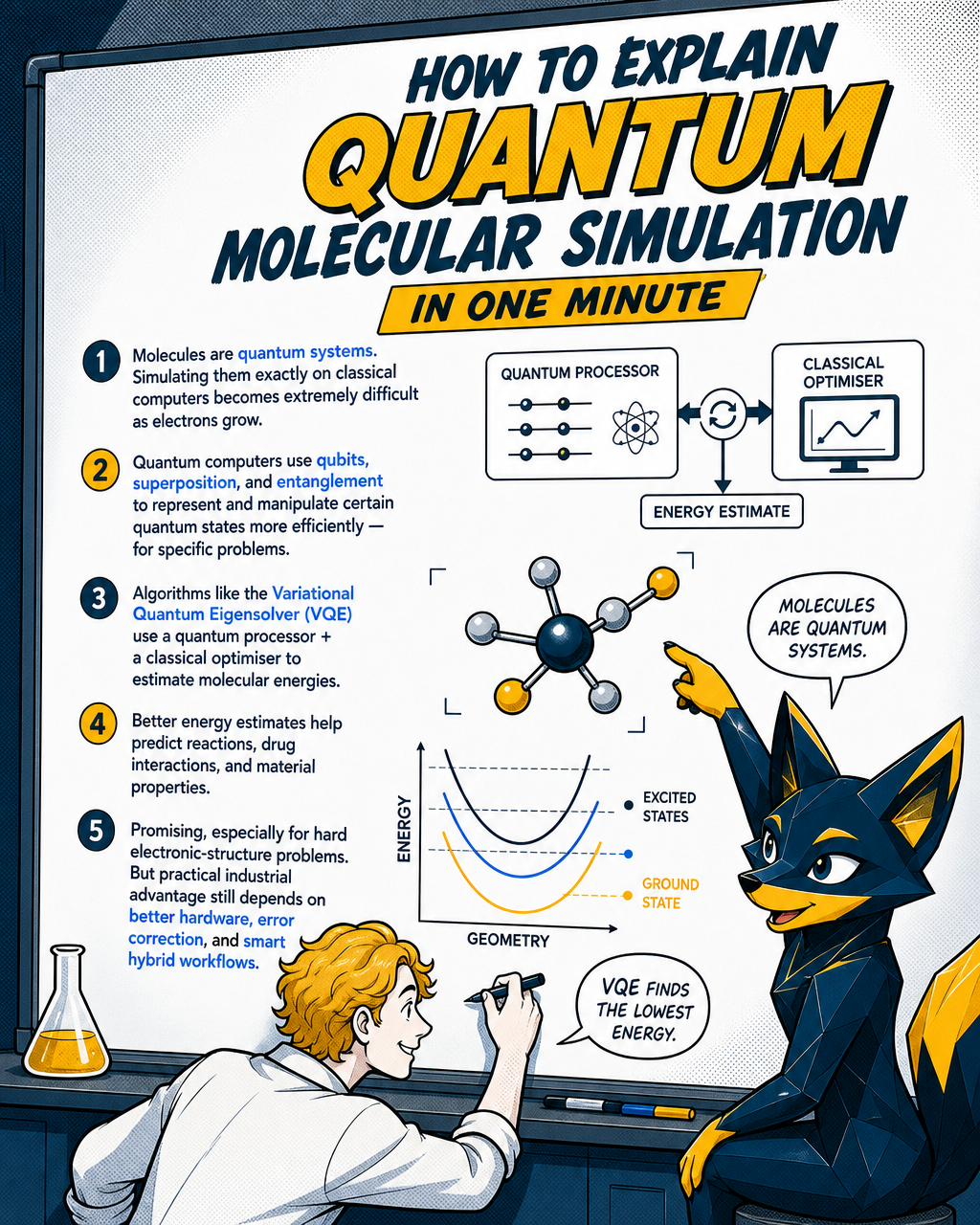
How to explain quantum molecular simulation in one minute
If you need the boardroom version, use this:
Molecules are quantum systems, so simulating them exactly on classical computers becomes extremely difficult as the number of interacting electrons grows. Quantum computers use qubits, superposition, and entanglement to represent and manipulate certain quantum states in ways that may be more tractable than classical methods for specific problem types. Algorithms such as the Variational Quantum Eigensolver use a quantum processor and a classical optimiser together to estimate molecular energies, though the practical advantage of such hybrid methods over classical approaches on current hardware remains an active area of research. Better energy estimates can help predict chemical reactions, drug interactions, and material properties. The technology is promising, especially for hard electronic-structure problems, but practical industrial advantage still depends on better hardware, error correction, and careful hybrid workflows.
That's the story. No fog. No miracle claims.
What to watch next
For the next few years, the most important signals won't be glossy quantum announcements.
Watch for evidence that quantum simulation improves a real workflow.
Good signs include:
- A clear classical benchmark.
- A specific molecular or material problem.
- Evidence of better accuracy, speed, or decision quality.
- Integration with existing computational chemistry tools.
- Transparent discussion of hardware noise and error mitigation.
- Results that help select or reject lab experiments.
Weak signs include:
- Claims of general quantum advantage with no benchmark.
- Beautiful diagrams with no chemical target.
- "AI plus quantum" language that never says what was calculated.
- No explanation of why classical methods weren't enough.
The bottom line
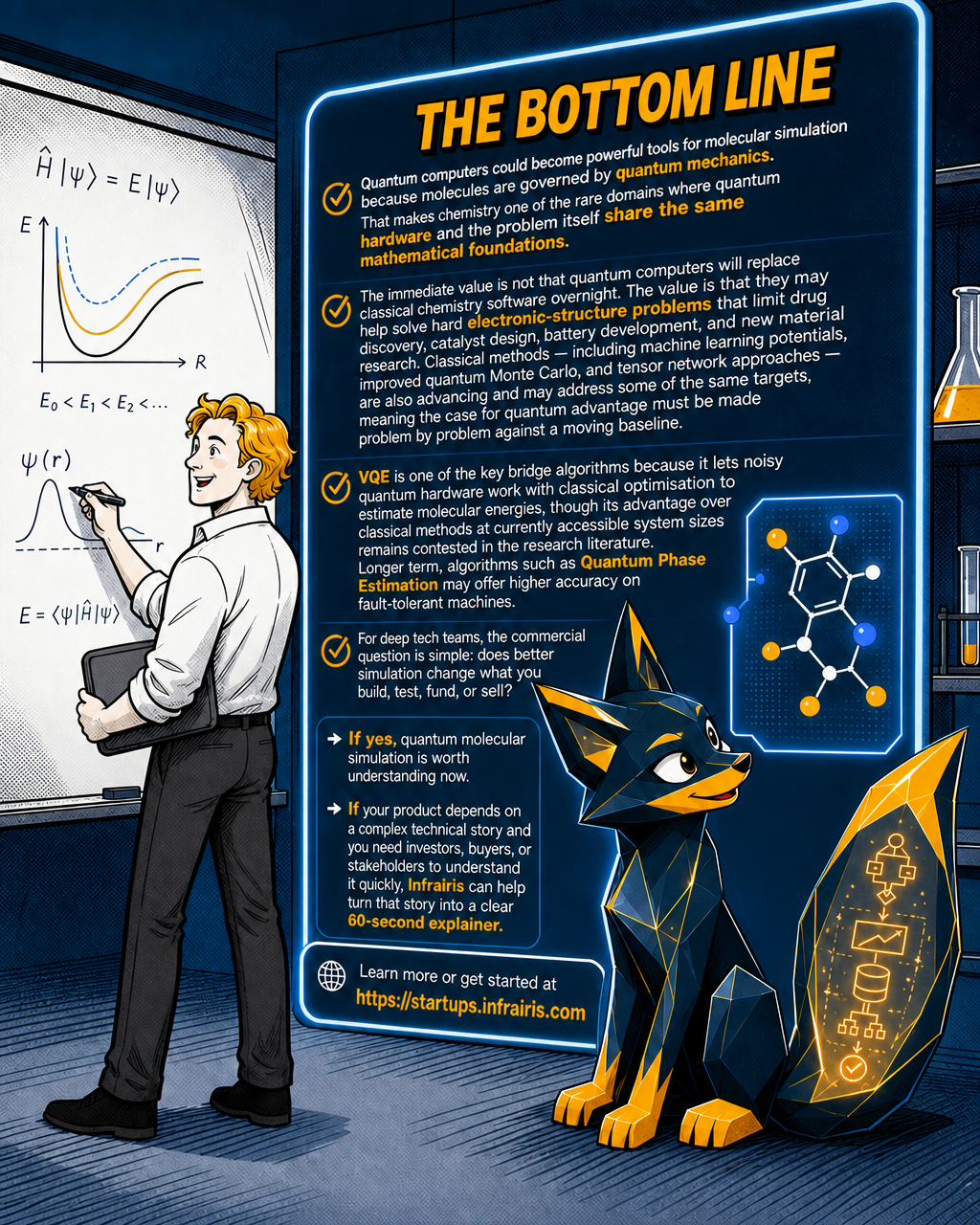
Quantum computers could become powerful tools for molecular simulation because molecules are governed by quantum mechanics. That makes chemistry one of the rare domains where quantum hardware and the problem itself share the same mathematical foundations.
The immediate value is not that quantum computers will replace classical chemistry software overnight. The value is that they may help solve hard electronic-structure problems that limit drug discovery, catalyst design, battery development, and new material research. Classical methods — including machine learning potentials, improved quantum Monte Carlo, and tensor network approaches — are also advancing and may address some of the same targets, meaning the case for quantum advantage must be made problem by problem against a moving baseline.
VQE is one of the key bridge algorithms because it lets noisy quantum hardware work with classical optimisation to estimate molecular energies, though its advantage over classical methods at currently accessible system sizes remains contested in the research literature. Longer term, algorithms such as Quantum Phase Estimation may offer higher accuracy on fault-tolerant machines.
For deep tech teams, the commercial question is simple: does better simulation change what you build, test, fund, or sell?
If yes, quantum molecular simulation is worth understanding now.
If your product depends on a complex technical story and you need investors, buyers, or stakeholders to understand it quickly, Infrairis can help turn that story into a clear 60-second explainer.
Learn more or get started at https://startups.infrairis.com.

Infrairis
Your complex product. In 60 seconds. Clearly.
Your complex product. In 60 seconds. Clearly.
Learn more about Infrairis and get started today.
Visit Infrairis