10 Communication Pains That Explainer Videos Solve






Why so many messages fail before they land
Most communication problems aren't problems of effort. People write thorough documentation, run detailed onboarding sessions, and field the same questions again and again. The effort is there. What's missing is a format that works with how people actually process and retain information. Explainer videos fill that gap in ways text rarely can.
Here are ten specific pains that a well-crafted explainer video addresses, and the reasons why each one responds so well to this format.
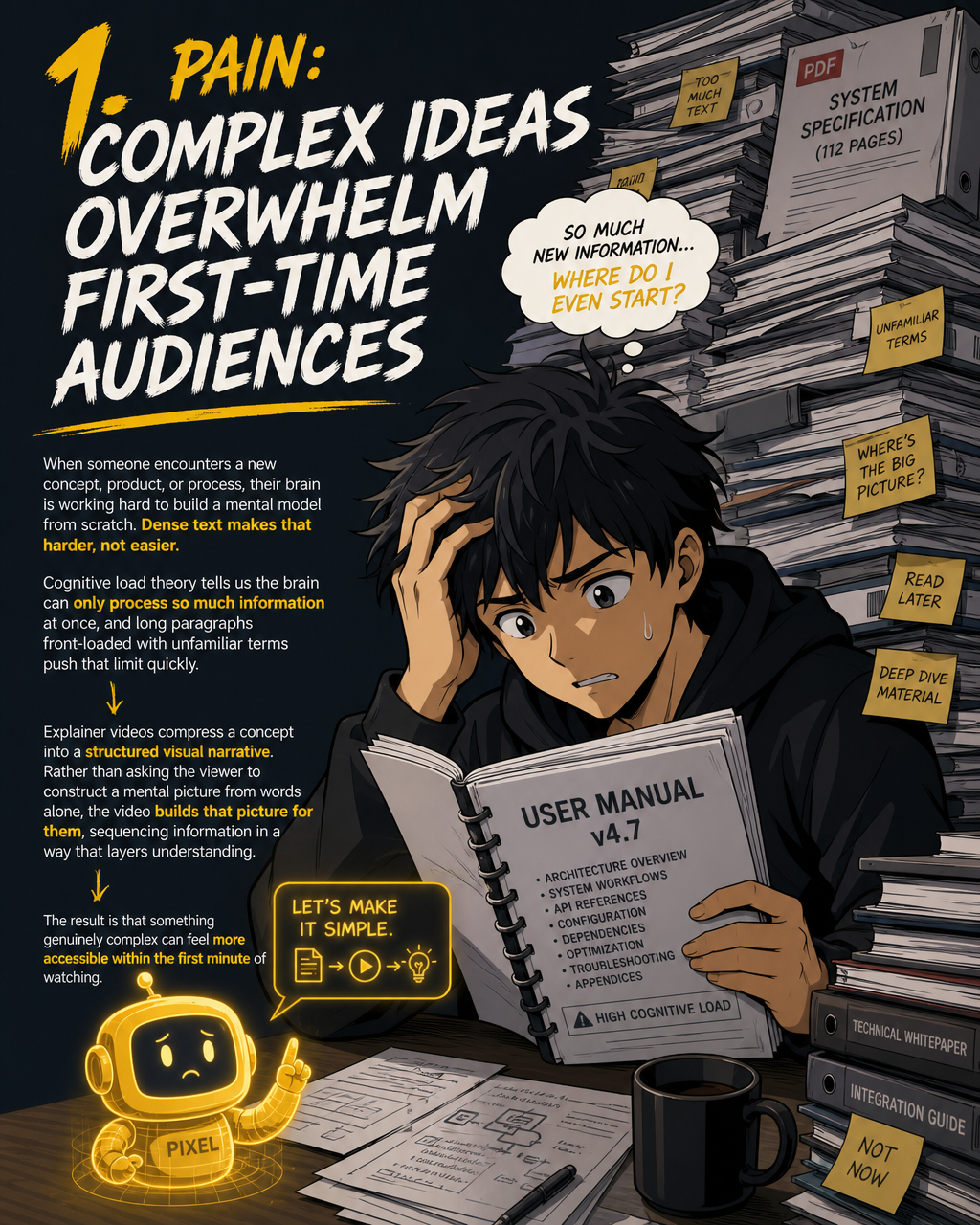
1. Pain: Complex ideas overwhelm first-time audiences
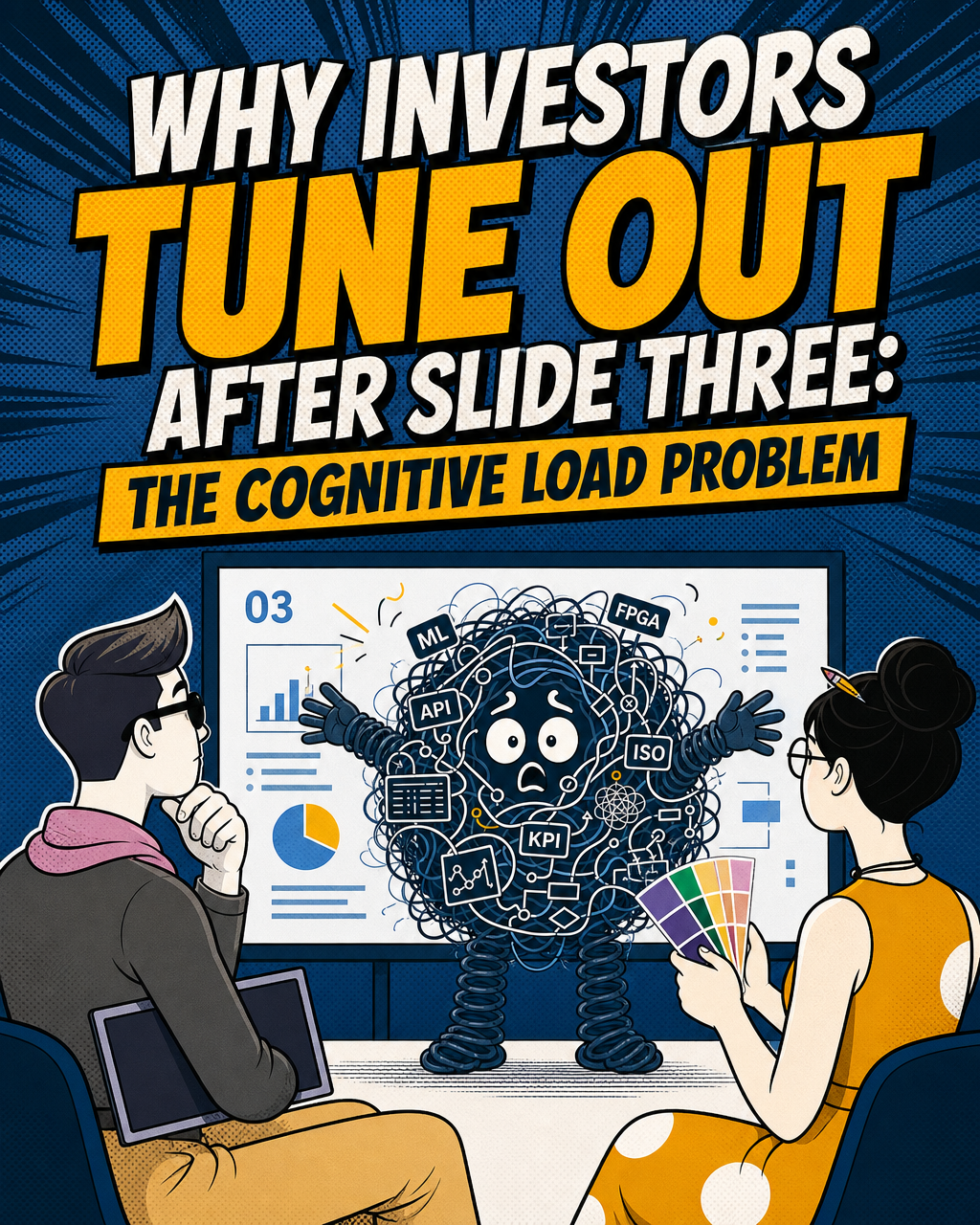
When someone encounters a new concept, product, or process, their brain is working hard to build a mental model from scratch. Dense text makes that harder, not easier. Cognitive load theory tells us the brain can only process so much information at once, and long paragraphs front-loaded with unfamiliar terms push that limit quickly.
Explainer videos compress a concept into a structured visual narrative. Rather than asking the viewer to construct a mental picture from words alone, the video builds that picture for them, sequencing information in a way that layers understanding. The result is that something genuinely complex can feel more accessible within the first minute of watching.
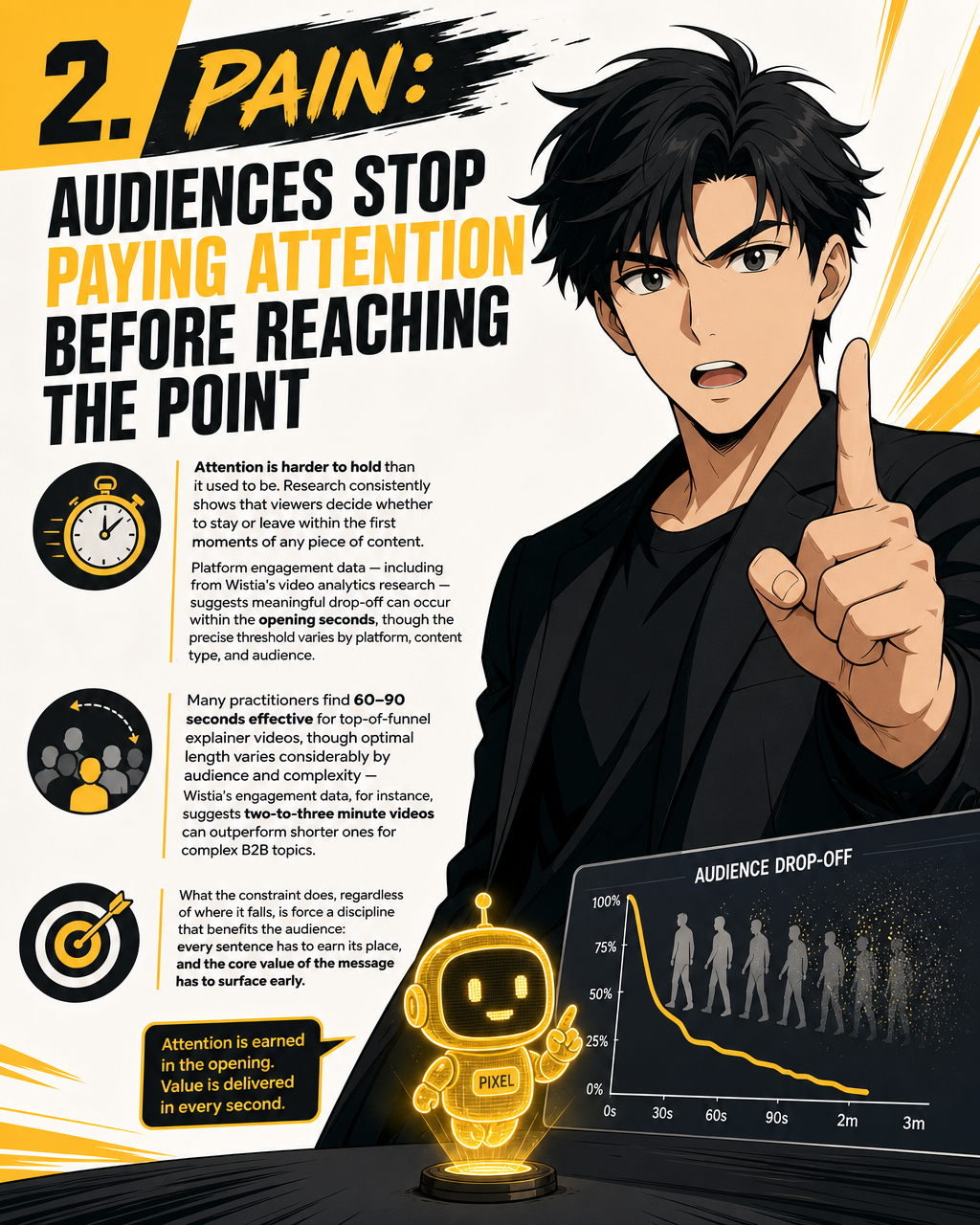
2. Pain: Audiences stop paying attention before reaching the point
Attention is harder to hold than it used to be. Research consistently shows that viewers decide whether to stay or leave within the first moments of any piece of content. Platform engagement data — including from Wistia's video analytics research — suggests meaningful drop-off can occur within the opening seconds, though the precise threshold varies by platform, content type, and audience.
Many practitioners find 60–90 seconds effective for top-of-funnel explainer videos, though optimal length varies considerably by audience and complexity — Wistia's engagement data, for instance, suggests two-to-three minute videos can outperform shorter ones for complex B2B topics. What the constraint does, regardless of where it falls, is force a discipline that benefits the audience: every sentence has to earn its place, and the core value of the message has to surface early.
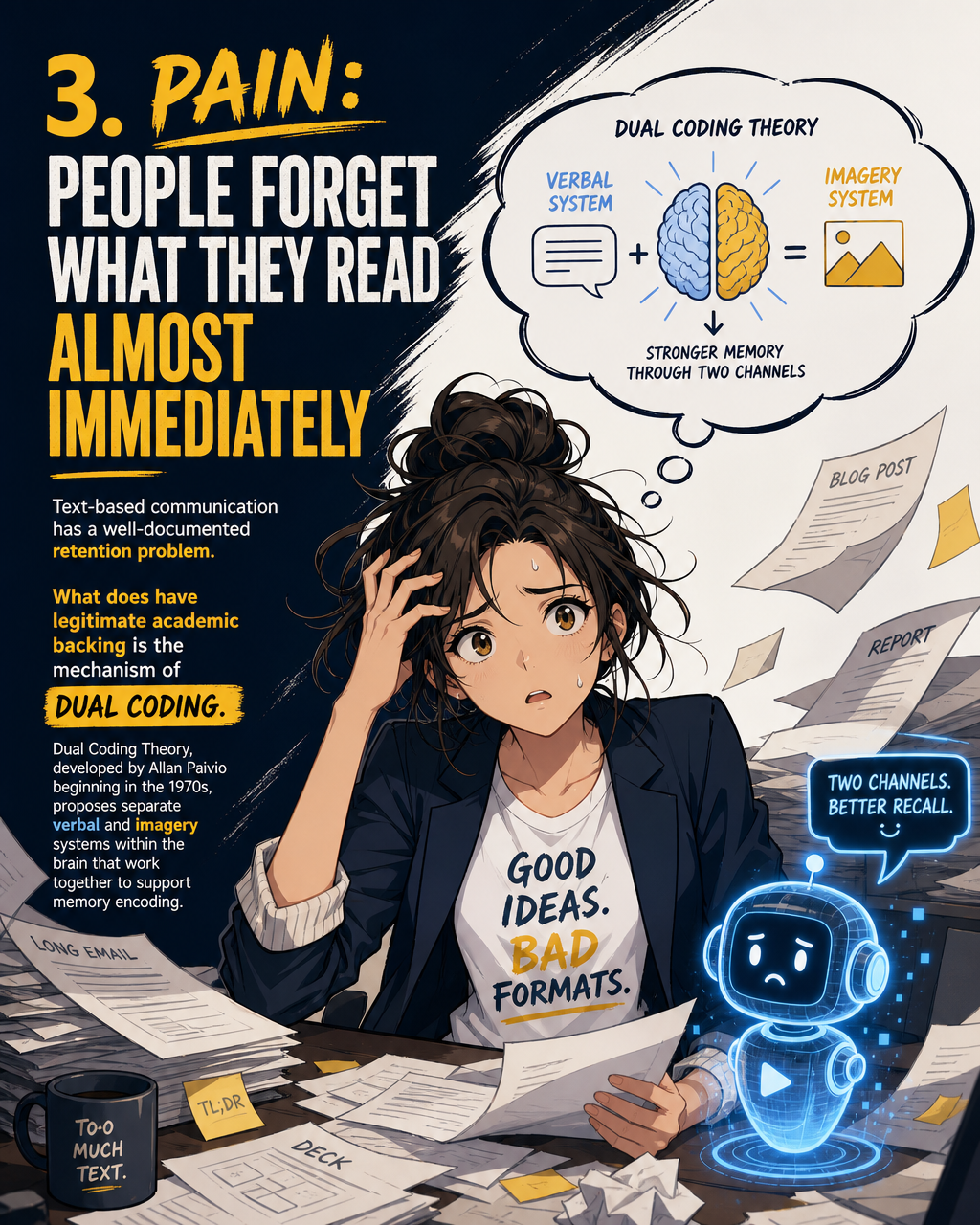
3. Pain: People forget what they read almost immediately
Text-based communication has a well-documented retention problem. Claims about precise retention percentages for video versus text are widespread in marketing literature but often lack credible peer-reviewed support, and should be treated with caution. What does have legitimate academic backing is the mechanism of dual coding.
Dual Coding Theory, developed by Allan Paivio beginning in the 1970s, proposes separate verbal and imagery systems within the brain that work together to support memory encoding. This provides a theoretical framework that may help explain why pairing audio narration with relevant visuals could aid comprehension and recall — though direct application to video retention specifically requires its own empirical support beyond the original theory. An explainer that gives the brain two separate channels to engage with the same message is, in principle, working with cognitive architecture rather than against it.
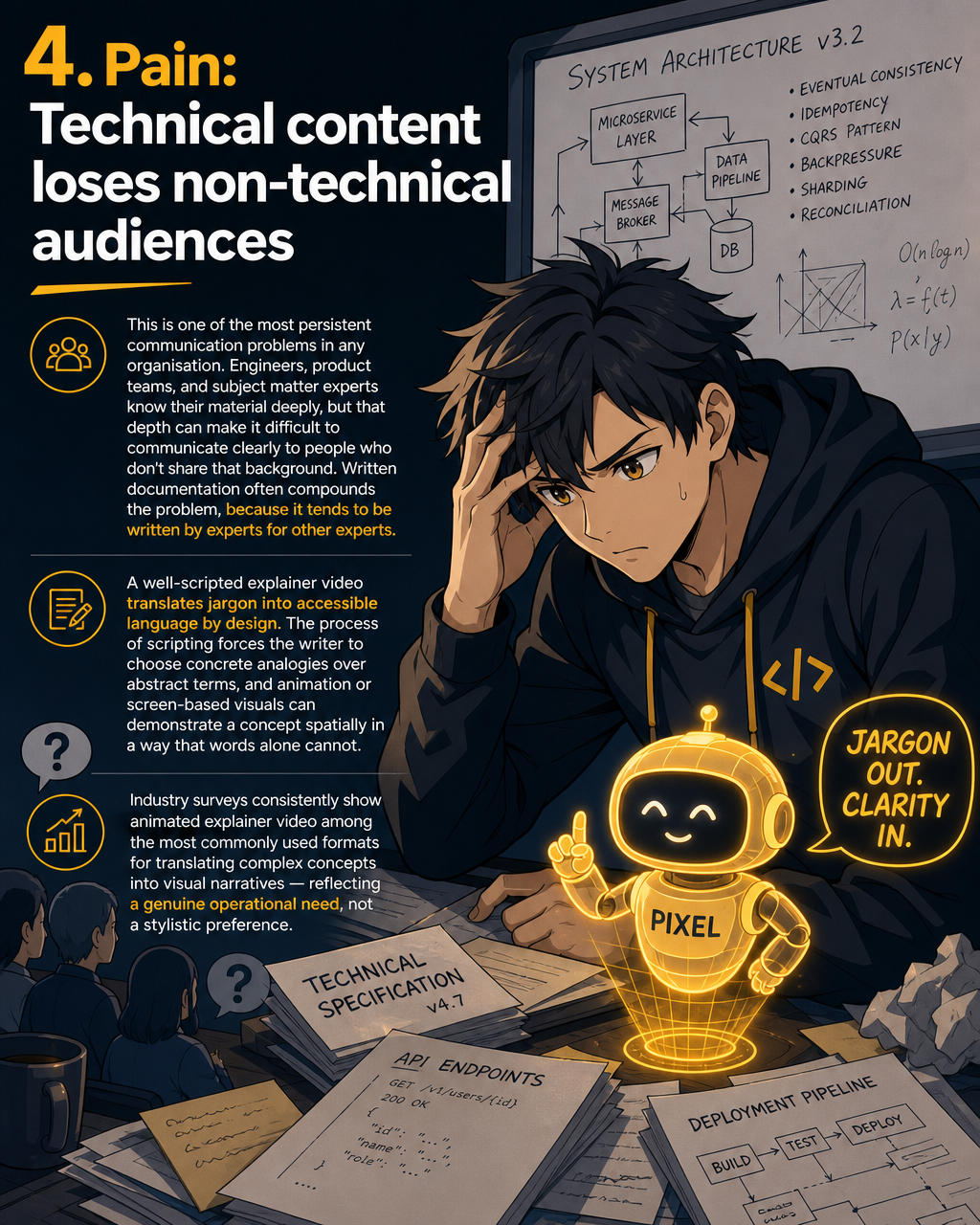
4. Pain: Technical content loses non-technical audiences
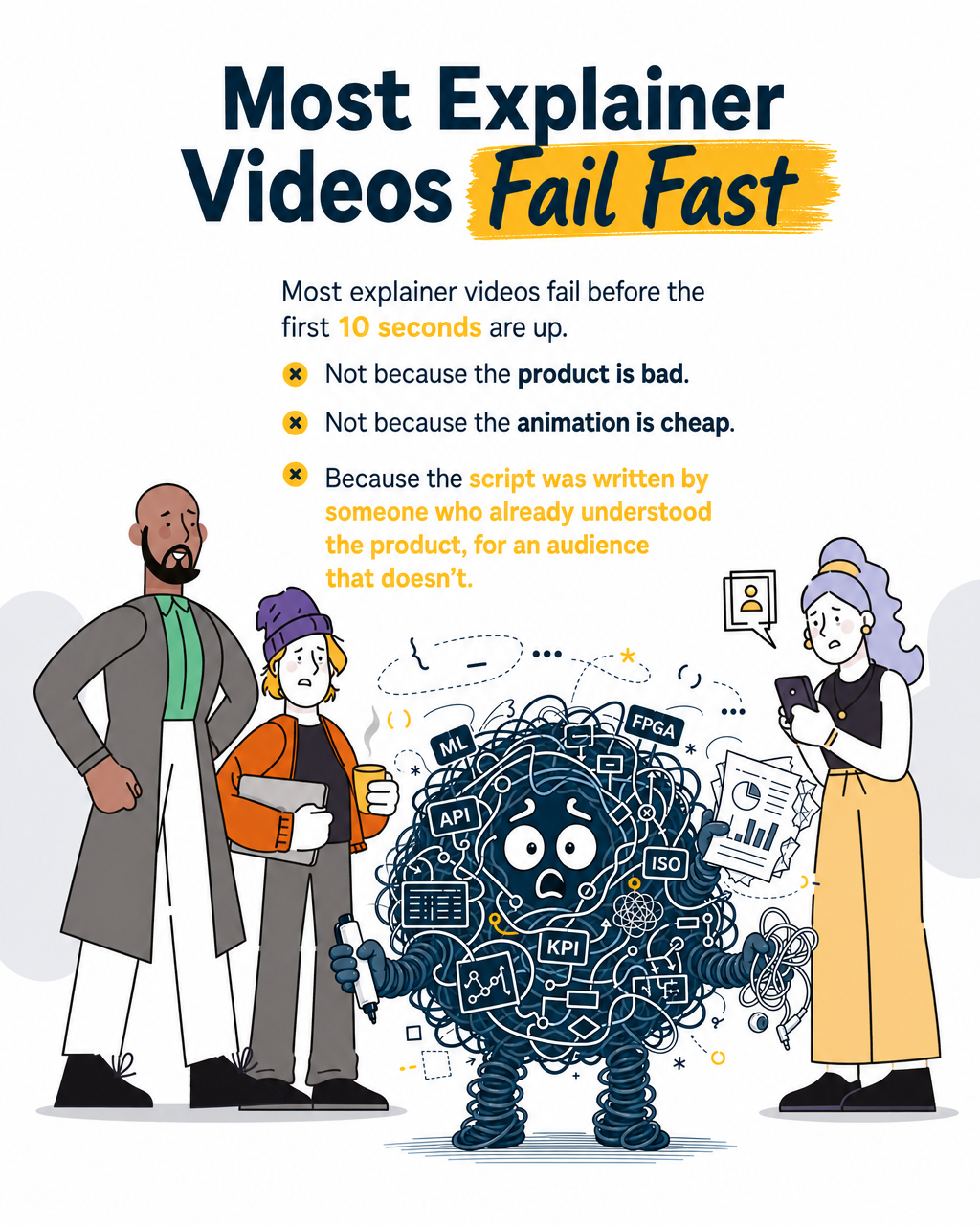
This is one of the most persistent communication problems in any organisation. Engineers, product teams, and subject matter experts know their material deeply, but that depth can make it difficult to communicate clearly to people who don't share that background. Written documentation often compounds the problem, because it tends to be written by experts for other experts.
A well-scripted explainer video translates jargon into accessible language by design. The process of scripting forces the writer to choose concrete analogies over abstract terms, and animation or screen-based visuals can demonstrate a concept spatially in a way that words alone cannot. Industry surveys consistently show animated explainer video among the most commonly used formats for translating complex concepts into visual narratives — reflecting a genuine operational need, not a stylistic preference.
5. Pain: Support teams answer the same questions repeatedly
Every support team has a mental list of the questions that come in every single week. Most of those questions are answerable. The problem isn't the complexity; it's the absence of a clear, findable explanation that the user can access without opening a ticket.
High-quality onboarding and FAQ videos can reduce repetitive tickets by providing customers with visual answers they can follow independently, freeing support teams to focus on more complex issues. Industry surveys of video practitioners — including Wistia's State of Video reports — consistently find that a majority of respondents report video has helped reduce support queries, though it is worth noting that self-selected video practitioners are a group likely to report positive outcomes.
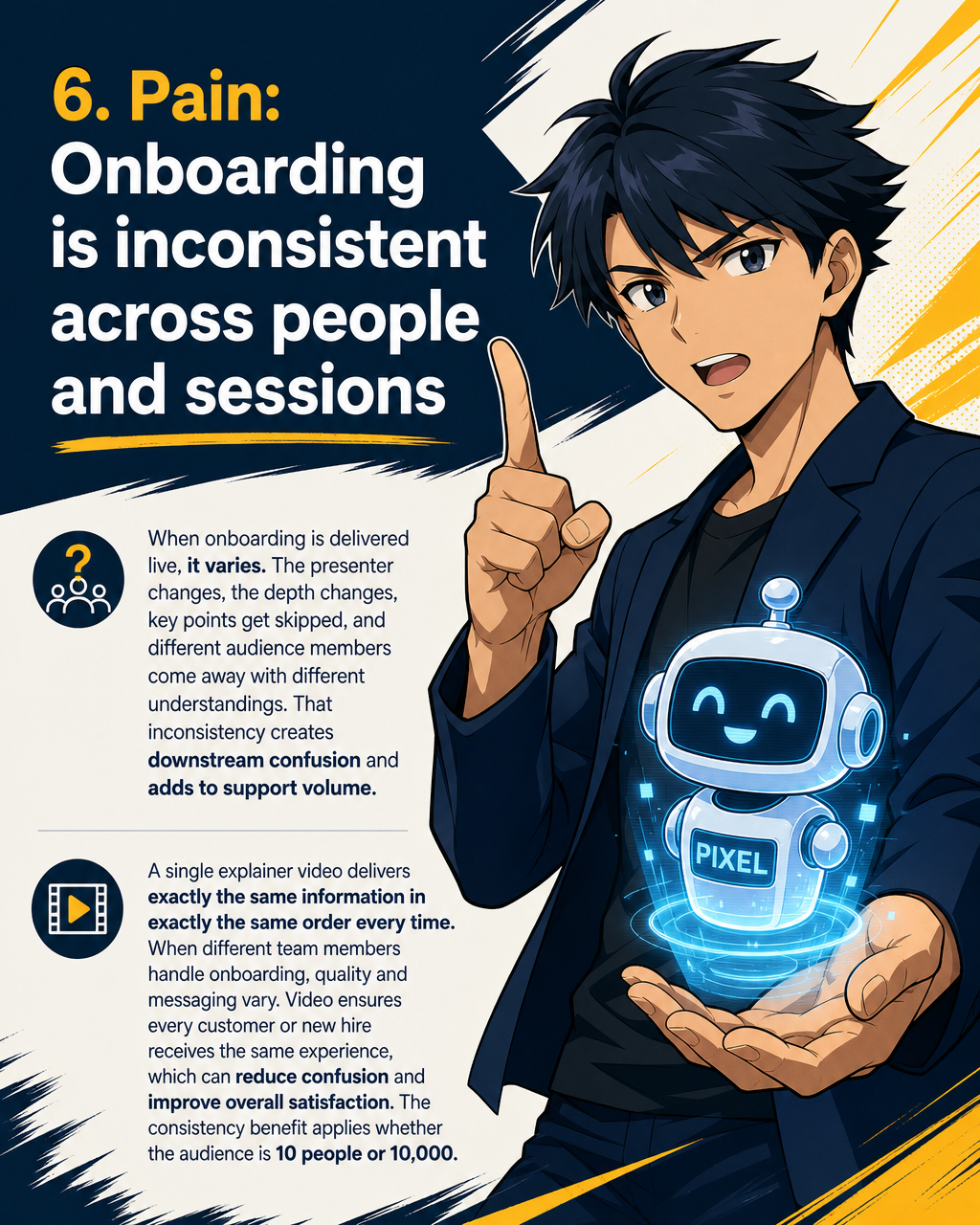
6. Pain: Onboarding is inconsistent across people and sessions
When onboarding is delivered live, it varies. The presenter changes, the depth changes, key points get skipped, and different audience members come away with different understandings. That inconsistency creates downstream confusion and adds to support volume.
A single explainer video delivers exactly the same information in exactly the same order every time. When different team members handle onboarding, quality and messaging vary. Video ensures every customer or new hire receives the same experience, which can reduce confusion and improve overall satisfaction. The consistency benefit applies whether the audience is 10 people or 10,000.
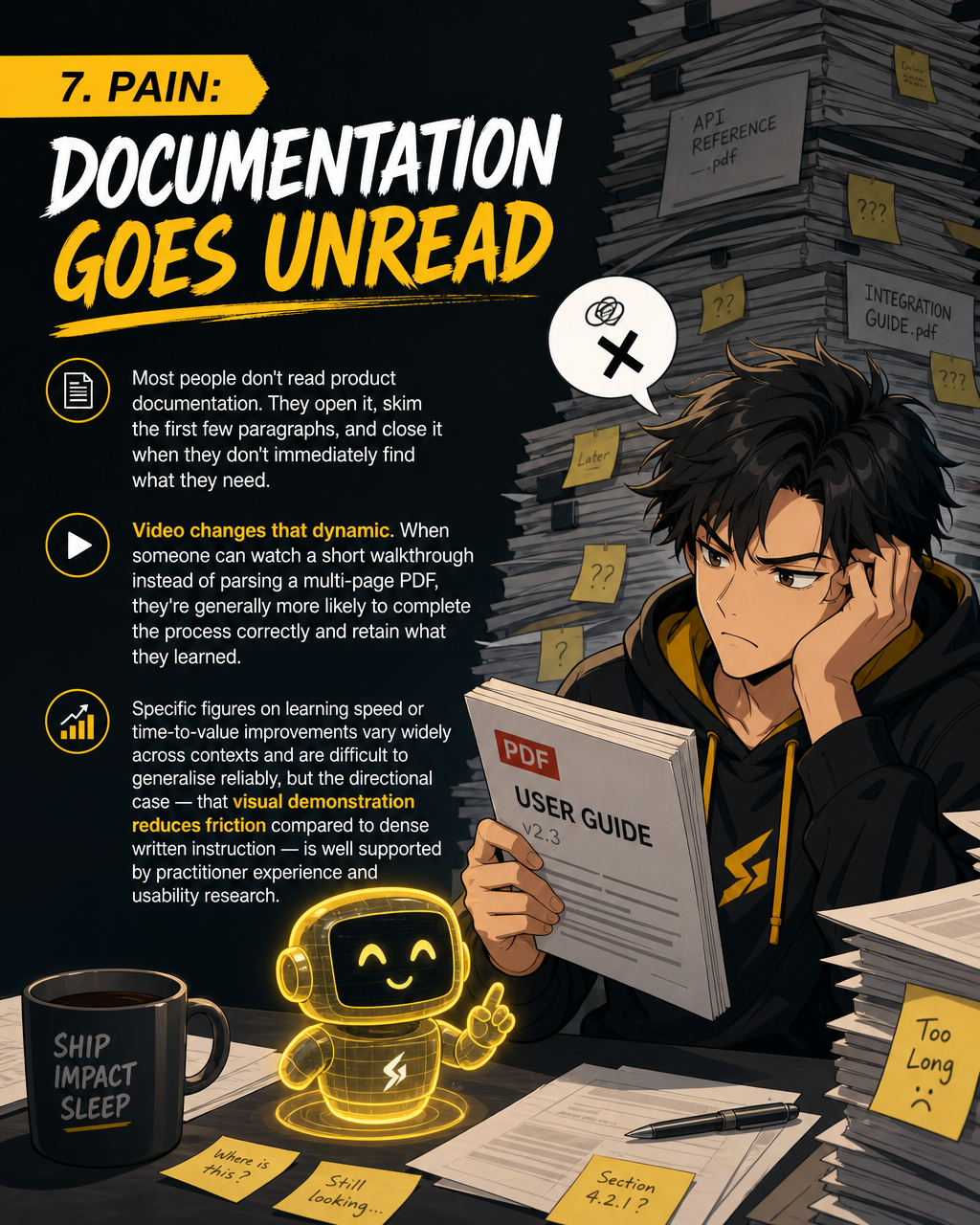
7. Pain: Documentation goes unread
Most people don't read product documentation. They open it, skim the first few paragraphs, and close it when they don't immediately find what they need.
Video changes that dynamic. When someone can watch a short walkthrough instead of parsing a multi-page PDF, they're generally more likely to complete the process correctly and retain what they learned. Specific figures on learning speed or time-to-value improvements vary widely across contexts and are difficult to generalise reliably, but the directional case — that visual demonstration reduces friction compared to dense written instruction — is well supported by practitioner experience and usability research.
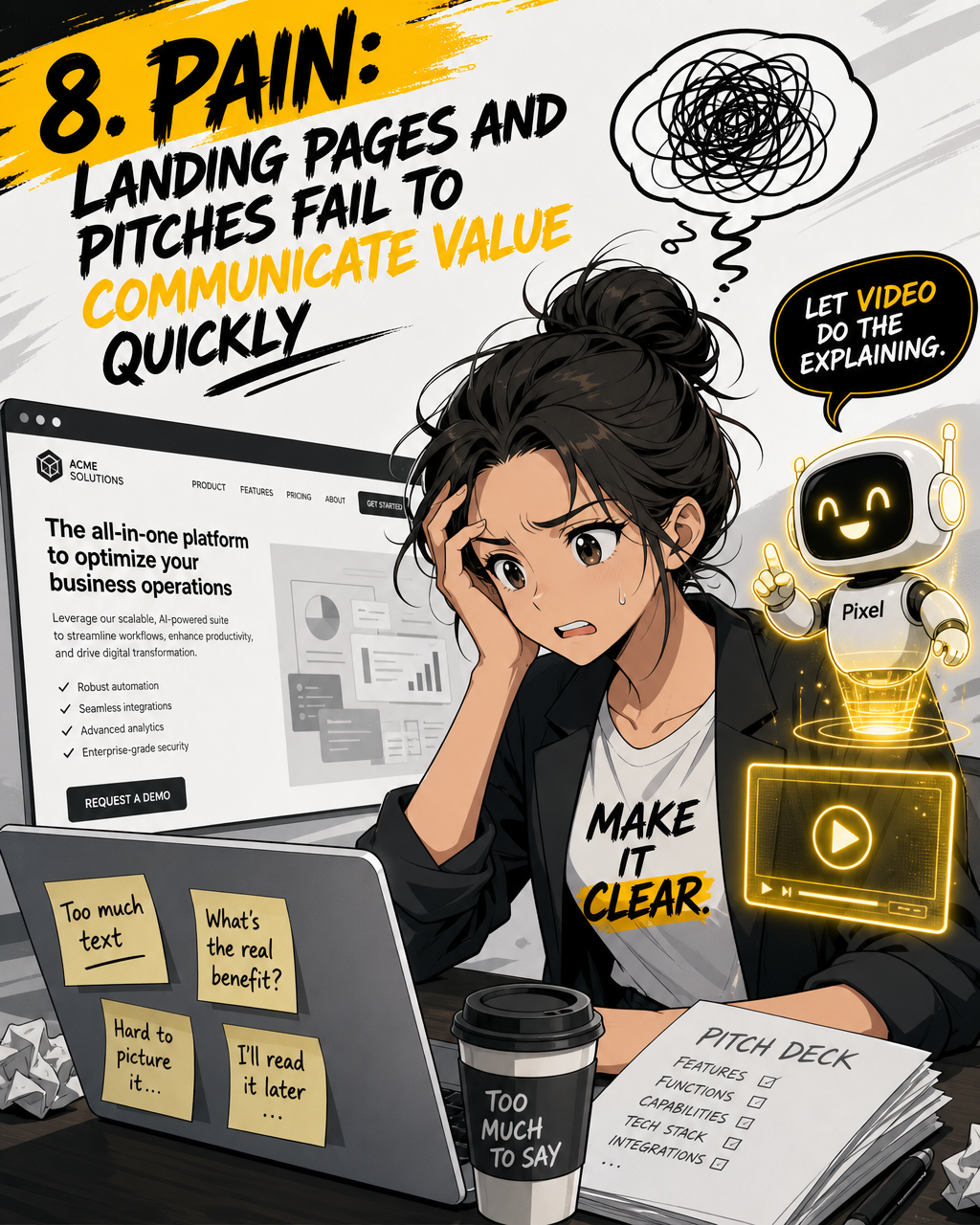
8. Pain: Landing pages and pitches fail to communicate value quickly
A written value proposition asks the reader to do significant cognitive work. They need to parse the language, extract the benefit, and build a mental picture of what the product or service actually does. That process has friction, and friction loses people.
Research and practitioner case studies consistently suggest that embedding video on landing pages can improve conversion rates, with the effect generally reported as strongest for complex products and services where video reduces cognitive load. The precise uplift varies considerably by industry, product, page design, and audience — reported figures in marketing literature range widely and often reflect specific contexts rather than universal benchmarks. The underlying reason is consistent: a short explainer video does the interpretive work on the viewer's behalf, showing the problem, presenting the solution, and making the benefit concrete before the viewer has to engage their own reading effort.
9. Pain: Audiences prefer self-service but can't find answers easily
Most users would rather find an answer on their own than raise a ticket or send an email. The barrier isn't willingness; it's discoverability and format. A text-heavy FAQ page requires reading and scanning, which takes time and often still leaves questions unanswered.
Surveys of user preferences — including from Wyzowl's annual State of Video Marketing reports — consistently find a strong majority of respondents say they prefer watching a video to solve a product problem rather than contacting support. It is worth noting these figures reflect self-reported preferences, which may not always match actual behaviour, and the samples tend to skew toward digitally engaged users. That said, the directional finding is consistent across multiple years of data: a library of short explainer videos, clearly titled and easy to find, lets users self-serve successfully. They get an answer they can follow step by step, at their own pace, at any time of day.
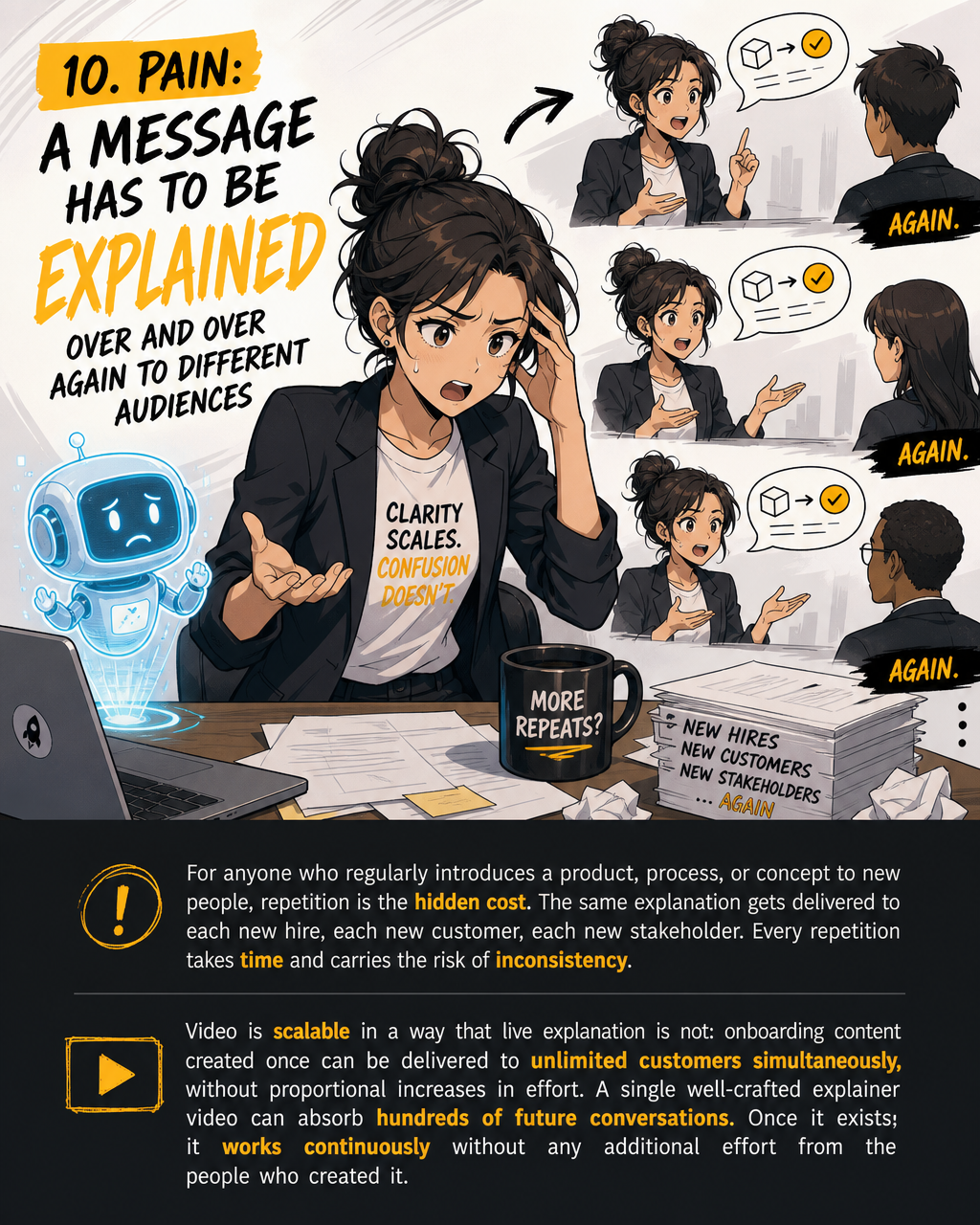
10. Pain: A message has to be explained over and over again to different audiences
For anyone who regularly introduces a product, process, or concept to new people, repetition is the hidden cost. The same explanation gets delivered to each new hire, each new customer, each new stakeholder. Every repetition takes time and carries the risk of inconsistency.
Video is scalable in a way that live explanation is not: onboarding content created once can be delivered to unlimited customers simultaneously, without proportional increases in effort. A single well-crafted explainer video can absorb hundreds of future conversations. Once it exists, it works continuously without any additional effort from the people who created it.
The format reflects the problem it's solving
Explainer videos aren't effective simply because video is popular. They work because the format itself is well-suited to the specific nature of communication problems: limited attention, limited retention, limited patience for complexity, and limited time on both sides of a conversation.
Clarity is consistently cited in viewer research as one of the most important factors in sustained engagement — the precise figures vary by study, but the finding is directionally stable across multiple sources. That's what a good explainer video delivers: a clear message, structured deliberately, delivered in a format the audience actually wants to consume. The ten pains above are each, at their core, a clarity problem. And explainer video, done well, is a clarity solution.

Infrairis
Your complex product. In 60 seconds. Clearly.
Your complex product. In 60 seconds. Clearly.
Learn more about Infrairis and get started today.
Visit Infrairis