Quantum Computing Explained: What It Actually Does and Why It Matters



Quantum computing has spent years as the technology that is always "just five years away." In 2026, that story is changing. Real quantum machines are running, industrial pilots are launching, and the conversation has quietly shifted from "if" to "which problems, and when." But most people still can't explain what a quantum computer actually does differently from the laptop on their desk.
This article fixes that. No physics degree required.
The classical bit: small, reliable, stubborn
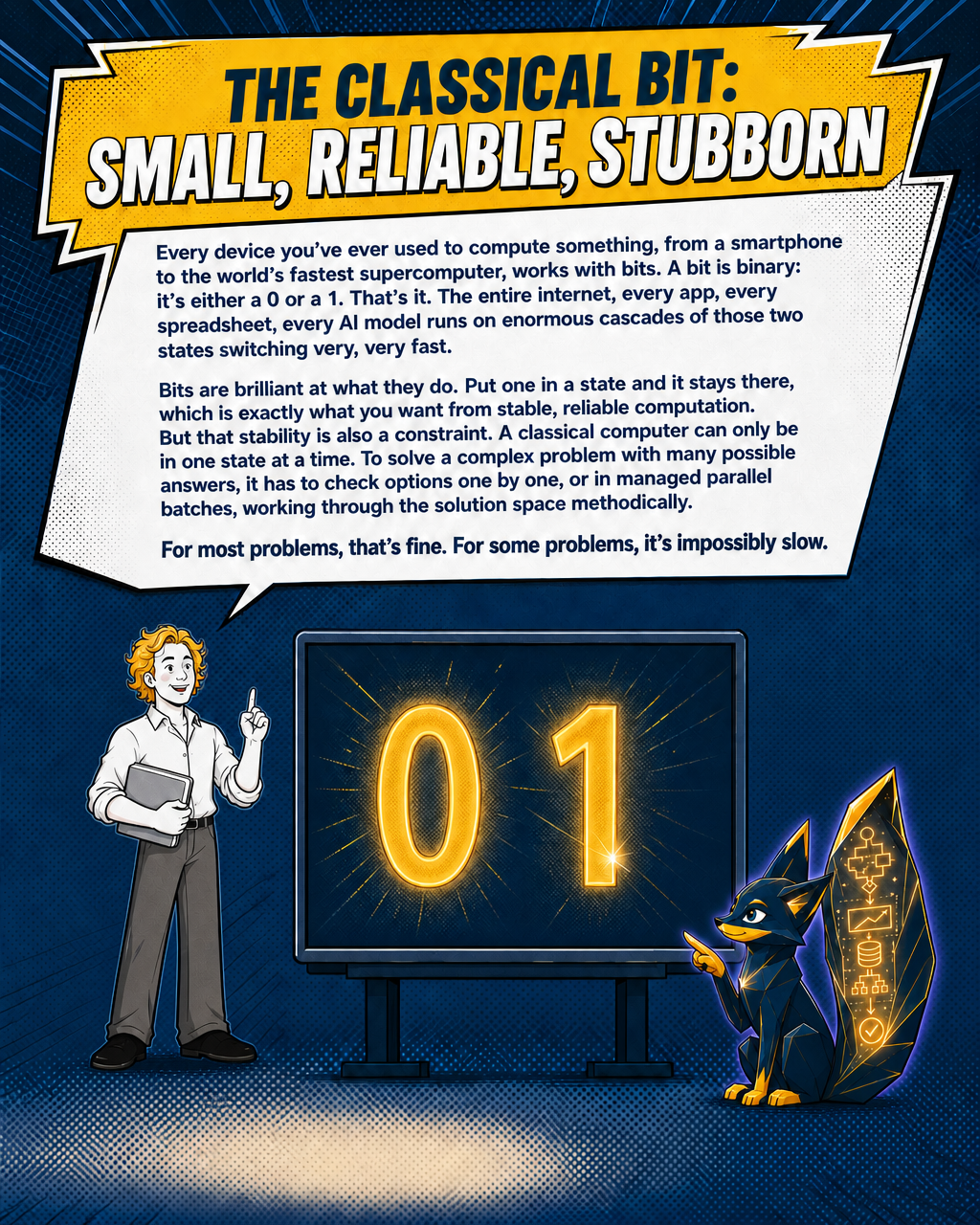
Every device you've ever used to compute something, from a smartphone to the world's fastest supercomputer, works with bits. A bit is binary: it's either a 0 or a 1. That's it. The entire internet, every app, every spreadsheet, every AI model runs on enormous cascades of those two states switching very, very fast.
Bits are brilliant at what they do. Put one in a state and it stays there, which is exactly what you want from stable, reliable computation. But that stability is also a constraint. A classical computer can only be in one state at a time. To solve a complex problem with many possible answers, it has to check options one by one, or in managed parallel batches, working through the solution space methodically.
For most problems, that's fine. For some problems, it's impossibly slow.
Qubits: the switch that isn't
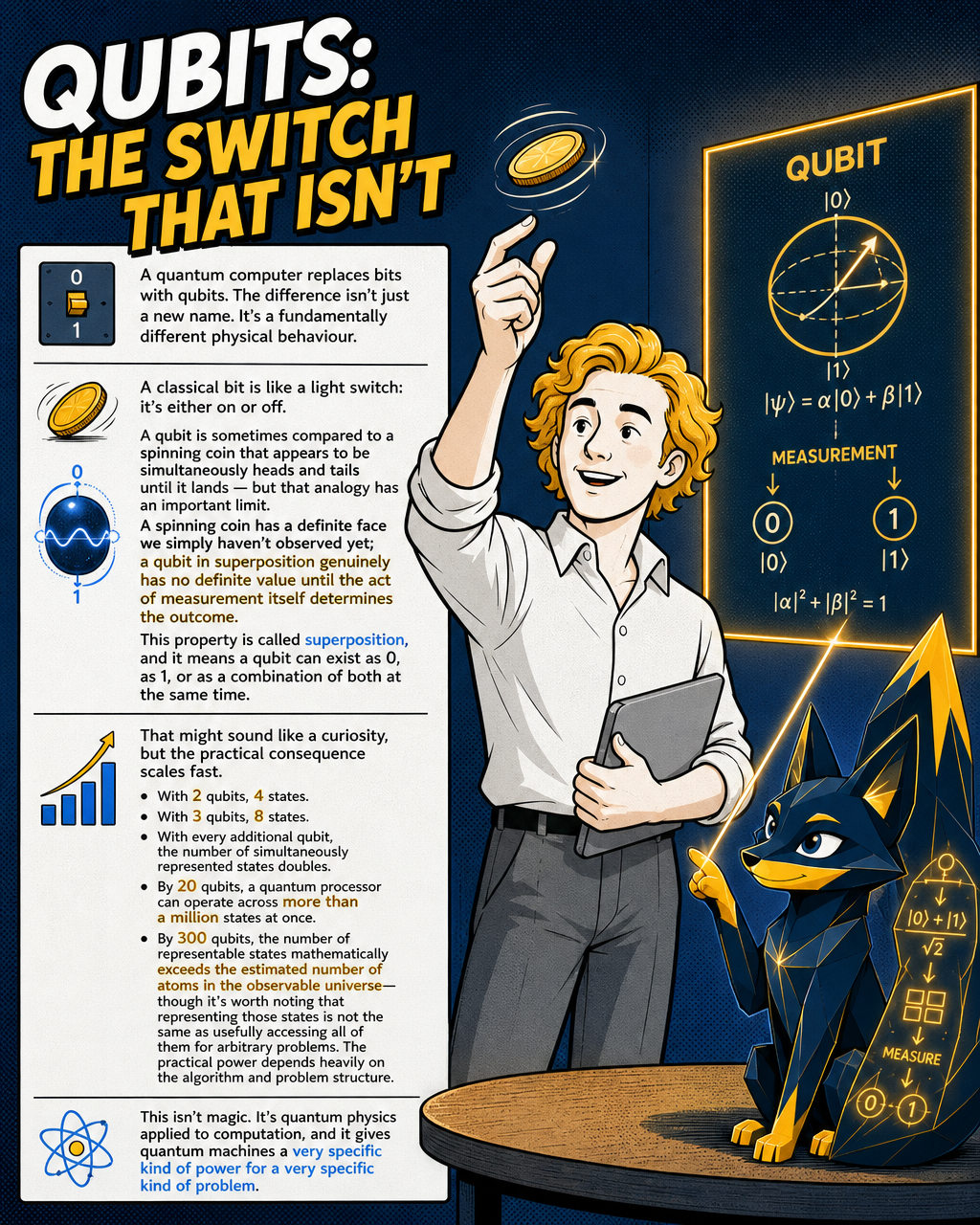
A quantum computer replaces bits with qubits. The difference isn't just a new name. It's a fundamentally different physical behaviour.
A classical bit is like a light switch: it's either on or off. A qubit is sometimes compared to a spinning coin that appears to be simultaneously heads and tails until it lands — but that analogy has an important limit. A spinning coin has a definite face we simply haven't observed yet; a qubit in superposition genuinely has no definite value until the act of measurement itself determines the outcome. This property is called superposition, and it means a qubit can exist as 0, as 1, or as a combination of both at the same time.
That might sound like a curiosity, but the practical consequence scales fast. With two qubits, a quantum computer can represent four states simultaneously. With three qubits, eight states. With every additional qubit, the number of simultaneously represented states doubles. By 20 qubits, a quantum processor can operate across more than a million states at once. By 300 qubits, the number of representable states mathematically exceeds the estimated number of atoms in the observable universe — though it's worth noting that representing those states is not the same as usefully accessing all of them for arbitrary problems. The practical power depends heavily on the algorithm and problem structure.
This isn't magic. It's quantum physics applied to computation, and it gives quantum machines a very specific kind of power for a very specific kind of problem.
Entanglement: qubits that think together
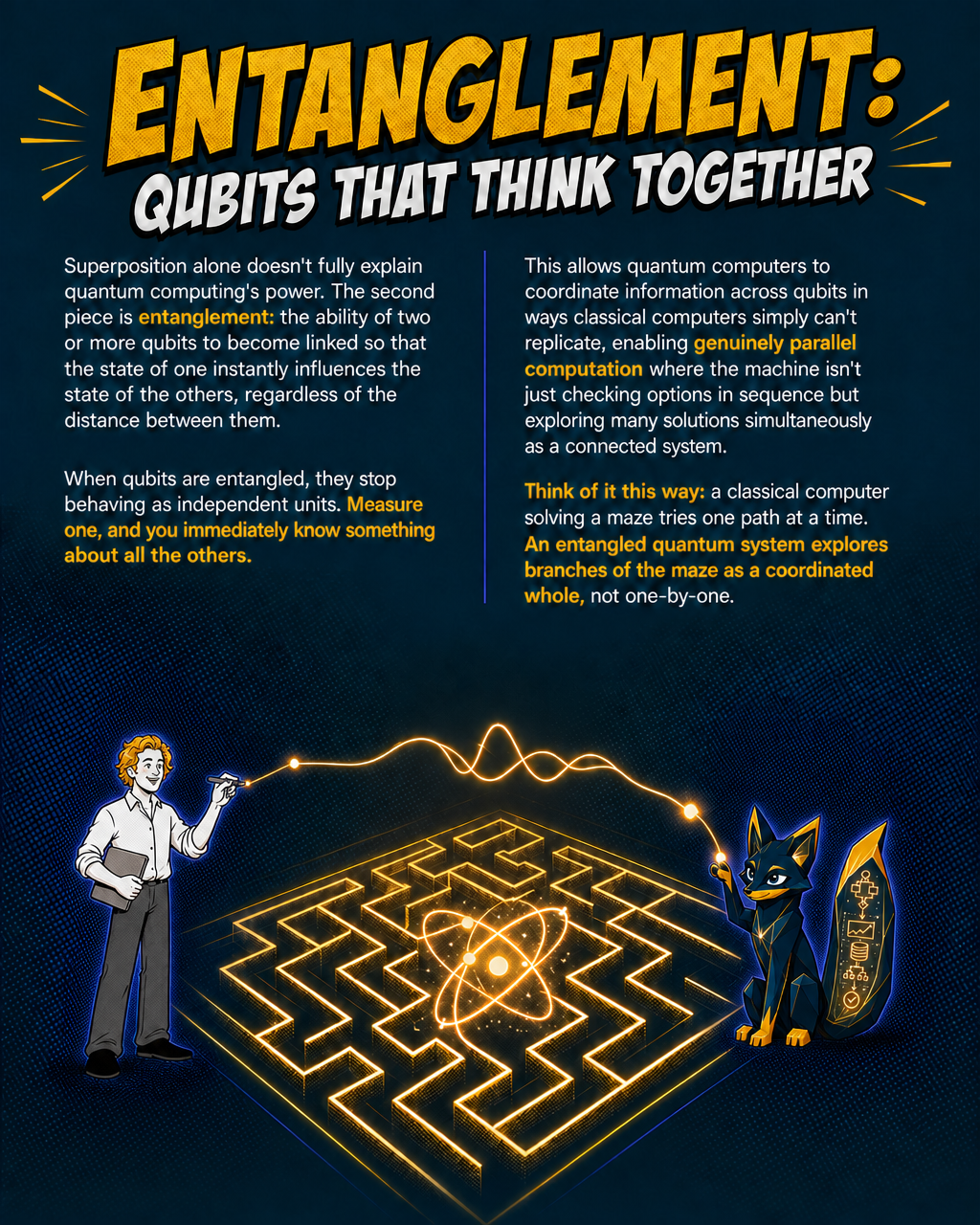
Superposition alone doesn't fully explain quantum computing's power. The second piece is entanglement: the ability of two or more qubits to become linked so that the state of one instantly influences the state of the others, regardless of the distance between them.
When qubits are entangled, they stop behaving as independent units. Measure one, and you immediately know something about all the others. This allows quantum computers to coordinate information across qubits in ways classical computers simply can't replicate, enabling genuinely parallel computation where the machine isn't just checking options in sequence but exploring many solutions simultaneously as a connected system.
Think of it this way: a classical computer solving a maze tries one path at a time. An entangled quantum system explores branches of the maze as a coordinated whole, not one-by-one.
Interference: filtering toward the right answer
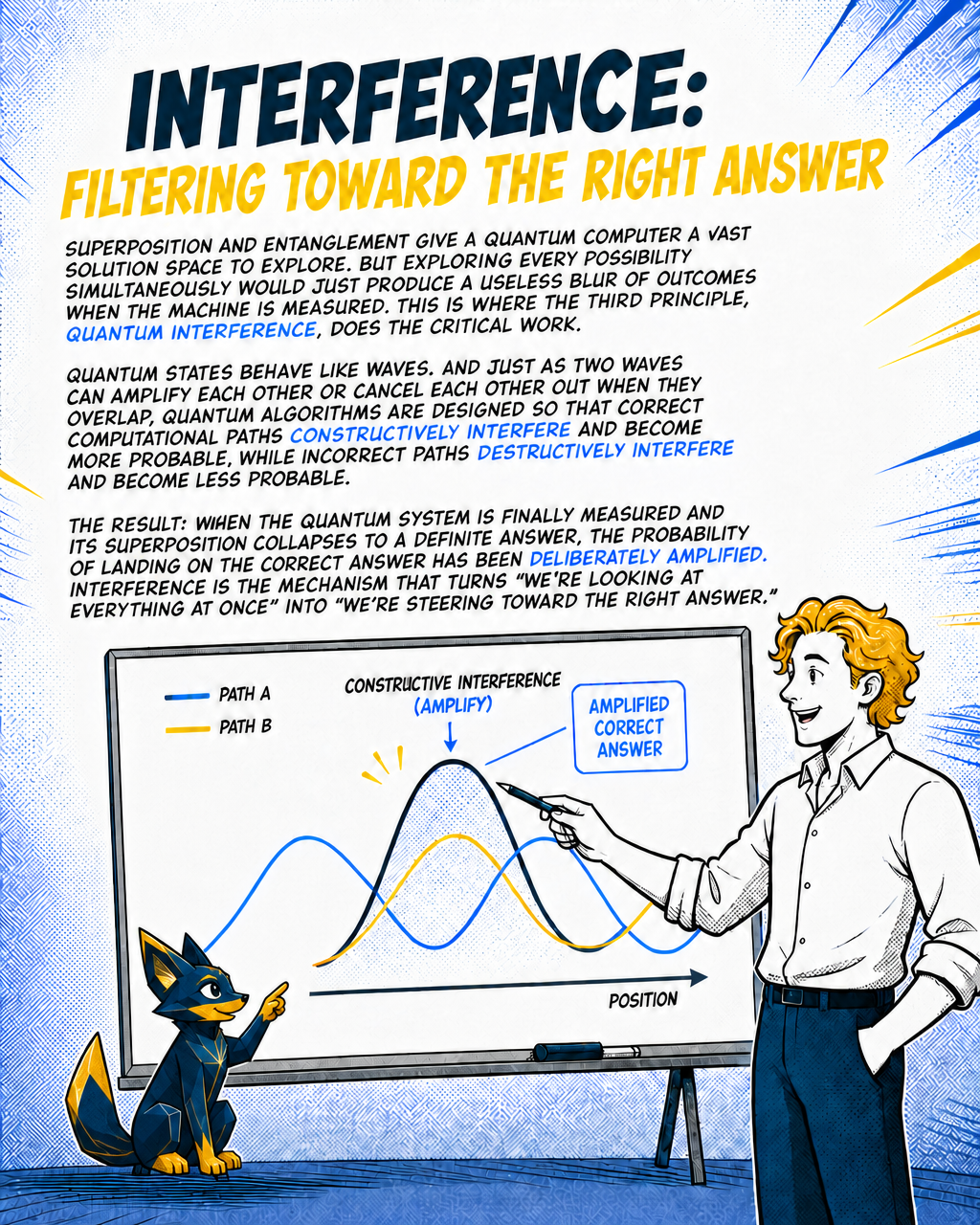
Superposition and entanglement give a quantum computer a vast solution space to explore. But exploring every possibility simultaneously would just produce a useless blur of outcomes when the machine is measured. This is where the third principle, quantum interference, does the critical work.
Quantum states behave like waves. And just as two waves can amplify each other or cancel each other out when they overlap, quantum algorithms are designed so that correct computational paths constructively interfere and become more probable, while incorrect paths destructively interfere and become less probable.
The result: when the quantum system is finally measured and its superposition collapses to a definite answer, the probability of landing on the correct answer has been deliberately amplified. Interference is the mechanism that turns "we're looking at everything at once" into "we're steering toward the right answer."
The honest hardware picture: cold, fragile, error-prone
Here's where the caveats come in, and they're worth knowing clearly.
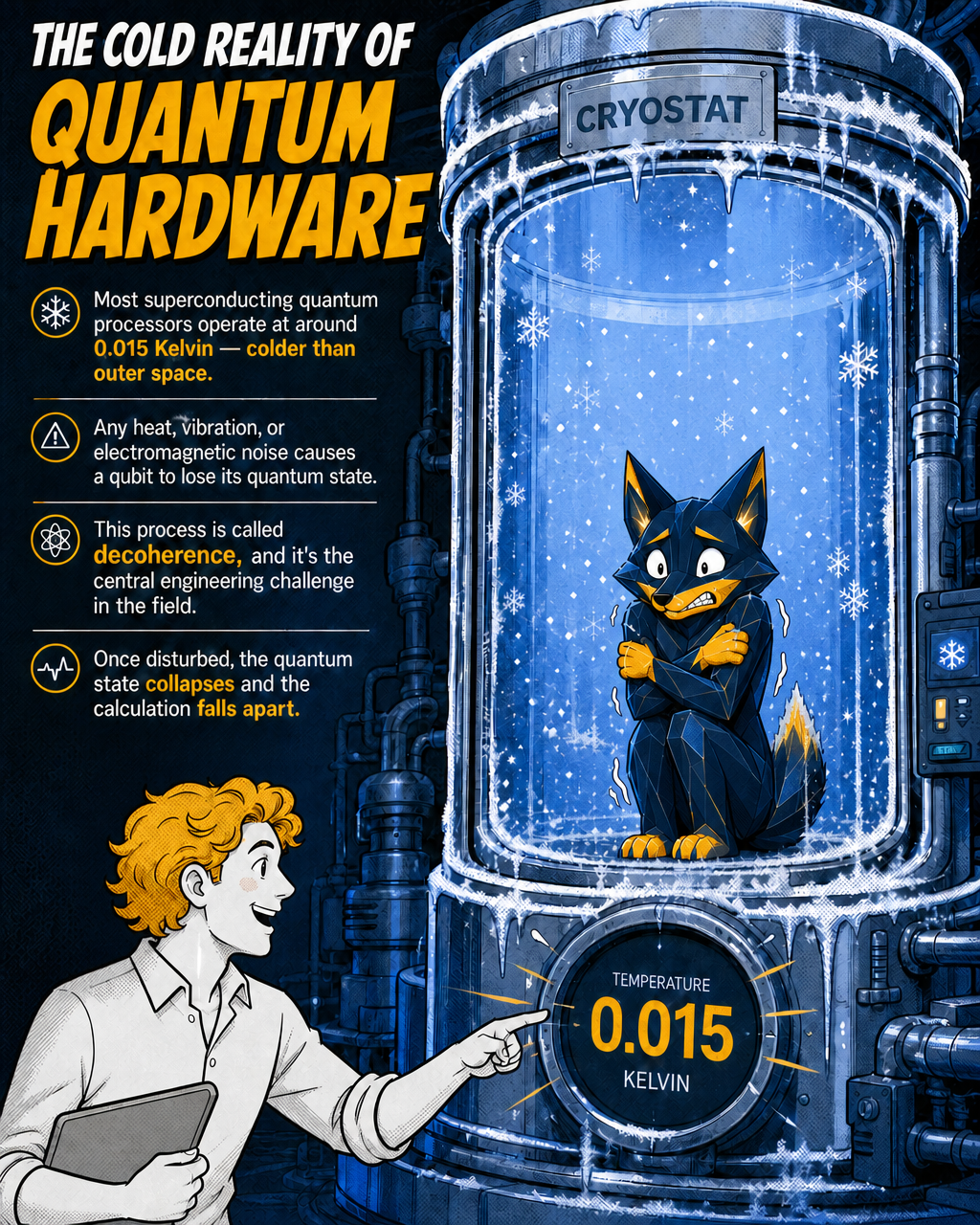
Quantum computers don't run at room temperature. Most superconducting quantum processors operate at around 0.015 Kelvin, colder than outer space, to prevent the qubits from interacting with their environment. The moment a qubit absorbs heat, vibration, or electromagnetic noise from its surroundings, it loses its quantum state. This process is called decoherence, and it's the central engineering challenge in the field. A quantum state, once disturbed, collapses, and the calculation falls apart.
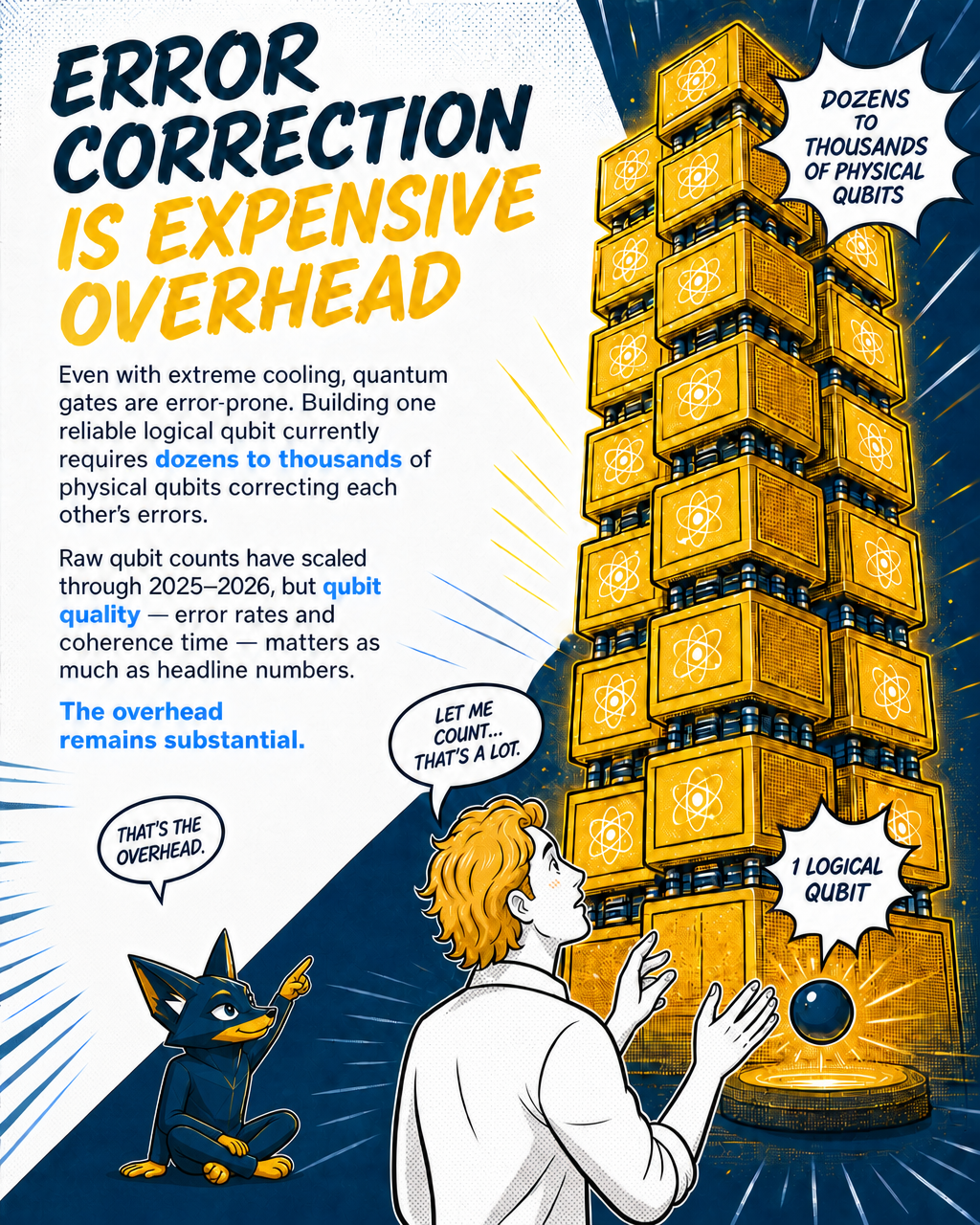
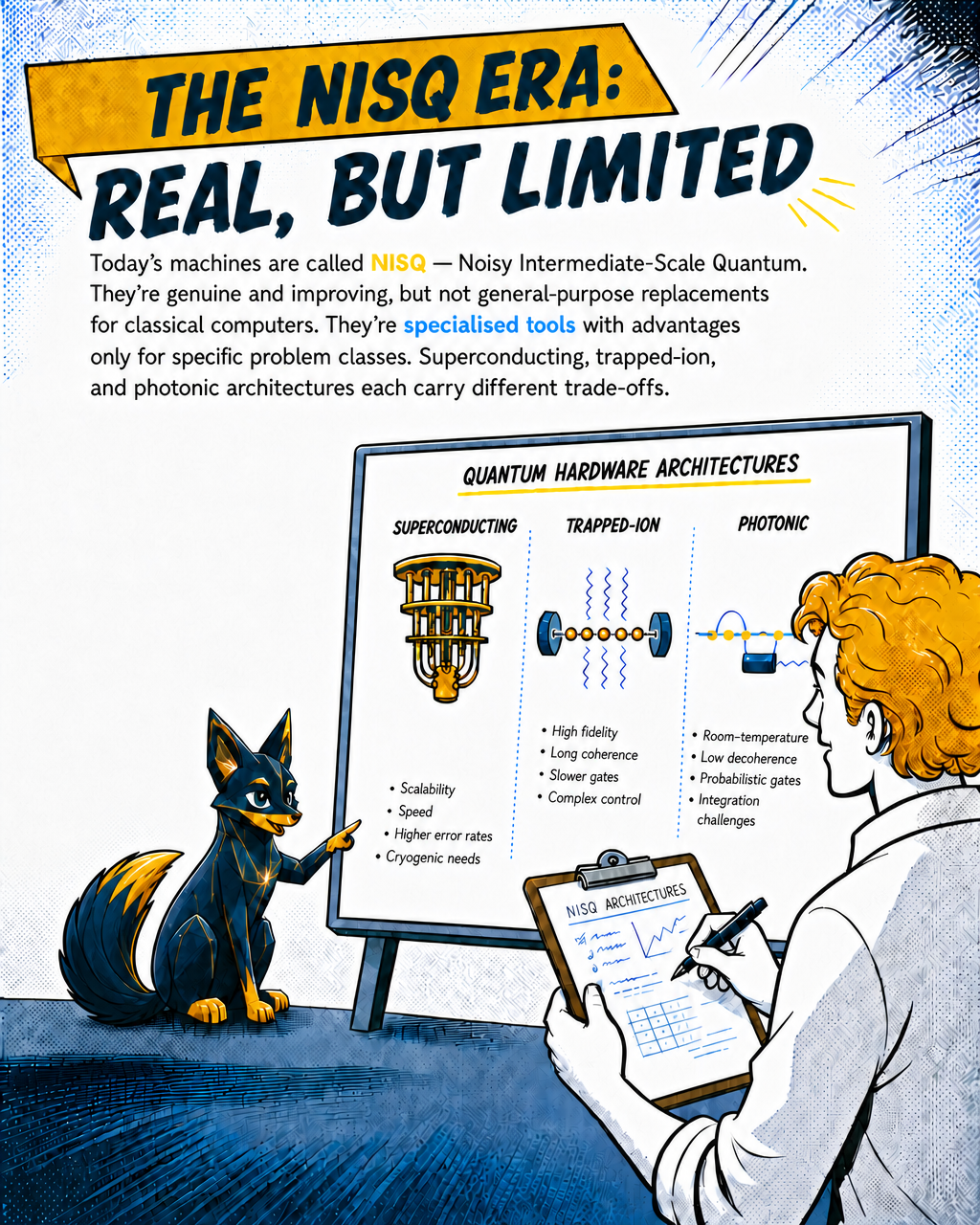
Even with extreme cooling, quantum gates are error-prone. Building a single reliable "logical qubit," the kind needed for serious computation, currently requires anywhere from dozens to thousands of physical qubits to detect and correct each other's errors. That overhead is substantial. Raw qubit counts across leading commercial platforms have continued to scale through 2025 and into 2026, but counts vary significantly by architecture — superconducting, trapped ion, and photonic systems each have different trade-offs — and qubit quality metrics such as error rates and coherence time matter as much as headline numbers. Researchers are working hard to make qubits more stable and the error-correction overhead more manageable.
The current era has a name: NISQ, which stands for Noisy Intermediate-Scale Quantum. Today's quantum computers are real and improving, but they're not general-purpose replacements for classical machines. They're specialised tools, best used for specific problem classes where their particular strengths create a genuine advantage.
In 2026, the industry is crossing a significant threshold: quantum error correction, long a theoretical goal, is becoming an engineering reality. Google's Willow chip, results from which were published in Nature in December 2024, demonstrated that error rates can decrease as the code distance increases within a specific error-correction scheme — an important milestone on the road toward fault-tolerant quantum computing, though a gap remains between that demonstration and practical fault-tolerant machines operating at scale.
Where quantum advantage is actually emerging
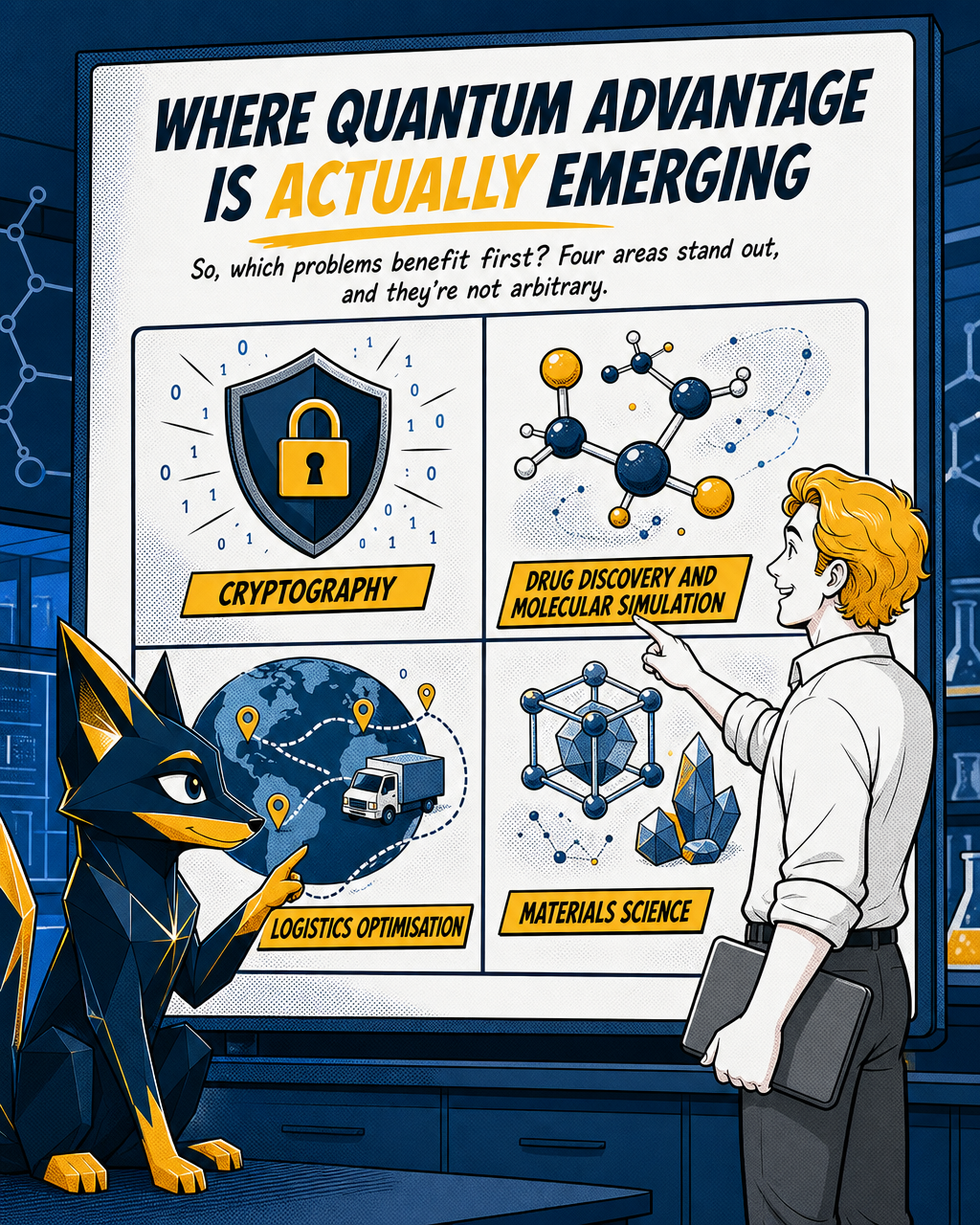
So, which problems benefit first? Four areas stand out, and they're not arbitrary.
Cryptography
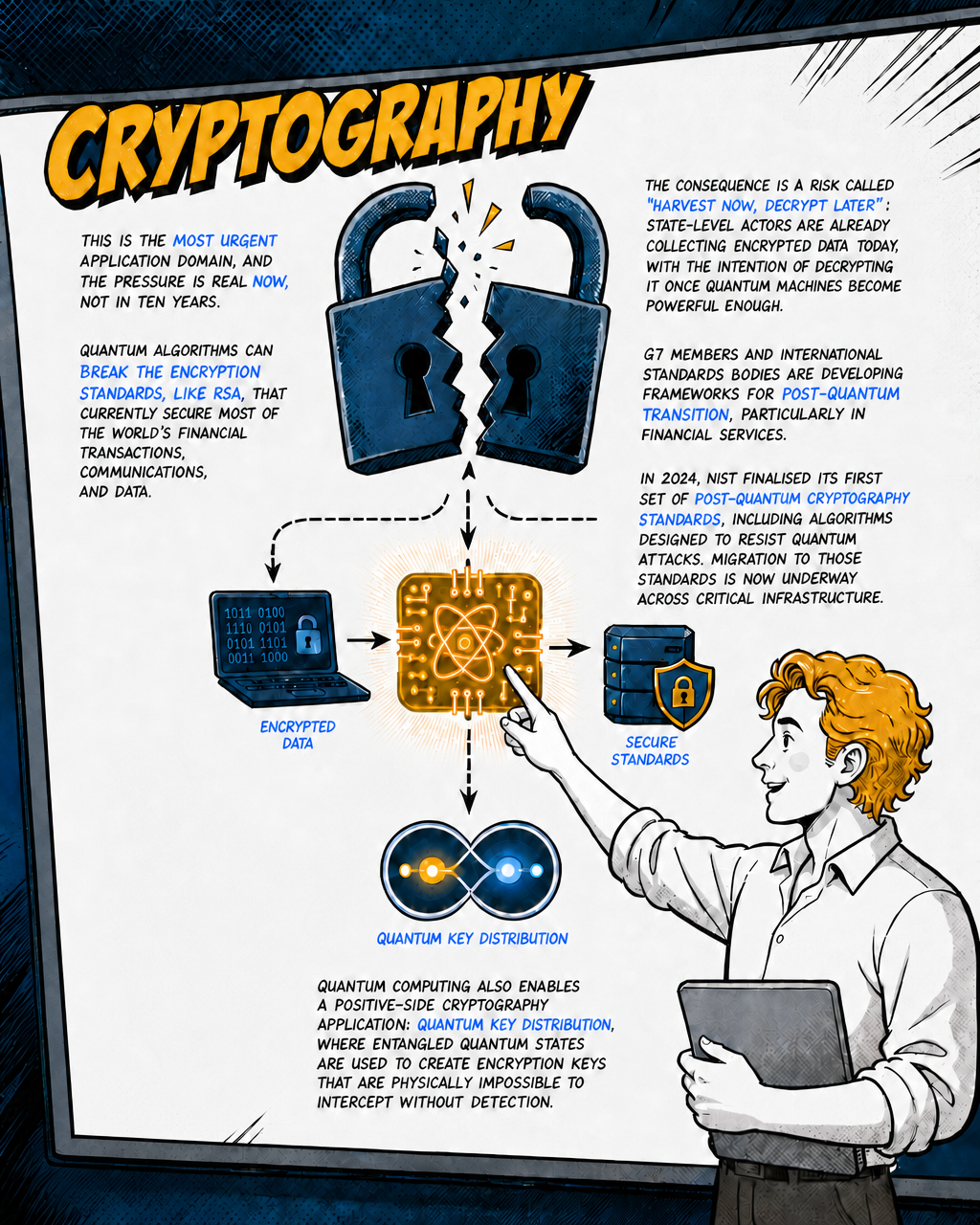
This is the most urgent application domain, and the pressure is real now, not in ten years. Quantum algorithms can break the encryption standards, like RSA, that currently secure most of the world's financial transactions, communications, and data. Research published in 2025 by teams exploring quantum-assisted cryptanalytic approaches has continued to compress estimated threat timelines, though the precise implications remain subject to active debate among cryptographers.
The consequence is a risk called "harvest now, decrypt later": state-level actors are already collecting encrypted data today, with the intention of decrypting it once quantum machines become powerful enough. That means sensitive data being encrypted in 2026 could be exposed within a decade. G7 members and international standards bodies have been developing frameworks for post-quantum transition, particularly in financial services. In 2024, NIST finalised its first set of post-quantum cryptography standards, including algorithms designed to resist quantum attacks. Migration to those standards is now underway across critical infrastructure.
Quantum computing also enables a positive-side cryptography application: quantum key distribution, where entangled quantum states are used to create encryption keys that are physically impossible to intercept without detection.
Drug discovery and molecular simulation
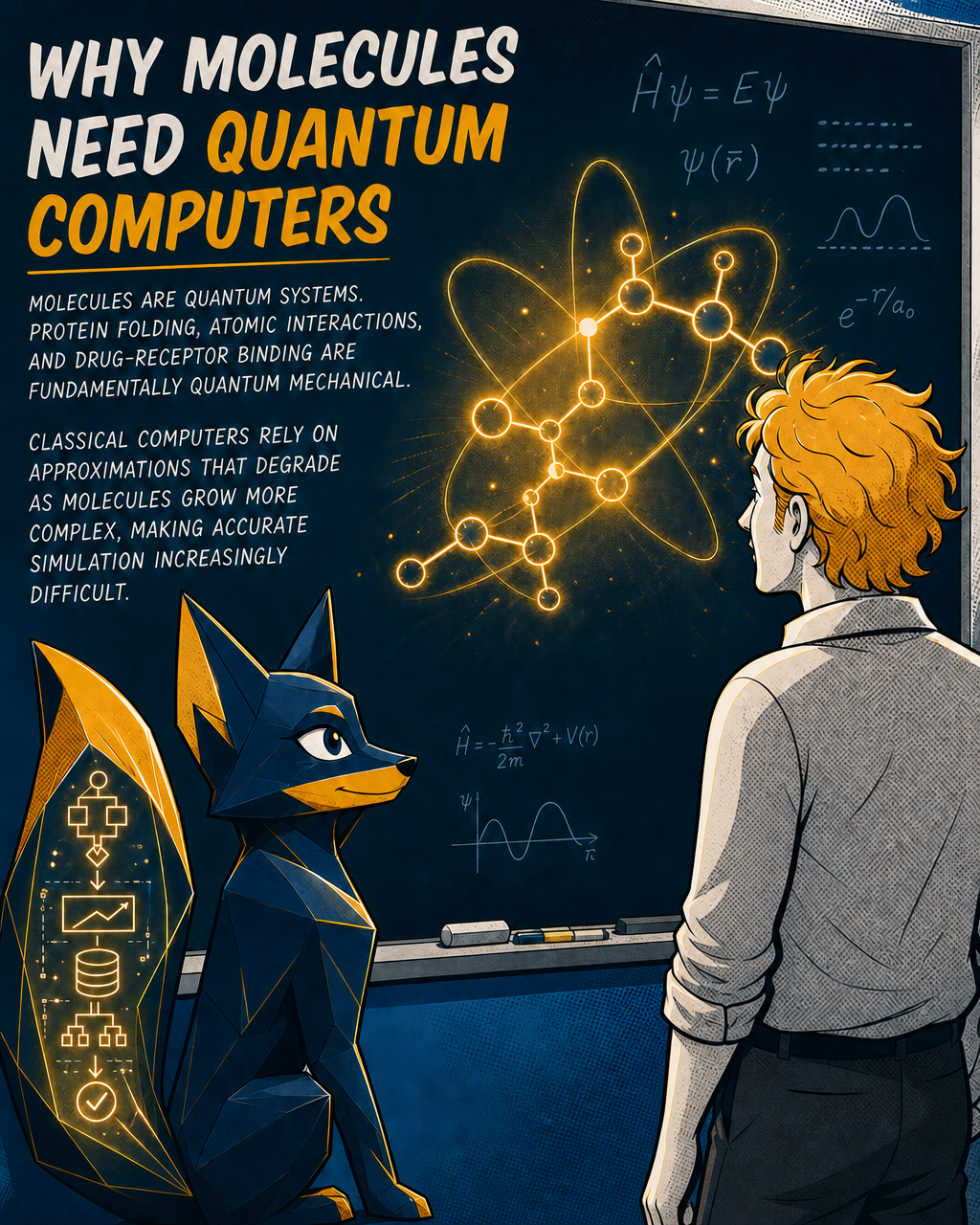
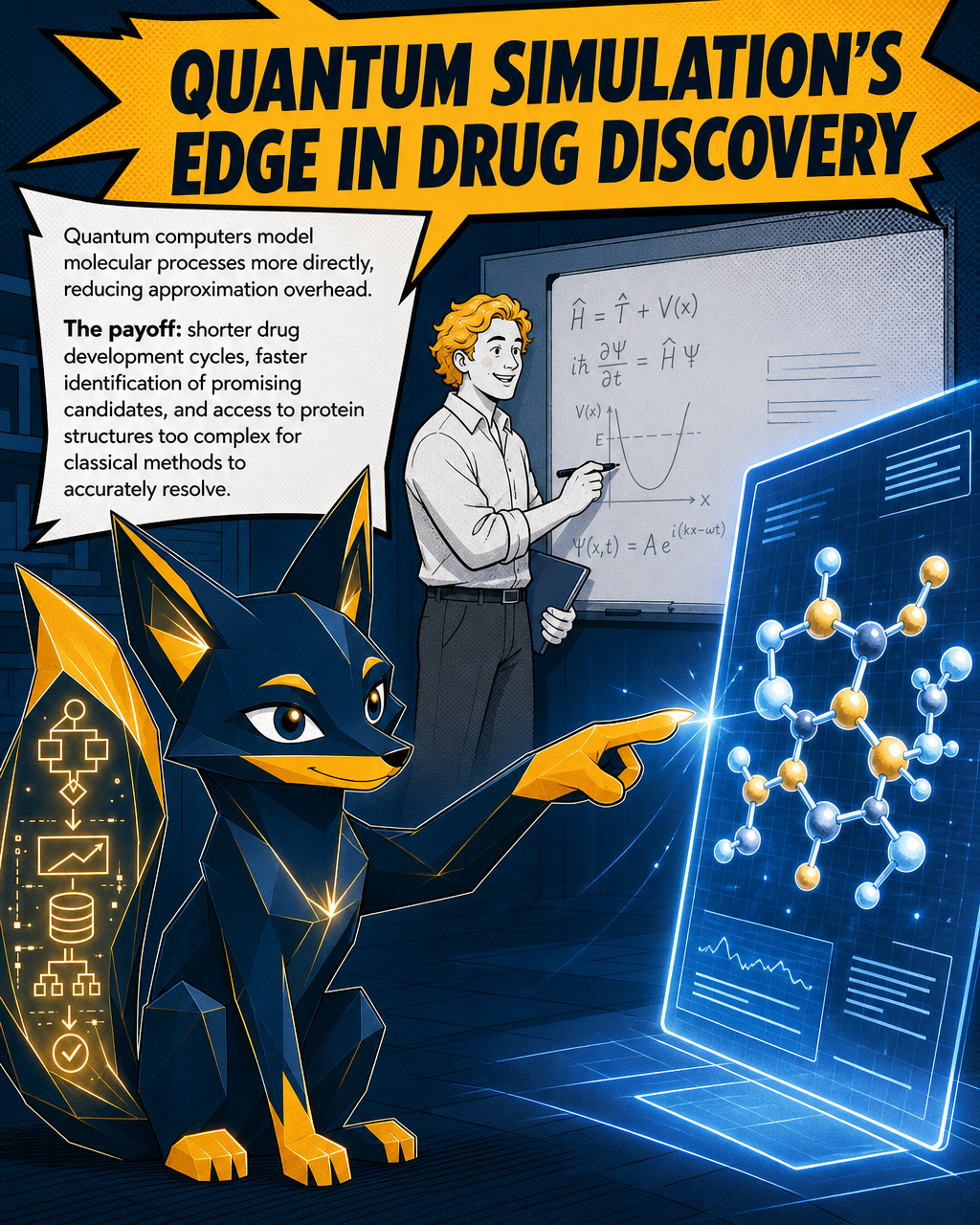
Molecules are quantum systems. The interactions between atoms, the way proteins fold, the way a candidate drug binds to a receptor: these are fundamentally quantum mechanical processes. Classical computers simulate them with approximations, and those approximations become less accurate as molecules grow more complex.
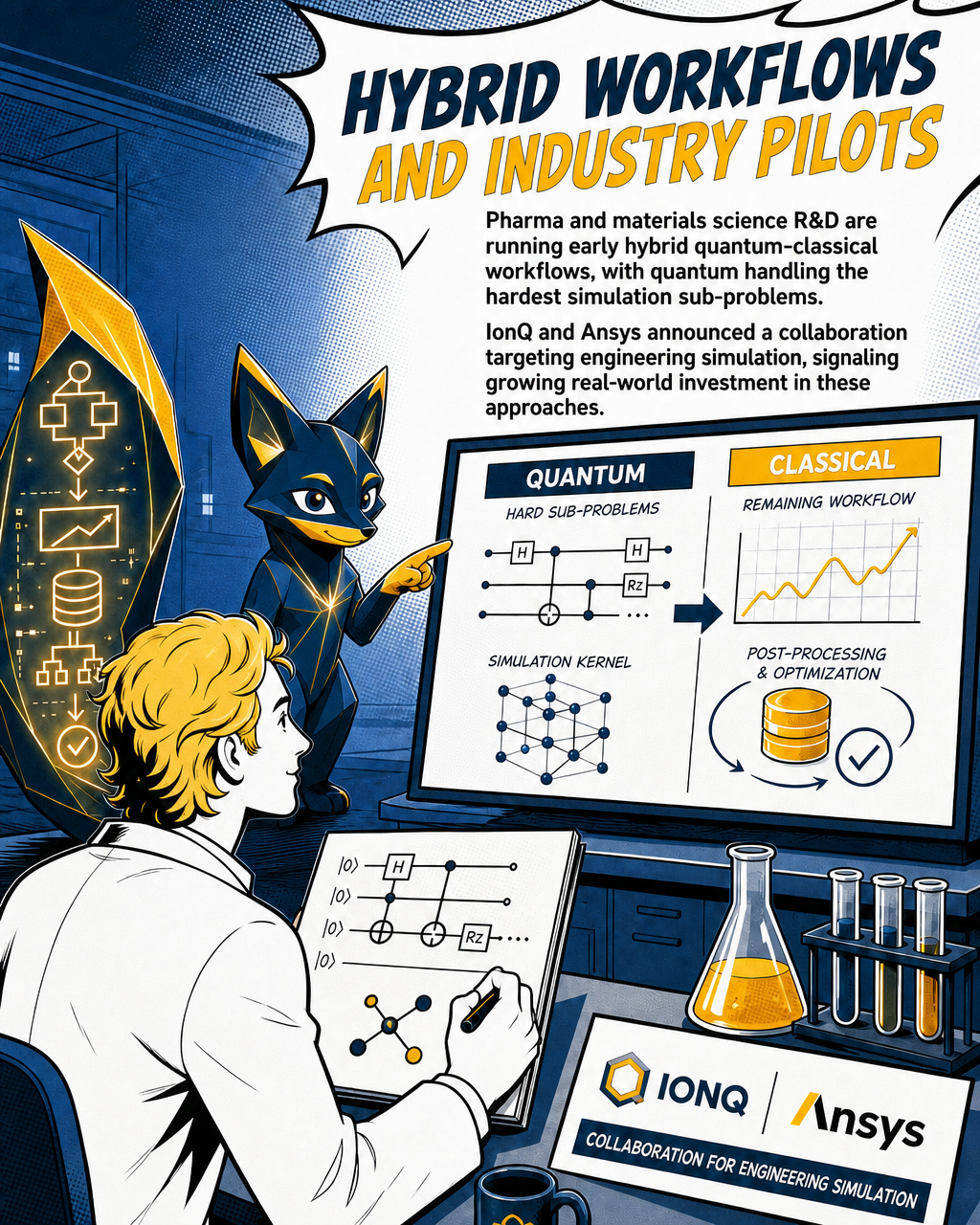
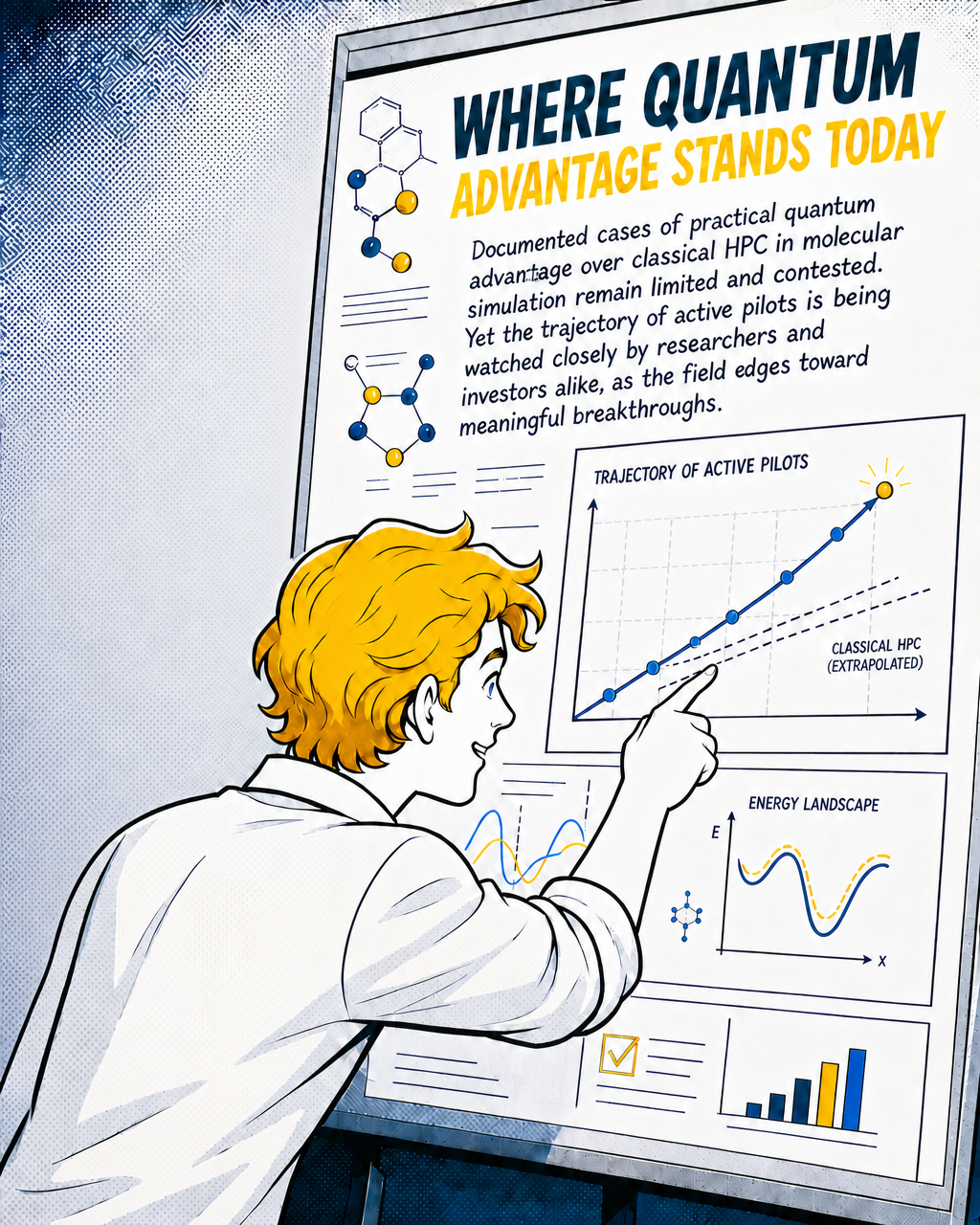
Quantum computers can model these processes more directly, reducing some of the approximation overhead. The potential impact is significant: shorter drug development cycles, faster identification of promising molecular candidates, and the ability to explore protein structures that are currently too complex to model accurately. IonQ and Ansys announced a collaboration targeting engineering simulation workflows, and pharmaceutical and materials science R&D more broadly are now running early hybrid quantum-classical workflows, with the quantum component handling the hardest simulation sub-problems. Documented cases of practical quantum advantage over classical high-performance computing remain limited and contested, but the trajectory of these pilots is being watched closely.
Logistics optimisation
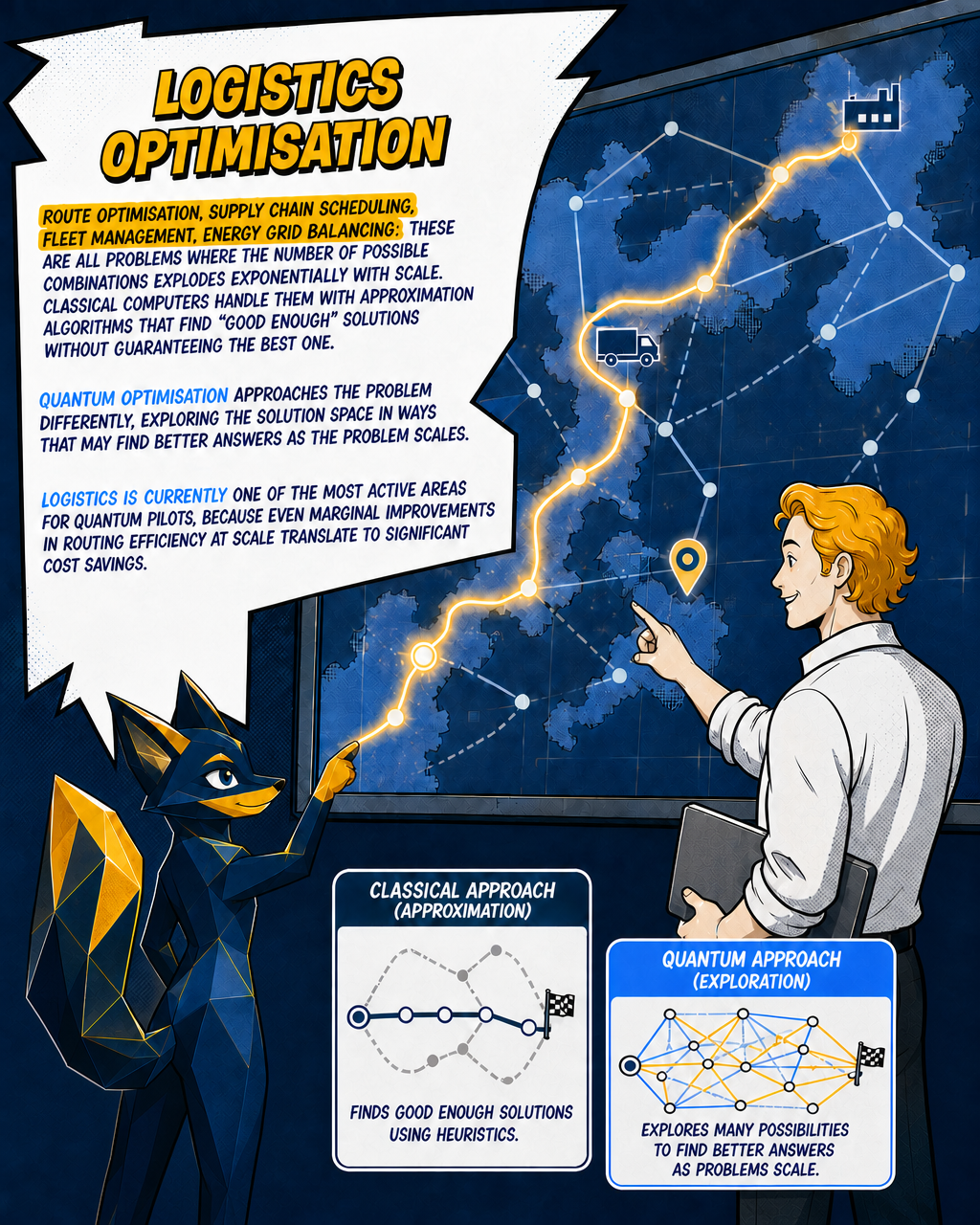
Route optimisation, supply chain scheduling, fleet management, energy grid balancing: these are all problems where the number of possible combinations explodes exponentially with scale. Classical computers handle them with approximation algorithms that find "good enough" solutions without guaranteeing the best one.
Quantum optimisation approaches the problem differently, exploring the solution space in ways that may find better answers as the problem scales. Logistics is currently one of the most active areas for quantum pilots, because even marginal improvements in routing efficiency at scale translate to significant cost savings.
Materials science
Designing better batteries, stronger alloys, more efficient solar cells, or new superconductors all share a common bottleneck: we can't easily model how novel materials will behave at the atomic level using classical simulation. Quantum simulation is well suited to this problem, modelling atomic and molecular interactions with quantum-level precision rather than approximation.
Researchers have applied quantum simulation methods to longstanding materials science questions, including problems in quasicrystal structure and other areas where classical approximations have historically fallen short. Battery development and semiconductor materials are now high-priority application areas for commercial quantum R&D.
What this means if you're not a physicist
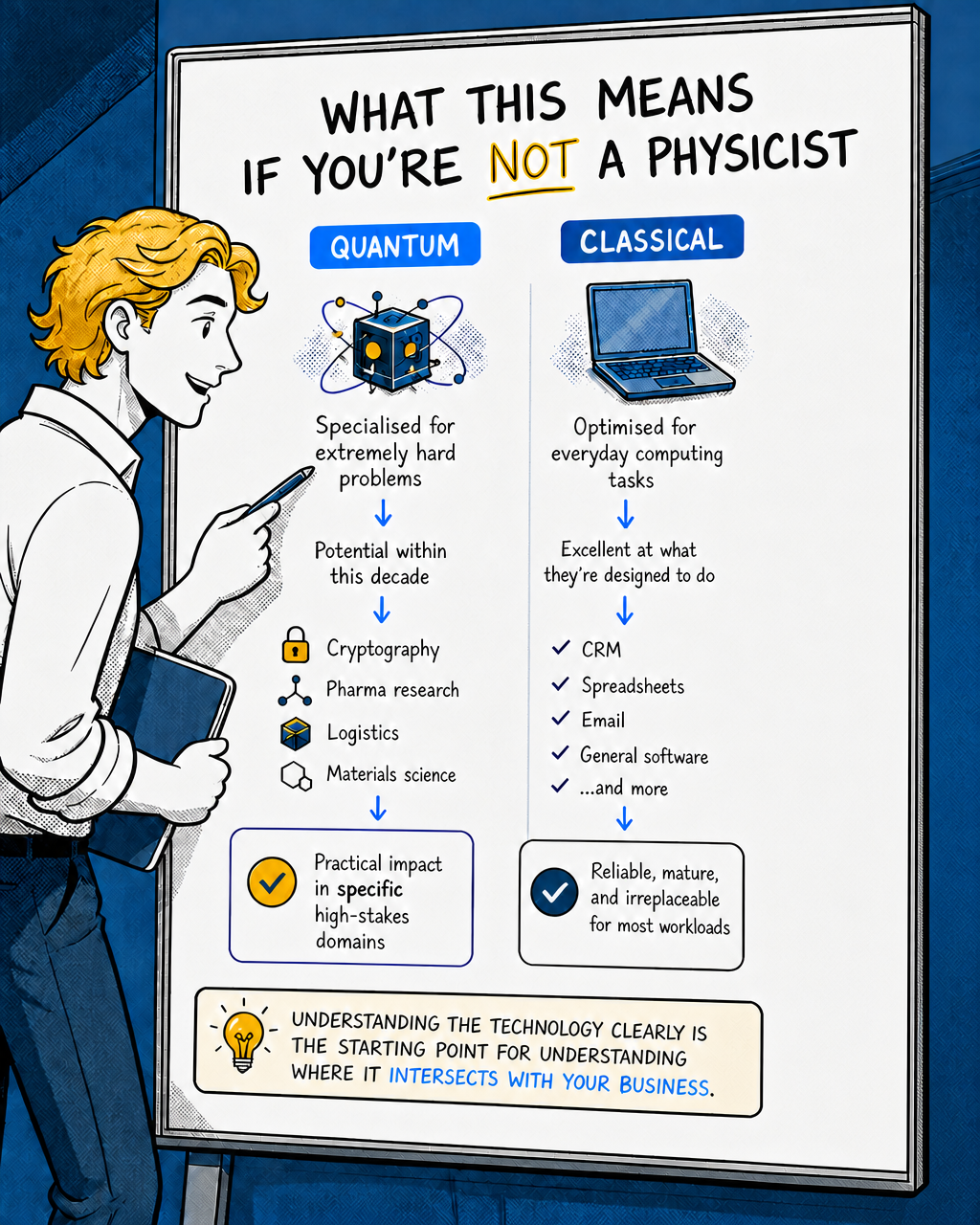
Quantum computing isn't going to replace your laptop. It isn't going to run your CRM or power your spreadsheets. Classical computers are excellent at what they do, and quantum machines aren't designed to compete on that ground.
What quantum computers may do, potentially within this decade, is solve a specific class of extremely hard problems faster and more accurately than classical systems can. Those problems sit at the heart of cryptography, pharmaceutical research, logistics, and materials science, which collectively represent enormous economic stakes.
For founders in biotech, regtech, fintech, or deep tech hardware, this matters in two ways. First, if your product touches encryption or data security, the post-quantum cryptography migration is a real and immediate concern for your buyers, not a future consideration. Second, if your R&D involves molecular simulation, materials optimisation, or complex scheduling, quantum methods are becoming a practical part of the toolkit for forward-planning purposes.
Understanding the technology clearly is the starting point for understanding where it intersects with your business.
Explaining complex technology is a skill
Quantum computing is genuinely hard to explain. Not because the ideas are inherently impenetrable, but because the gap between the technical reality and the human-scale story requires real work to bridge. The same problem faces founders and technical teams in every complex tech category: the thing you built is sophisticated, but your buyers, investors, and partners need to understand it in 60 seconds.
That gap costs deals. It costs funding rounds. It costs the room.
If your product has a comprehension problem, not a product problem, Infrairis builds technically accurate explainer content for complex technology. Take a look at how we work.

Infrairis
Your complex product. In 60 seconds. Clearly.
Your complex product. In 60 seconds. Clearly.
Learn more about Infrairis and get started today.
Visit Infrairis