Four Fusion Confinement Technologies: An Investor's Field Guide


Fusion Confinement Technologies: A Plain-English Investor Guide
Fusion energy has attracted significant capital. Private and public investment has now exceeded $10 billion, and the question for investors is no longer whether fusion works in principle — it's which approach will deliver electricity to the grid first, and at what cost. Before you can evaluate a fusion company, you need to understand what it's actually building. There are four main confinement families in serious commercial development today: tokamaks, stellarators, magneto-inertial/pulsed approaches, and inertial confinement fusion (ICF). Each operates on different physics, carries different risks, and sits at a different point on the readiness curve.
This guide explains all four in plain language, then compares them across the five dimensions that matter most for investment decisions.
A Quick Primer: What Fusion Confinement Actually Is
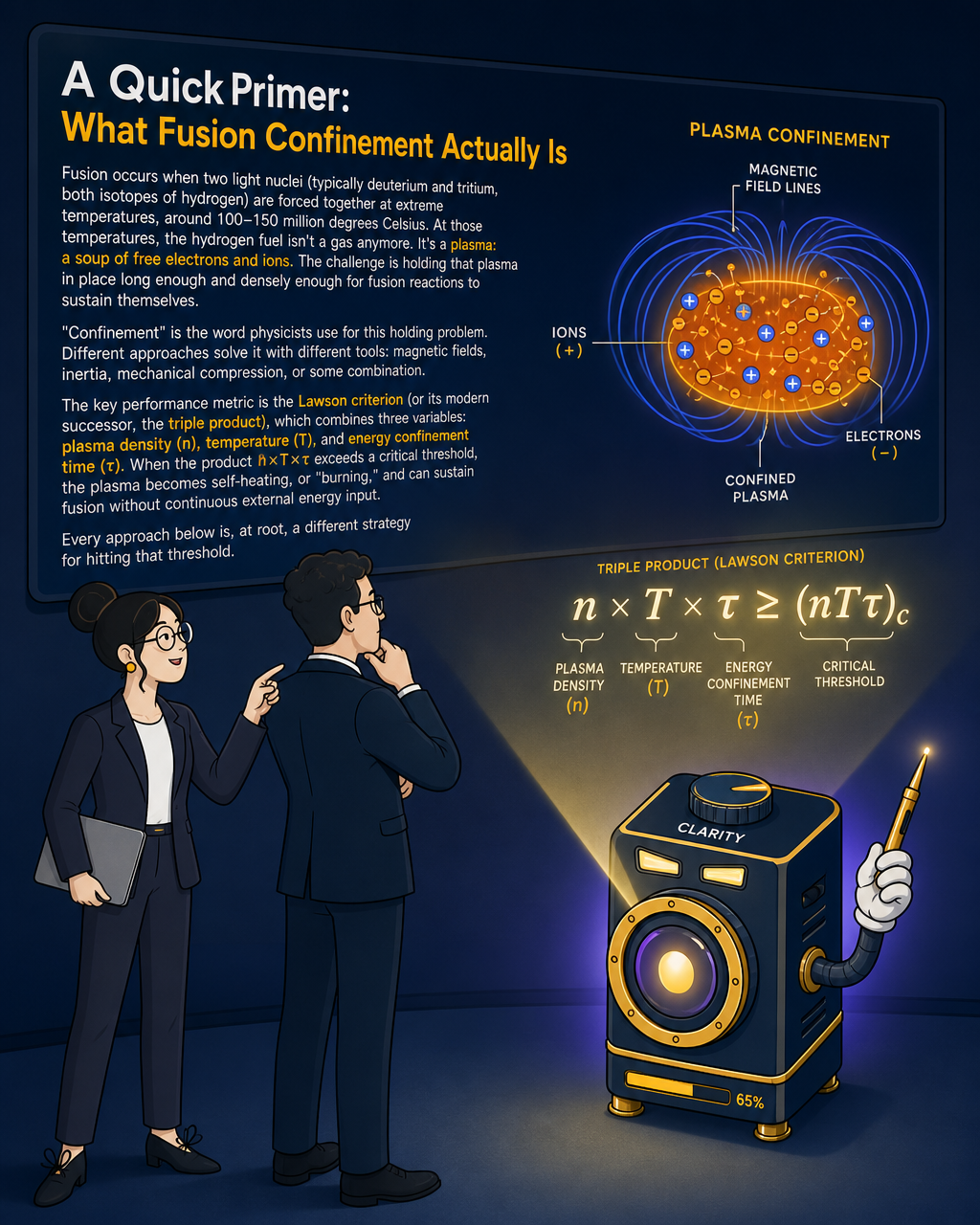
Fusion occurs when two light nuclei (typically deuterium and tritium, both isotopes of hydrogen) are forced together at extreme temperatures, around 100–150 million degrees Celsius. At those temperatures, the hydrogen fuel isn't a gas anymore. It's a plasma: a soup of free electrons and ions. The challenge is holding that plasma in place long enough and densely enough for fusion reactions to sustain themselves.
"Confinement" is the word physicists use for this holding problem. Different approaches solve it with different tools: magnetic fields, inertia, mechanical compression, or some combination. The key performance metric is the Lawson criterion (or its modern successor, the triple product), which combines three variables: plasma density (n), temperature (T), and energy confinement time (τ). When the product n×T×τ exceeds a critical threshold, the plasma becomes self-heating, or "burning," and can sustain fusion without continuous external energy input. Every approach below is, at root, a different strategy for hitting that threshold.
1. Tokamaks: The Established Approach
The physics
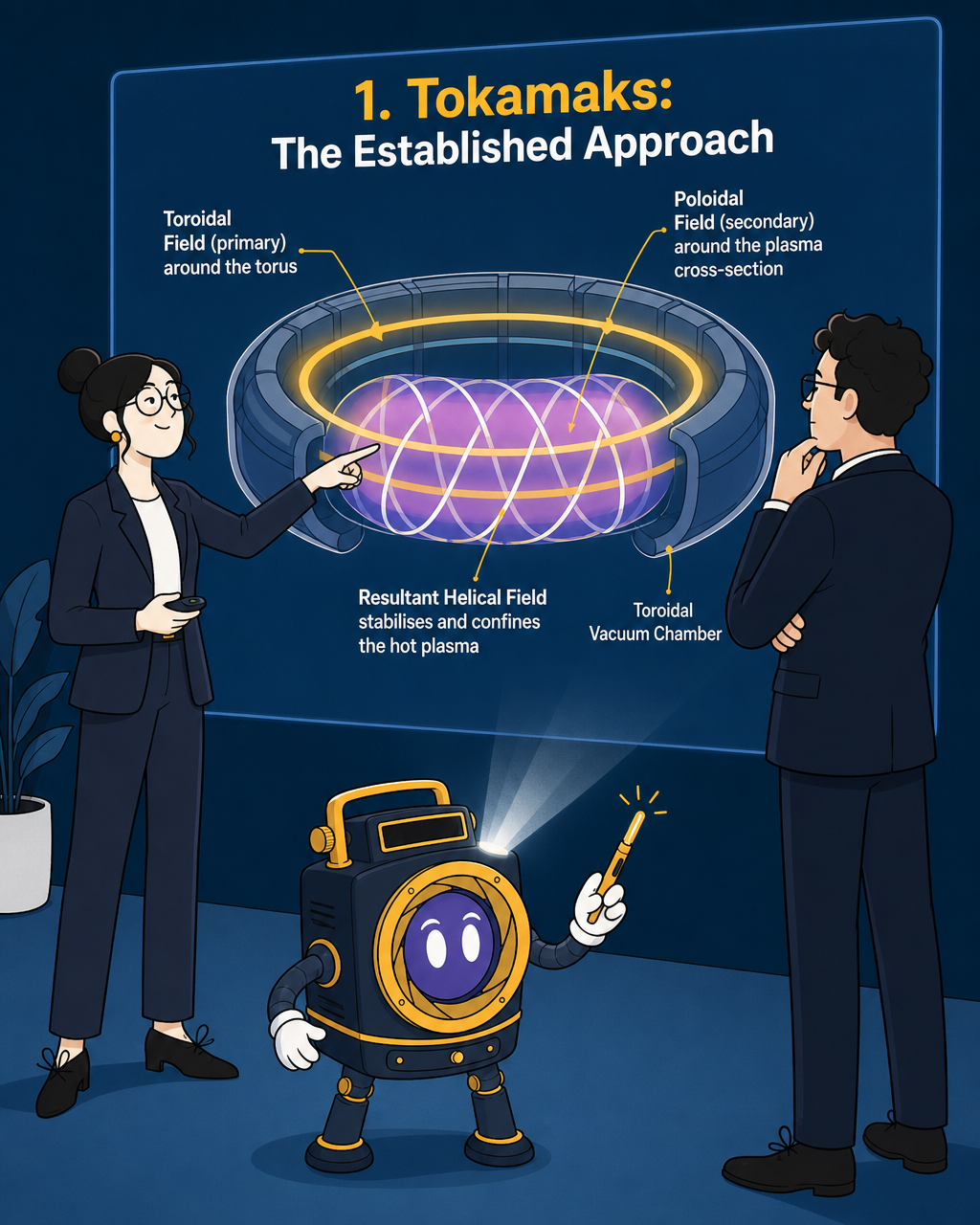
A tokamak confines plasma inside a donut-shaped (toroidal) vacuum chamber using two interlocking magnetic fields. The primary field runs around the torus like a ring. The secondary field runs the other way, around the plasma cross-section. Together they produce a helical, twisting field that stabilises the hot plasma and keeps it from touching the chamber walls.
The crucial design choice: tokamaks rely on an internal plasma current to generate part of that secondary field. A large transformer coil induces the current at startup, but sustaining it continuously requires ongoing energy input. This is the tokamak's core engineering tension. It works. But it's not inherently a steady-state device.
Maturity and milestones
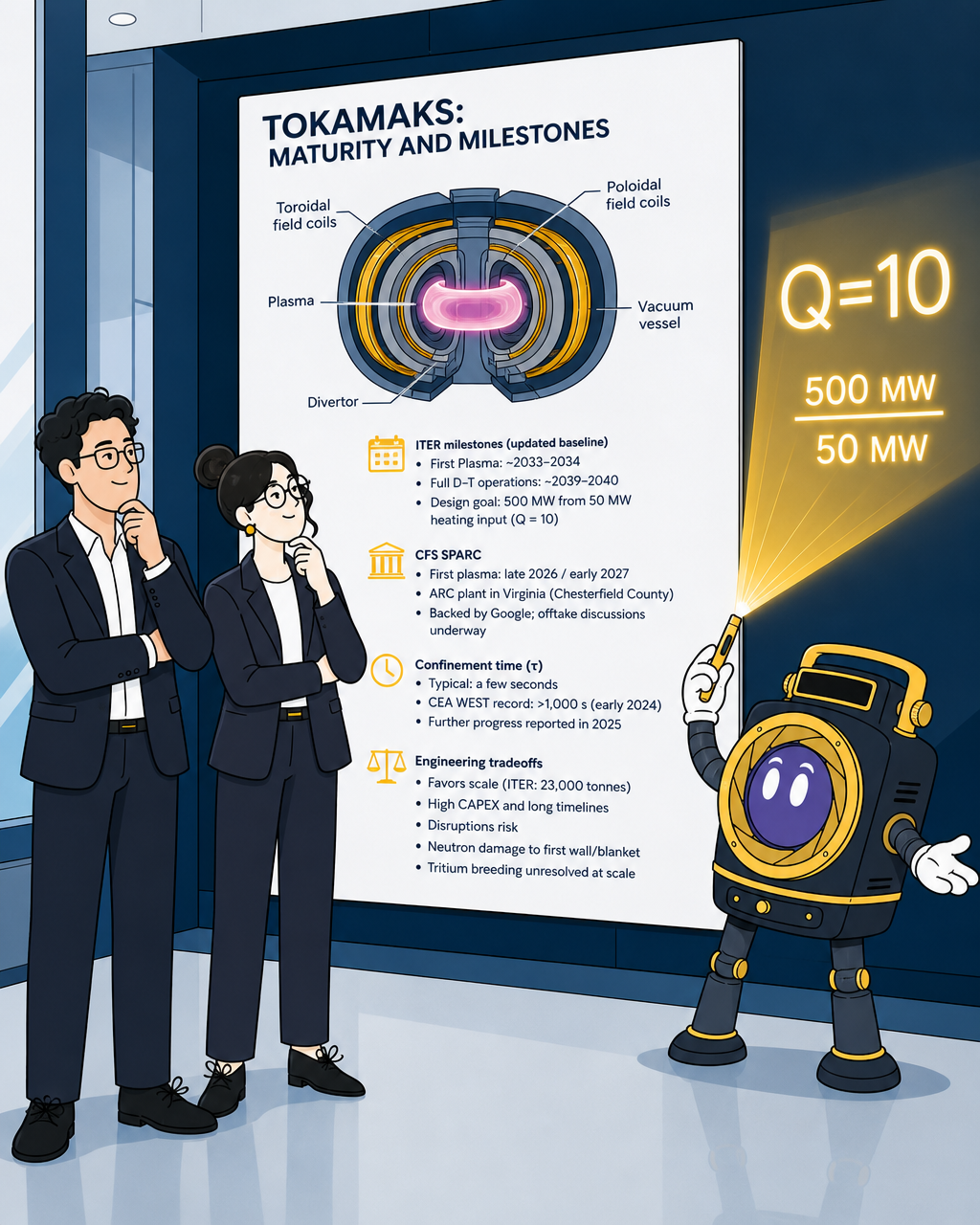
Tokamaks are the most heavily funded and technically mature approach. The international ITER project, now under construction in southern France, is the world's largest tokamak. Its schedule has undergone significant revision; as of mid-2026, ITER IO's updated baseline targets First Plasma around 2033–2034 and full deuterium-tritium (D-T) operations approximately in the 2039–2040 timeframe, though investors should consult ITER IO's current official schedule documents, as intermediate milestones continue to be refined. ITER's design goal is to produce 500 MW of fusion power from 50 MW of plasma heating input, a Q factor of 10.
On the private side, Commonwealth Fusion Systems (CFS), spun out of MIT, is building SPARC — a compact tokamak that uses a new generation of high-temperature superconducting magnets that achieved a world-record field strength of 20 tesla at large scale during testing in 2021. SPARC is expected to produce its first plasma in late 2026 or early 2027, and CFS has announced a Virginia site (Chesterfield County) for its commercial power plant (ARC) and has secured investment from Google, with power offtake discussions underway.
The tokamak confinement time (τ) in leading devices typically sits in the range of a few seconds under high-performance conditions, with the CEA WEST tokamak setting a continuous plasma duration record of over 1,000 seconds in early 2024, and reporting further progress in 2025 — investors should verify the latest confirmed figures against CEA's official announcements, as specific numbers from subsequent runs are still being reported.
Engineering tradeoffs
Tokamaks scale favorably with size: larger machines confine plasma more efficiently, which is why ITER is 23,000 tonnes. This creates an economic tension. The per-unit cost of large tokamaks is enormous, and construction timelines stretch accordingly. Disruptions, where the plasma current suddenly collapses and dumps energy into the chamber walls, are a serious operational risk at scale. High neutron flux from D-T fusion also causes material degradation in the first wall and blanket over time. Tritium breeding — manufacturing your own fuel inside the reactor blanket — is an unsolved engineering problem at commercial scale.
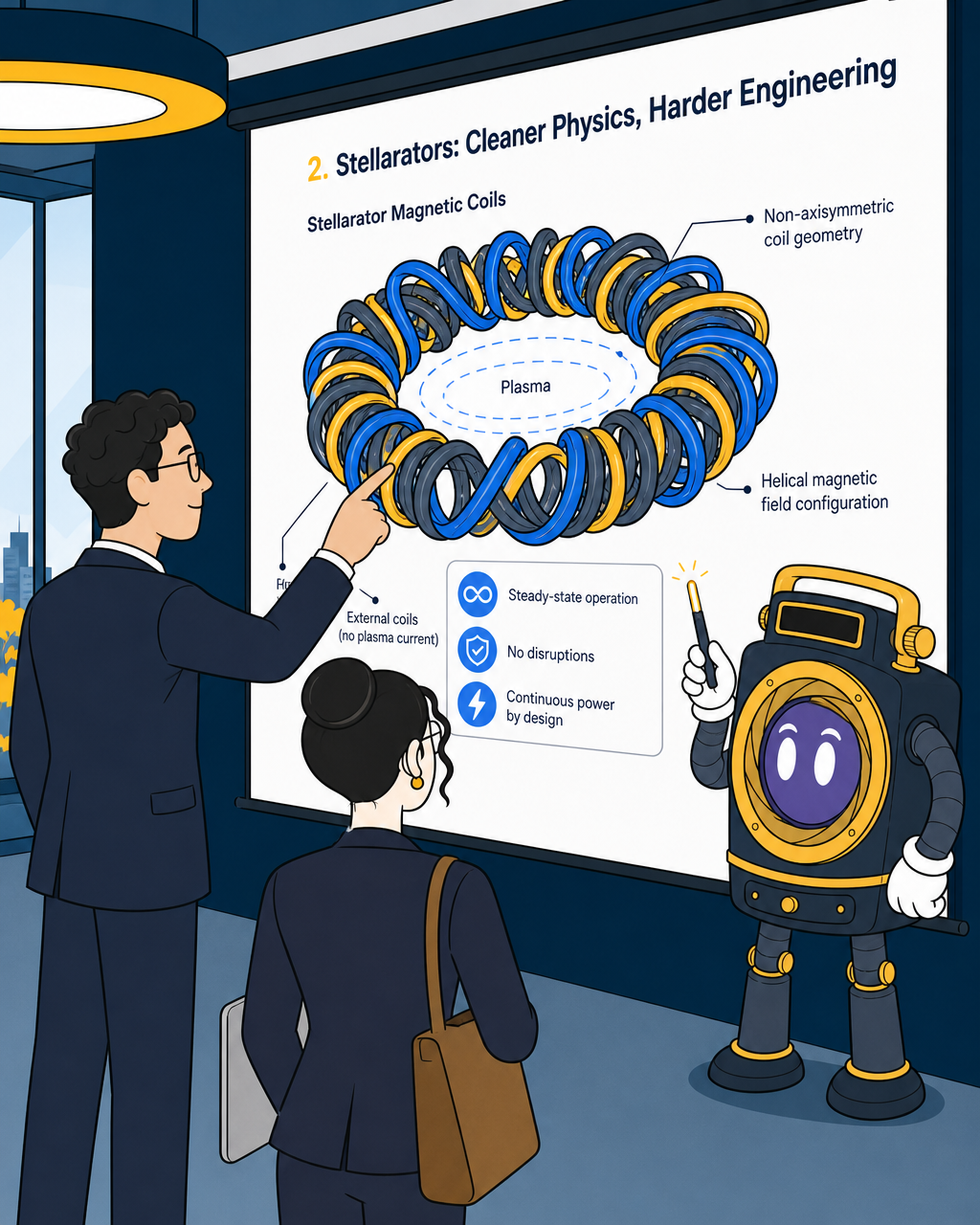
2. Stellarators: Cleaner Physics, Harder Engineering
The physics
A stellarator also confines plasma in a magnetic field inside a torus, but it solves the stability problem differently. Unlike a tokamak, a stellarator generates its entire confining magnetic field from external coils. There is no plasma current to induce and sustain. The price is coil geometry: a stellarator's external magnets must be twisted into complex, non-axisymmetric (non-uniform) shapes to produce the helical field that tokamaks generate internally. Think of it as solving the same problem with the mechanical complexity pushed entirely outside the plasma.
Because there's no plasma current to sustain, a stellarator is inherently a steady-state device. There are no disruptions. The plasma can, in principle, run continuously without the transformer cycling that limits tokamak pulse length.
Maturity and milestones
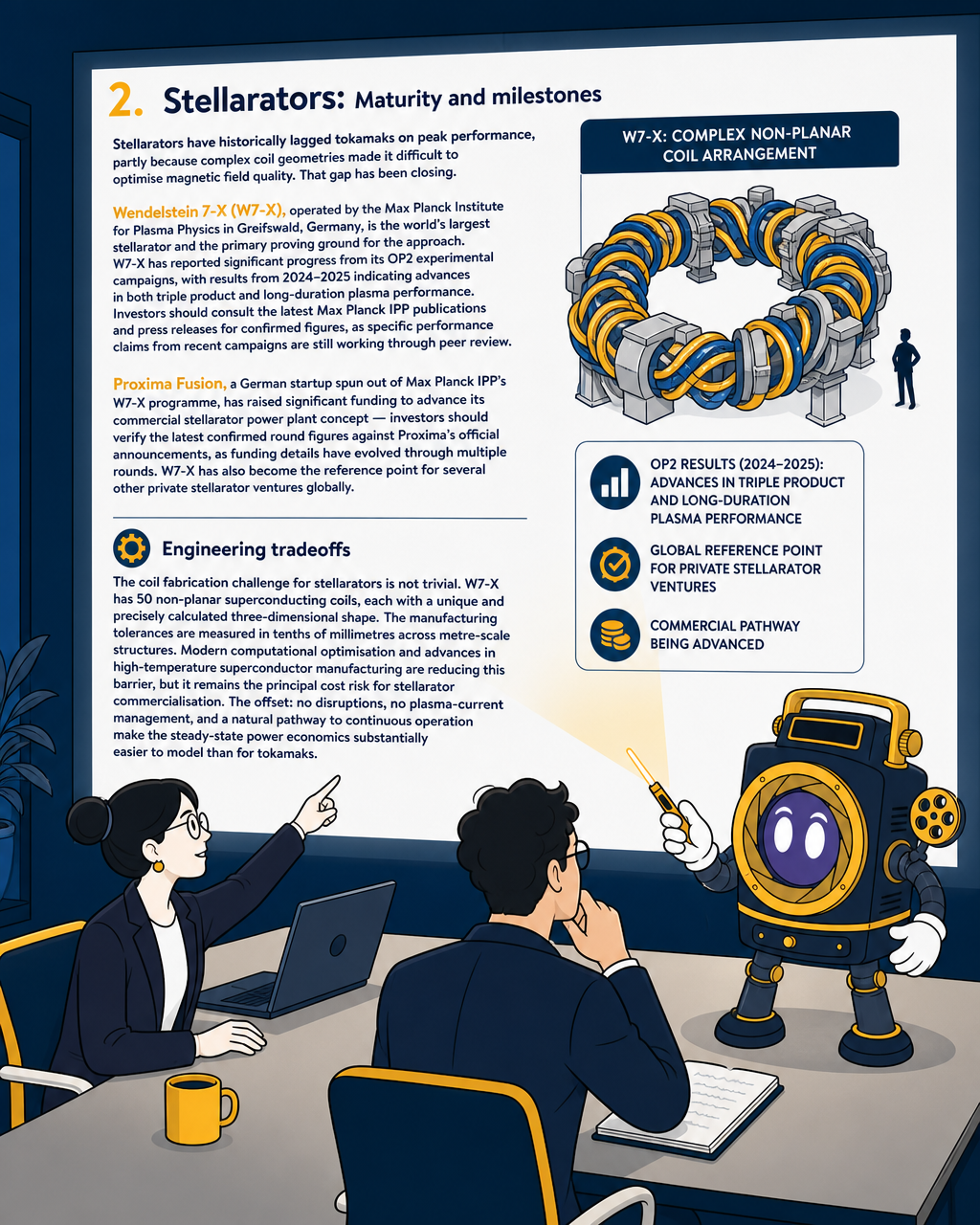
Stellarators have historically lagged tokamaks on peak performance, partly because complex coil geometries made it difficult to optimise magnetic field quality. That gap has been closing.
Wendelstein 7-X (W7-X), operated by the Max Planck Institute for Plasma Physics in Greifswald, Germany, is the world's largest stellarator and the primary proving ground for the approach. W7-X has reported significant progress from its OP2 experimental campaigns, with results from 2024–2025 indicating advances in both triple product and long-duration plasma performance. Investors should consult the latest Max Planck IPP publications and press releases for confirmed figures, as specific performance claims from recent campaigns are still working through peer review.
Proxima Fusion, a German startup spun out of Max Planck IPP's W7-X programme, has raised significant funding to advance its commercial stellarator power plant concept — investors should verify the latest confirmed round figures against Proxima's official announcements, as funding details have evolved through multiple rounds. W7-X has also become the reference point for several other private stellarator ventures globally.
Engineering tradeoffs
The coil fabrication challenge for stellarators is not trivial. W7-X has 50 non-planar superconducting coils, each with a unique and precisely calculated three-dimensional shape. The manufacturing tolerances are measured in tenths of millimetres across metre-scale structures. Modern computational optimisation and advances in high-temperature superconductor manufacturing are reducing this barrier, but it remains the principal cost risk for stellarator commercialisation. The offset: no disruptions, no plasma-current management, and a natural pathway to continuous operation make the steady-state power economics substantially easier to model than for tokamaks.
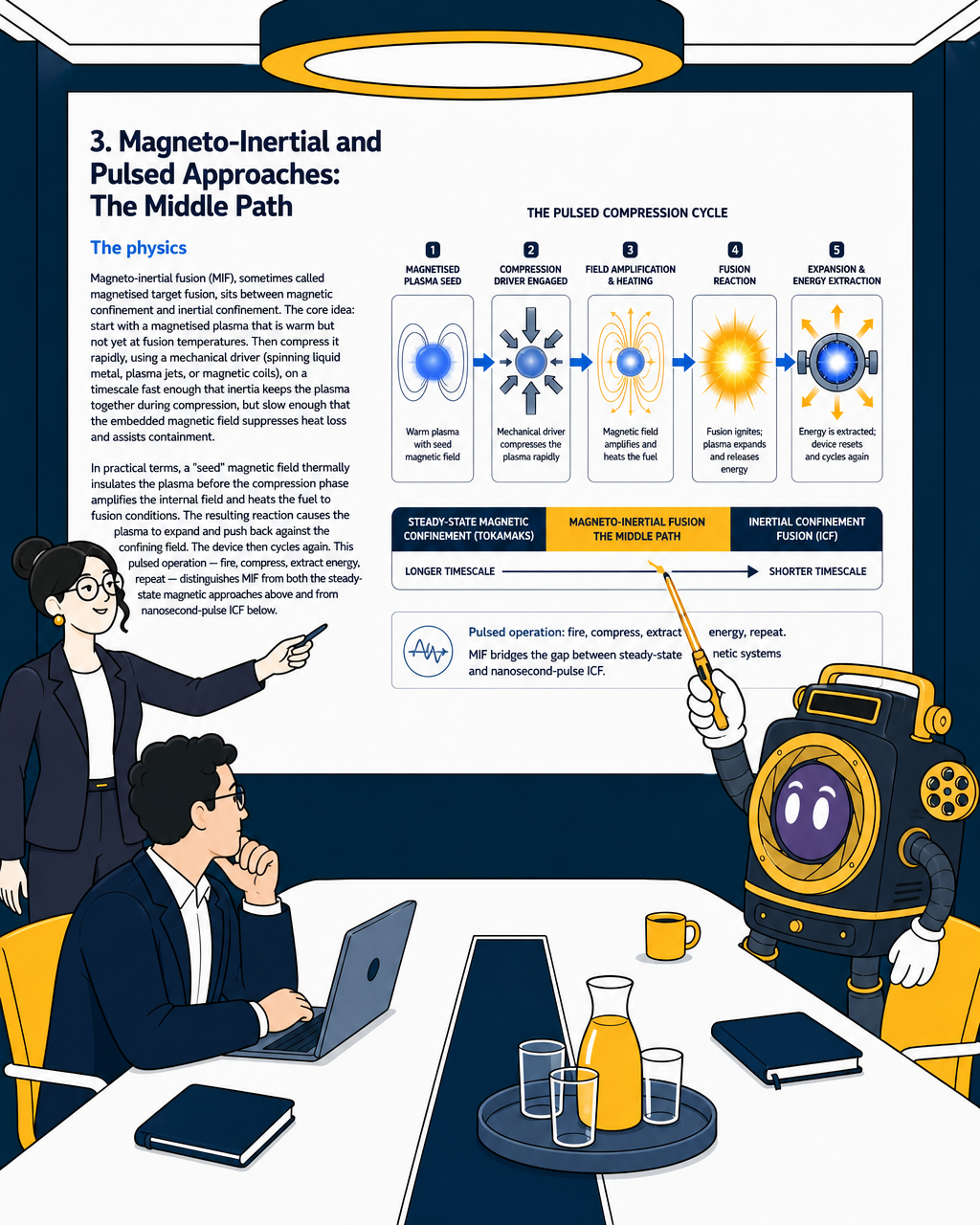
3. Magneto-Inertial and Pulsed Approaches: The Middle Path
The physics
Magneto-inertial fusion (MIF), sometimes called magnetised target fusion, sits between magnetic confinement and inertial confinement. The core idea: start with a magnetised plasma that is warm but not yet at fusion temperatures. Then compress it rapidly, using a mechanical driver (spinning liquid metal, plasma jets, or magnetic coils), on a timescale fast enough that inertia keeps the plasma together during compression, but slow enough that the embedded magnetic field suppresses heat loss and assists containment.
In practical terms, a "seed" magnetic field thermally insulates the plasma before the compression phase amplifies the internal field and heats the fuel to fusion conditions. The resulting reaction causes the plasma to expand and push back against the confining field. The device then cycles again. This pulsed operation — fire, compress, extract energy, repeat — distinguishes MIF from both the steady-state magnetic approaches above and from nanosecond-pulse ICF below.
Maturity and milestones
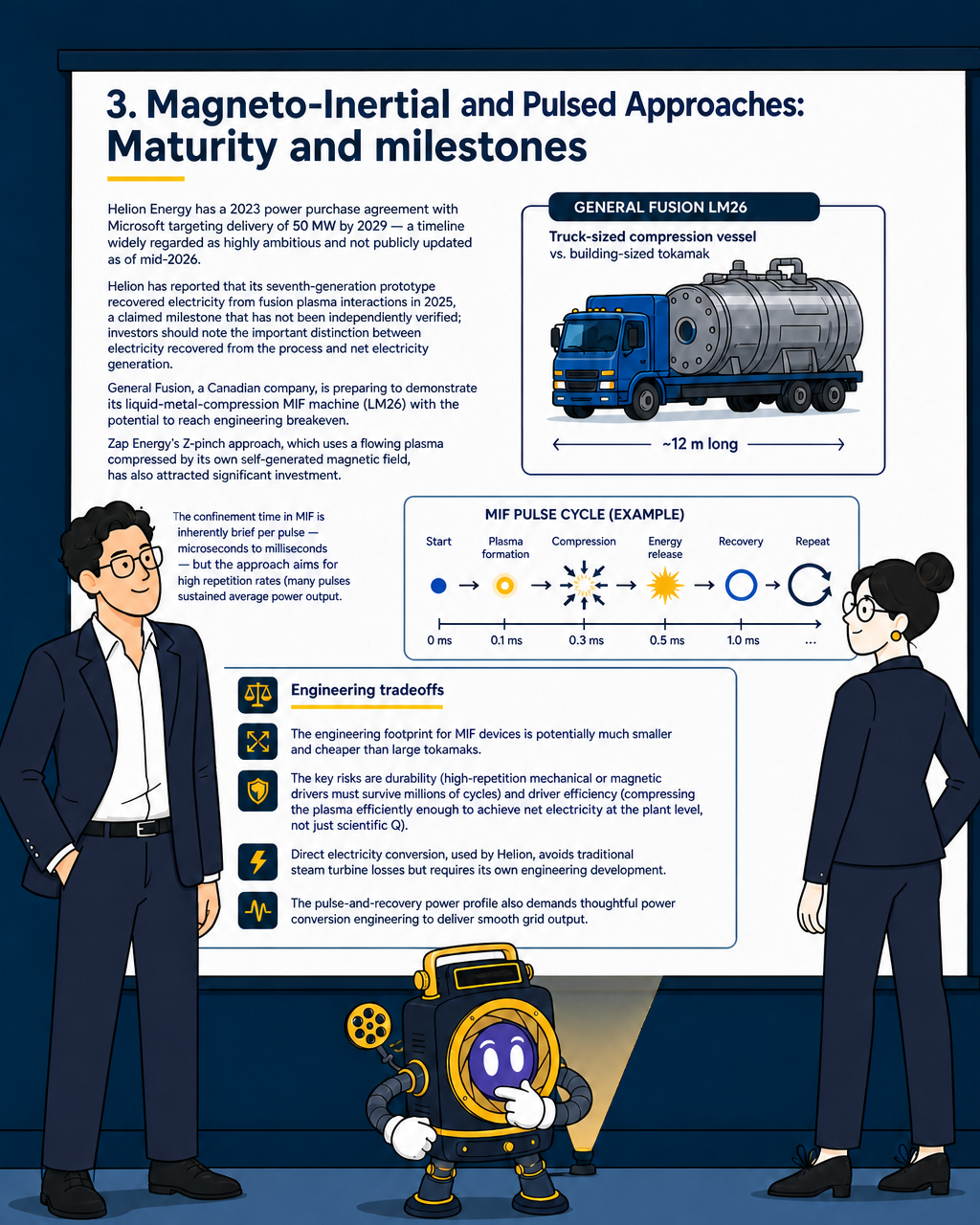
Helion Energy has a 2023 power purchase agreement with Microsoft targeting delivery of 50 MW by 2029 — a timeline widely regarded as highly ambitious and not publicly updated as of mid-2026. Helion has reported that its seventh-generation prototype recovered electricity from fusion plasma interactions in 2025, a claimed milestone that has not been independently verified; investors should note the important distinction between electricity recovered from the process and net electricity generation. General Fusion, a Canadian company, is preparing to demonstrate its liquid-metal-compression MIF machine (LM26) with the potential to reach engineering breakeven. Zap Energy's Z-pinch approach, which uses a flowing plasma compressed by its own self-generated magnetic field, has also attracted significant investment.
The confinement time in MIF is inherently brief per pulse — microseconds to milliseconds — but the approach aims for high repetition rates (many pulses per second) to produce sustained average power output.
Engineering tradeoffs
The engineering footprint for MIF devices is potentially much smaller and cheaper than large tokamaks. General Fusion's compression vessel, for example, is roughly truck-sized rather than building-sized. The key risks are durability (high-repetition mechanical or magnetic drivers must survive millions of cycles) and driver efficiency (compressing the plasma efficiently enough to achieve net electricity at the plant level, not just scientific Q). Direct electricity conversion, used by Helion, avoids traditional steam turbine losses but requires its own engineering development. The pulse-and-recovery power profile also demands thoughtful power conversion engineering to deliver smooth grid output.
4. Inertial Confinement Fusion (ICF): The Laser Path
The physics
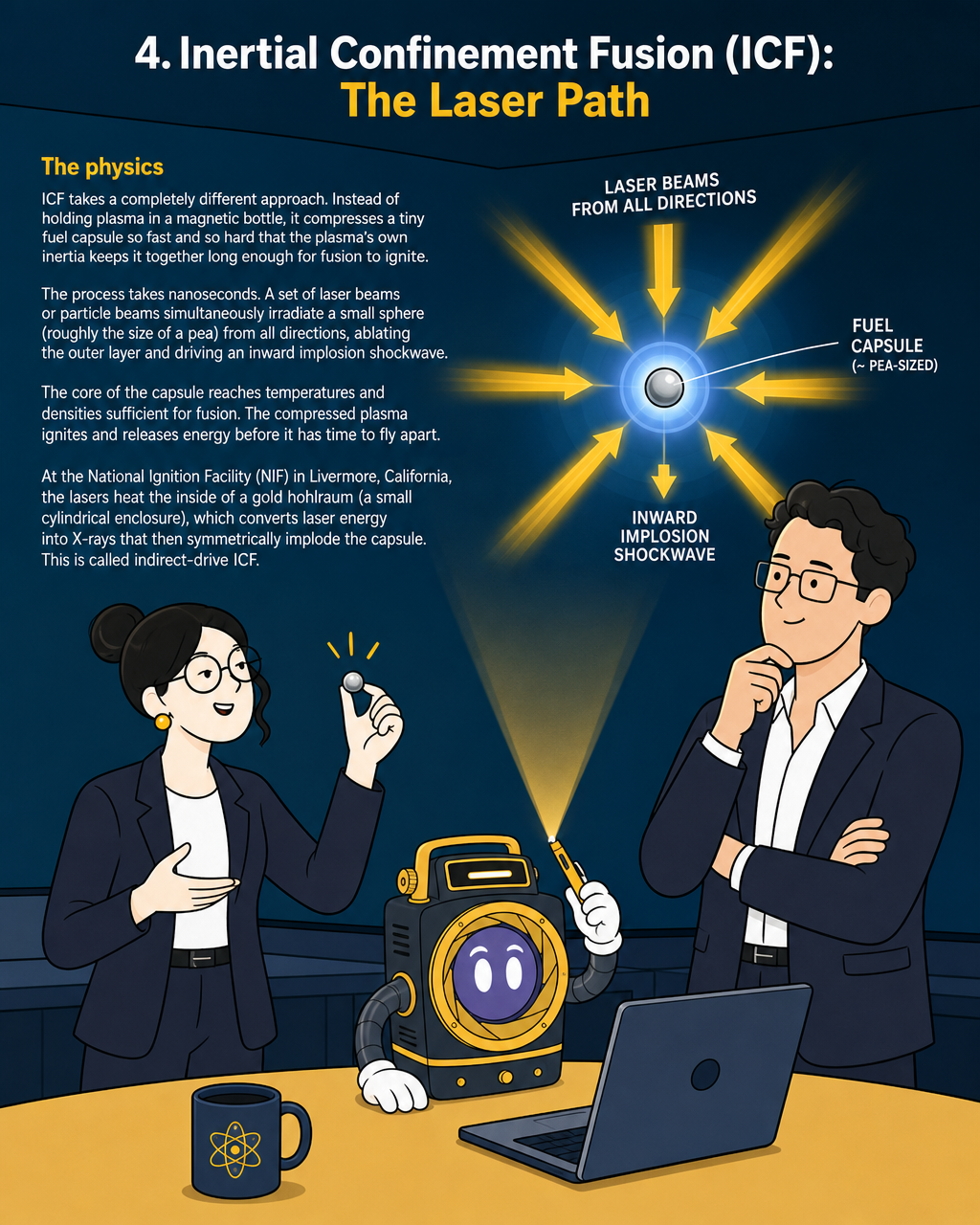
ICF takes a completely different approach. Instead of holding plasma in a magnetic bottle, it compresses a tiny fuel capsule so fast and so hard that the plasma's own inertia keeps it together long enough for fusion to ignite. The process takes nanoseconds. A set of laser beams or particle beams simultaneously irradiate a small sphere (roughly the size of a pea) from all directions, ablating the outer layer and driving an inward implosion shockwave. The core of the capsule reaches temperatures and densities sufficient for fusion. The compressed plasma ignites and releases energy before it has time to fly apart.
At the National Ignition Facility (NIF) in Livermore, California, the lasers heat the inside of a gold hohlraum (a small cylindrical enclosure), which converts laser energy into X-rays that then symmetrically implode the capsule. This is called indirect-drive ICF.
Maturity and milestones
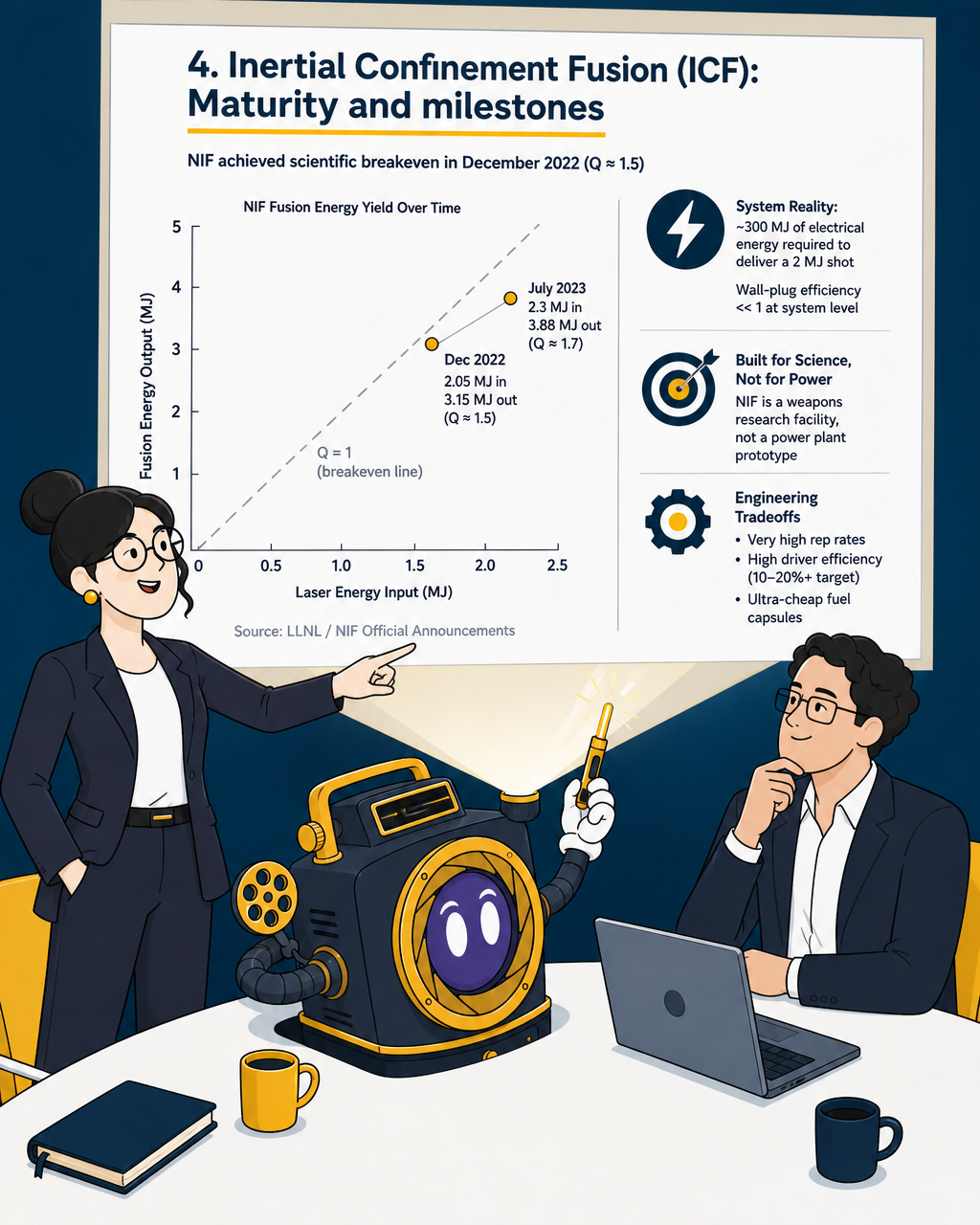
NIF achieved scientific breakeven in December 2022, producing 3.15 MJ of fusion energy from 2.05 MJ of laser energy (Q of approximately 1.5). Since then, NIF has continued to improve yields — a July 2023 shot produced approximately 3.88 MJ, and LLNL has reported further progress in subsequent campaigns. Investors should consult the latest official LLNL and NIF announcements and peer-reviewed publications for confirmed yield figures, as specific results from 2024–2025 shots are still being formally reported.
This is genuine scientific progress. But it comes with an important caveat for investors. The NIF lasers themselves require roughly 300 MJ of electrical energy to deliver a 2 MJ shot to the target. The ratio of electrical energy in to fusion energy out remains far below 1 at the system level, regardless of target gain. NIF was built as a nuclear weapons research facility, not a power plant prototype. That wall-plug inefficiency is the central engineering challenge ICF must solve for commercial viability.
Engineering tradeoffs
ICF requires three things simultaneously: very high repetition rates (many shots per second to produce sustained megawatt-scale power), very high driver efficiency (lasers that convert electricity to laser light at 10–20% or above, not the current 1%), and very cheap, mass-produced fuel capsules (which currently cost thousands of dollars each to fabricate to the required precision). Private companies such as Xcimer Energy are developing high-efficiency laser architectures. Marvel Fusion and others are pursuing alternative driver approaches using shorter-pulse lasers or particle beams. The scientific gain is proven. The engineering scale-up is the open question, and it is substantial.
Investor Comparison: The Five Dimensions That Matter
1. Confinement time (τ)
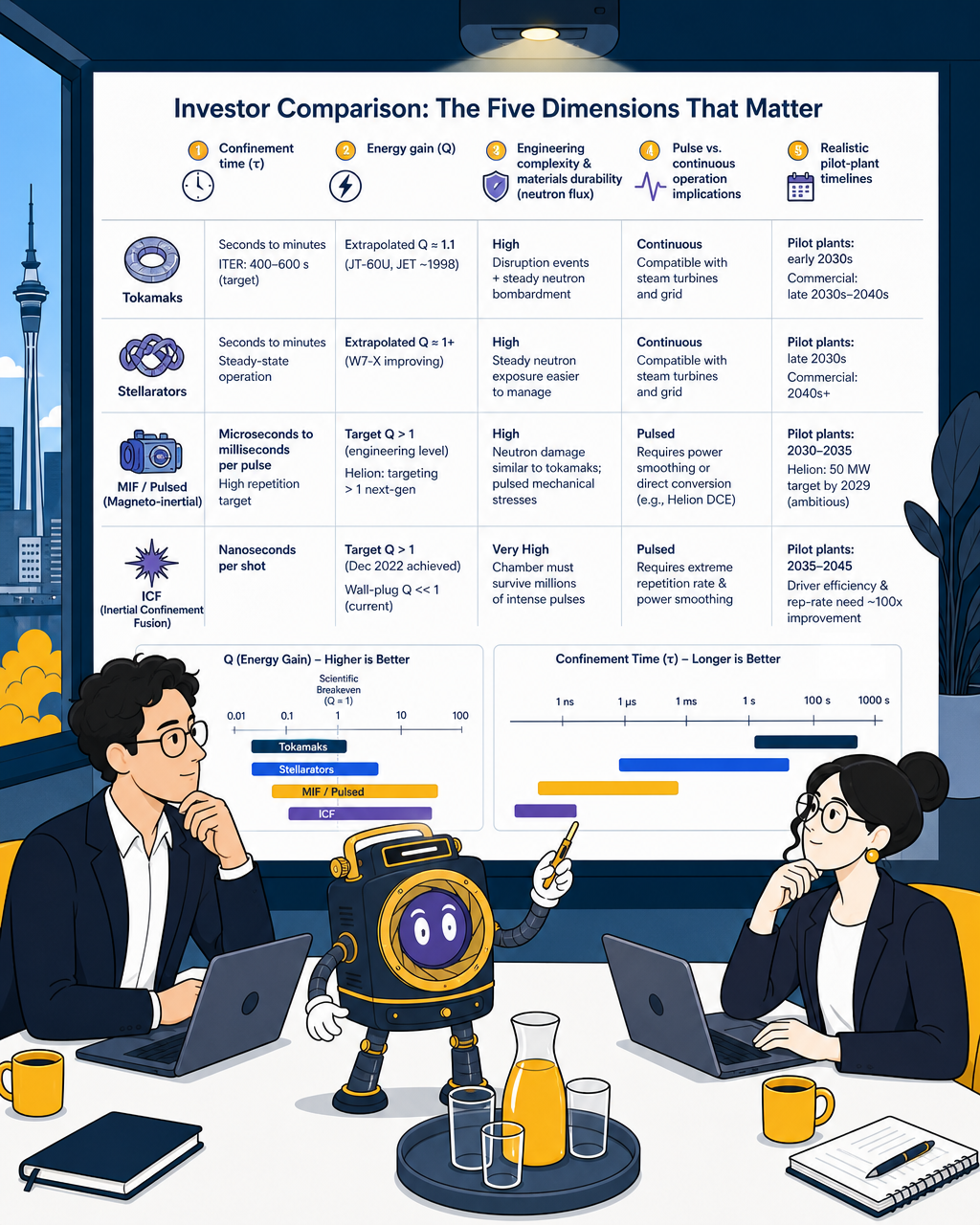
This is how long the plasma is held at fusion conditions. For magnetic approaches, longer is generally better and correlates with energy gain. Tokamaks and stellarators can sustain plasma for seconds to minutes in current experimental devices, with ITER targeting pulses of 400–600 seconds at full performance. MIF operates in microseconds-to-milliseconds per pulse but aims to compensate with high repetition. ICF confines plasma for nanoseconds per shot, relying entirely on implosion physics rather than sustained containment.
Investor implication: Shorter confinement time means higher repetition-rate requirements and different power conversion engineering. Tokamaks and stellarators have the clearest path to continuous (baseload) output.
2. Energy gain (Q)
Q is the ratio of fusion energy produced to heating energy supplied to the plasma. Q > 1 is "scientific breakeven." Commercial power plants need Q in the range of 5–10 or higher to account for conversion and plant efficiency losses and deliver net electricity.
Current Q records: tokamak extrapolated Q equivalent slightly above 1 (JT-60U and JET experiments around 1998); NIF target Q above 1 achieved in December 2022 and improving in subsequent shots, though the wall-plug Q for the full NIF system remains well below 1 due to laser inefficiency; MIF companies such as Helion are targeting Q > 1 at the engineering level in their next-generation machines.
Investor implication: Q figures in press releases require careful reading. Target Q (energy out of the capsule versus laser energy in) is not the same as scientific Q (fusion power versus total plasma heating) or wall-plug Q (fusion power versus total electricity consumed by the plant). Ask which definition is being used.
3. Engineering complexity and materials durability under neutron flux
All D-T fusion produces high-energy (14.1 MeV) neutrons. These neutrons don't stay in the plasma — they escape into the surrounding structure and over time damage materials, activate them radioactively, and degrade mechanical properties. This is one of the most significant unsolved engineering challenges in fusion generally, and it applies to tokamaks, stellarators, and MIF equally.
For ICF, the pulsed nature means the chamber walls experience repeating intense pulses of neutron and X-ray flux. Developing a chamber that can survive millions of shots is an area of active research. Stellarators benefit from their steady-state profile — gradual, continuous neutron exposure is easier to manage with known materials science. Tokamaks must handle disruption events in addition to steady neutron bombardment.
Investor implication: First-wall and blanket materials are a capital cost wildcard in all fusion approaches. Companies claiming near-term commercial viability should have credible materials strategies, not just plasma performance milestones.
4. Pulse-versus-continuous operation implications for power conversion
This is often underweighted in public discussion. Steam turbines and grid interconnection infrastructure are designed for continuous or slowly varying power input. A tokamak or stellarator that produces steady thermal output can be connected to a conventional turbine-generator. An ICF plant firing many shots per second produces power in rapid pulses that must be smoothed before they can drive a turbine or feed the grid. MIF approaches that fire large pulses at lower repetition rates face the same challenge, but the engineering path is different.
Helion's approach of direct electricity conversion (using the expanding plasma to induce current in surrounding coils) sidesteps the steam turbine entirely, but requires the plasma-current induction to work efficiently at scale.
Investor implication: Power conversion is a separate engineering programme from plasma performance. A company that has solved plasma Q but not power conversion is not closer to a power plant than its Q number suggests.
5. Realistic pilot-plant timelines
Here the honest answer requires distinguishing between scientific milestones (plasma performance), engineering milestones (net electricity at the plant level), and commercial milestones (dispatchable grid power at competitive cost).
Current landscape, as of mid-2026:
- Tokamaks: ITER targets D-T operations in the 2039–2040 timeframe. Private tokamak companies (CFS/SPARC, Tokamak Energy) are targeting net energy demonstration in the late 2020s and pilot plants in the early 2030s. Commercial fusion plants from this pathway are most credibly projected for the late 2030s to 2040s.
- Stellarators: Behind tokamaks on the commercial timeline by roughly a decade, though recent W7-X experimental results have compressed that gap. Proxima Fusion and others are targeting power plant design completion in the early 2030s with demonstration plants possible in the late 2030s.
- Magneto-inertial/pulsed: Helion's Microsoft agreement targets 50 MW by 2029, though this is widely regarded as a highly ambitious milestone. Most analysts place credible pilot-plant timelines from serious MIF companies in the 2030–2035 window.
- ICF: Driver efficiency and repetition rate must improve by roughly two orders of magnitude from current NIF performance before commercial viability is plausible. Private ICF companies targeting these improvements project pilot plants in the 2035–2045 range.
What This Means Before You Write the Cheque
Fusion is not a binary bet. The question isn't "will fusion work?" — it already does, in a laboratory. The question is which approach solves the engineering-to-commercial pathway fastest.
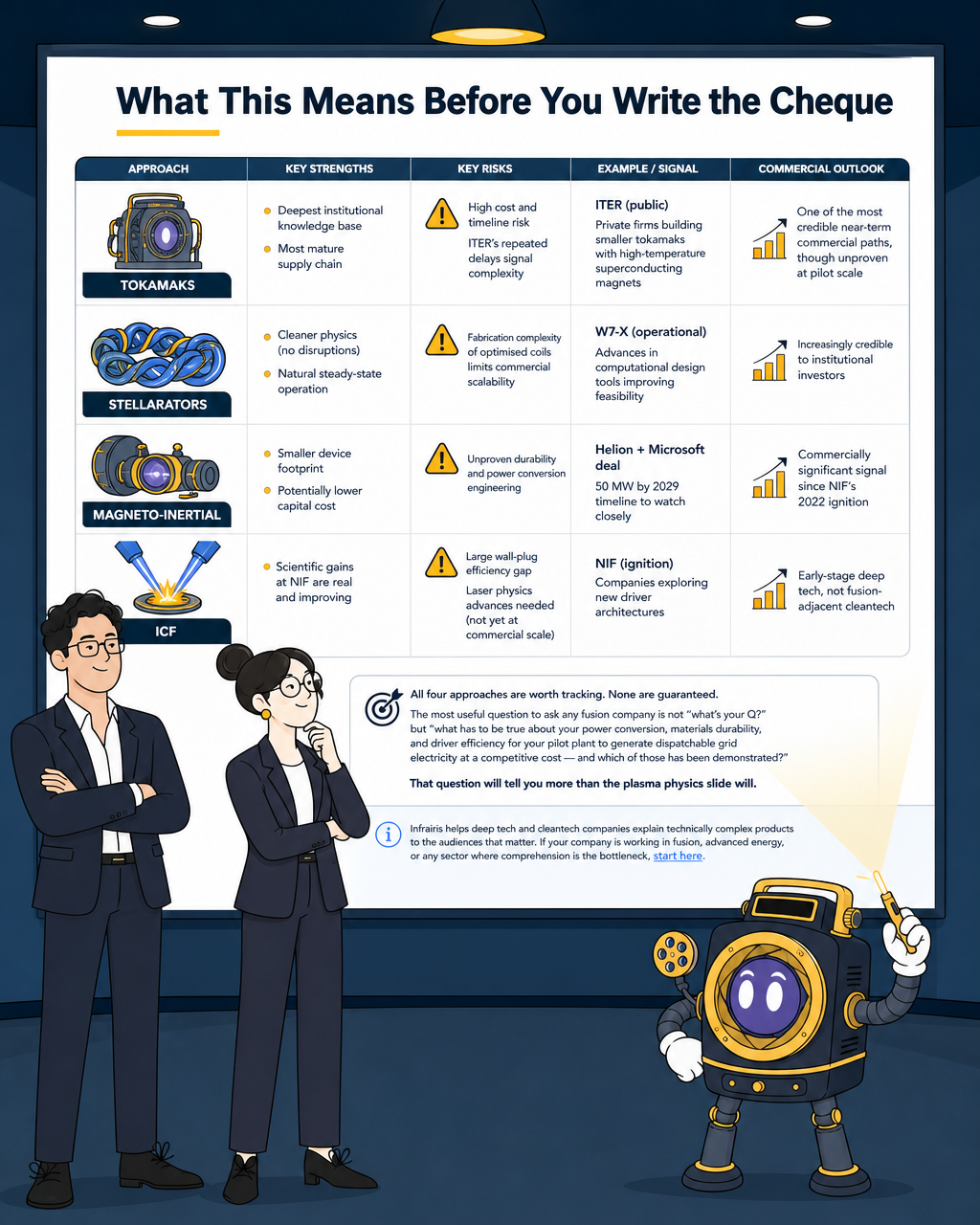
Tokamaks carry the deepest institutional knowledge base and the most mature supply chain. Their risk is cost and timeline: ITER's repeated delays are a cautionary signal about the complexity of large-scale magnetic confinement construction. Private tokamak companies betting on high-temperature superconducting magnets to build smaller, cheaper devices represent one of the more credible near-term commercial paths, though that thesis remains unproven at pilot scale.
Stellarators carry a different risk profile: the physics is arguably cleaner (no disruptions, natural steady-state operation), but the fabrication complexity of optimised coil geometries has historically limited commercial scalability. Recent computational design tools are changing this, and W7-X's ongoing experimental results have made stellarators increasingly credible to institutional investors.
Magneto-inertial approaches offer a smaller device footprint and potentially lower capital cost, at the price of unproven durability and power conversion engineering. Helion's Microsoft deal is among the most commercially significant signals in fusion since NIF's 2022 ignition, but that timeline (50 MW by 2029) will need to be watched closely.
ICF's scientific gains at NIF are genuine and improving. The wall-plug inefficiency gap remains large, and closing it requires advances in laser physics that are progressing but not yet demonstrated at commercial scale. ICF companies betting on new driver architectures are effectively early-stage deep tech, not fusion-adjacent cleantech.
All four approaches are worth tracking. None are guaranteed. The most useful question to ask any fusion company is not "what's your Q?" but "what has to be true about your power conversion, materials durability, and driver efficiency for your pilot plant to generate dispatchable grid electricity at a competitive cost — and which of those has been demonstrated?"
That question will tell you more than the plasma physics slide will.
Infrairis helps deep tech and cleantech companies explain technically complex products to the audiences that matter. If your company is working in fusion, advanced energy, or any sector where comprehension is the bottleneck, start here.

Infrairis
Your complex product. In 60 seconds. Clearly.
Your complex product. In 60 seconds. Clearly.
Learn more about Infrairis and get started today.
Visit Infrairis