Physical vs Logical Qubits: What Investors Actually Need to Know



Every quantum computing pitch deck you've seen this year mentions qubits. Some quote thousands of them. Some quote millions. A few quietly mention something called "logical qubits" — and that distinction is the one that actually matters when you're deciding whether a company's roadmap is credible or aspirational fiction.
This is a plain-language breakdown of the difference. No physics degree required.
The raw material: physical qubits
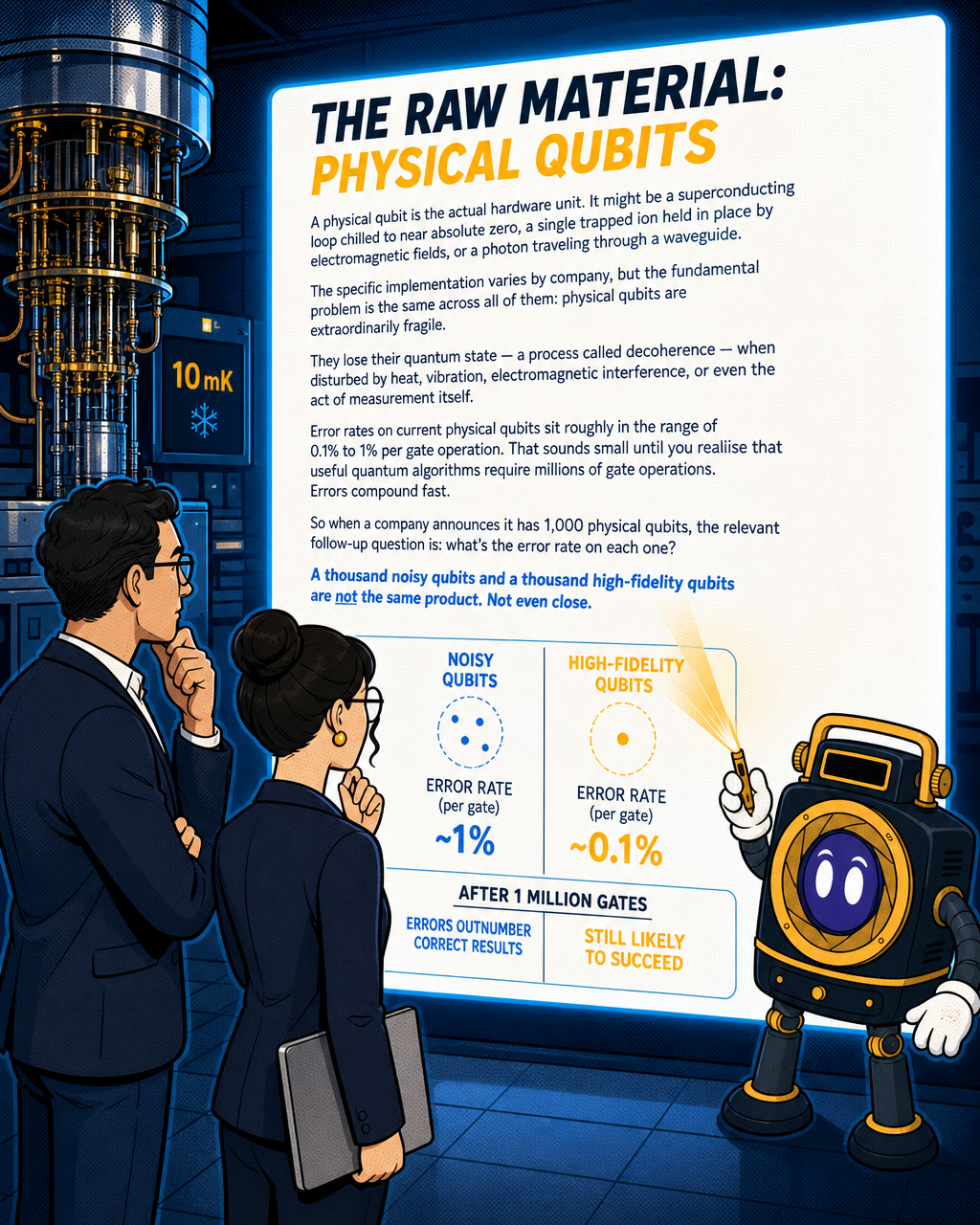
A physical qubit is the actual hardware unit. It might be a superconducting loop chilled to near absolute zero, a single trapped ion held in place by electromagnetic fields, or a photon traveling through a waveguide. The specific implementation varies by company, but the fundamental problem is the same across all of them: physical qubits are extraordinarily fragile.
They lose their quantum state — a process called decoherence — when disturbed by heat, vibration, electromagnetic interference, or even the act of measurement itself. Error rates on current physical qubits sit roughly in the range of 0.1% to 1% per gate operation. That sounds small until you realise that useful quantum algorithms require millions of gate operations. Errors compound fast.
So when a company announces it has 1,000 physical qubits, the relevant follow-up question is: what's the error rate on each one? A thousand noisy qubits and a thousand high-fidelity qubits are not the same product. Not even close.
The construct that actually does useful work: logical qubits
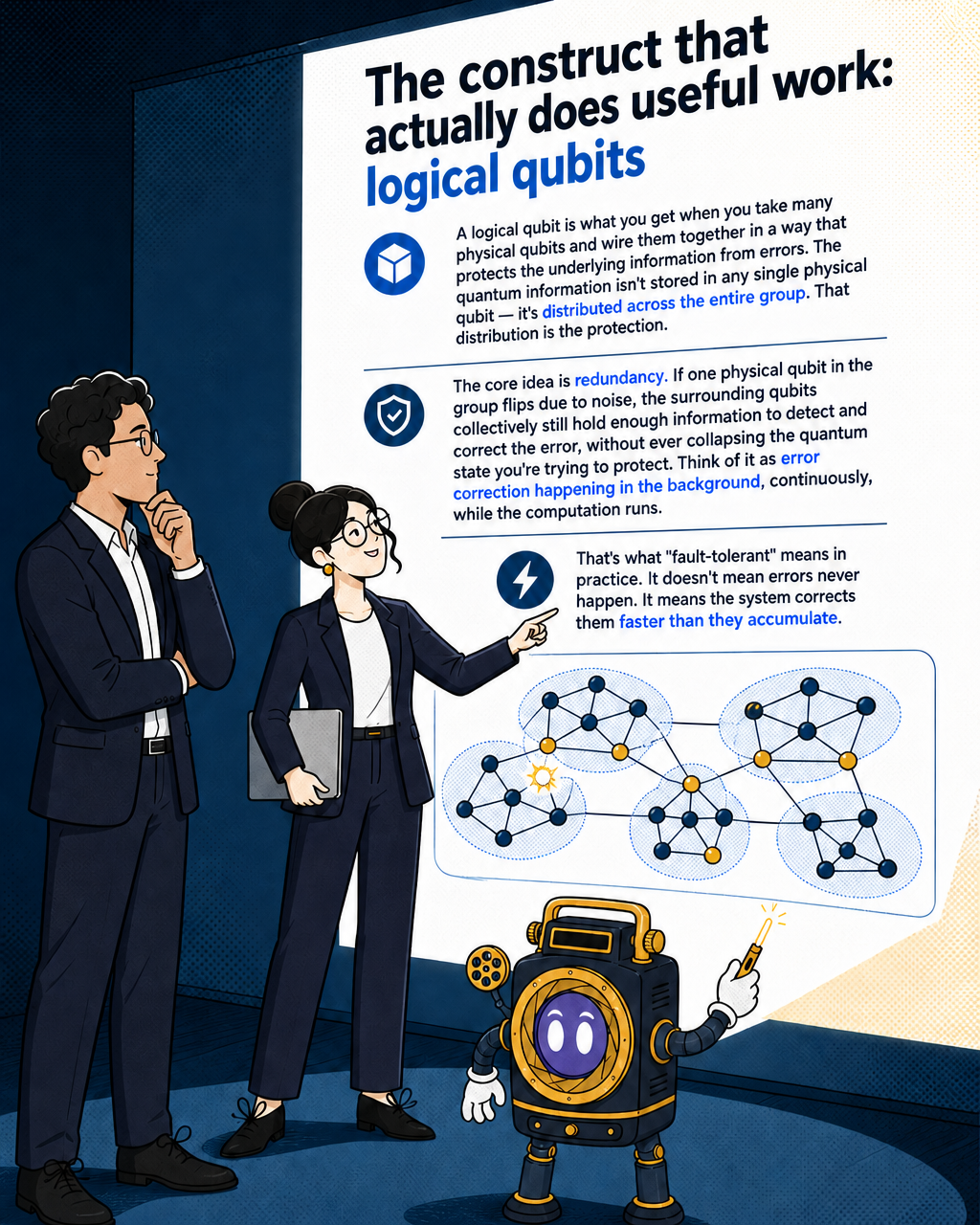
A logical qubit is what you get when you take many physical qubits and wire them together in a way that protects the underlying information from errors. The quantum information isn't stored in any single physical qubit — it's distributed across the entire group. That distribution is the protection.
The core idea is redundancy. If one physical qubit in the group flips due to noise, the surrounding qubits collectively still hold enough information to detect and correct the error, without ever collapsing the quantum state you're trying to protect. Think of it as error correction happening in the background, continuously, while the computation runs.
That's what "fault-tolerant" means in practice. It doesn't mean errors never happen. It means the system corrects them faster than they accumulate.
How error correction codes actually work
The two most discussed approaches are the surface code and the color code. Both belong to a family called quantum error-correcting codes, but they differ in geometry and overhead.
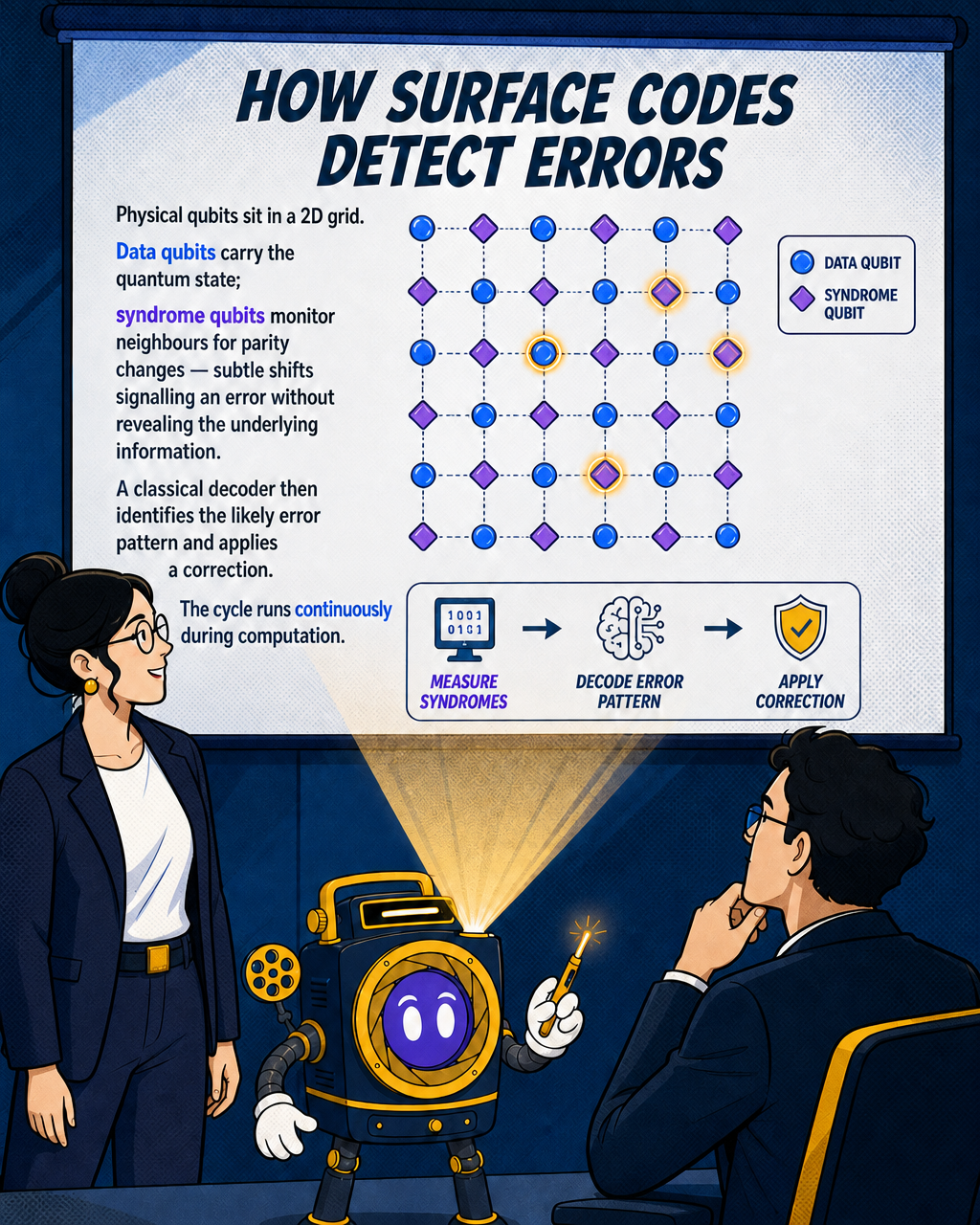
In a surface code, physical qubits are arranged in a two-dimensional grid. Some are "data qubits" that carry the actual quantum state. Others are "syndrome qubits" (also called ancilla or measurement qubits) that monitor their neighbours for anomalies. The syndrome qubits don't read the data directly — that would collapse the state. Instead, they detect parity changes across adjacent data qubits: subtle shifts that signal an error has occurred without revealing the underlying information.
A classical decoder then processes the syndrome measurement history and figures out the most likely pattern of errors, allowing the system to apply a corrective operation. The whole cycle runs continuously during computation.
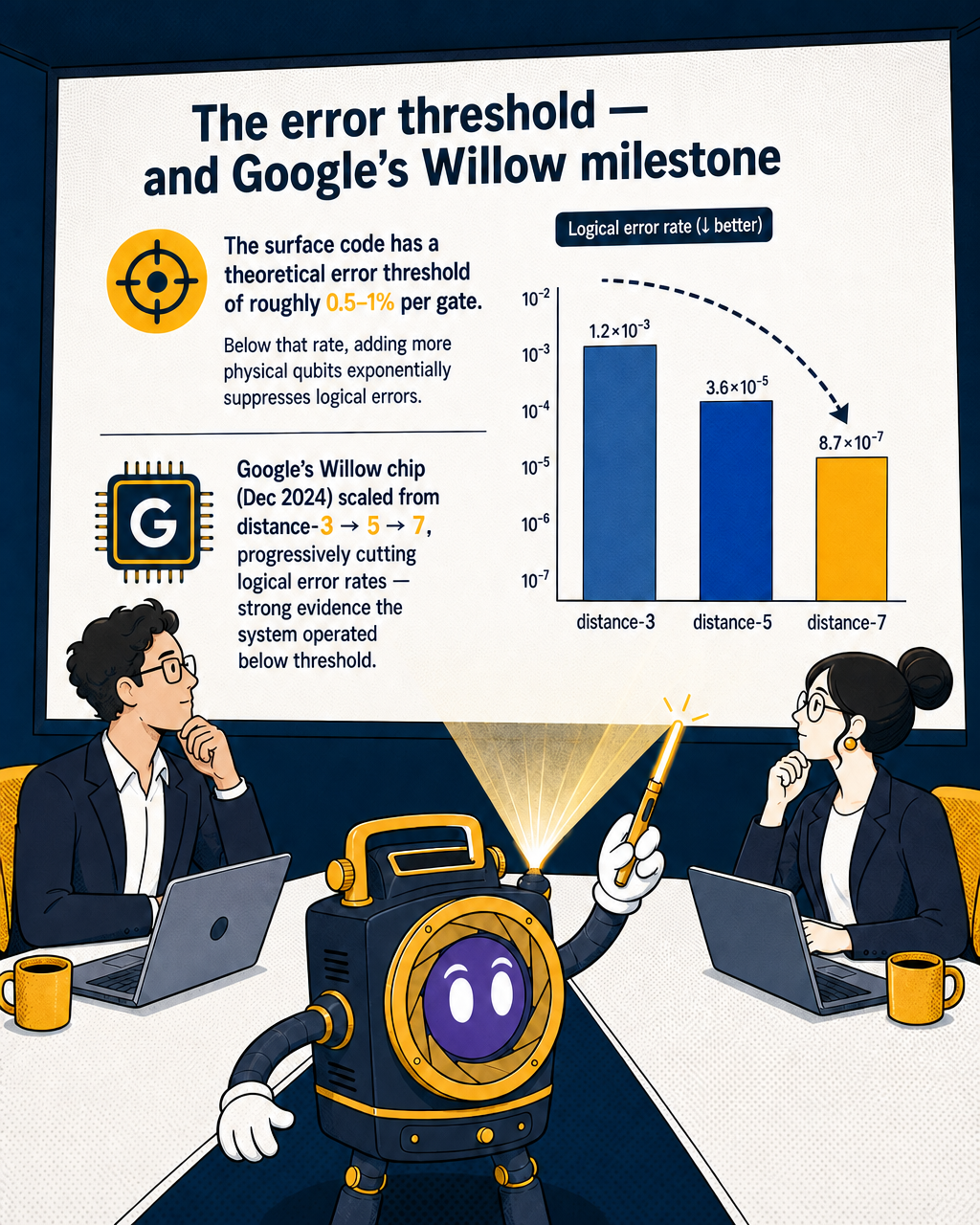
The surface code has a theoretical error threshold estimated at roughly 0.5–1% per gate operation under idealised noise models — meaning physical error rates must stay meaningfully below this range, and the precise threshold depends on the noise characteristics of the hardware. If the physical error rate is below that threshold, increasing the size of the code (adding more physical qubits to protect each logical qubit) exponentially suppresses the logical error rate. Google's Willow chip demonstrated this in December 2024: scaling from a distance-3 to distance-5 to distance-7 surface code progressively suppressed the logical error rate, providing strong experimental evidence that the system was operating below the error threshold. That was a significant experimental milestone, though the research community continues to debate the implications for practical fault-tolerant timelines.
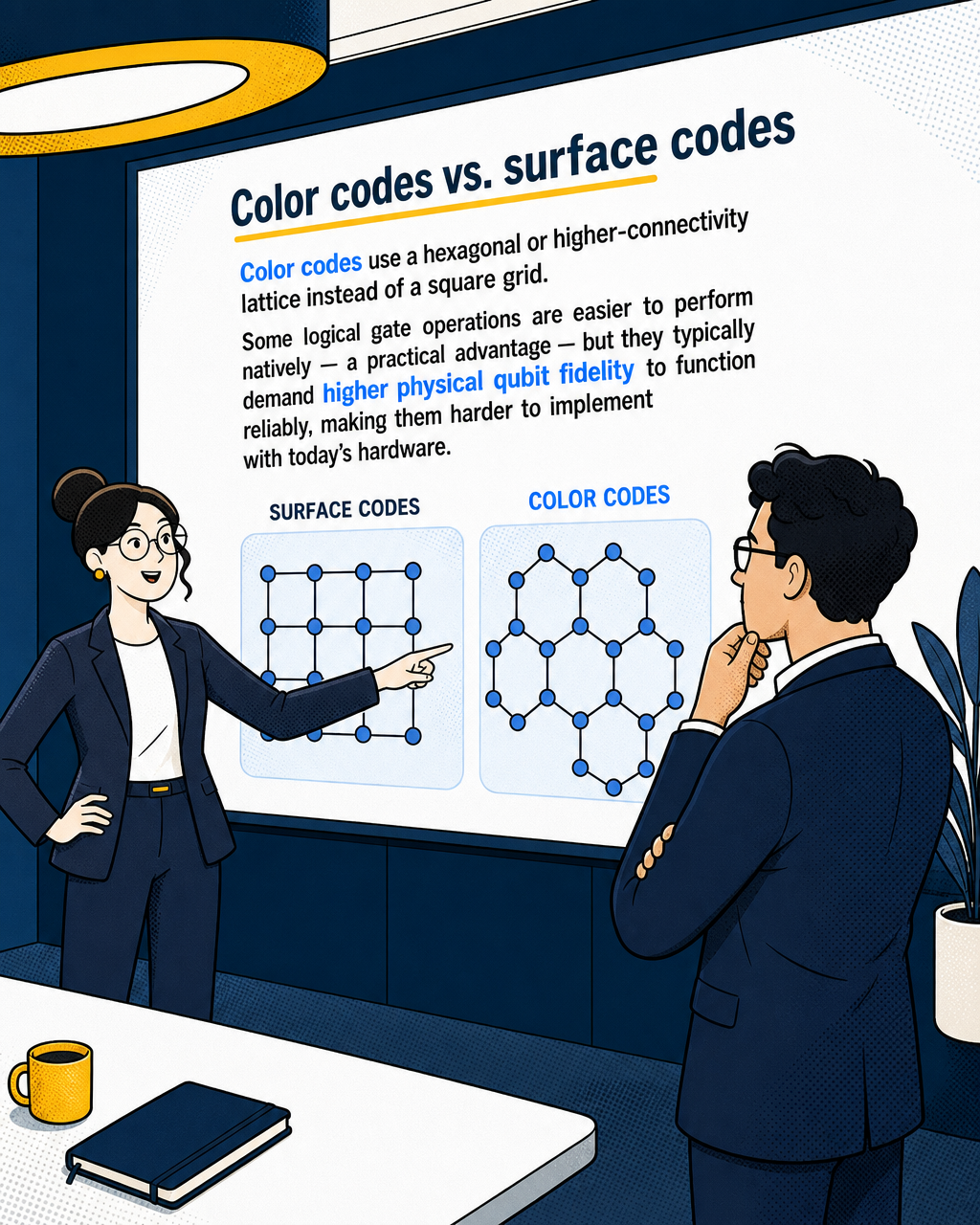
Color codes work on a similar principle but use a different geometric arrangement — a hexagonal or other higher-connectivity lattice. They offer some operational advantages (certain logical gate operations are easier to perform natively) but typically require higher physical qubit fidelity to function.
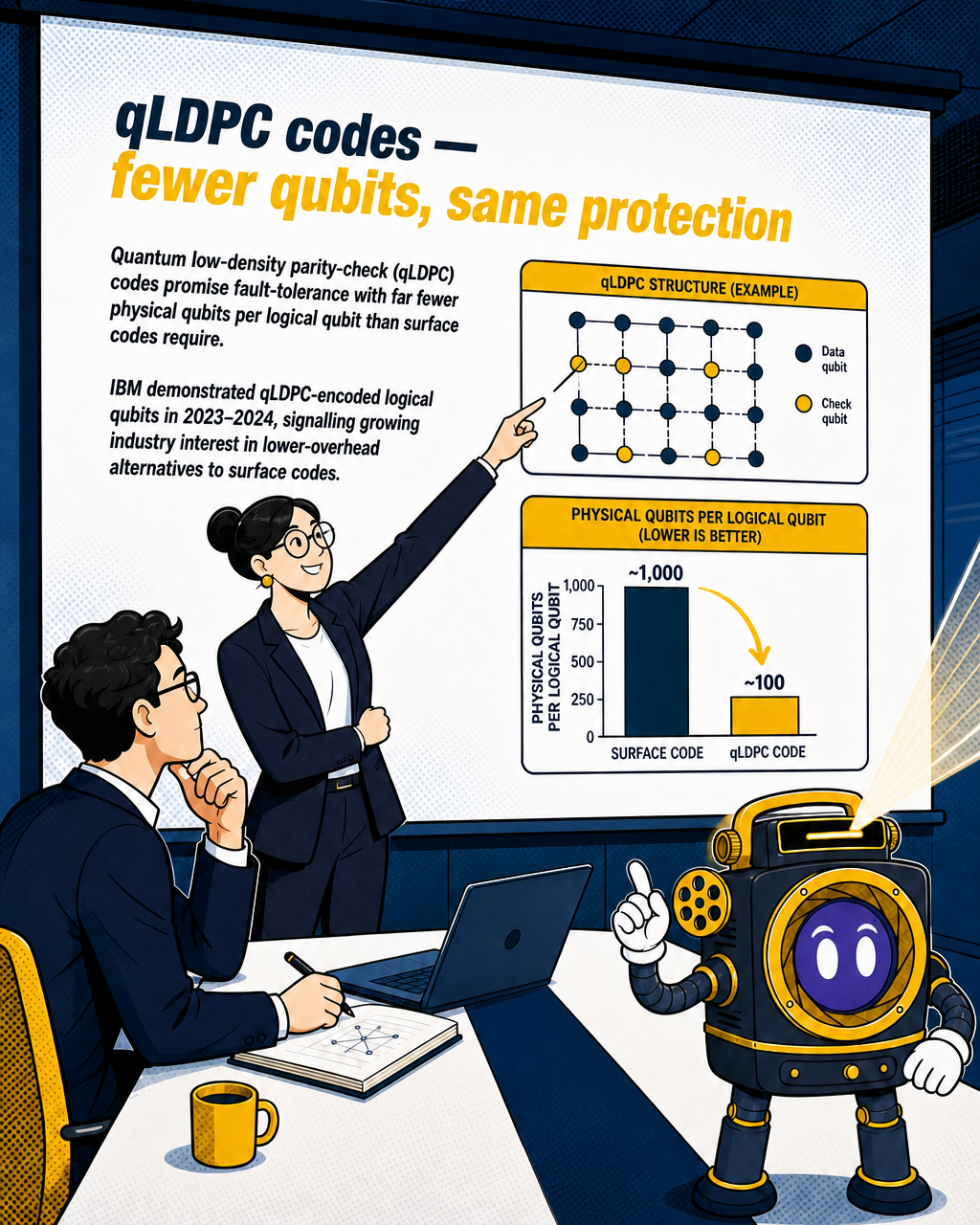
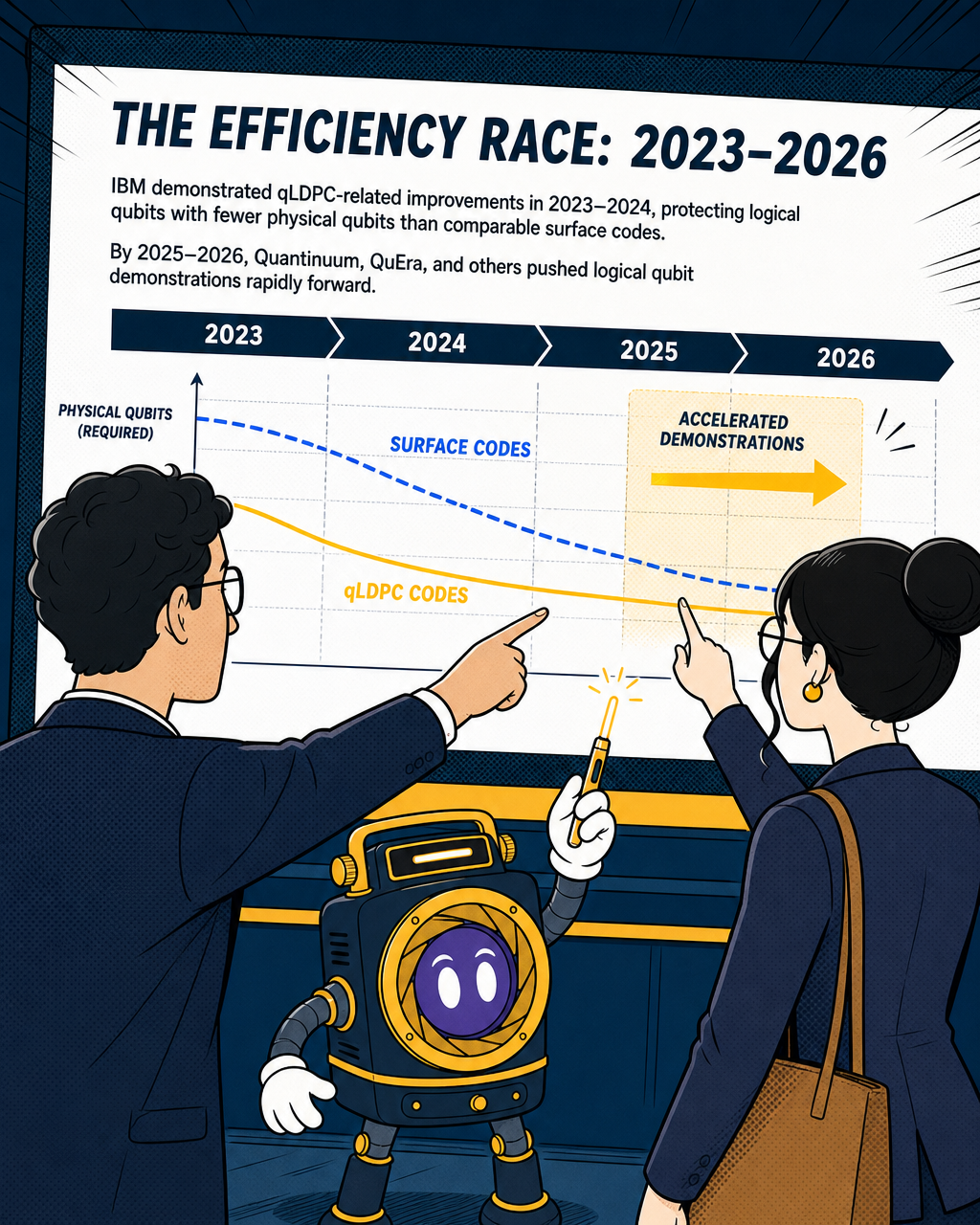
More recent approaches, particularly quantum low-density parity-check (qLDPC) codes, are attracting significant research interest because they promise to achieve the same fault-tolerance with far fewer physical qubits per logical qubit than surface codes require. IBM demonstrated qLDPC-encoded logical qubits in research settings in 2023–2024, signalling growing industry interest in alternatives to surface codes with lower qubit overhead.
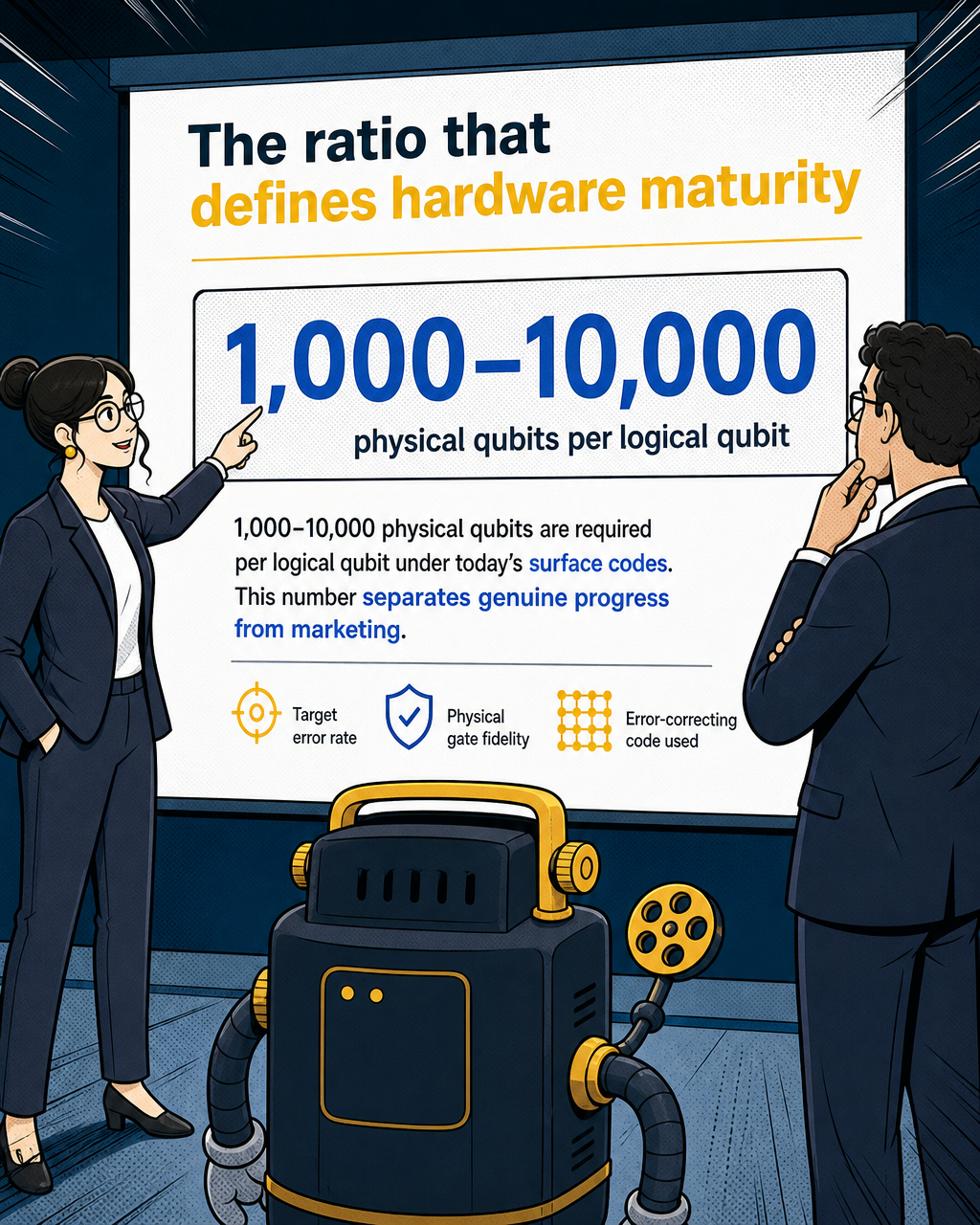
The ratio that defines hardware maturity: 1,000 to 10,000 physical qubits per logical qubit
This is the number that separates genuine technical progress from marketing.
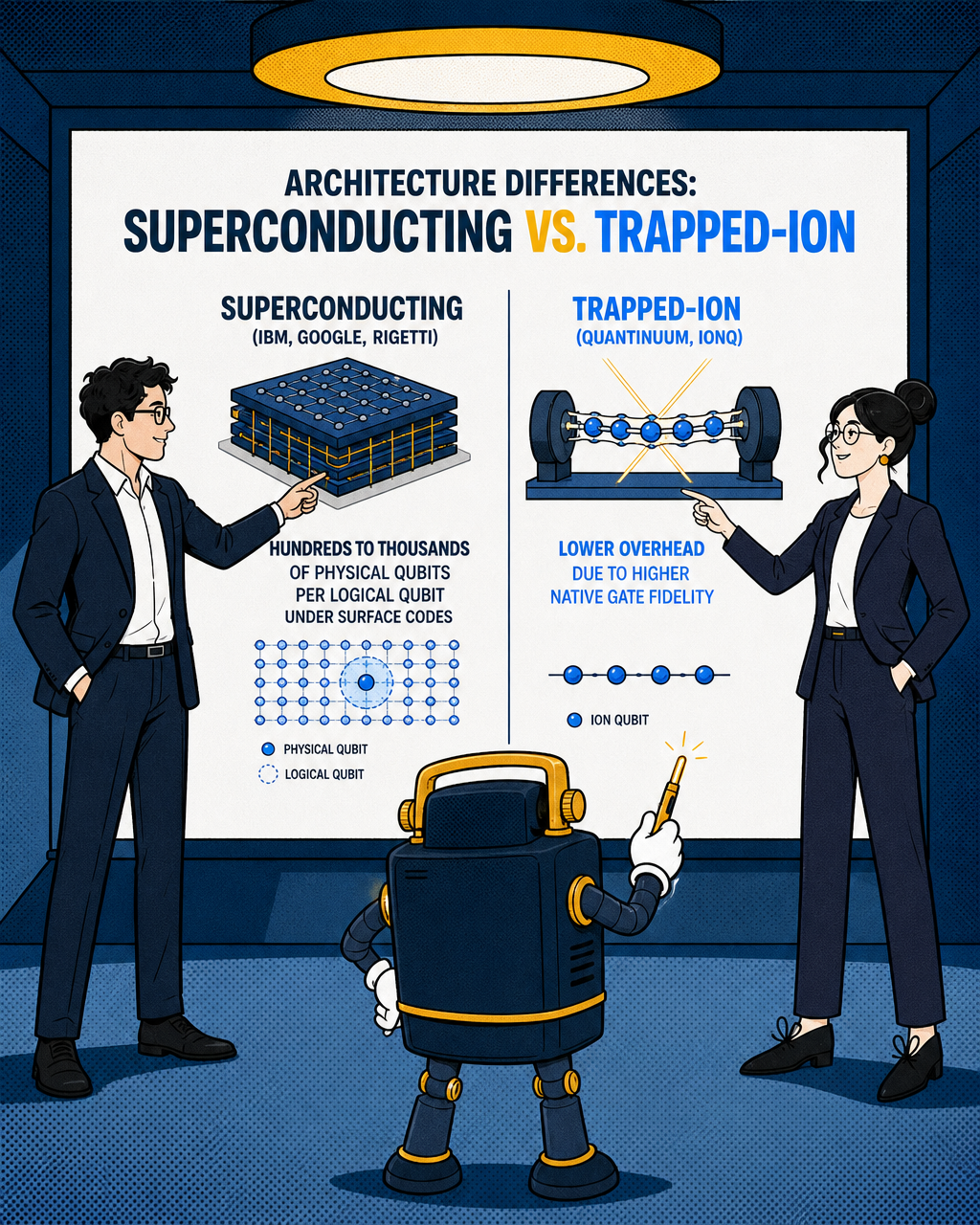
For superconducting qubit architectures (IBM, Google, Rigetti), the overhead of running a surface code at a useful distance currently requires roughly hundreds to thousands of physical qubits to sustain a single reliable logical qubit. In published demonstrations, trapped-ion systems (Quantinuum, IonQ) have achieved lower physical-to-logical overhead than superconducting approaches, owing to higher native gate fidelity — though published ratios vary by code and target error rate.
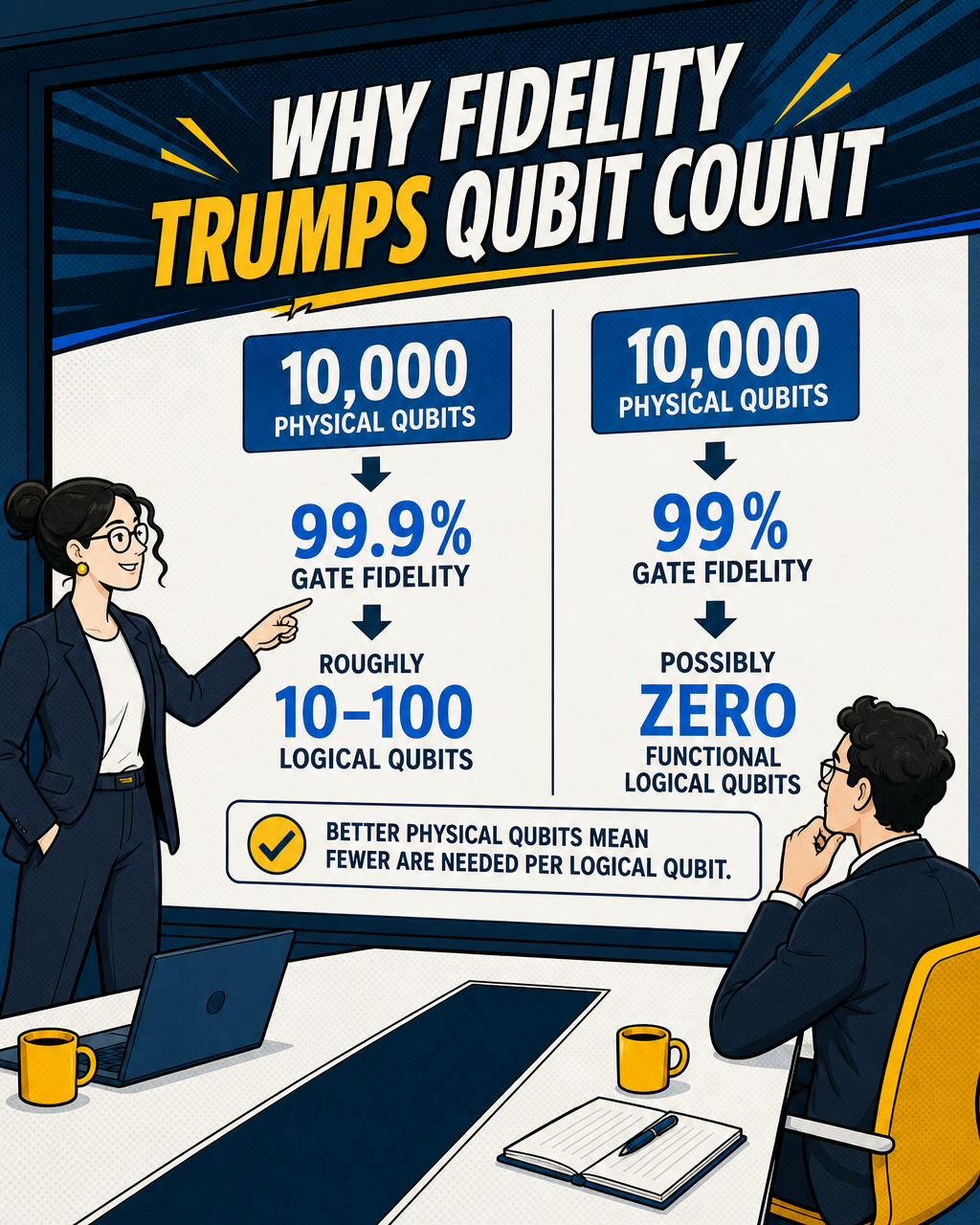
The range is wide because the ratio depends on the target error rate of the logical qubit, the fidelity of the underlying physical hardware, and the specific error-correcting code being used. Better physical qubits mean fewer of them are needed to build each logical qubit.
This overhead is why the headline physical qubit count is often a misleading number. A company with 10,000 physical qubits running at 99.9% gate fidelity under a surface code might produce roughly 10 to 100 reliable logical qubits, depending on code distance and error targets. That's a useful but small machine. The same company with 10,000 physical qubits at 99% fidelity might not produce any functional logical qubits at all.
The efficiency benchmark improving fastest right now is the physical-to-logical ratio itself. IBM demonstrated significant improvements in physical-to-logical qubit overhead in 2023–2024, using qLDPC-related approaches to protect logical qubits with fewer physical qubits than surface codes of comparable distance require. By 2025 and into 2026, the wave of logical qubit demonstrations from Quantinuum, QuEra, and others showed the field moving rapidly — though the numbers vary dramatically depending on the code, the hardware, and what "logical qubit" each company is actually claiming.
Why logical qubit count determines when quantum advantage becomes commercially real
This is the investment question underneath all the physics.
The short answer: quantum advantage in commercially meaningful problems requires not just a few logical qubits, but a sufficient number of high-quality ones running complex algorithms for extended periods.
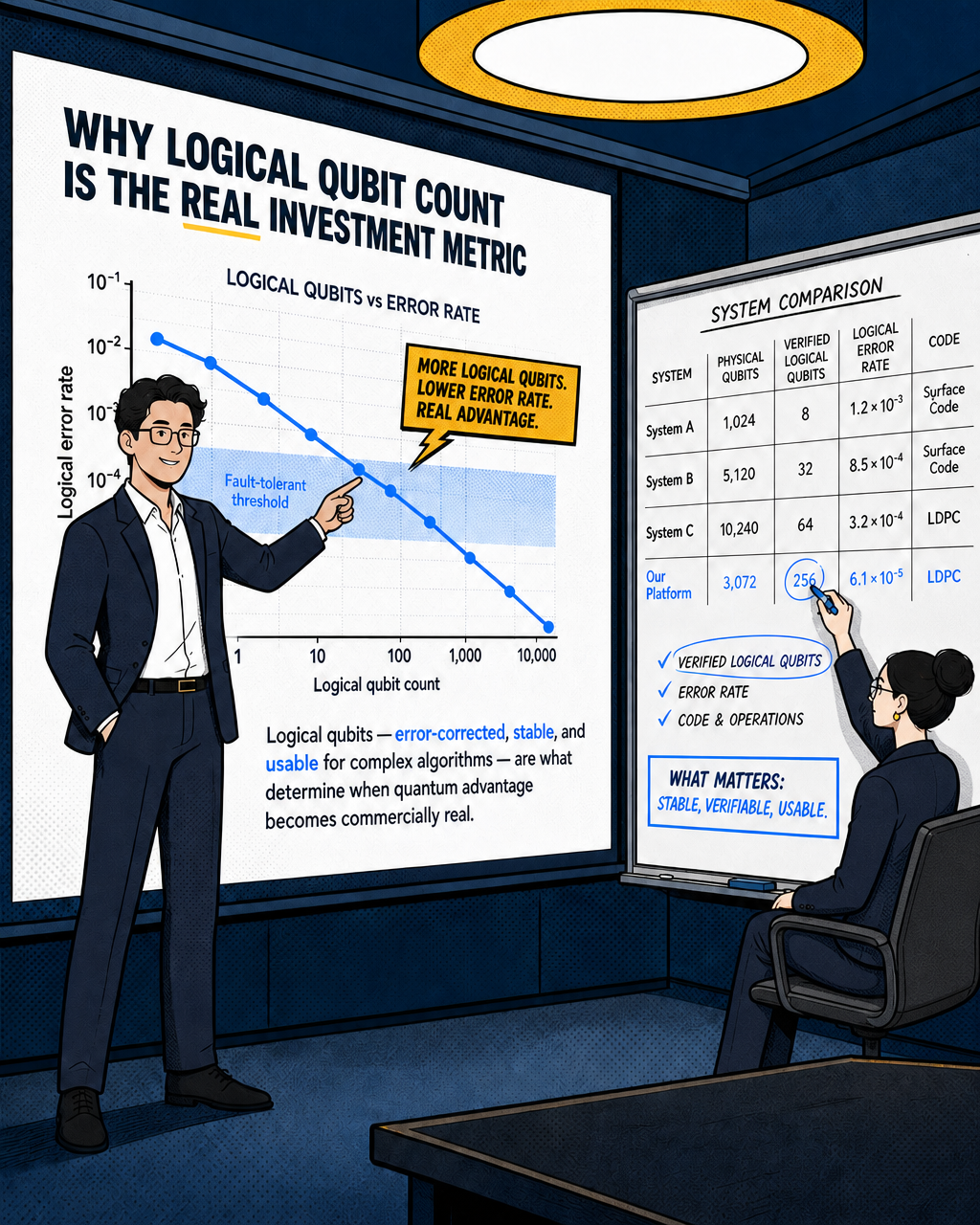
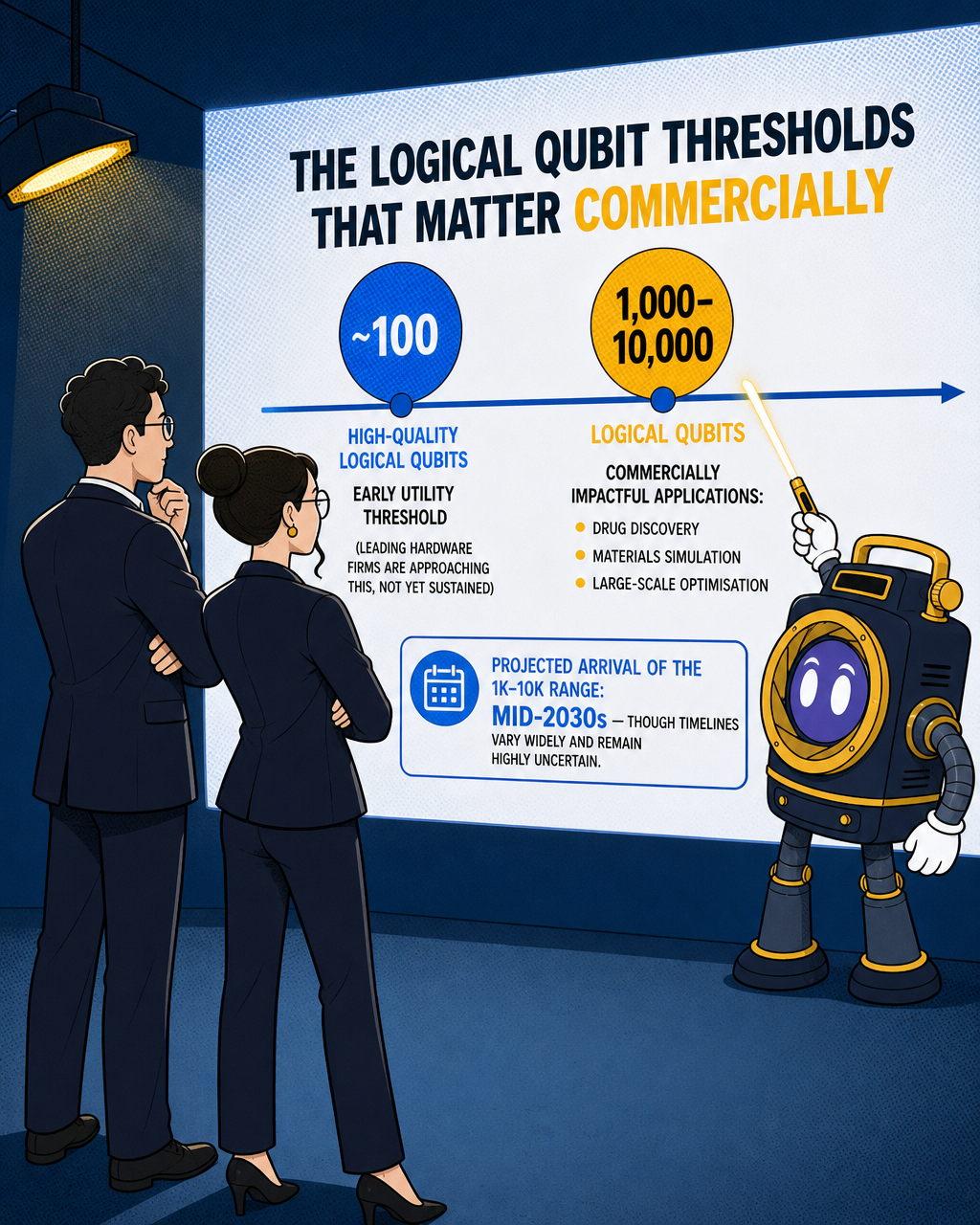
Estimates from researchers and analysts, as of mid-2026, frequently cite an early utility threshold of roughly 100 high-quality logical qubits — a level the leading hardware companies are approaching but haven't yet sustained across general-purpose workloads, though the threshold varies significantly depending on the problem class and error rate assumptions. For commercially impactful applications like drug discovery, materials simulation, or large-scale optimisation, the requirement climbs to 1,000 to 10,000 logical qubits. Several analyst and academic projections, as of 2025–2026, suggest this scale may emerge in the mid-2030s, though timelines vary widely across sources and remain highly uncertain.
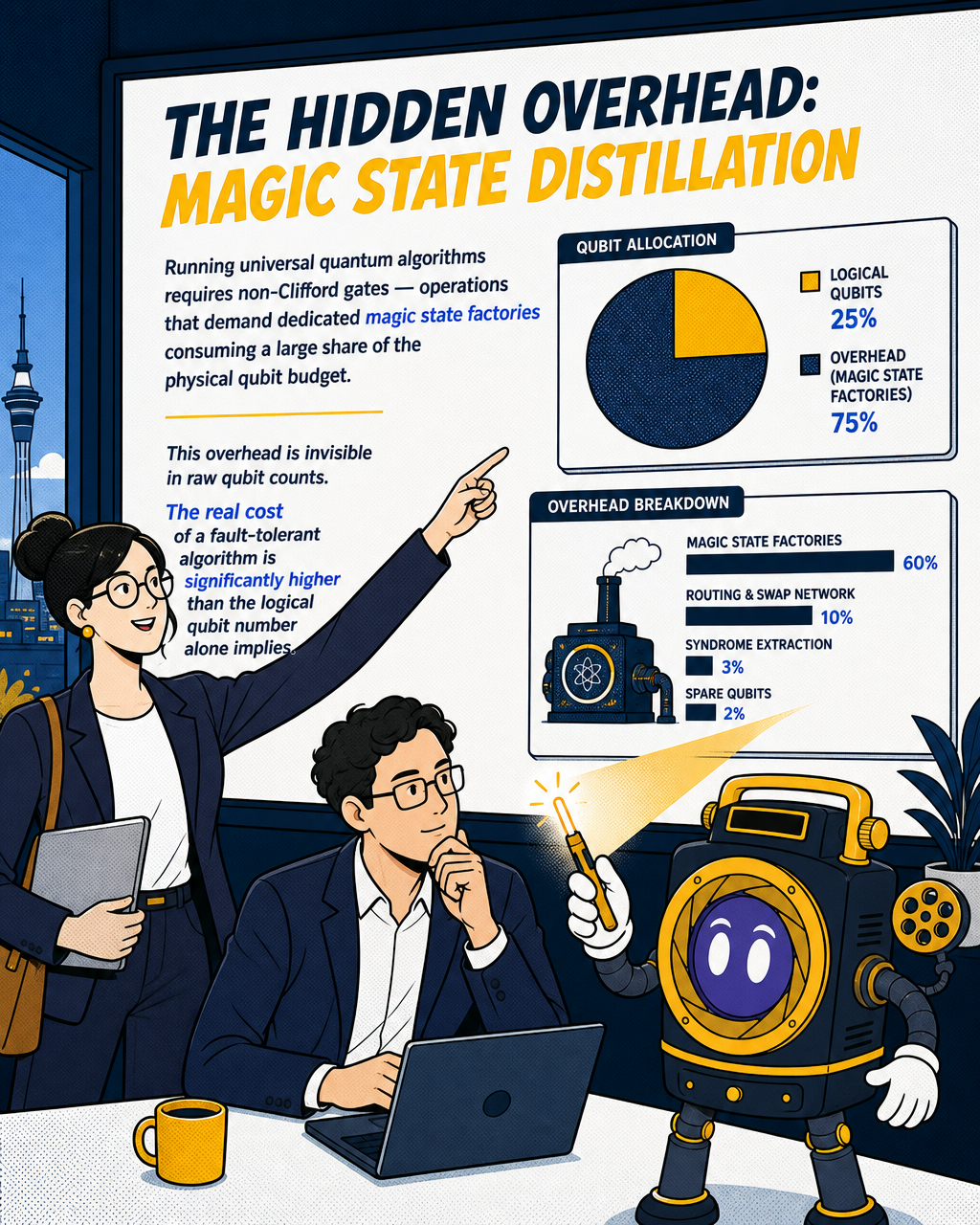
There's an additional cost that the logical qubit count alone doesn't capture: magic state distillation. Running certain essential algorithm operations (specifically non-Clifford gates, required for universal quantum computation) demands dedicated physical qubit factories that produce special quantum states on demand. This overhead consumes a large fraction of the physical qubit budget in surface-code architectures, and it means the real cost of running a useful fault-tolerant algorithm is significantly higher than the raw logical qubit count implies.
As a result, investors evaluating hardware companies need to look past the physical qubit count entirely and ask: how many verified logical qubits does the system support, at what error rate, under what code, and for what class of operations?
A company with 50 high-fidelity logical qubits and a credible path to 500 is a fundamentally different investment proposition from a company with 10,000 physical qubits and no demonstrated error correction below threshold.
The ANZ angle
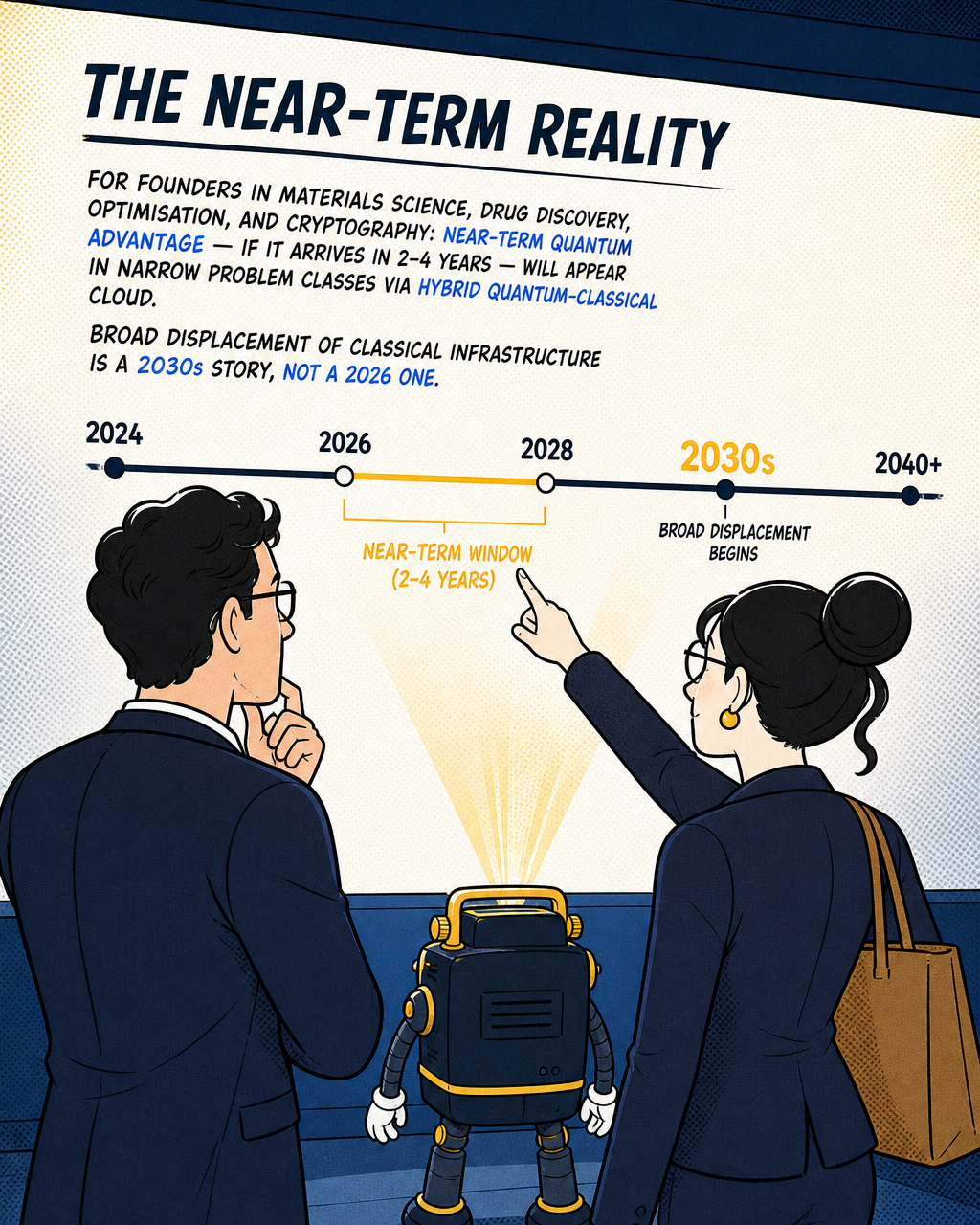
For founders and IR leads at ANZ deep tech companies working adjacent to quantum hardware — materials science, drug discovery, optimisation, cryptography infrastructure — the timeline implications are concrete.
Near-term quantum advantage, if it emerges in the next two to four years, is most likely to appear in narrow, well-defined problem classes accessed through hybrid quantum-classical cloud systems — though this timeline remains contested among researchers. Broad commercial displacement of classical computing infrastructure is a 2030s story at the earliest, not a 2026 one.
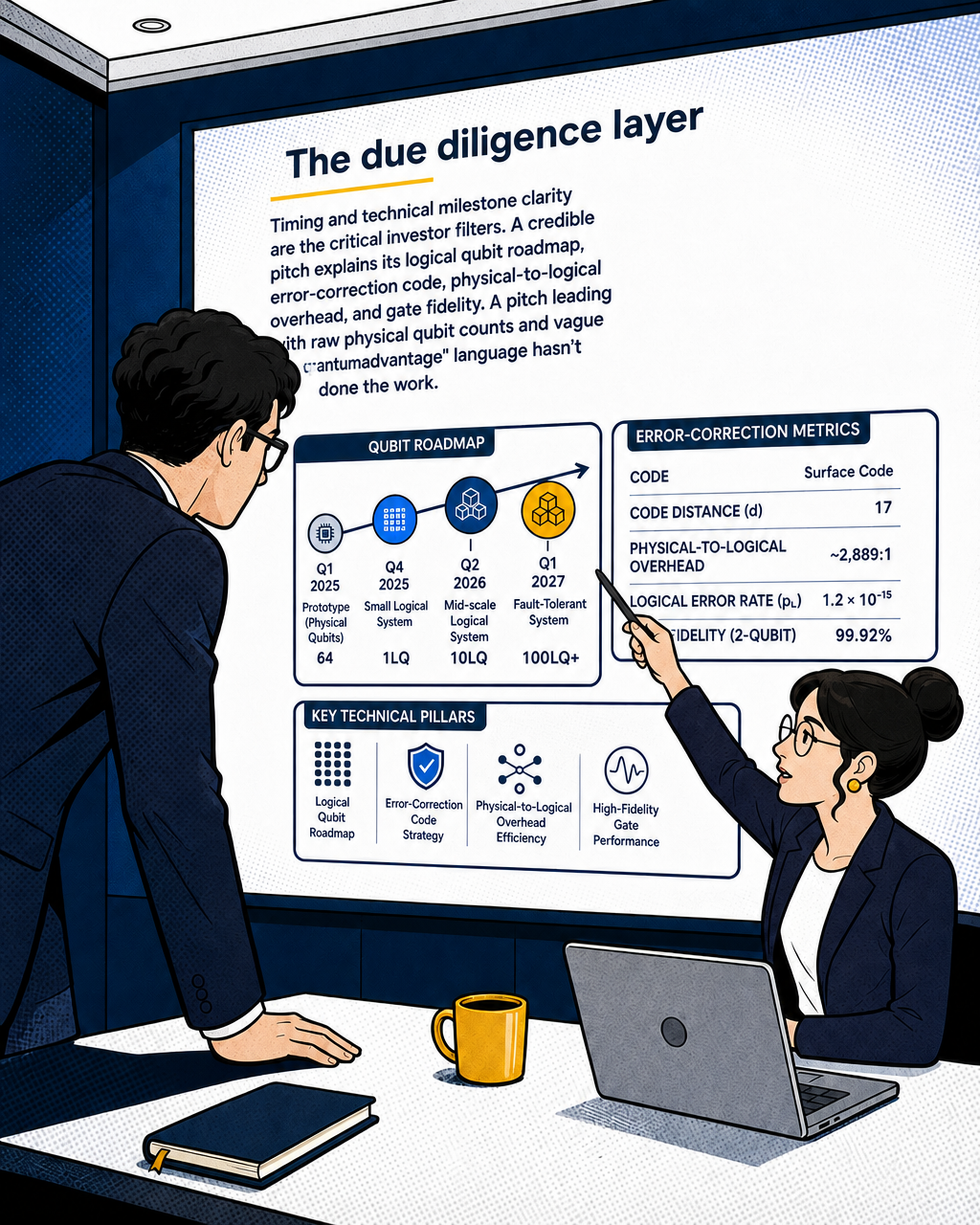
That doesn't make the sector less interesting for investors. It makes timing and technical milestone clarity the critical due-diligence layer. A company that can explain its logical qubit roadmap, the code it's using, the physical-to-logical overhead at target error rates, and the gate fidelity of its underlying hardware has done the work. A company that leads with physical qubit counts and vague "quantum advantage" language probably hasn't.
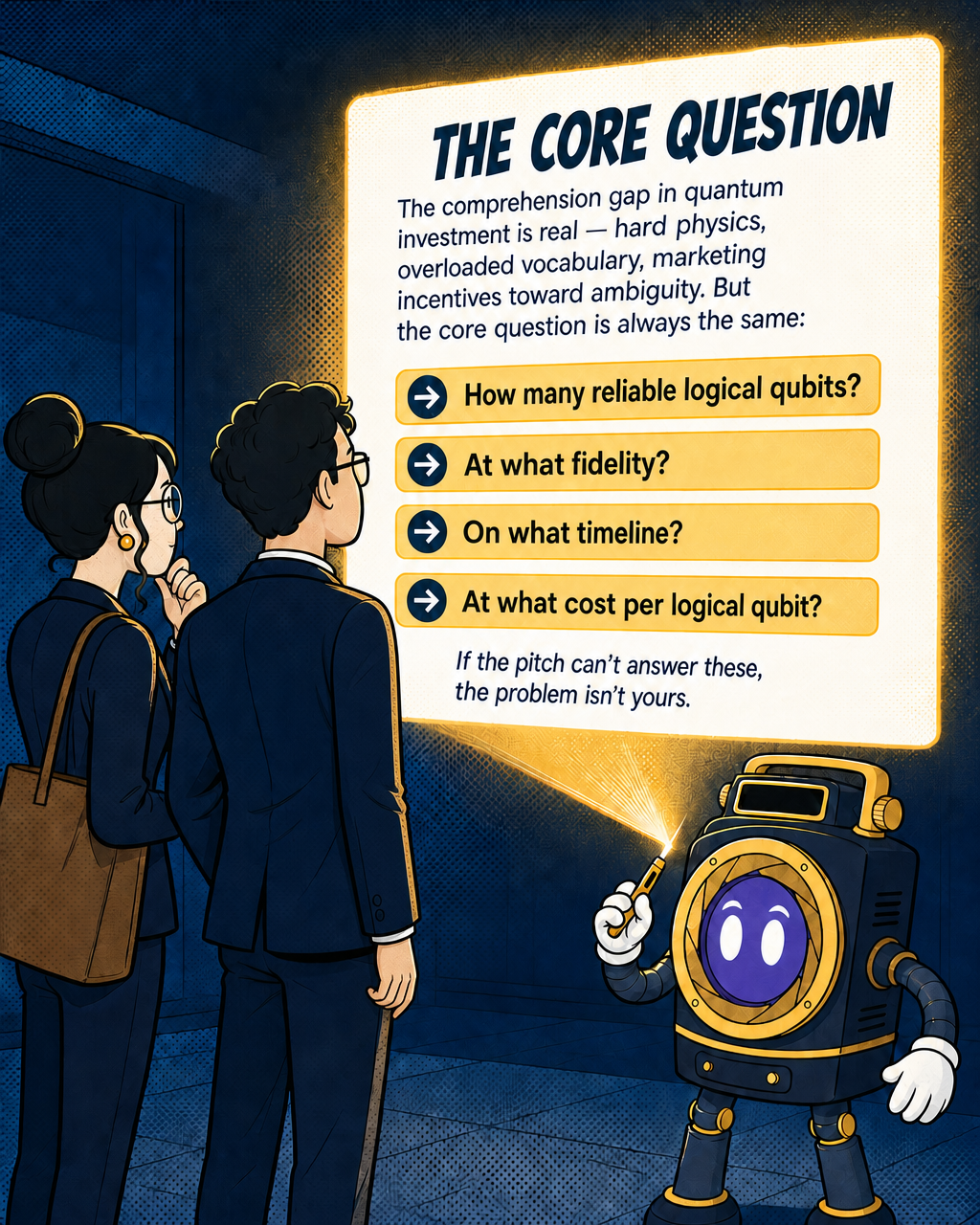
The comprehension gap in quantum computing investment is real. The physics is genuinely hard, the vocabulary is overloaded, and the marketing incentives push toward ambiguity. But the core question is always the same: how many reliable logical qubits, at what fidelity, on what timeline, and at what cost per logical qubit?
If the pitch can't answer those four questions clearly, the comprehension problem isn't yours. It's theirs.
At Infrairis, we help complex tech companies — including those in quantum, deep tech hardware, and advanced computing — turn 30-minute technical briefings into 60-second explainers that investors and buyers actually understand. If your product explanation is losing rooms it should be winning, we should talk.

Infrairis
Your complex product. In 60 seconds. Clearly.
Your complex product. In 60 seconds. Clearly.
Learn more about Infrairis and get started today.
Visit Infrairis