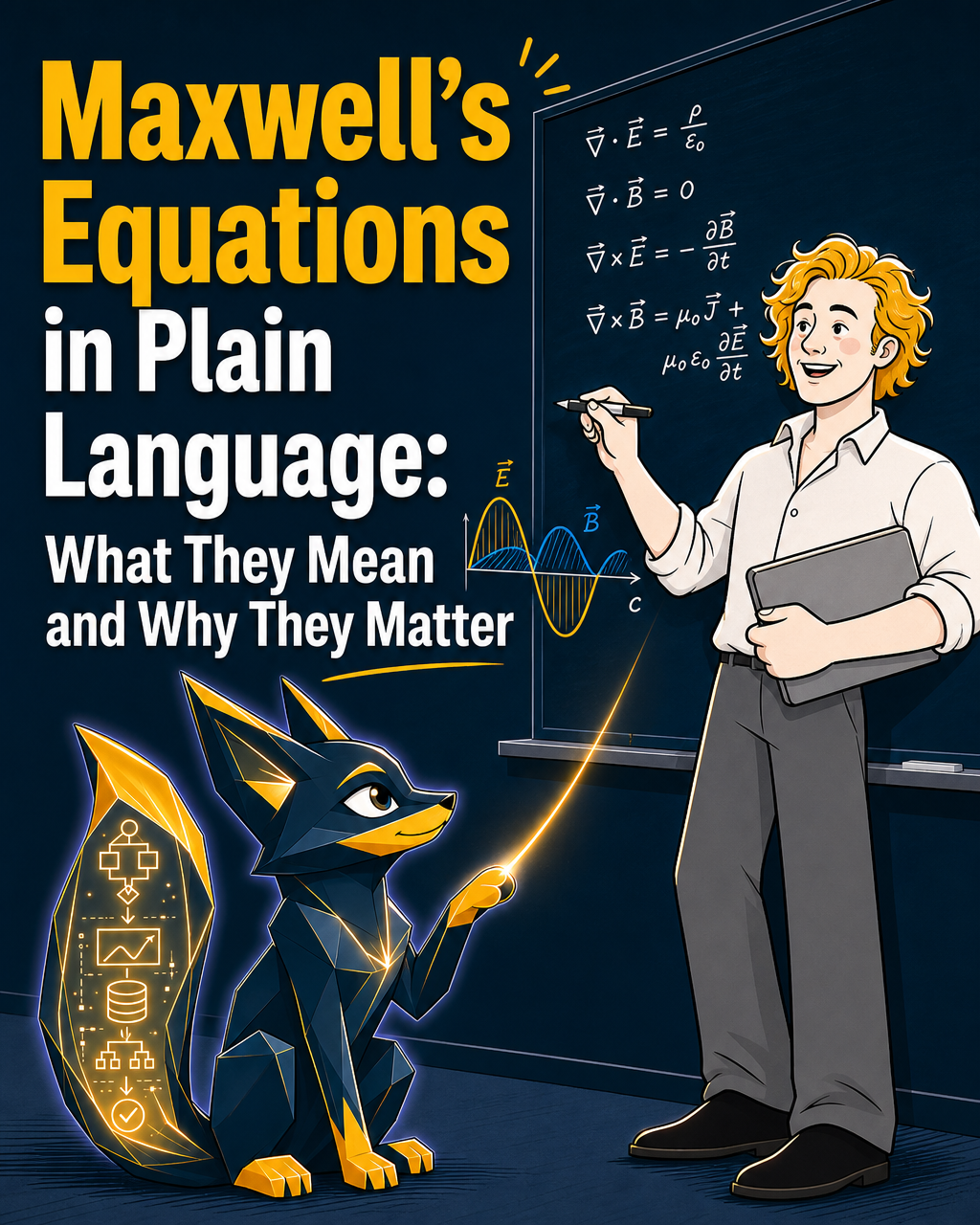
Maxwell's Equations in Plain Language: What They Mean and Why They Matter

Four equations. Written in the 1860s. Between them, they explain almost every piece of technology you touched today.
Maxwell's equations describe how electric and magnetic fields are generated, how they interact with each other, and how they travel through space as waves. They predicted that light is an electromagnetic wave. They laid the foundation for radio, Wi-Fi, MRI machines, electric motors, GPS, and fibre optics. In effect, Maxwell's equations have enabled virtually all modern electrical, electronic and photonic technologies.
The maths, if you go looking for it, can look intimidating. But the underlying ideas aren't complicated. Here's what each one actually says, in plain language, and why it matters.
A quick note on fields before we start
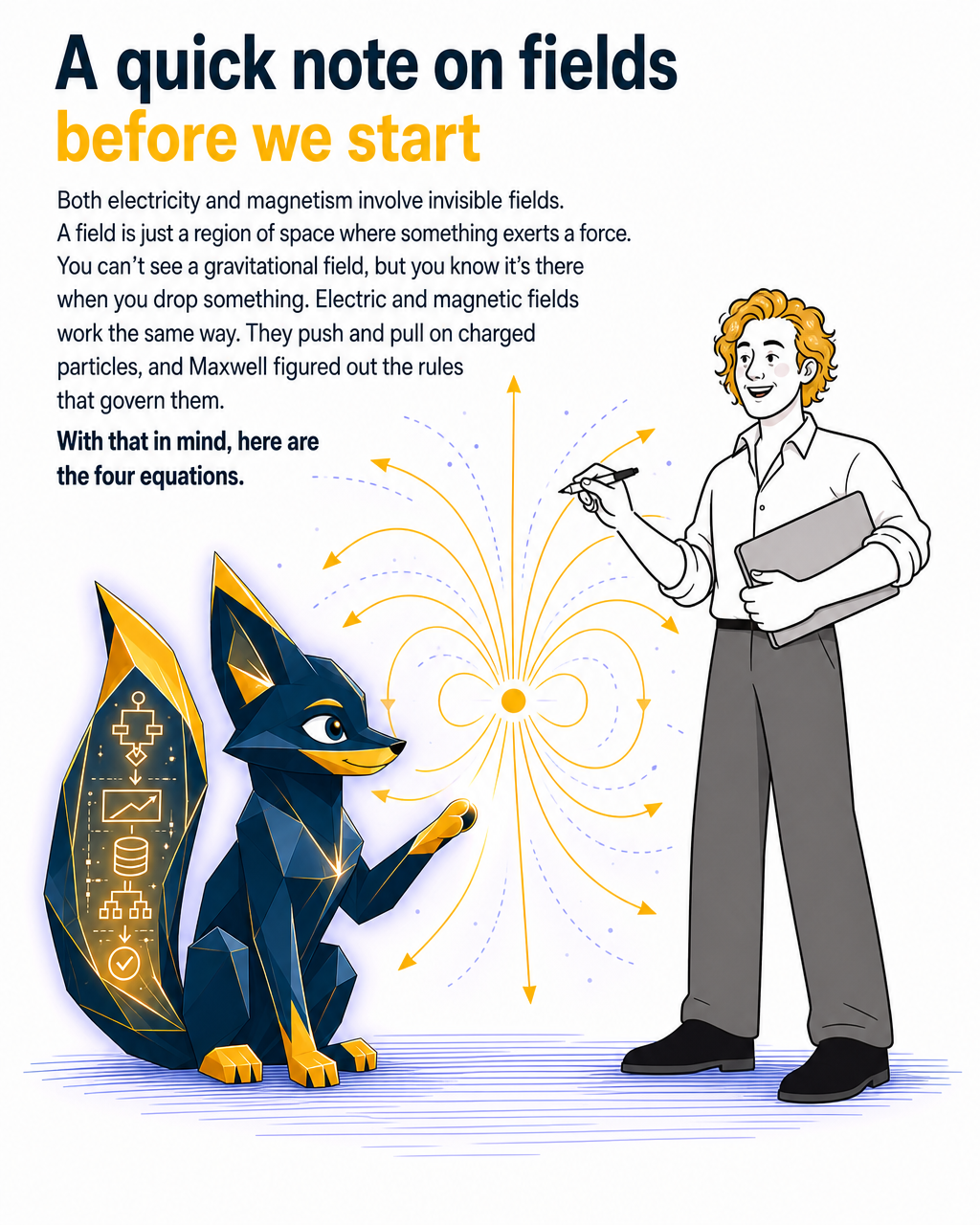
Both electricity and magnetism involve invisible fields. A field is just a region of space where something exerts a force. You can't see a gravitational field, but you know it's there when you drop something. Electric and magnetic fields work the same way. They push and pull on charged particles, and Maxwell figured out the rules that govern them.
With that in mind, here are the four equations.
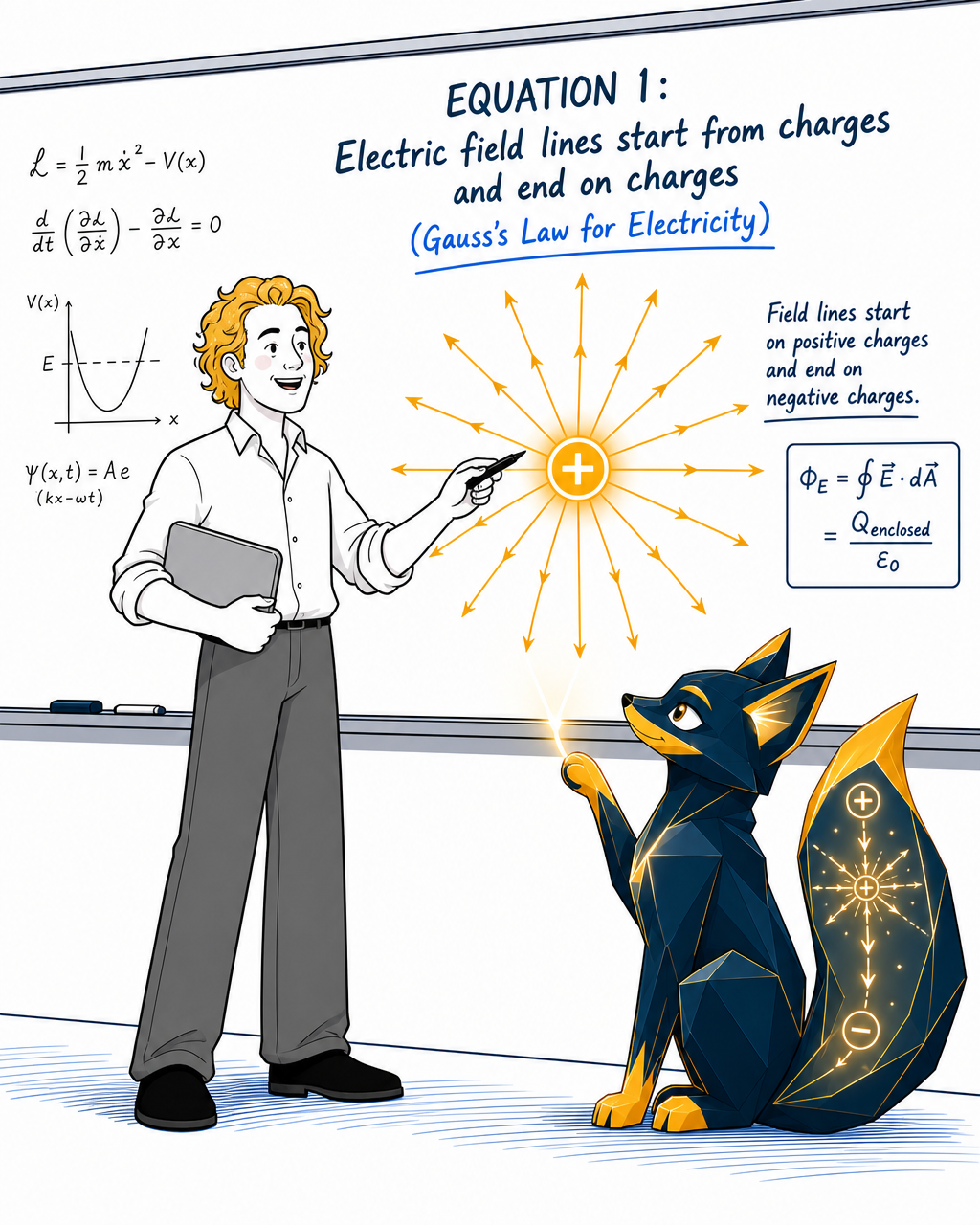
Equation 1: Electric field lines start from charges and end on charges (Gauss's Law for Electricity)
Picture a positive electric charge sitting in space. It pushes everything away from itself. Lines of electric force radiate outward in all directions, like spines on a sea urchin. A negative charge does the opposite: it pulls lines inward, toward itself.
Electric field lines originate on positive charges and terminate on negative charges. That's the whole idea. The strength of the field spreading outward is directly proportional to how much charge is sitting inside.
Think of it like this. A single lit match produces a small amount of heat spreading outward. A bonfire produces far more heat spreading outward. More charge, more field. The field spreads outward in proportion to what's there.
What this tells us: charges are the source of electric fields. No charges, no electric field. And there's a strict accounting: field lines that spread out from a region have to be explained by charges within that region.
These phenomena — capacitors, lightning rods, hair standing up from a charged balloon — are all governed by electrostatics, of which Gauss's Law is a foundational expression.
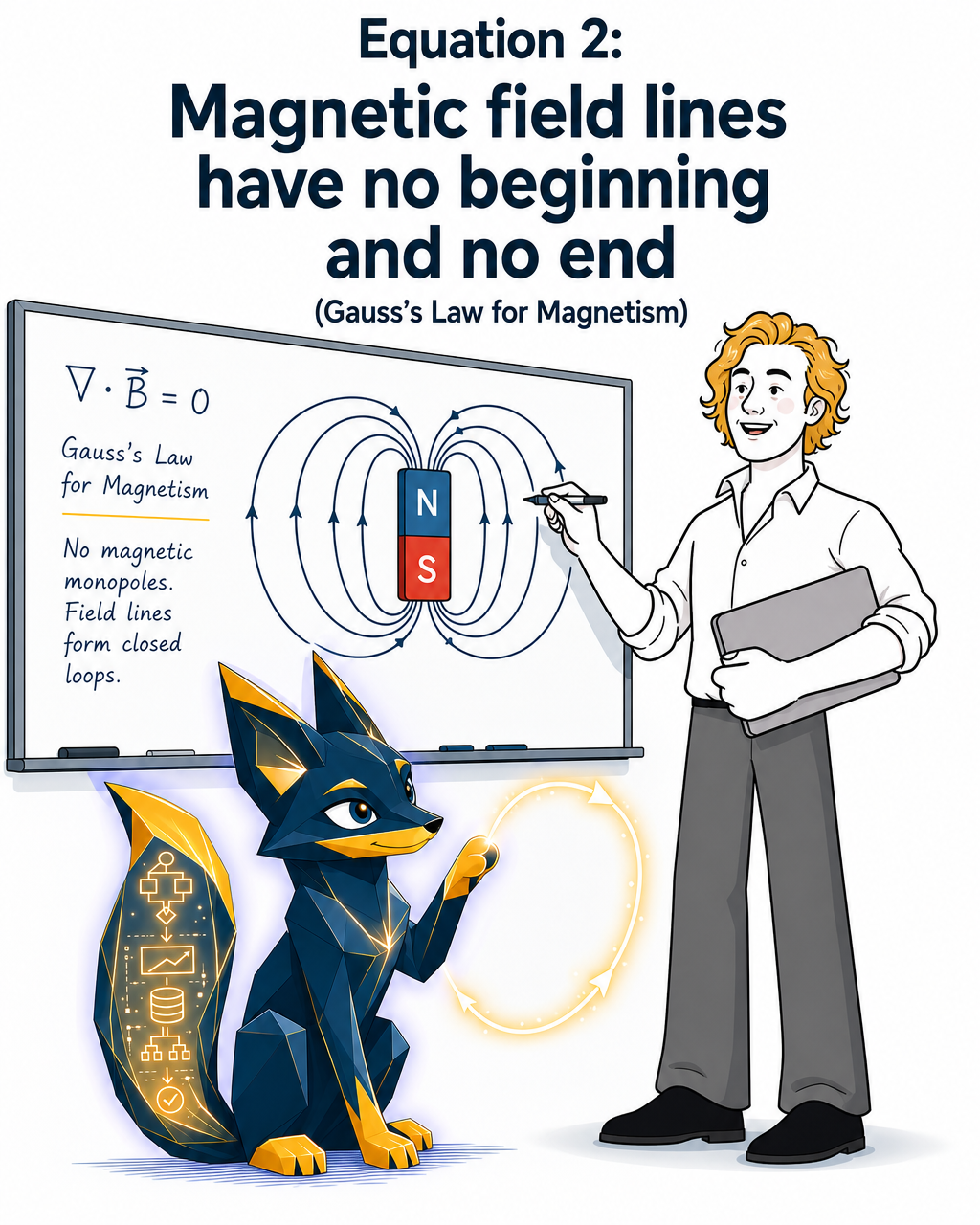
Equation 2: Magnetic field lines have no beginning and no end (Gauss's Law for Magnetism)
This one is often called the "boring" equation, but it's actually quite profound.
Magnetic field lines don't start anywhere and don't end anywhere. They always loop back on themselves. If you cut a bar magnet in half, you don't get a north pole and a south pole sitting separately. You get two smaller magnets, each with both poles. The north and south always come together.
This stands in contrast to electricity, where positive and negative charges can exist independently. There's no magnetic equivalent of a lone electric charge. No magnetic monopoles have been observed in nature — though quasi-particle analogues have been observed in condensed matter systems such as spin ice materials. The equations for the effects of both changing electric fields and changing magnetic fields differ in form only where the absence of magnetic monopoles leads to missing terms.
For practical purposes, this equation tells engineers what to expect when they work with magnets. The lines must loop. If your simulation shows field lines starting and stopping in empty space, something is wrong.
This looping nature of magnetic field lines informs why transformers, motors, and generators are built with closed magnetic cores: containing flux within a closed loop minimises magnetic reluctance and flux leakage, improving efficiency. The geometry of magnetism makes this the practical optimum.
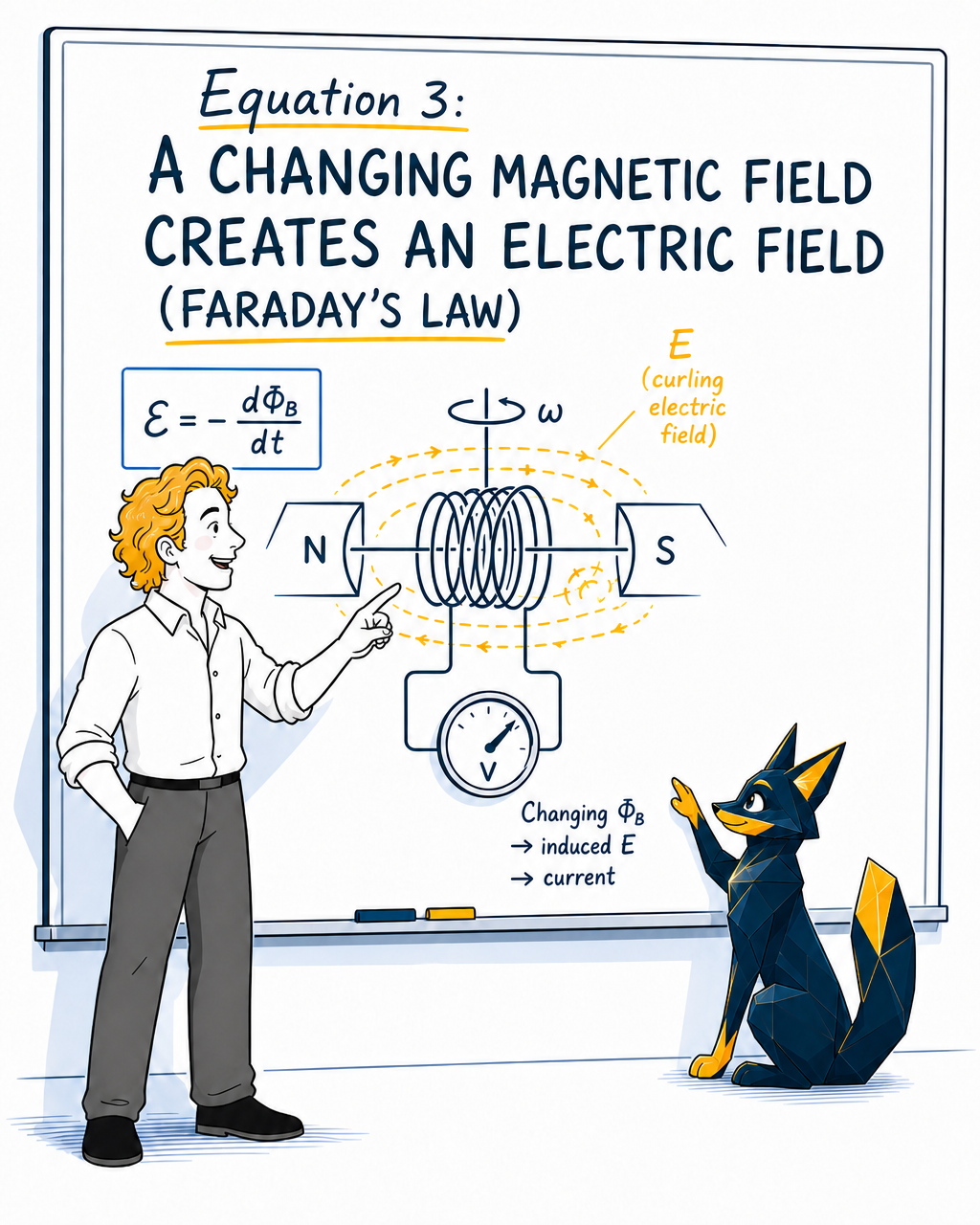
Equation 3: A changing magnetic field creates an electric field (Faraday's Law)
This is where things get interesting.
Faraday's law describes how changing magnetic fields produce electric fields. Not a static magnetic field sitting still. A changing one. When the magnetic field through a region increases or decreases, an electric field curls into existence around it.
Here's the analogy. Imagine a river suddenly rushing faster through a town. The faster current creates eddies and whirlpools in the water around the riverbanks. The change in the river's flow generates circular motion nearby. Faraday's law says something structurally similar happens with fields: a changing magnetic field creates a circling electric field.
Why does this matter? Because a circling electric field pushes charges around a loop. Push charges around a loop of wire and you have a current. That's a generator.
Every power station in the world, whether it burns coal, splits uranium, or catches wind, ultimately works by spinning a coil of wire inside a magnetic field. The magnetic field through the coil changes constantly as it spins, and that constantly changing field induces an electric current. Faraday's law is why you can charge your phone tonight.
Transformers use the same principle. The alternating current in the primary coil creates a constantly changing magnetic field, which induces a new current in the secondary coil. Step the geometry right and you can raise or lower the voltage to whatever you need.
Without Faraday's law, the electric grid doesn't exist. It's that foundational.
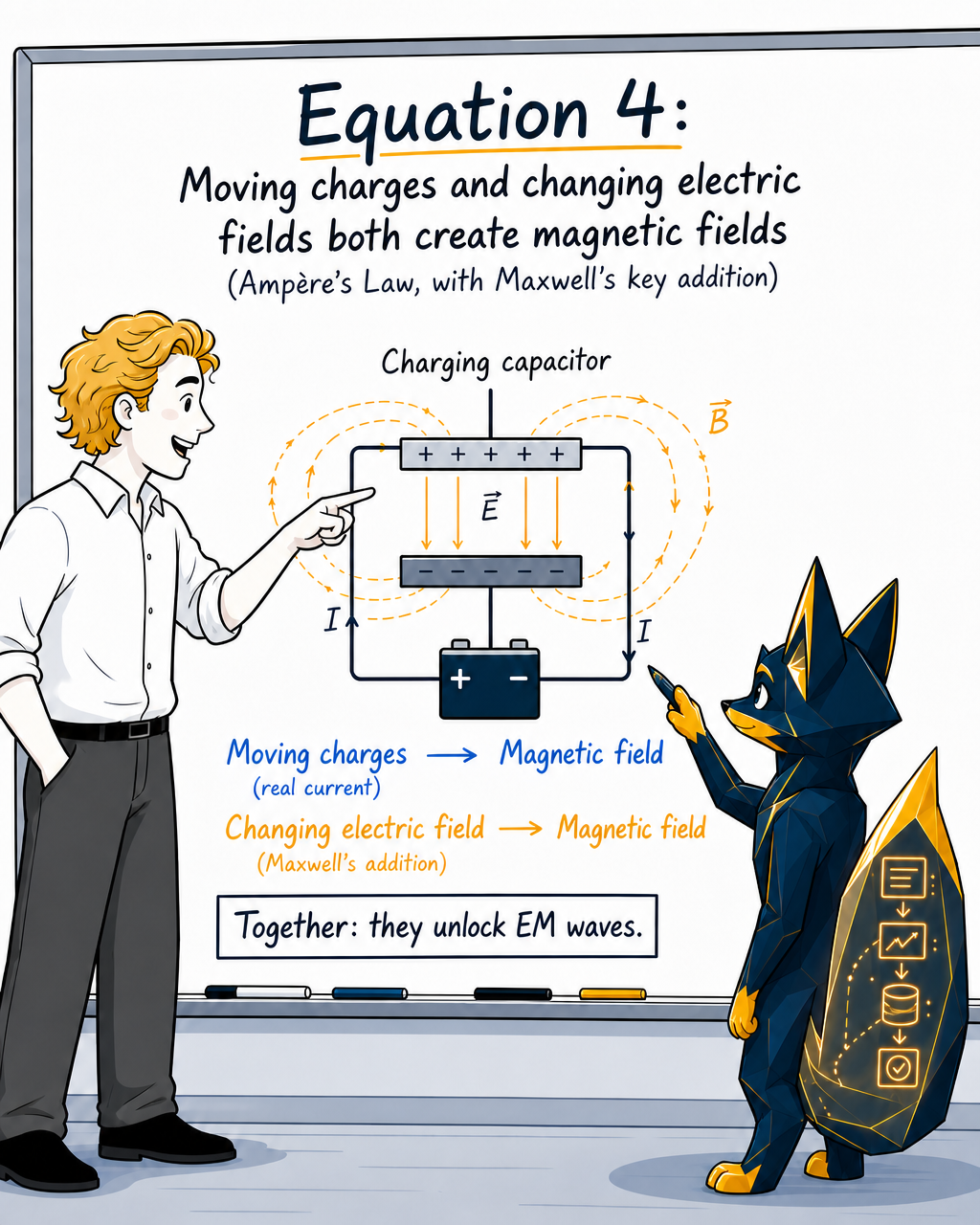
Equation 4: Moving charges and changing electric fields both create magnetic fields (Ampère's Law, with Maxwell's key addition)
Ørsted noticed in 1820 that a wire carrying current made a nearby compass needle deflect. A moving charge, it turned out, creates a magnetic field around itself. That's the original Ampère's law.
Maxwell looked at this and noticed a problem. The law worked when current was flowing through a wire, but it broke down when you tried to apply it to a capacitor being charged. Current flows into a capacitor on one side and out on the other, but doesn't flow through the gap between the plates. Yet a magnetic field still appears around that gap. Something was generating that field even though no charges were moving through it.
Maxwell's insight: a changing electric field does the same job as a moving charge when it comes to producing a magnetic field. The displacement current introduced by Maxwell results instead from a changing electric field and accounts for a changing electric field producing a magnetic field.
So the full equation says: both moving charges (real current) and changing electric fields (Maxwell's addition) create magnetic fields.
This might seem like a minor patch to an equation. It wasn't. It was the key that unlocked electromagnetic waves.
The thing Maxwell noticed when he put all four together
Once Maxwell had all four equations sitting in front of him, he did something elegant. He combined equations 3 and 4 to see what they implied together.
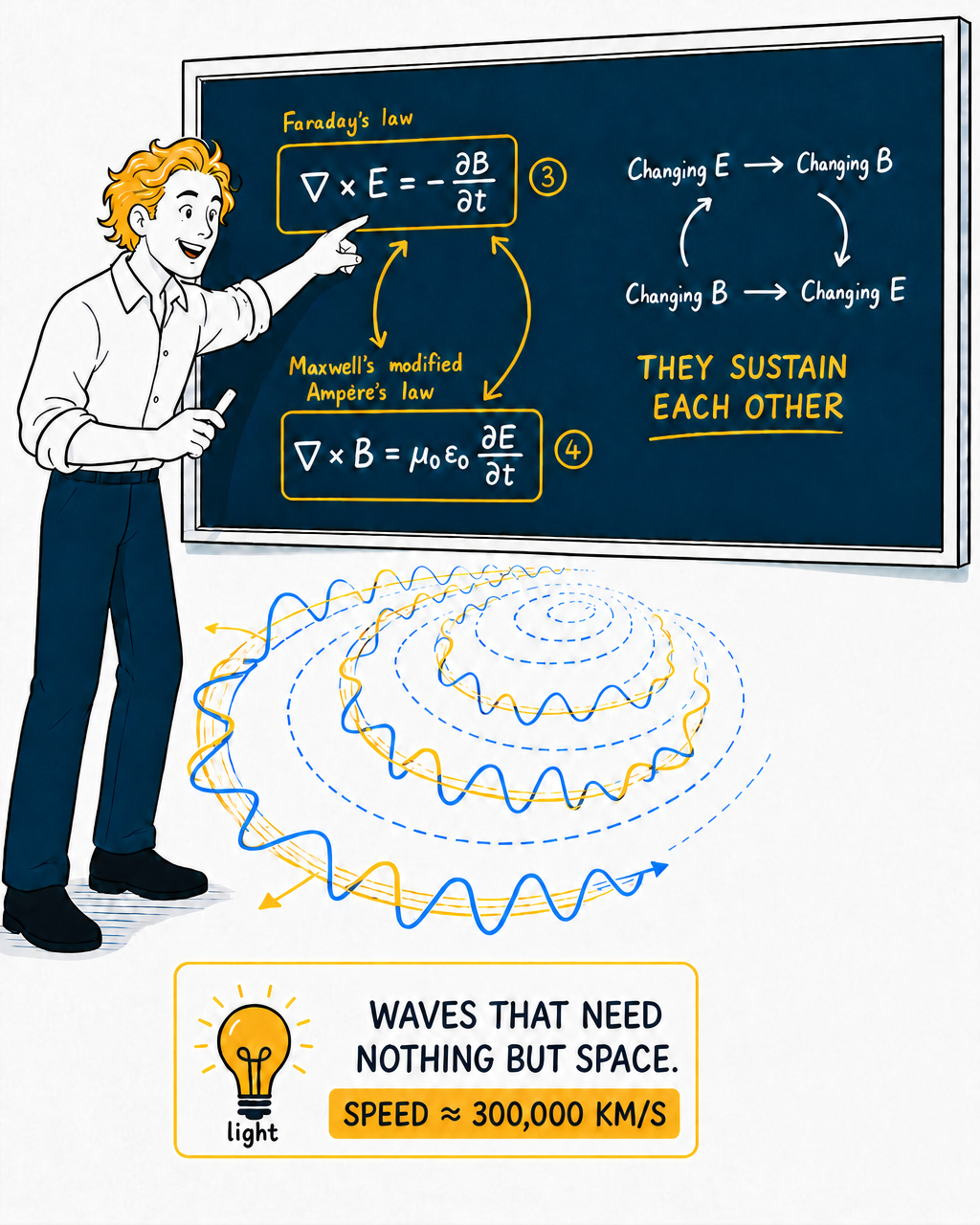
Faraday's law says a changing magnetic field creates a changing electric field. Maxwell's modified Ampère's law says a changing electric field creates a changing magnetic field. The changing magnetic field creates a changing electric field through Faraday's law. In turn, that electric field creates a changing magnetic field through Maxwell's modification of Ampère's law. This perpetual cycle allows these waves, now known as electromagnetic radiation, to move through space at velocity c.
Neither field needs a wire. Neither needs a medium to travel through. They sustain each other, passing energy back and forth, rippling outward through empty space at a fixed speed.
Maxwell calculated what that speed would be from constants already measured in his day. The speed was roughly 300,000 km/s, otherwise known as the speed of light. Maxwell had proved that light was an electromagnetic wave.
This was one of the most astonishing moments in the history of science. Nobody set out to explain light. Maxwell was doing maths about electricity and magnetism, and light fell out of the equations as an inevitable consequence. Optics, electricity, and magnetism, which had been treated as completely separate subjects for centuries, turned out to be one thing.
Maxwell identified the correspondence between electromagnetic wave speed and the speed of light in 1861–1862, and presented his full unified theory in his 1865 paper 'A Dynamical Theory of the Electromagnetic Field', thereby unifying the theories of electromagnetism and optics. And since the equations made no restriction on wavelength, the spectrum didn't stop at visible light. Radio waves, infrared, ultraviolet, X-rays, gamma rays: all of them are the same phenomenon at different frequencies. The light that we see, the wifi signals for our phones, the highly penetrating radiation from nuclear reactors are all examples of electromagnetic waves, of different wavelengths.
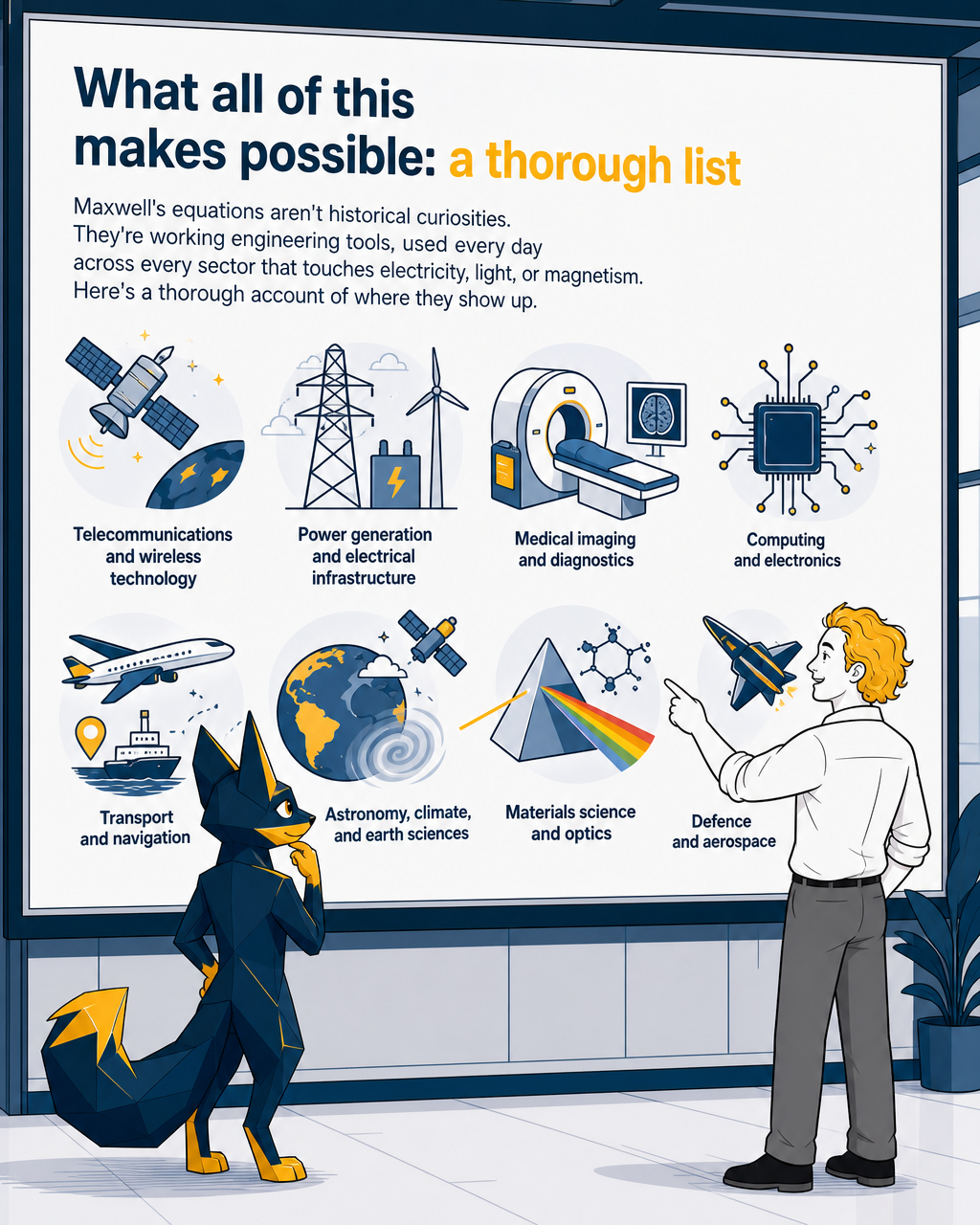
What all of this makes possible: a thorough list
Maxwell's equations aren't historical curiosities. They're working engineering tools, used every day across every sector that touches electricity, light, or magnetism. Here's a thorough account of where they show up.
Telecommunications and wireless technology
One of the most important practical implications of Maxwell's equations is in the field of telecommunications. The equations predicted that electromagnetic waves could be used to transmit information over long distances, which led to the development of radio and television broadcasting. The equations also led to the development of wireless communication technologies such as cell phones and Wi-Fi.
- Radio and television broadcasting. Every radio station transmitter, every AM and FM signal, every television broadcast is an application of Faraday's and Ampère's laws. An oscillating current in an antenna produces oscillating electric and magnetic fields, which propagate outward as radio waves.
- Mobile phones. If you use a cellphone, you are using designs based upon Maxwell's equations. The antenna in your phone both transmits and receives electromagnetic waves, governed entirely by Maxwell's framework.
- Wi-Fi and Bluetooth. The 2.4 GHz and 5 GHz bands that carry your internet traffic are specific frequency bands of the electromagnetic spectrum, chosen for their propagation and penetration characteristics. Antenna design, signal strength, and interference management all derive from Maxwell's equations.
- Satellite communication. Signals sent to and from geostationary satellites, GPS, and low-earth-orbit communications satellites all depend on electromagnetic wave propagation across thousands of kilometres of vacuum.
- Radar. Radar works by transmitting a pulse of electromagnetic energy and measuring what reflects back. The shape of the beam, its propagation speed, and the way it reflects off surfaces all come directly from Maxwell.
- 5G and antenna design. Antennas and RF interference are designed and vetted with Maxwell's equations. Every antenna shape, every beamforming array, every MIMO configuration in a 5G base station is an electromagnetic engineering problem solved with Maxwell's framework.
Power generation and electrical infrastructure
- Generators and alternators. Every generator converts mechanical rotation into electrical current via Faraday's law. Maxwell's equations govern the design of alternators and generators. Wind turbines, hydroelectric plants, coal-fired power stations, and nuclear plants all depend on electromagnetic induction.
- Transformers. The alternating current grid works only because transformers can step voltage up and down efficiently. Faraday's law is the operating principle. Without it, long-distance power transmission at high voltage is impossible.
- Electric motors. A motor is essentially a generator running in reverse. Ampère's law explains why a current-carrying wire in a magnetic field experiences a force. Every electric vehicle, every washing machine, every cooling fan in your laptop, runs on this.
- Power grid design. Maxwell's equations are used to design and analyze power transmission and distribution systems, which are critical to the operation of the electric power grid.
- Induction heating. Changing magnetic fields induce currents directly inside a metal object, heating it without contact. Induction cooktops and industrial furnaces use this.
- Wireless charging. Faraday's law again. A changing magnetic field from a charging pad induces current in the receiver coil in your phone.
Medical imaging and diagnostics
- MRI (magnetic resonance imaging). In the medical field, magnetic resonance imaging uses a strong magnet to generate a magnetic field. A strong magnetic field aligns hydrogen protons in the body. Radiofrequency pulses knock them out of alignment, and as they relax back, they emit signals detected by the scanner. These signals are processed to reconstruct a detailed image of internal tissue. The field geometry, the radiofrequency pulses, and the signal detection are all governed by Maxwell's equations.
- X-rays. X-rays are electromagnetic waves at very high frequency. Their generation, their interaction with tissue, and their detection on the imaging plate all follow from the electromagnetic framework Maxwell unified.
- Radiation therapy. Linear accelerators that deliver high-energy radiation for cancer treatment produce electromagnetic radiation and use carefully engineered magnetic fields to steer electron beams. All of it governed by Maxwell.
Computing and electronics
- Circuit design. Ohm's Law and Kirchhoff's Laws can be seen as simplified applications of Maxwell's equations. Every circuit simulator solving voltage and current distributions is working from assumptions that Maxwell's equations validate.
- Electromagnetic compatibility (EMC). Maxwell's equations play a critical role in ensuring electronic designs meet electromagnetic compliance (EMC) and performance standards. Every electronic product sold globally must pass EMC testing, which checks that the device neither emits interference beyond set limits nor is susceptible to interference from others. The test methodologies are built on Maxwell.
- Optical fibres. Light in an optical fibre is an electromagnetic wave guided by total internal reflection at the glass boundary. The propagation modes, the bandwidth limits, and the dispersion characteristics all follow from Maxwell applied to dielectric waveguides.
- Semiconductor lithography. Extreme ultraviolet (EUV) lithography, which is used to print the smallest transistors in modern chips, uses EUV light at 13.5 nm wavelength. Managing that light, reflecting it off mirrors, and patterning it through a mask is a Maxwell problem at the nanoscale.
- Photonic integrated circuits. As electronics moves toward optical computing, Maxwell's equations govern how light propagates and is manipulated on chip.
Transport and navigation
- GPS. Global Positioning System satellites broadcast signals at carefully chosen frequencies. Your device calculates position from the time-of-arrival of those signals. The propagation of those signals through the ionosphere and atmosphere requires Maxwell to model accurately.
- Maglev trains. The maglev train uses magnetic levitation to move. One magnet lifts the train off the ground and another propels it forward. In testing, maglev trains have exceeded 600 km/h (370 mph), with commercial services operating at speeds conventional rail cannot match. The levitation and propulsion forces are all electromagnetic.
- Electric vehicle motors and regenerative braking. Every EV drivetrain uses electromagnetic motors. Regenerative braking uses those same motors as generators to recover kinetic energy, governed by Faraday's law.
- Automotive radar and lidar. The collision-avoidance and lane-assist systems in modern vehicles use radar (electromagnetic waves) and laser-based lidar (also electromagnetic). Signal processing and beam steering all derive from Maxwell.
Astronomy, climate, and earth sciences
- Radio astronomy. Radio telescopes detect electromagnetic waves from distant galaxies, pulsars, and the cosmic microwave background. The signal capture, noise floor, and antenna design are all Maxwell problems.
- Remote sensing and weather satellites. Satellites observe the earth using radar (microwave reflection) and radiometric sensors across multiple bands. Cloud cover, sea surface temperature, soil moisture: all derived from electromagnetic measurements governed by Maxwell.
- Ionospheric physics. The ionosphere reflects certain radio frequencies back to earth, enabling long-distance shortwave communication. The reflection mechanism is electromagnetic wave propagation through a plasma, described by Maxwell's equations extended to conducting media.
Materials science and optics
- Laser design. A laser produces coherent electromagnetic radiation. The resonant cavity, the gain medium, and the output beam profile are all electromagnetic engineering problems.
- Photovoltaic cells. Sunlight arriving at a solar cell is an electromagnetic wave described by Maxwell's equations, but the conversion of photons into electrical carriers is a quantum mechanical process governed by semiconductor physics.
- Optical coatings and anti-reflection coatings. The thin layers on camera lenses, telescope mirrors, and solar panels that reduce reflection or enhance transmission are designed using Maxwell's equations applied to layered media.
- Fibre Bragg gratings. Periodic refractive index variations in optical fibre reflect specific wavelengths of light. Used in sensors and telecommunications, they're a direct Maxwell application.
- Metamaterials and cloaking research. Materials engineered with structures smaller than the wavelength of light can bend electromagnetic waves in unusual ways, including around objects. The design framework is Maxwell.
Defence and aerospace
Maxwell's equations have widespread importance in the aerospace industry. Some applications include hypersonic flight (which frequently involves the formation of weakly-ionized plasma). Beyond hypersonics, the equations govern radar cross-section analysis for stealth aircraft, electronic warfare jamming and countermeasures, missile guidance systems, and the electromagnetic shielding of aircraft wiring from lightning strikes.
The big picture
Four equations. Written over 160 years ago. Every device in your building that uses electricity or light, every signal transmitted wirelessly, every image taken inside a body with a scanner, every motor that turns, every transformer that steps voltage up or down: all of it is Maxwell's equations made physical.
Maxwell's complete and symmetric theory showed that electric and magnetic forces are not separate, but different manifestations of the same thing, the electromagnetic force. That unification, from a set of equations derived by following the maths where it led, is one of the most productive intellectual achievements in human history.
The thing worth sitting with: Maxwell didn't set out to explain the internet, or MRI, or satellite navigation. He set out to understand the relationship between electricity and magnetism. Clarity about the fundamentals is what made every downstream application possible.
If your company builds something complex and technical, that's a lesson worth noticing. The clearest explanation of what you actually do is almost always the most productive thing you can invest in. Everything else builds from there.
If that's where you're stuck, Infrairis exists precisely for that problem. We take a 30-minute technical briefing and turn it into a 60-second explainer designed to make your product click. No dumbing down. No generic AI output. A senior creative director who's shipped tech, working with an agentic production stack we built ourselves.

Infrairis
Your complex product. In 60 seconds. Clearly.
Your complex product. In 60 seconds. Clearly.
Learn more about Infrairis and get started today.
Visit Infrairis