Superconducting Qubits: A Clear Guide for the Technically Curious














What is a superconducting qubit, and why should you care?
Most people encounter the phrase "quantum computing" somewhere between a VC pitch deck and a science magazine headline. The word "qubit" gets dropped, eyebrows go up, and then the conversation moves on without anyone being much clearer on what the thing actually is.
That's worth fixing. Superconducting qubits are the architecture behind the quantum computers built by Google, IBM, and Rigetti, among others. They're the most commercially mature route into quantum hardware right now. And understanding how they work, even at a surface level, is useful if you're a founder pitching to deep tech investors, a CMO marketing to technically literate buyers, or an IR professional explaining your company's quantum program to retail shareholders who didn't study physics.
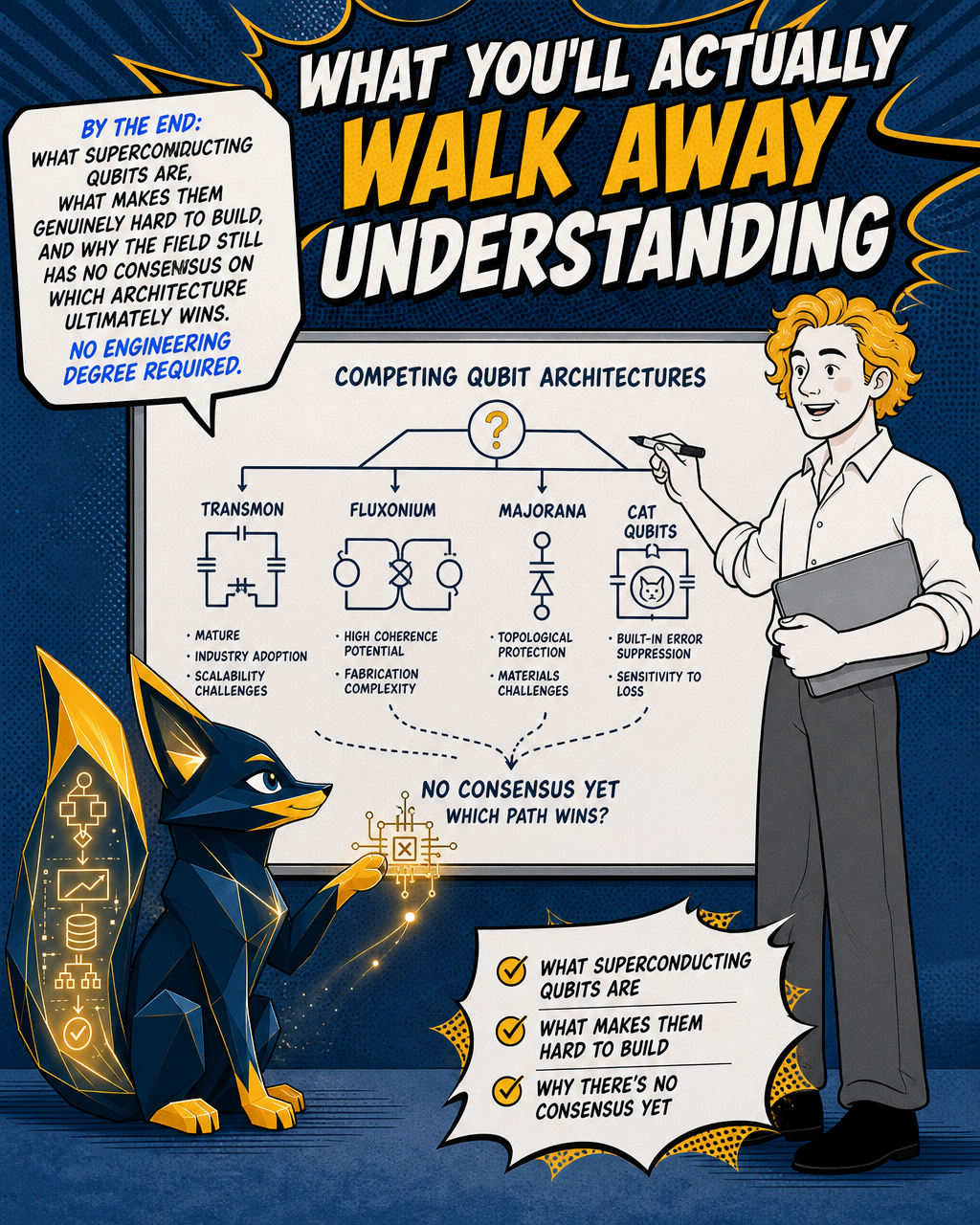
This post won't make you a quantum engineer. But by the end of it, you'll be able to hold a basic conversation about what superconducting qubits are, what makes them hard to build, and why the field still doesn't have a definitive answer on which architecture wins.
First: what makes a bit "quantum"?
A classical computer bit is binary. It's a 0 or a 1. Full stop. Every calculation your laptop performs, every email it sends, every pixel it renders, reduces to a chain of 0s and 1s flipping on and off. That's not a limitation of engineering, it's a deliberate design. Binary logic is fast, predictable, and easy to manufacture at scale.
A qubit is different. Rather than being locked to 0 or 1, a qubit can exist in a superposition of both states simultaneously. The common analogy is a coin spinning in the air: while it's spinning, it's neither heads nor tails. Only when it lands do you get a definitive answer. A qubit is similar. It holds a probabilistic combination of 0 and 1 until you measure it, at which point it collapses to one or the other.
This sounds like a party trick. It isn't. Because you can operate on a qubit while it's still spinning, a quantum computer can process many possible outcomes at once rather than evaluating them sequentially. String enough qubits together and the number of simultaneous states grows exponentially. Ten qubits can represent 1,024 states at the same time. The exponential scaling is striking: by around 265–280 qubits, the number of simultaneous states exceeds estimates for the number of atoms in the observable universe.
That's the theory. The engineering reality is considerably more complicated.
Why you need to get to near absolute zero
Superconducting qubits are made from materials that, when cooled to temperatures close to absolute zero, lose all electrical resistance. At normal temperatures, electrons passing through a metal collide with atoms, generating heat and losing energy. That constant jostling is incompatible with the delicate quantum states a qubit needs to maintain.
At around 15 millikelvin (roughly −273.135°C, or about 0.015 degrees above absolute zero), certain metals enter a superconducting state. Electrons pair up into what physicists call Cooper pairs and flow without resistance, without friction, without the thermal noise that would otherwise destroy any quantum information almost instantly.
That temperature is colder than outer space. The cosmic microwave background, the ambient temperature of the universe, sits at about 2.7 kelvin. The dilution refrigerators that house superconducting quantum processors operate at a fraction of that.
This is not a small infrastructure ask. These refrigerators are large, expensive, and slow to cool down. They need to be isolated from vibration, electromagnetic interference, and even the heat generated by the control electronics nearby. Every qubit you add to a chip makes the engineering problem harder, because more qubits need more control lines, and more control lines mean more potential sources of noise and heat creeping into a system that can't tolerate either.
Scaling the wiring is, in fact, one of the dominant engineering bottlenecks in the field right now. A machine with a thousand qubits in conventional packaging needs thousands of coaxial cables routed through the refrigerator. Solving that without introducing noise is a serious materials and packaging challenge that the industry is actively working on.
The Josephson junction: where the quantum behaviour actually lives
So you've got a superconducting circuit cooled to near zero. What makes it a qubit rather than just a very cold wire?
The answer is a Josephson junction.
A Josephson junction is a tiny device. It consists of two superconducting layers of metal (often aluminium) separated by an extremely thin layer of insulating material, typically aluminium oxide, just a few nanometres thick. That's roughly one ten-thousandth the width of a human hair.
At that scale, something strange happens. Quantum mechanics allows Cooper pairs to tunnel through the insulating barrier rather than being blocked by it. This tunnelling creates a non-linear inductance in the circuit, which is the key property that makes the junction useful as a qubit.
Without that non-linearity, a superconducting circuit would behave like a quantum harmonic oscillator: an infinite ladder of evenly spaced energy levels that are impossible to address selectively. You couldn't isolate just the ground state and first excited state to use as your 0 and 1. The Josephson junction warps that energy ladder, making the spacing between the lowest two levels unique. Microwave pulses can then be tuned to target those two specific levels without accidentally exciting the others.
The most common design built around this principle is the transmon qubit, which has become the dominant variant used by IBM, Google, and most commercial and research programs. Transmons are relatively insensitive to charge noise (a key source of errors in earlier designs) and are manufacturable using processes borrowed from the semiconductor industry, though with considerably tighter tolerances.
Decoherence: the central problem that hasn't been fully solved
Here's the honest part.
Superconducting qubits are extraordinarily sensitive. That sensitivity is what makes them useful. A qubit needs to hold a fragile quantum superposition long enough to be operated on before it collapses. But the same sensitivity that allows a qubit to exist in superposition also makes it vulnerable to anything in its environment: stray electromagnetic fields, thermal fluctuations, vibration, even cosmic rays passing through the chip.
The process by which a qubit loses its quantum state to the surrounding environment is called decoherence. It's the reason quantum computers don't just run hotter and faster versions of classical code. The quantum state leaks away before the computation is done.
Coherence time is the measure of how long a qubit can maintain its quantum state before decoherence kills it. Early superconducting qubits had coherence times measured in nanoseconds. Improvements in materials, chip design, and fabrication have pushed that out considerably. Some research groups have reported superconducting transmon qubits reaching millisecond-range coherence times in specific experimental configurations, though results vary by design and operating conditions.
A millisecond doesn't sound like much. But quantum gate operations are fast — single-qubit gates on superconducting processors typically complete in tens of nanoseconds, though two-qubit gates and other operations can take longer — so a millisecond of coherence time can be enough for many operations to run before the qubit loses its state.
The deeper problem is that decoherence sources are varied and not all of them are easy to eliminate. Some come from defects in the materials at the junction itself. Others come from the electromagnetic environment, from control electronics, from the refrigerator hardware. Improving one source often reveals another. It's a game of diminishing returns that requires extremely clean fabrication and careful engineering at every layer of the stack.
Error correction is the field's answer to decoherence: using many physical qubits to encode a single logical qubit that behaves reliably. The overhead is significant. Depending on the error rate of the underlying physical qubits, current estimates typically run to hundreds or thousands of physical qubits to protect one logical qubit well enough for useful computation. That's why qubit count alone is a misleading metric. What matters is the quality of the qubit and the error rate, not just how many you have.
Why there's no single winning architecture yet
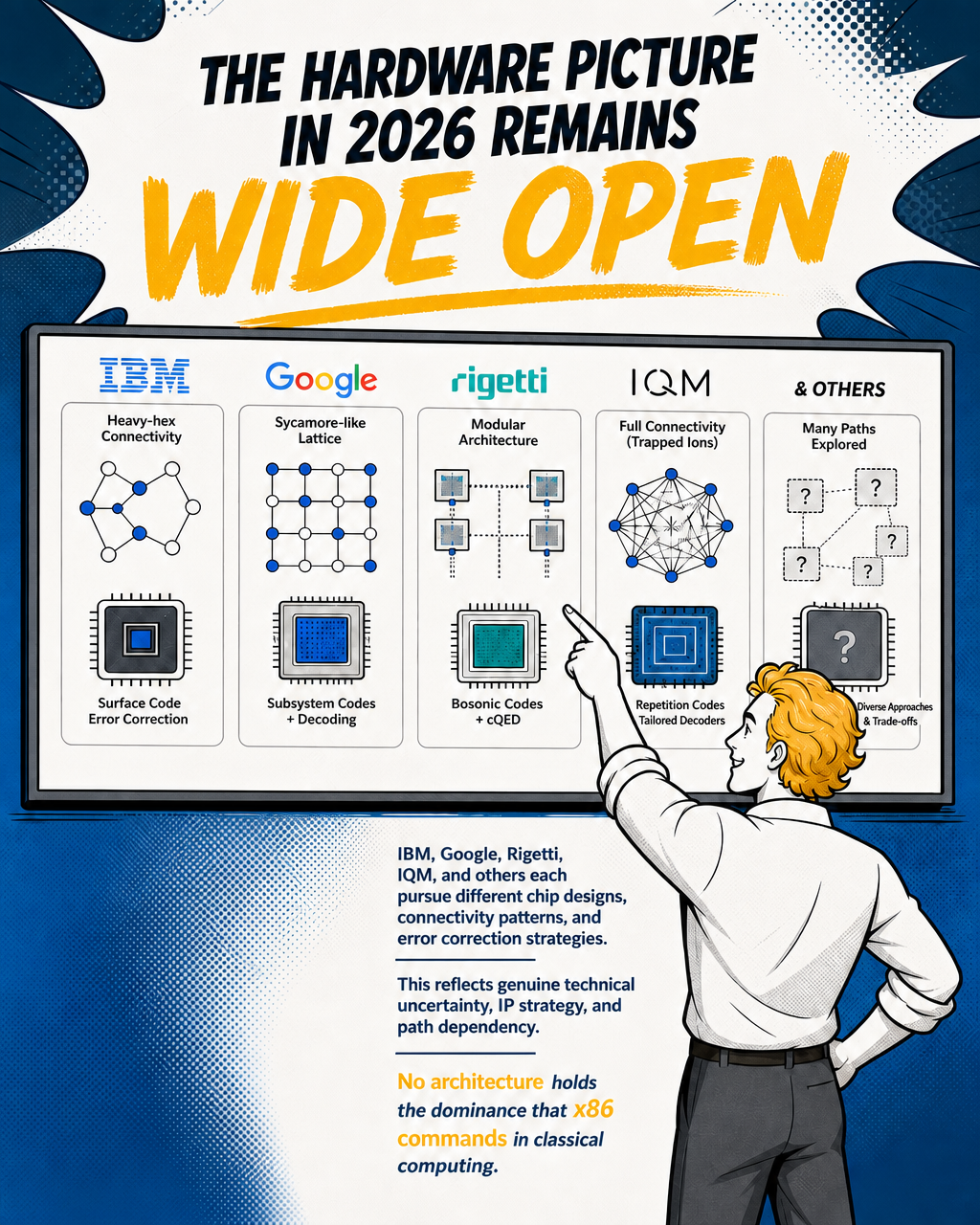
If you've read any quantum computing news, you'll have noticed that IBM, Google, Rigetti, IQM, and others all have different chip designs, different qubit connectivity patterns, and different approaches to error correction. None of them are using the same playbook.
That's not purely an accident. It reflects genuine technical uncertainty about which architectural choices produce the best outcomes at scale, but also IP strategy, engineering team histories, and path dependencies that have shaped each organisation's approach differently.
Qubit connectivity is one variable. Some designs connect each qubit only to its nearest neighbours on a grid, which simplifies fabrication but limits how flexibly the computer can route calculations. Others pursue denser connectivity, which is more powerful but harder to build cleanly. IBM's recent processors have been exploring new coupler designs to push circuit complexity higher without proportional noise increases.
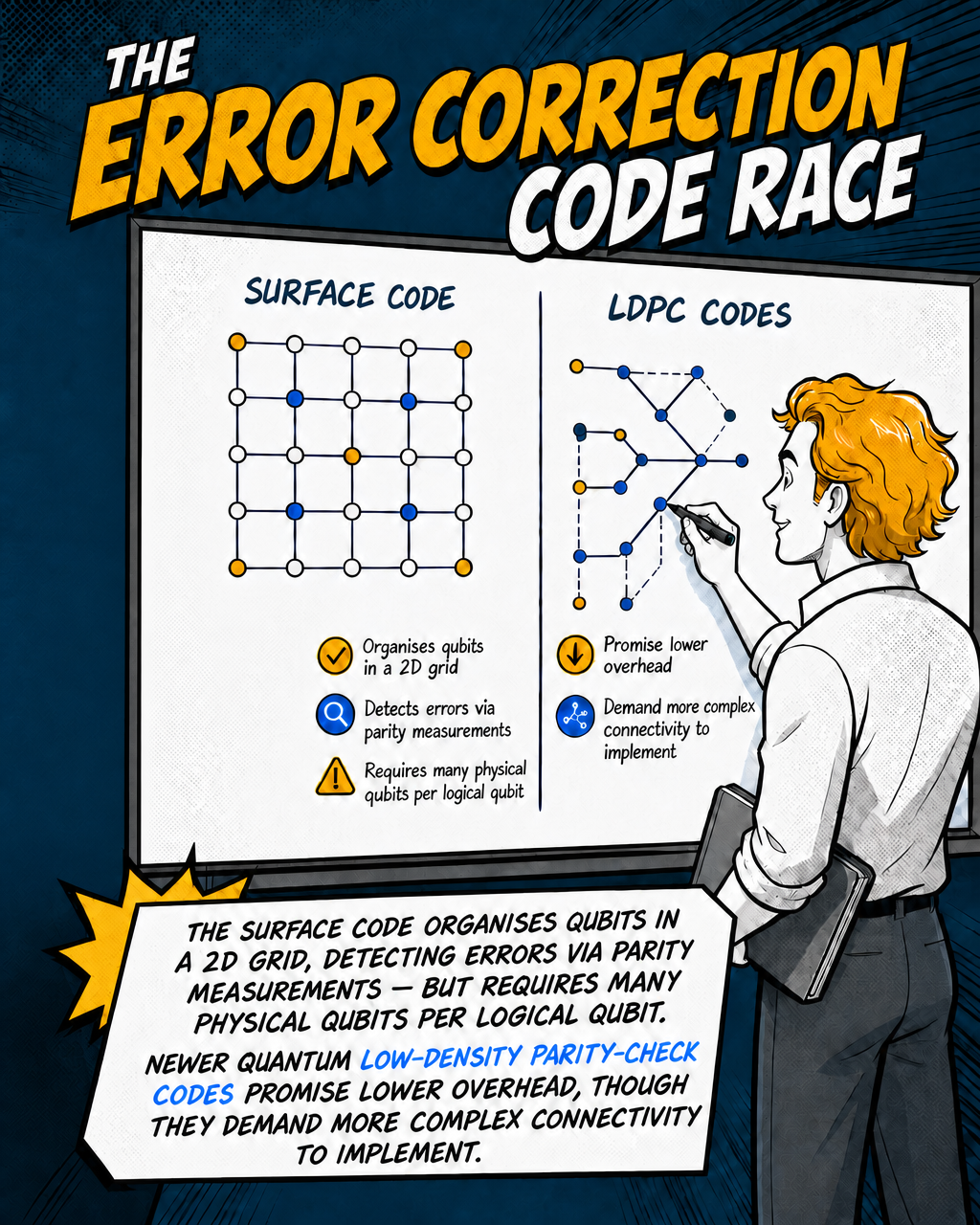
Error correction codes are another variable. The surface code, which organises qubits in a 2D grid and detects errors through parity measurements, has been the most studied approach. But it requires large numbers of physical qubits per logical qubit. Newer code families, like quantum low-density parity-check codes, are showing promise with lower overhead, though implementation requires more complex qubit connectivity.
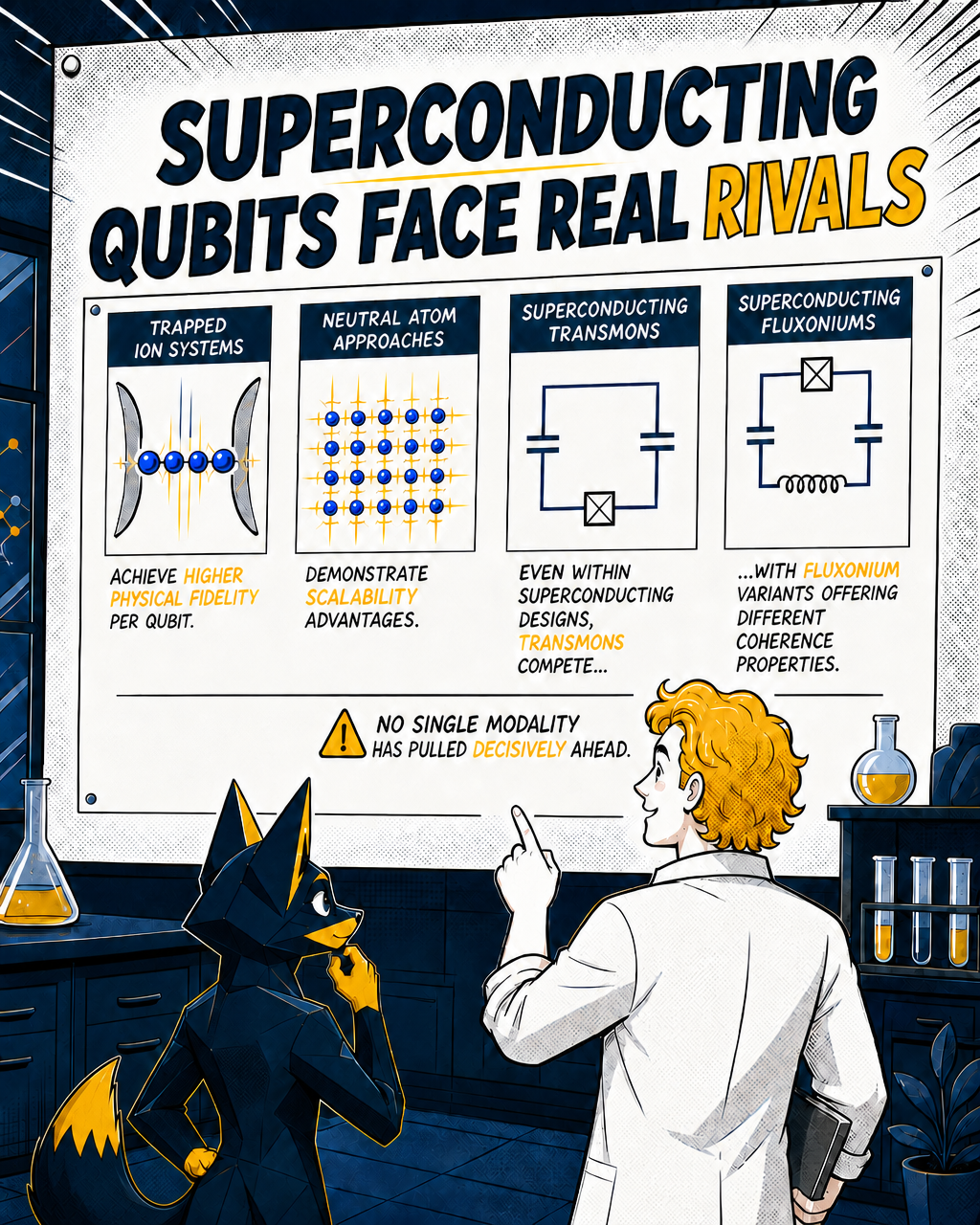
Meanwhile, superconducting qubits face competitive pressure from other qubit modalities entirely. Trapped ion systems are achieving higher physical fidelity per qubit. Neutral atom approaches are demonstrating scalability advantages. Even within the superconducting category, transmons compete with fluxonium designs that can offer different coherence properties.
The hardware picture in 2026 remains genuinely open. Multiple qubit modalities are in active commercial development, and no single approach has established the kind of dominance that, say, x86 holds in classical computing.
Manufacturability and commercial potential: the honest picture
Superconducting qubits have one significant advantage over most competing approaches: they're built using processes that are at least adjacent to semiconductor fabrication. The lithography techniques, the deposition methods, the chip-level packaging — these borrow from an industry that already knows how to make very small, very precise things at scale. That said, this adjacency has limits: quantum-grade fabrication is far more demanding than standard chip manufacturing, and the gap between "similar process tools" and "equivalent manufacturing maturity" remains wide.
The challenge is that Josephson junctions are sensitive to material defects at the atomic level. A tiny impurity in the aluminium oxide layer can create a source of decoherence that ruins the qubit. Achieving consistent, high-fidelity junctions across a chip, and then across a manufacturing run, is not yet a solved problem. Yield and reproducibility at scale are active research areas.
Commercially, the field is no longer purely academic. IBM operates a large fleet of cloud-accessible quantum systems through its Quantum Network, with hundreds of organisations reported to be accessing its processors — though readers should consult IBM's current published membership data for precise figures, as the programme's structure and access tiers have evolved in recent years. Cloud access is the current commercial model: most buyers don't own a dilution refrigerator. They access quantum processors via API, run their algorithms on someone else's hardware, and pay per compute time. That's the practical entry point for companies in pharma, materials science, finance, and logistics that are starting to prototype quantum-adjacent workflows.
The honest assessment is that we're in a phase where quantum computers can demonstrate interesting results in specific constrained problem domains, but are not yet capable of running the large-scale fault-tolerant computations that would represent a decisive advantage over the best classical hardware. The timelines for that transition have repeatedly been revised. That's not a reason for scepticism about the technology's eventual trajectory; it's a reason to be precise about what stage we're actually at.
What this means if you're explaining it to someone else
If you're a founder, investor, or communications professional whose work touches quantum computing, the ability to explain this clearly — without either overselling or dismissing it — is commercially useful.
The five things worth knowing are these.
Superconducting qubits exploit quantum superposition: they can hold multiple states simultaneously until measured, which enables a fundamentally different kind of computation. They require extreme cold (near absolute zero) because quantum states are destroyed by thermal noise. Josephson junctions are the core physical mechanism — a tiny insulating barrier through which quantum particles tunnel — that gives the qubit its controllable, non-linear behaviour. Decoherence is the primary engineering challenge: the qubit loses its quantum state to environmental noise, which is why error correction is essential and why high physical qubit counts don't automatically mean high-quality computation. And there is no settled architectural standard yet: the field remains genuinely competitive across both qubit designs and qubit modalities.
That's the story. It's not simple, but it is explainable. The gap between "this is too technical to convey" and "this landed clearly" is almost always a narrative problem, not a complexity problem.
If your company is working in quantum computing, deep tech hardware, or any sector where the product explanation is the growth bottleneck, Infrairis builds 60-second explainer videos that make complex tech click for investors, buyers, and partners. See how we work at startups.infrairis.com.

Infrairis
Your complex product. In 60 seconds. Clearly.
Your complex product. In 60 seconds. Clearly.
Learn more about Infrairis and get started today.
Visit Infrairis