Anatomy of a Stalled Enterprise Sales Cycle



Anatomy of a Stalled Enterprise Sales Cycle: Where Complex Products Actually Lose the Buyer
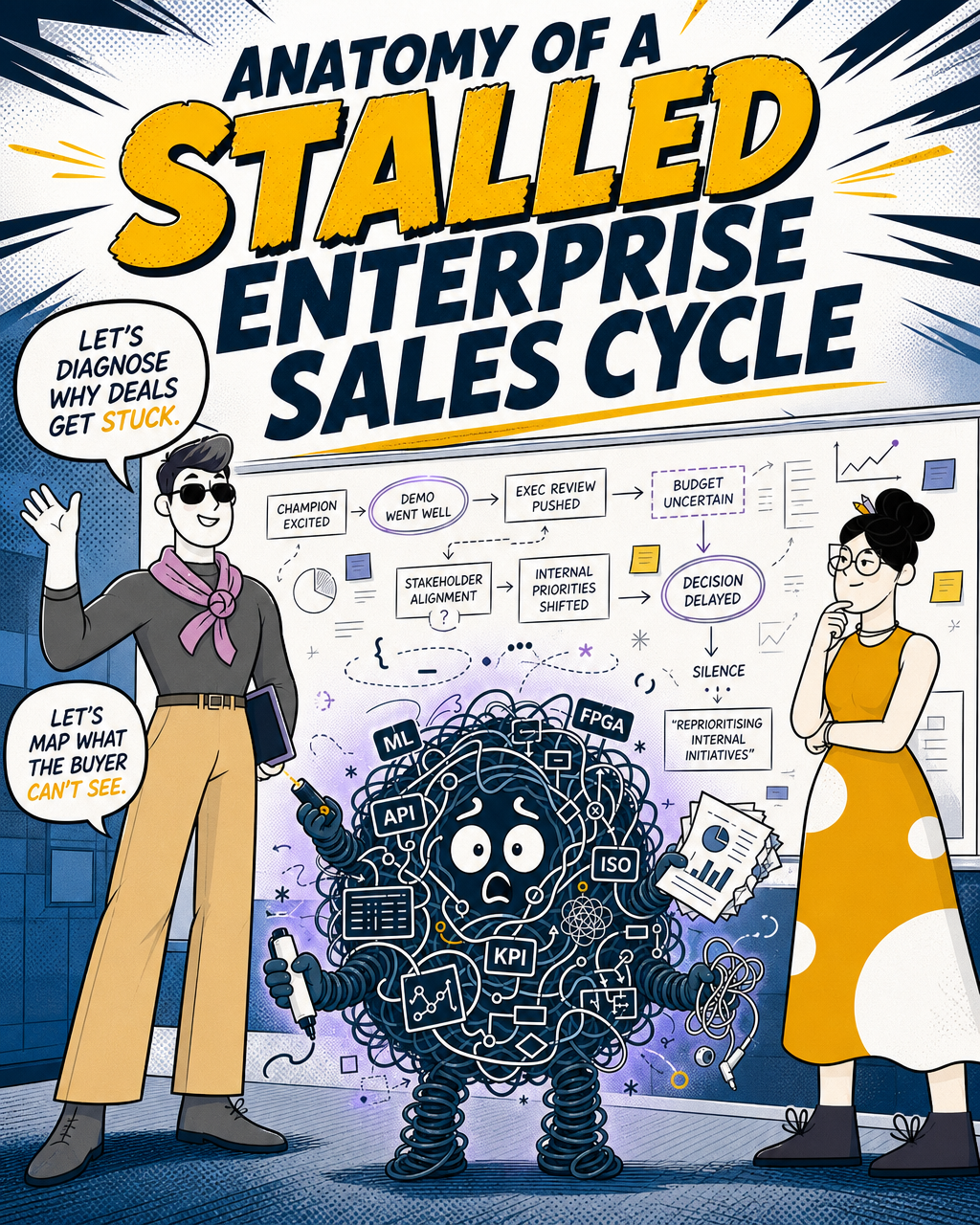
The deal looked good. The demo went well. The champion was genuinely excited. Then it just... stopped moving.
No rejection. No competitor win. Just silence, followed eventually by a polite email about "reprioritising internal initiatives."
If you sell a complex product into enterprise accounts, this pattern will feel familiar. And it costs more than most sales teams acknowledge. Industry research consistently finds that a substantial share of qualified B2B pipeline ends in no decision — an outcome that, by most estimates, exceeds losses to any single competitor. Your fiercest rival, statistically, is inaction.
Understanding why deals stall is the only way to structurally prevent it. This post breaks down the specific failure points in a complex enterprise sales cycle, and what deals that survive them actually have in common.
The committee problem nobody adequately prepares for
Most enterprise sales motions are built around a single champion. Find the person who gets it, build the relationship, get them to push it through. That approach made sense when a buying decision involved three or four people.
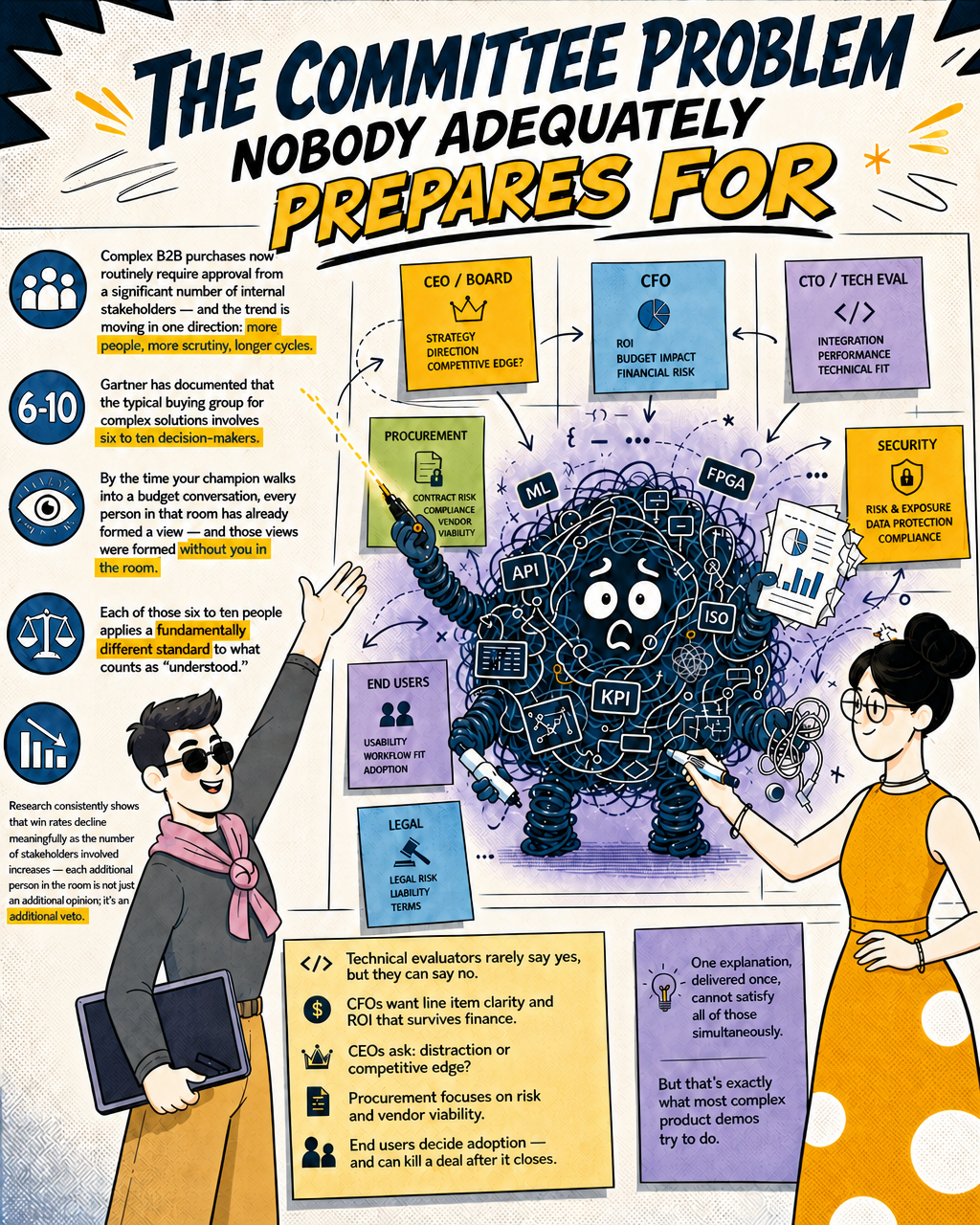
It doesn't reflect how buying actually works now. Complex B2B purchases now routinely require approval from a significant number of internal stakeholders — and the trend is moving in one direction: more people, more scrutiny, longer cycles.
Gartner has documented that the typical buying group for complex solutions involves six to ten decision-makers. That means by the time your champion walks into a budget conversation, every person in that room has already formed a view — and those views were formed without you in the room.
This matters because each of those six to ten people applies a fundamentally different standard to what counts as "understood." The technical evaluator is asking whether your integration actually works the way you described it. The CFO is asking what line item this replaces and whether the ROI model survives contact with finance. The CEO or board representative is asking whether this is a distraction or a competitive edge. The procurement lead is asking about contract risk and vendor viability.
End users care about whether they'll live in this product daily, and they can kill a deal in adoption even after it closes if they were ignored during evaluation. Technical evaluators rarely say yes, but they can say no.
One explanation, delivered once, cannot satisfy all of those simultaneously. But that's exactly what most complex product demos try to do.
Research consistently shows that win rates decline meaningfully as the number of stakeholders involved increases — each additional person in the room is not just an additional opinion; it's an additional veto.
The internal champion gap: where deals actually die
Here's the scenario that kills more enterprise deals than anything else, and it almost never shows up in a loss analysis.
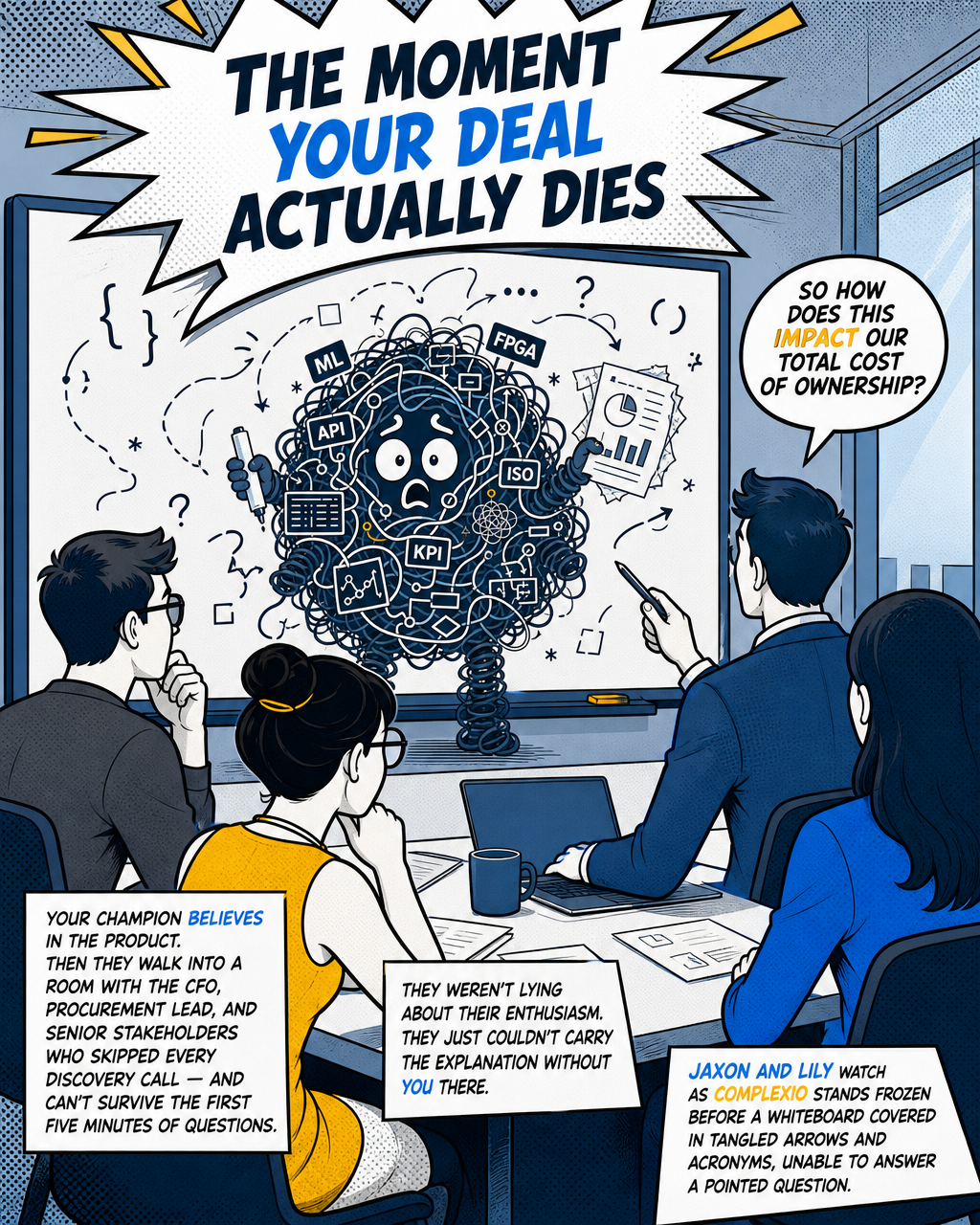
Your champion gets the product. They genuinely believe in it. They're your best advocate. They walk into a meeting with their CFO, their procurement lead, and two senior stakeholders who weren't on any of the discovery calls — and they can't explain it clearly enough to survive the first five minutes of questions.
They weren't lying to you about their enthusiasm. They just couldn't carry the explanation without you in the room.
The core reason deals stall often isn't that buyers don't like the product. It's that the internal champion lacks the materials necessary to align stakeholders who all evaluate risk through completely different lenses.
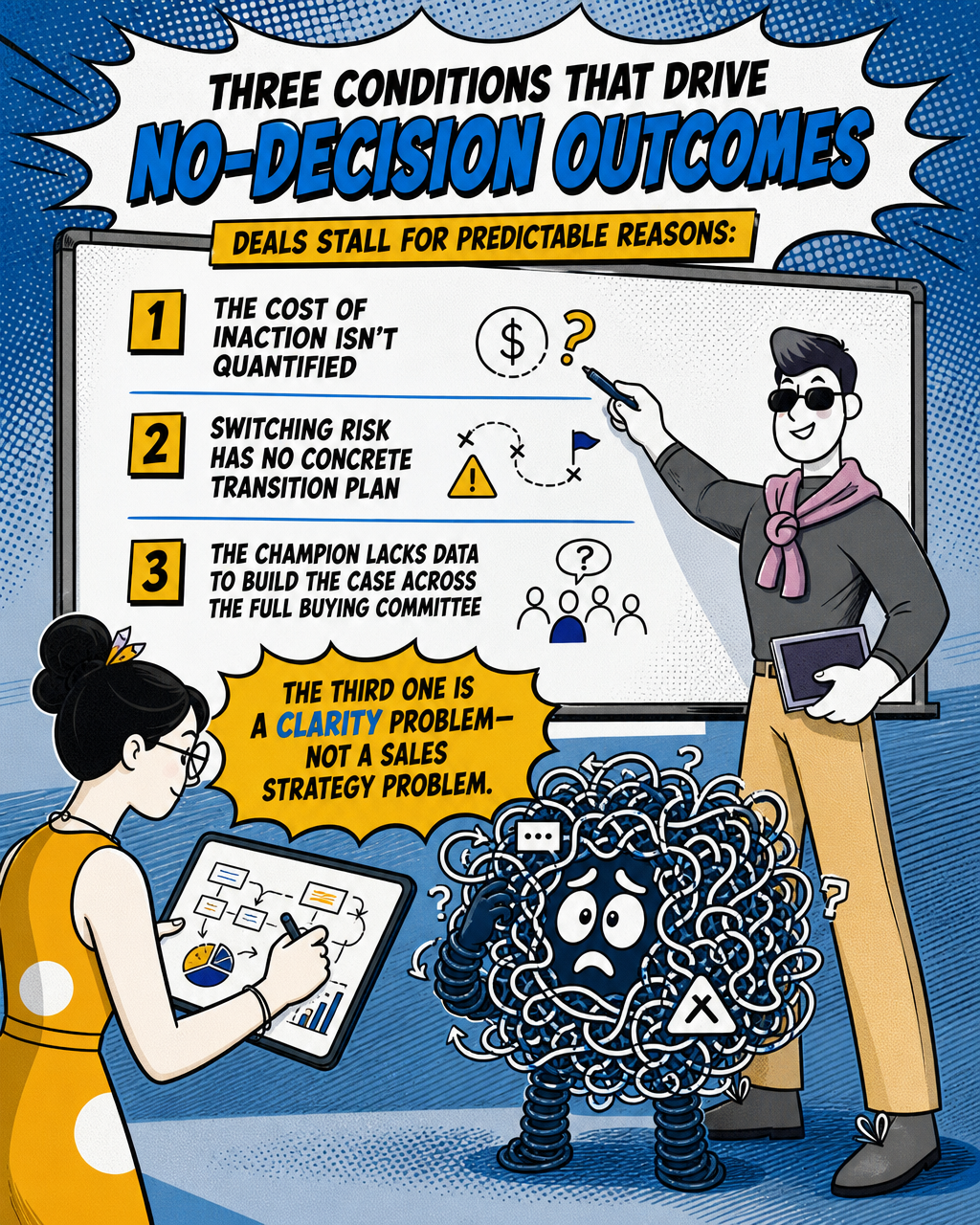
Three conditions consistently drive no-decision outcomes: the cost of inaction isn't quantified, switching risk isn't addressed with concrete transition plans, and the internal champion lacks the data to build the case across the full committee.
The third one is the narrative problem. It's not a sales strategy problem. It's a clarity problem.
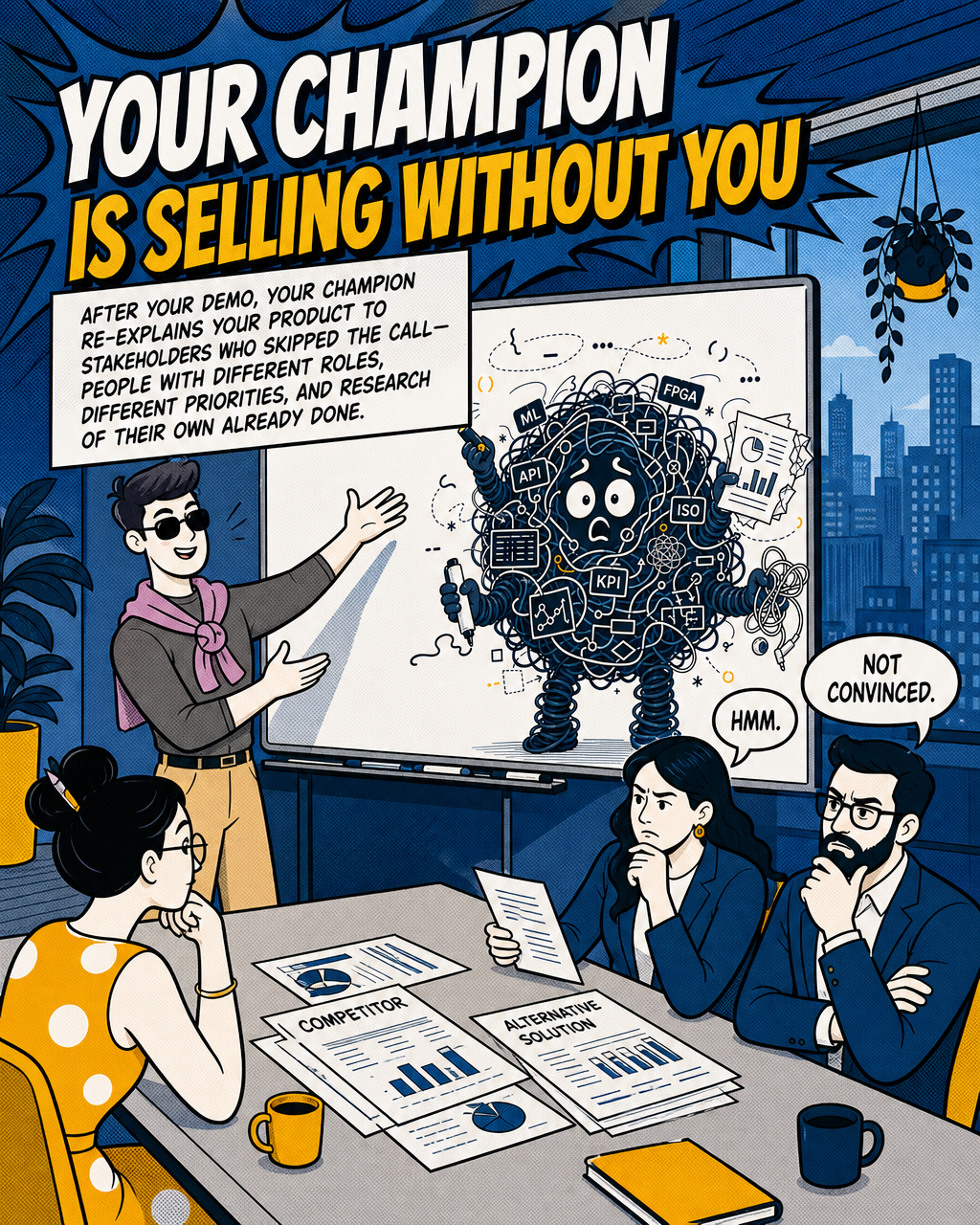
Think about what your champion is actually trying to do when they advocate internally. They're attempting to re-explain a complex technical product, without your help, to people who have done their own research, formed their own assumptions, and who have entirely different concerns from the person who originally championed the evaluation.
Deals stall when buyers can't build internal consensus or defend the investment. The value story doesn't travel: champions can't repeat it, Finance can't validate it, and stakeholders aren't aligned on the problem.
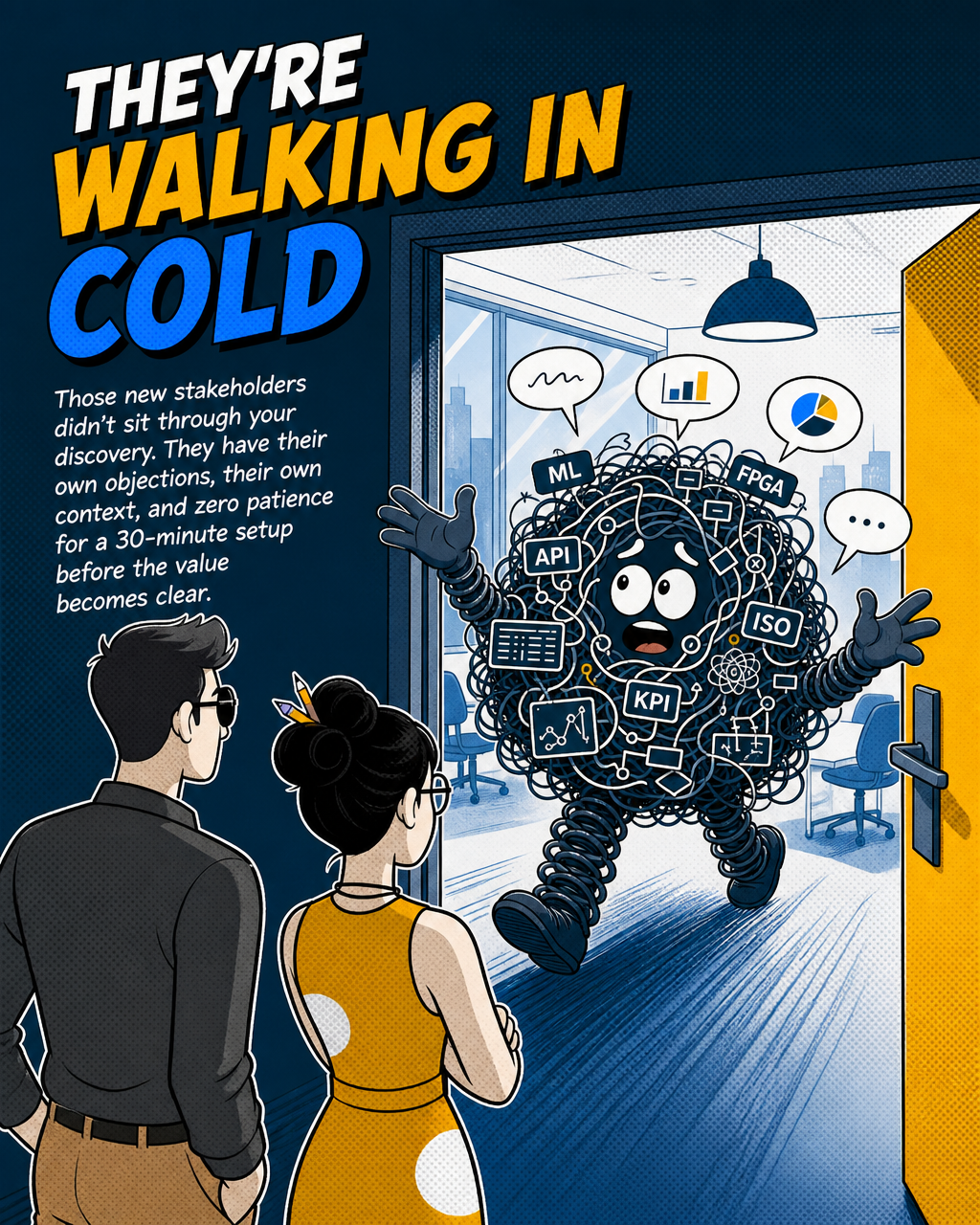
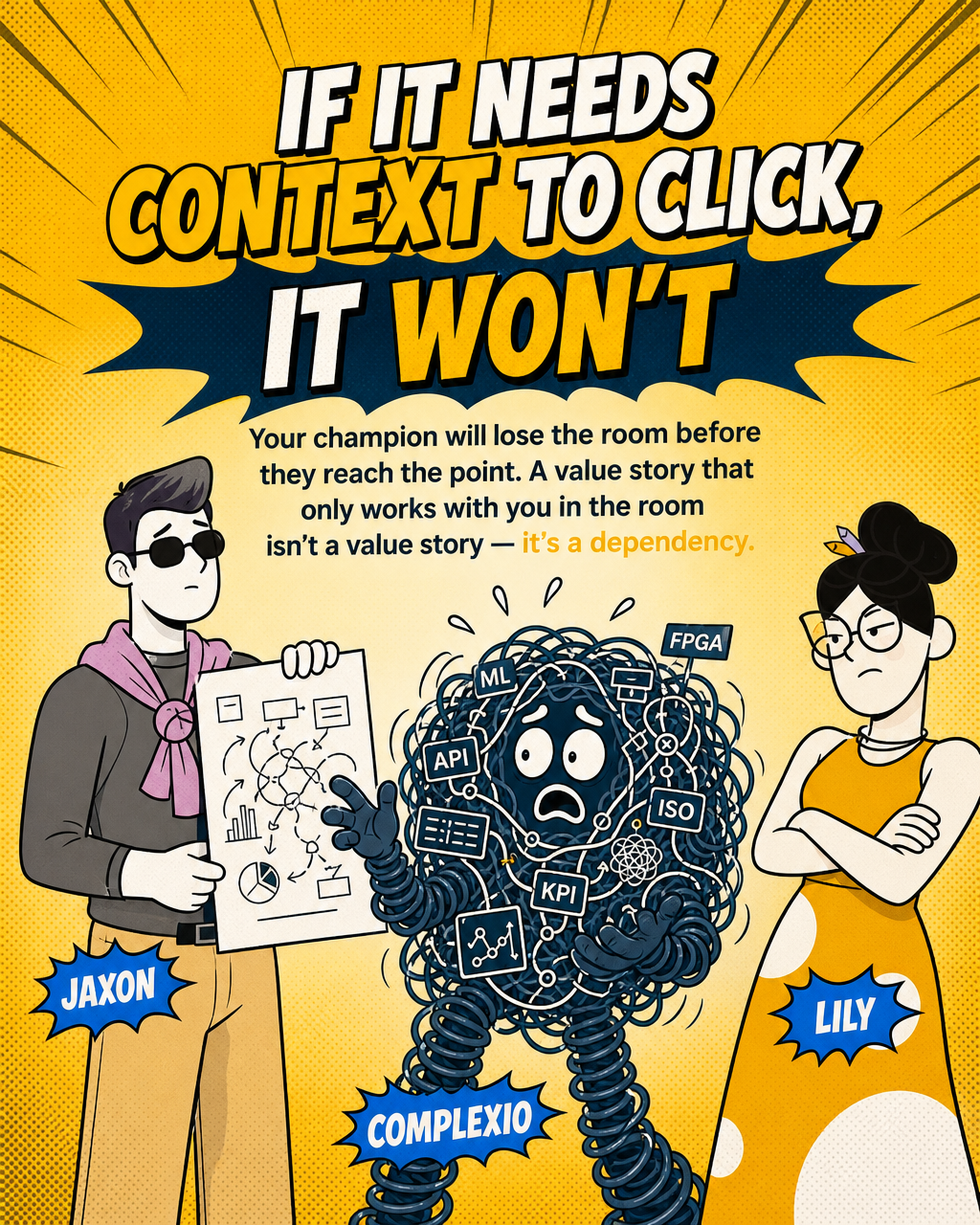
If your product explanation requires 30 minutes of context before it clicks, your champion is going to lose that room before they get to the value. Not because they're unconvincing. Because the explanation itself wasn't designed to travel.
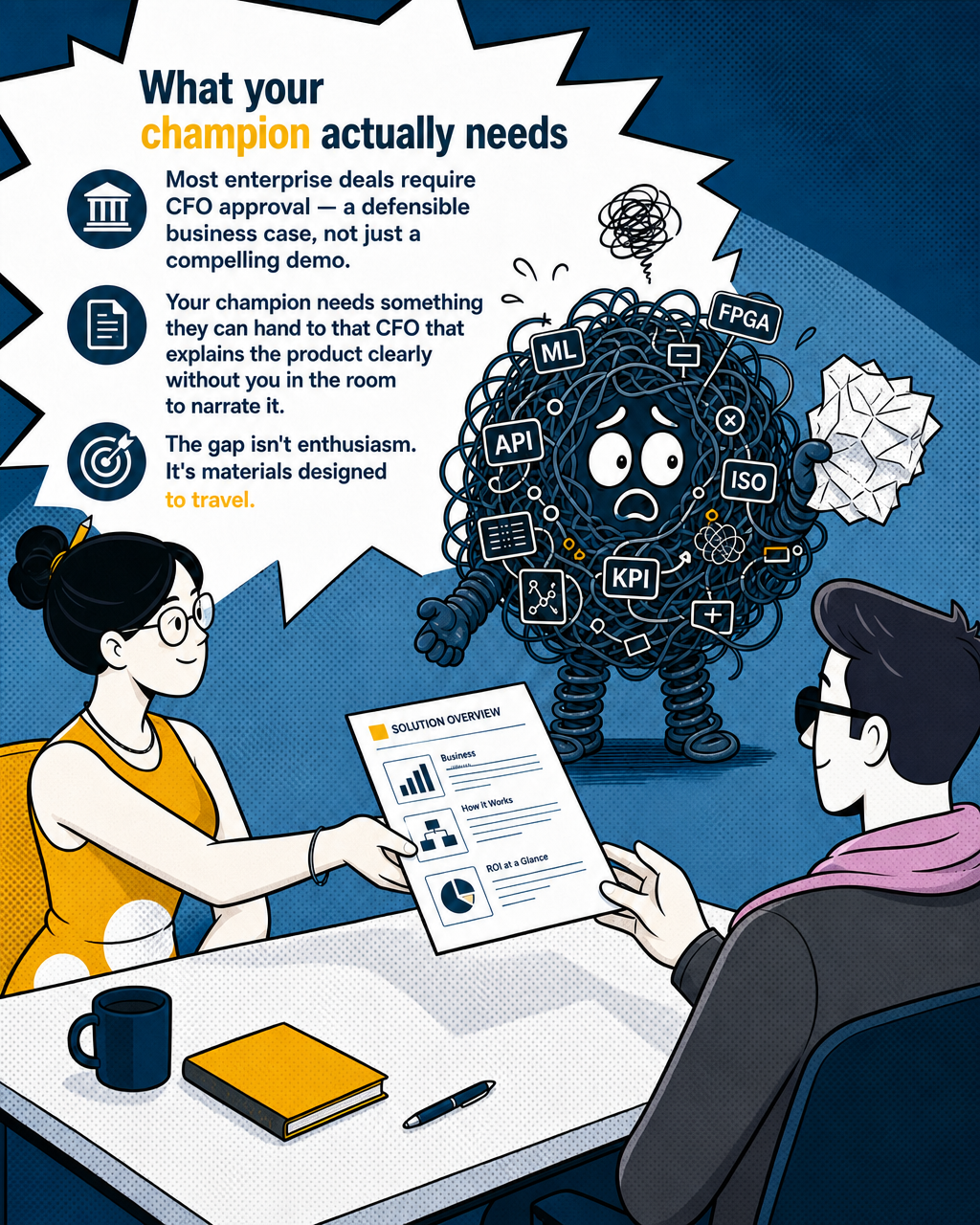
Most complex enterprise deals require CFO approval, which means they need a defensible business case, not just a compelling demo. Your champion needs something they can hand to that CFO that explains the product without them present to narrate it.
Evaluation fatigue: when repeated clarification becomes a red flag
There's a pattern that sellers often misread as progress: multiple follow-up sessions, extended evaluation periods, more stakeholders asking more questions. It can feel like growing engagement. Often it's the opposite.
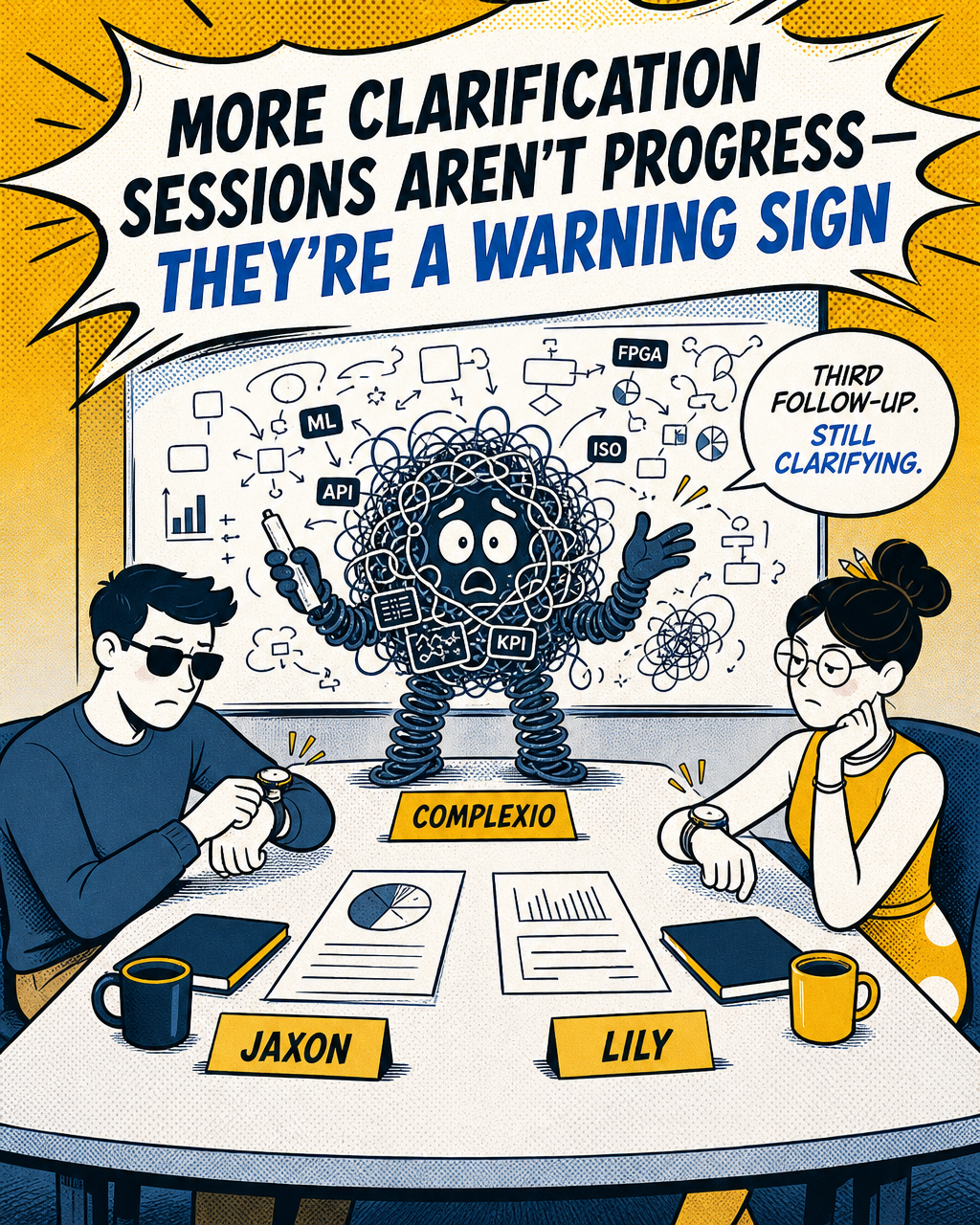
When a product requires three separate sessions to clarify what it actually does, the buying committee is drawing a quiet inference about what implementation will look like. Sales research indicates that as decision timelines stretch, buyer enthusiasm wanes and competing priorities emerge — and sellers who rely on rep self-reporting of lost deals consistently hear that overly long sales processes are a leading reason prospects back out.
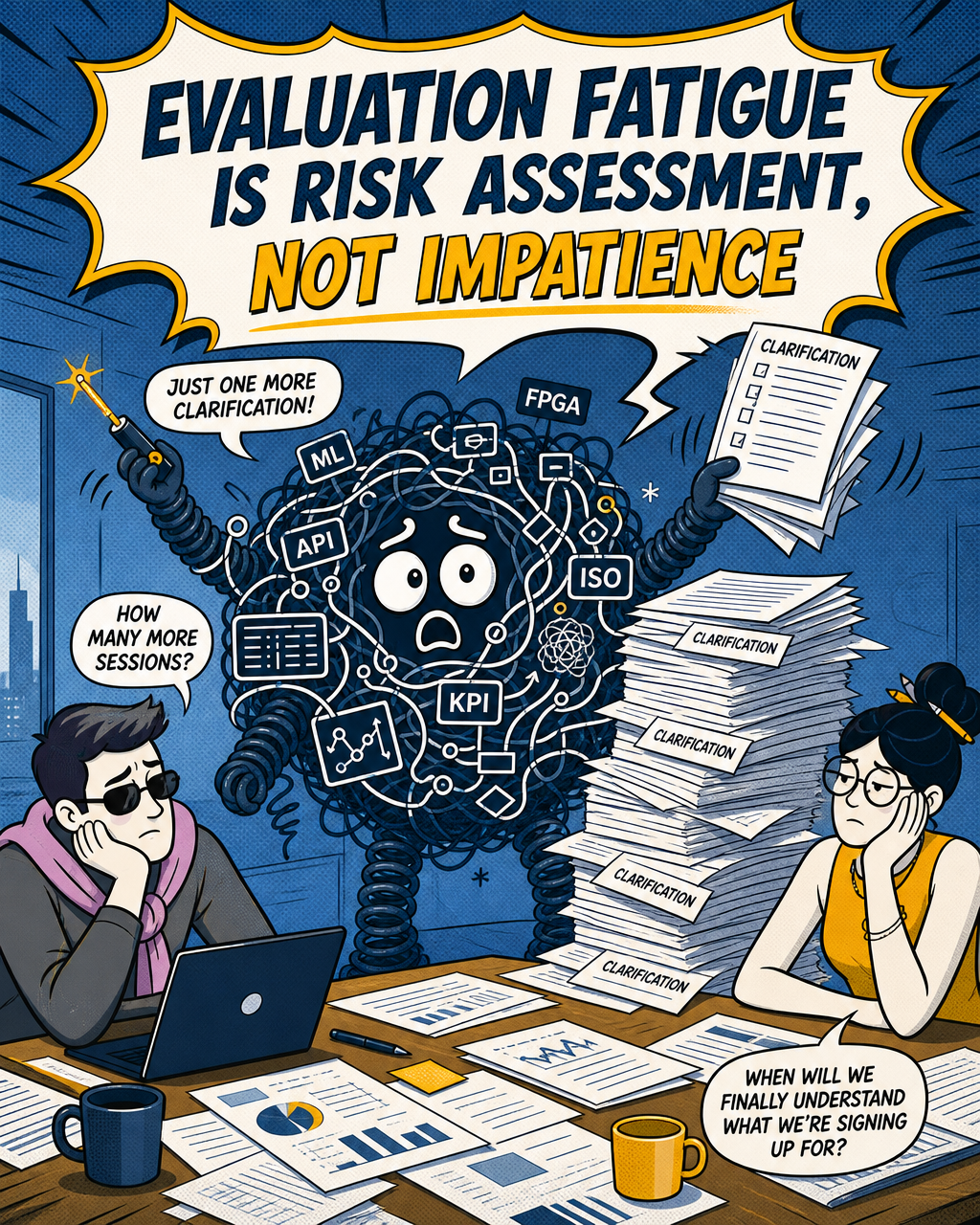
This is evaluation fatigue. It's not impatience; it's risk assessment.
Every additional clarification session carries an implicit message: this product is hard to understand, which probably means it'll be hard to implement, hard to onboard, hard to explain to the board, and hard to defend if something goes wrong. The buying committee isn't just evaluating your product's features. They're evaluating the operational and reputational risk of committing to something they can't fully articulate.
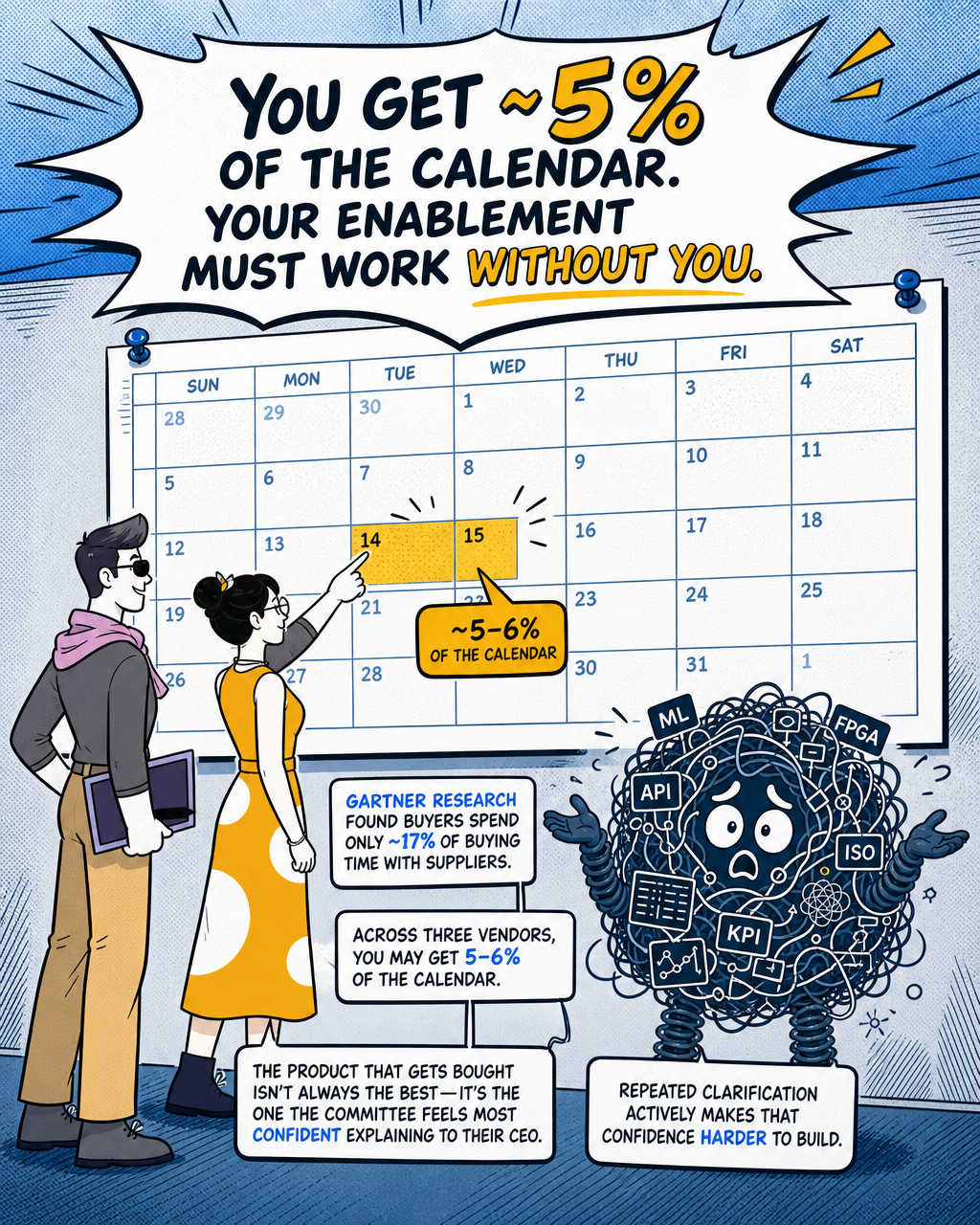
Gartner research (published circa 2019–2020, though digital-first buying trends may have reduced supplier face time further since) found that buyers spend only about 17% of their total buying time with potential suppliers — and if they're evaluating three vendors, you might get around 5–6% of the calendar. Your enablement must work when you're not in the room.
The product that gets bought is not always the best product. It's the product the committee feels most confident explaining to their CEO and their board. When you require repeated clarification to be understood, you're actively making that confidence harder to build.
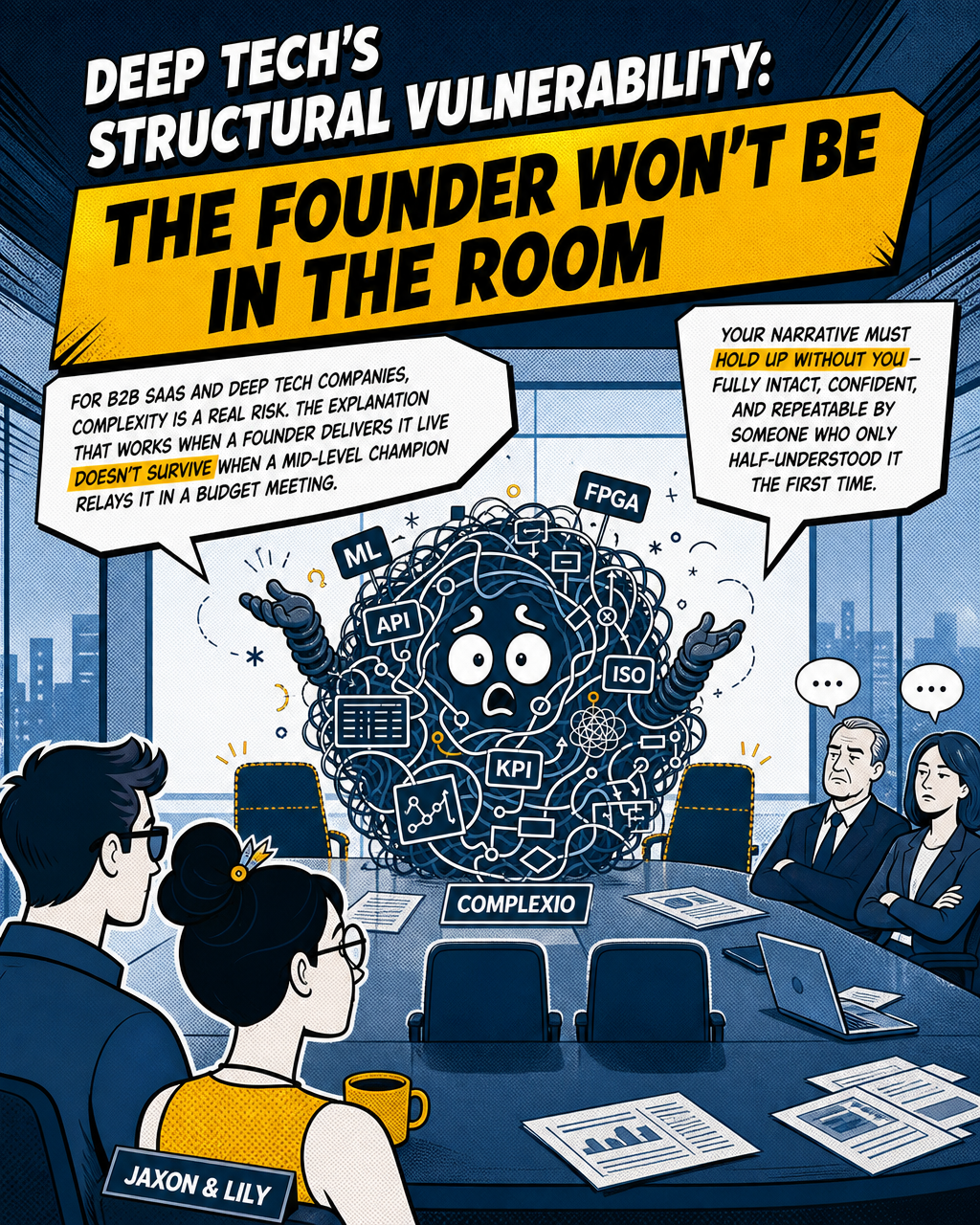
For deep tech and B2B SaaS companies in particular, this is a structural vulnerability. The product is genuinely complex. The founders know it better than anyone. But the explanation that works when a founder is in the room delivering it live, responding to questions in real time, doesn't survive intact when a mid-level champion tries to relay it in a budget meeting on a Tuesday afternoon.
Why 'do nothing' beats a confusing competitor
Sales teams tend to frame losses as competitive events. Another vendor won. The price was too high. The budget dried up. Those losses are visible. They have an explanation.
The majority of losses don't work that way. Research consistently finds that a large share of qualified B2B pipeline ends in no decision — and that no-decision outcomes exceed losses to any single competitor.
The conventional explanation is status quo bias: buyers prefer inaction over risk. But research in this area, including work associated with the concept of FOMU — "fear of messing up," explored by Matt Dixon and Ted McKinnon in The JOLT Effect (2022) — distinguishes between buyers who genuinely prefer the status quo and those experiencing active indecision driven by fear of making the wrong choice. The latter, Dixon and McKinnon argue, accounts for the majority of stalled deals.
This is a critical distinction. Most sales advice focuses on overcoming status quo bias: create urgency, quantify the cost of inaction, build the ROI case. That's the right approach for buyers who genuinely prefer to do nothing.
But many stalled deals involve buyers who wanted to buy. They engaged seriously. They ran a proper evaluation. They just couldn't get their committee aligned on what they were actually buying.
When each member of a buying committee has developed a different understanding of the solution, their ability to discuss it coherently is compromised before any formal decision conversation begins. The champion believes the integration works one way. The IT evaluator believes it works another way. The CFO has a pricing assumption that matches neither. Each is confident. None of them is entirely right.
A confused buying committee doesn't choose your competitor. They choose to do nothing, because inaction is the only option that doesn't require consensus around something nobody can fully articulate.
Gartner has reported that buying teams frequently experience significant internal conflict during complex purchases — and that when committees do reach genuine consensus, they are substantially more likely to rate the outcome as a high-quality decision. (For the specific figures, see Gartner's research on B2B buying consensus.)
The path to closing is not better selling into confusion. It's removing the confusion that makes doing nothing feel rational.
What structurally successful deals actually share
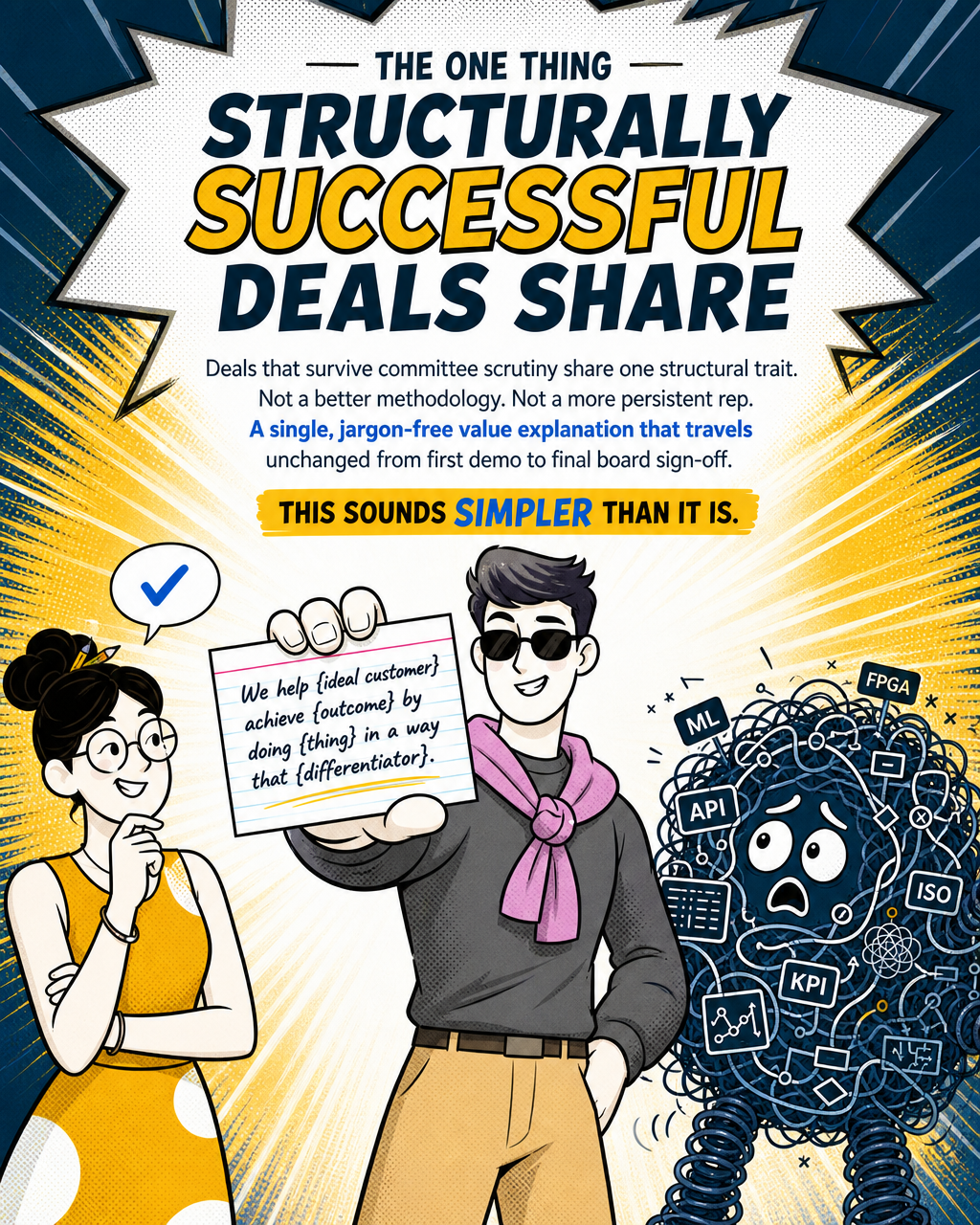
Deals that survive committee scrutiny and close without extended stall periods tend to share one structural characteristic. Not a better sales methodology. Not a more persistent rep. A single, jargon-free explanation of value that travels unchanged from the first demo to the final board sign-off.
This sounds simpler than it is.
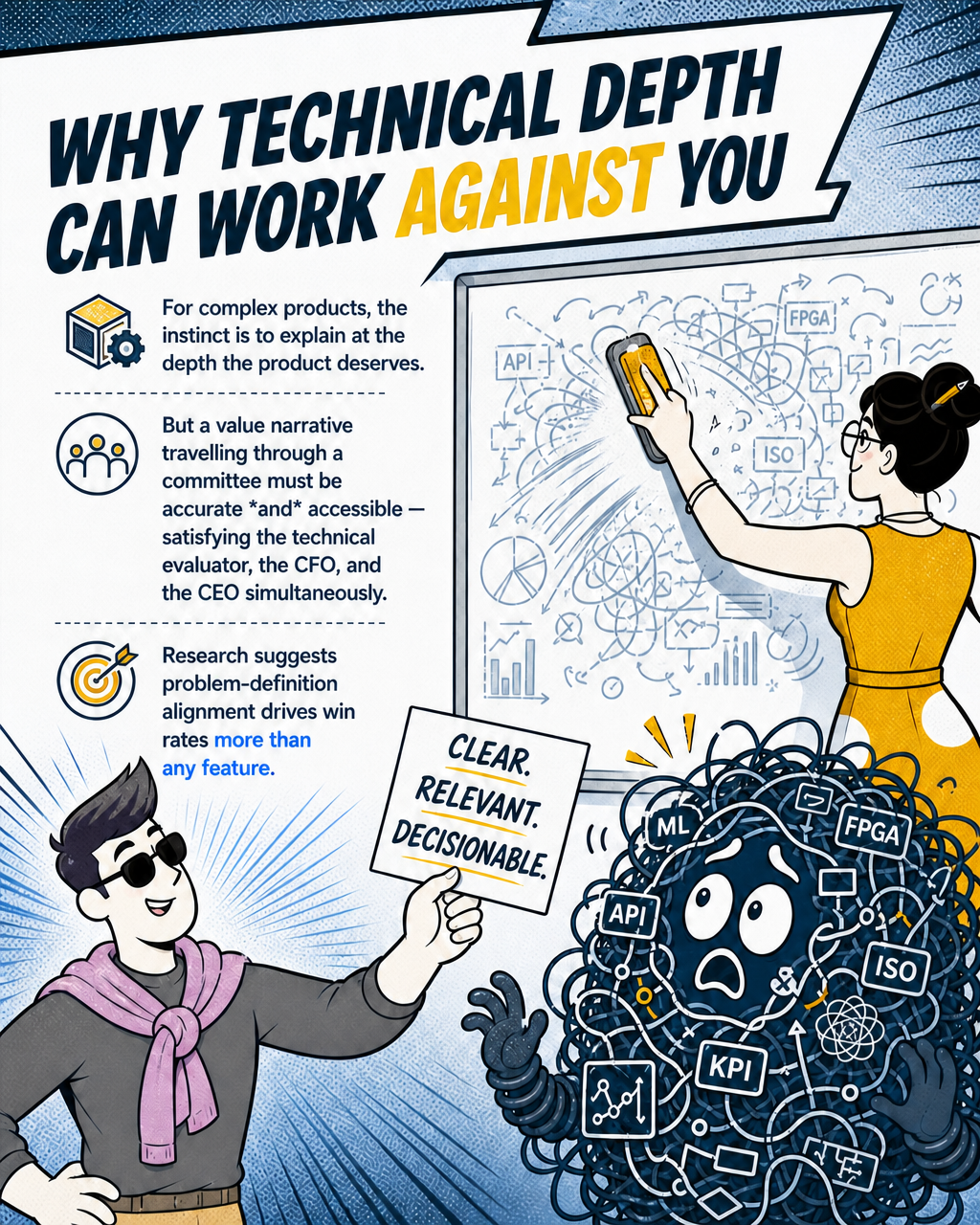
For complex technical products, the instinct is to explain at the level of technical depth the product deserves. Founders and technical sales leaders can become defensive of that depth. It feels like respecting the buyer's intelligence.
But a value narrative that travels through a committee must be accurate and accessible. It needs to satisfy the technical evaluator's question about how the integration works, the CFO's question about what problem it solves and at what cost, and the CEO's question about why this product, why now, why this company.
Research suggests that when sellers and buyers align on the problem definition, win rates improve meaningfully — and that alignment rarely comes from a better product feature. It comes from a shared, simple framing of the problem the product solves.
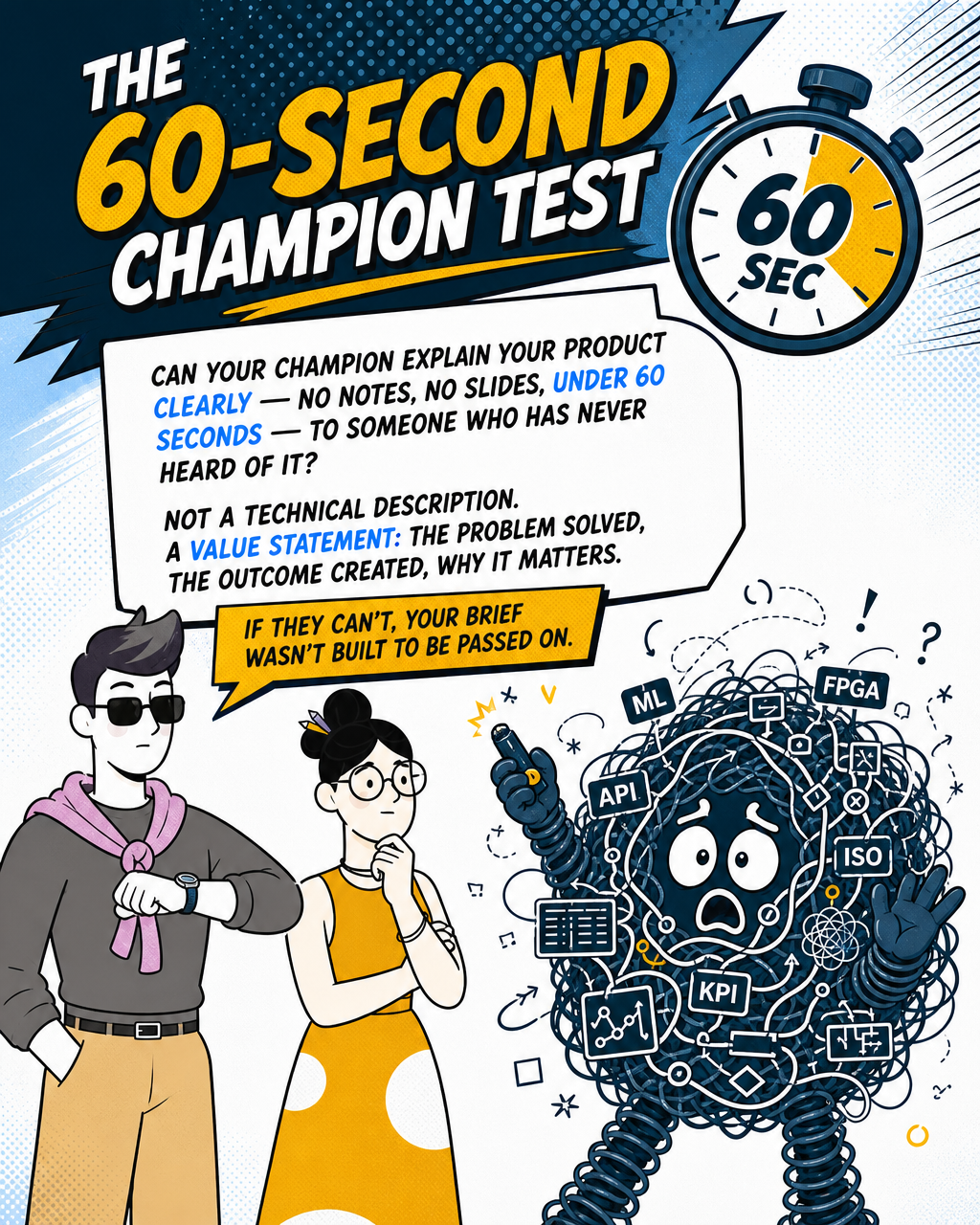
The test for whether your value narrative is ready to travel through a committee is straightforward. Can your champion explain your product clearly to someone who has never heard of it, without notes, without slides, in under 60 seconds? Not a technical description. A value statement. The problem it solves, the outcome it creates, and why that matters to the person being addressed.
If they can't, your champion is carrying a brief that wasn't built to be passed on.
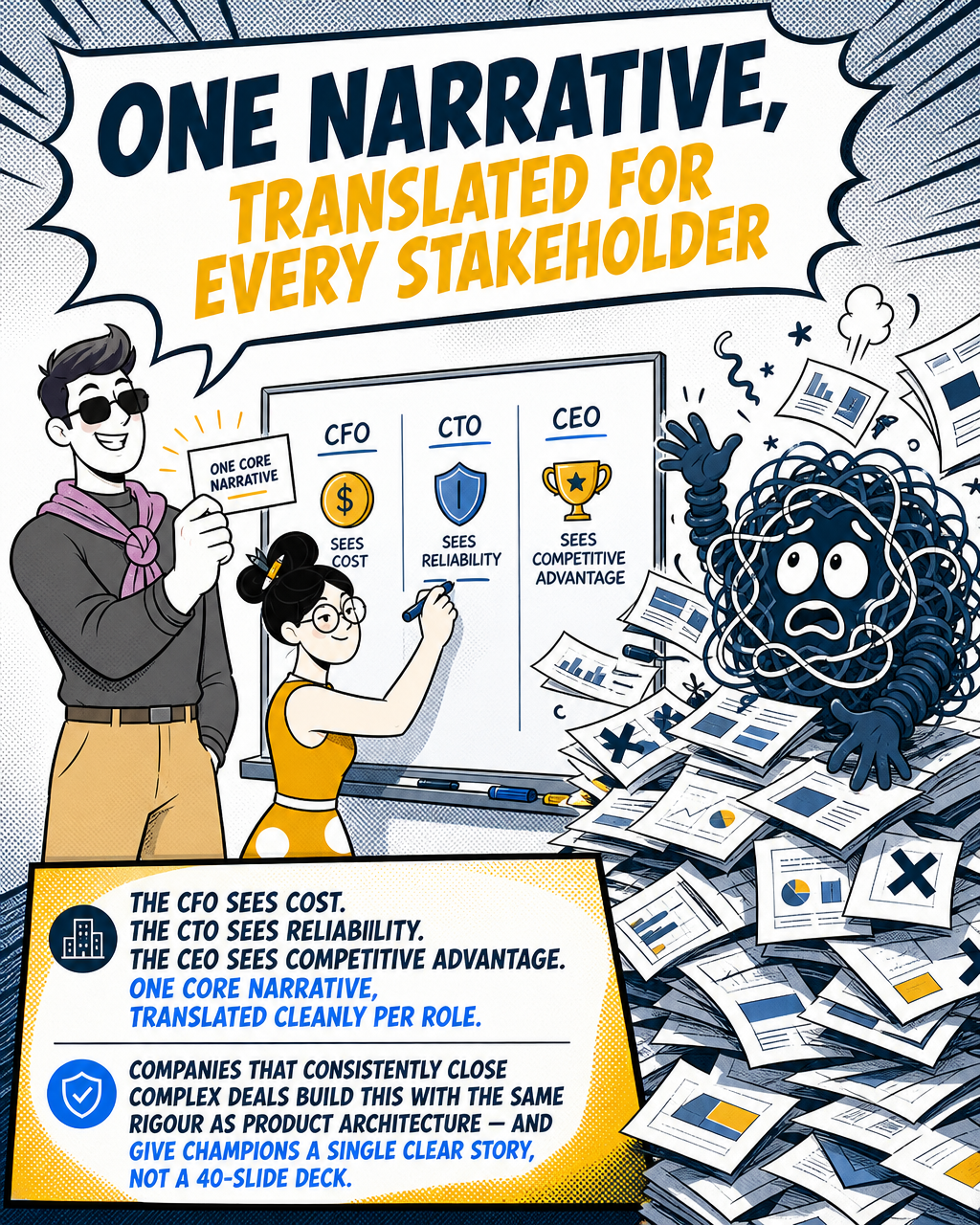
The business case needs to be built in the customer's language, not yours — with the CFO seeing cost, the CTO seeing reliability, and the CEO seeing competitive advantage. One narrative, translated cleanly for each role. Some B2B SaaS founders report meaningful improvements in close rates after building stakeholder-specific templates along these lines, though results vary considerably depending on deal complexity, market, and execution.
The companies that consistently close complex enterprise deals don't wing this. They build a core value narrative with the same rigour they apply to product architecture. They test it against non-technical audiences before it goes anywhere near a buying committee. And they give their champion a version they can genuinely use — not a 40-slide deck to relay under pressure, but a single clear story that doesn't require them to be a product expert to tell it.
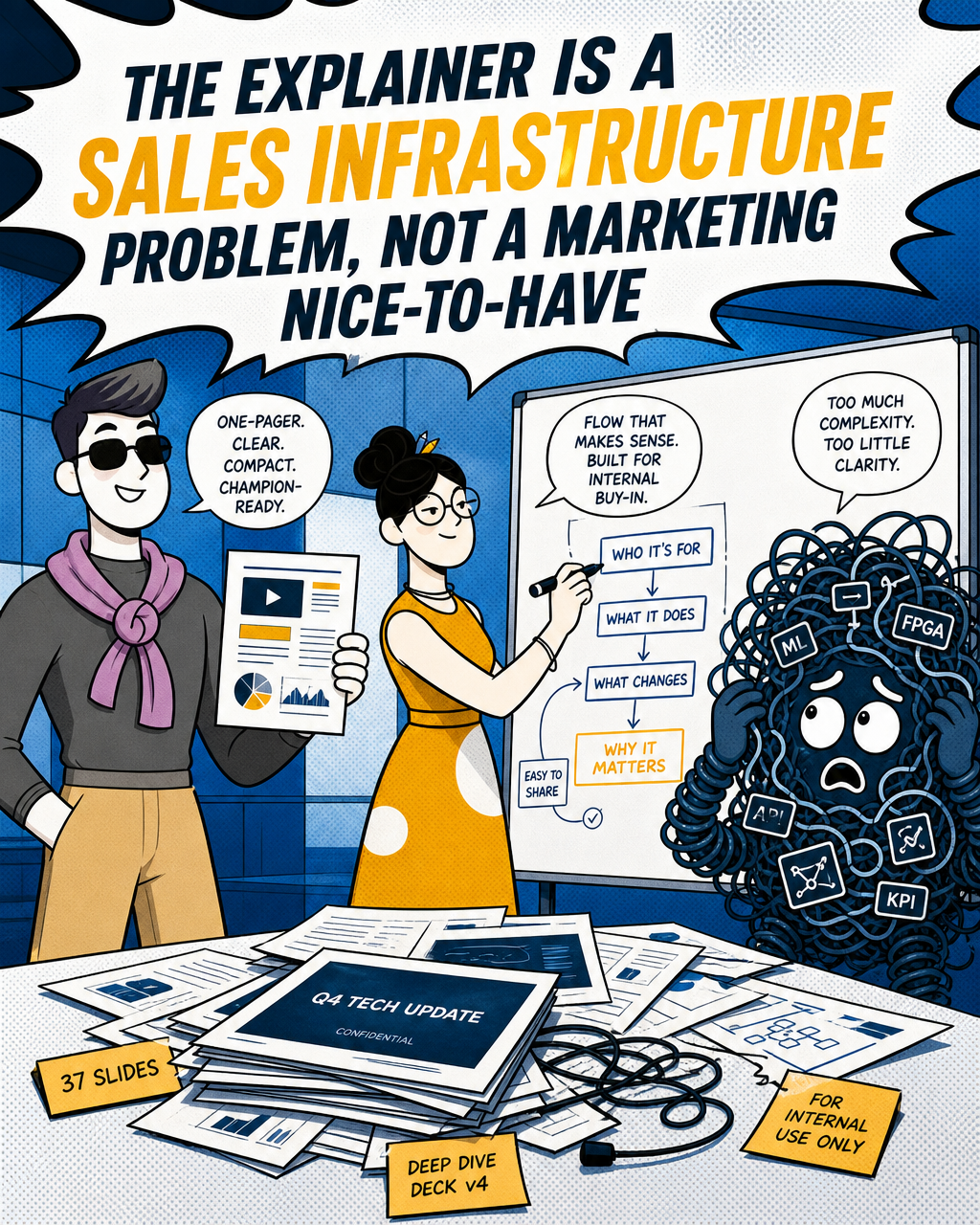
The explainer is a sales infrastructure problem, not a marketing nice-to-have
This is the part most ANZ deep tech companies get wrong. They treat the explainer video, the one-pager, the clear product summary as a marketing asset. Something to put on the website. Something for the top of the funnel.
It's actually the thing your champion needs in the room when you're not there.
When a CFO sees a 60-second video that explains what your product does, who it's for, and what changes after they buy it, they're not watching a marketing video. They're watching the internal validation tool your champion has been missing. When a procurement lead can watch something that makes the product click in under a minute, the "implementation risk" inference from all those clarification sessions starts to reverse.
A well-built explainer is not a promotional asset. It's a compression of your most important internal communication challenge: getting 8–10 people who think differently about risk to arrive at a shared, accurate understanding of why your product is worth the commitment.
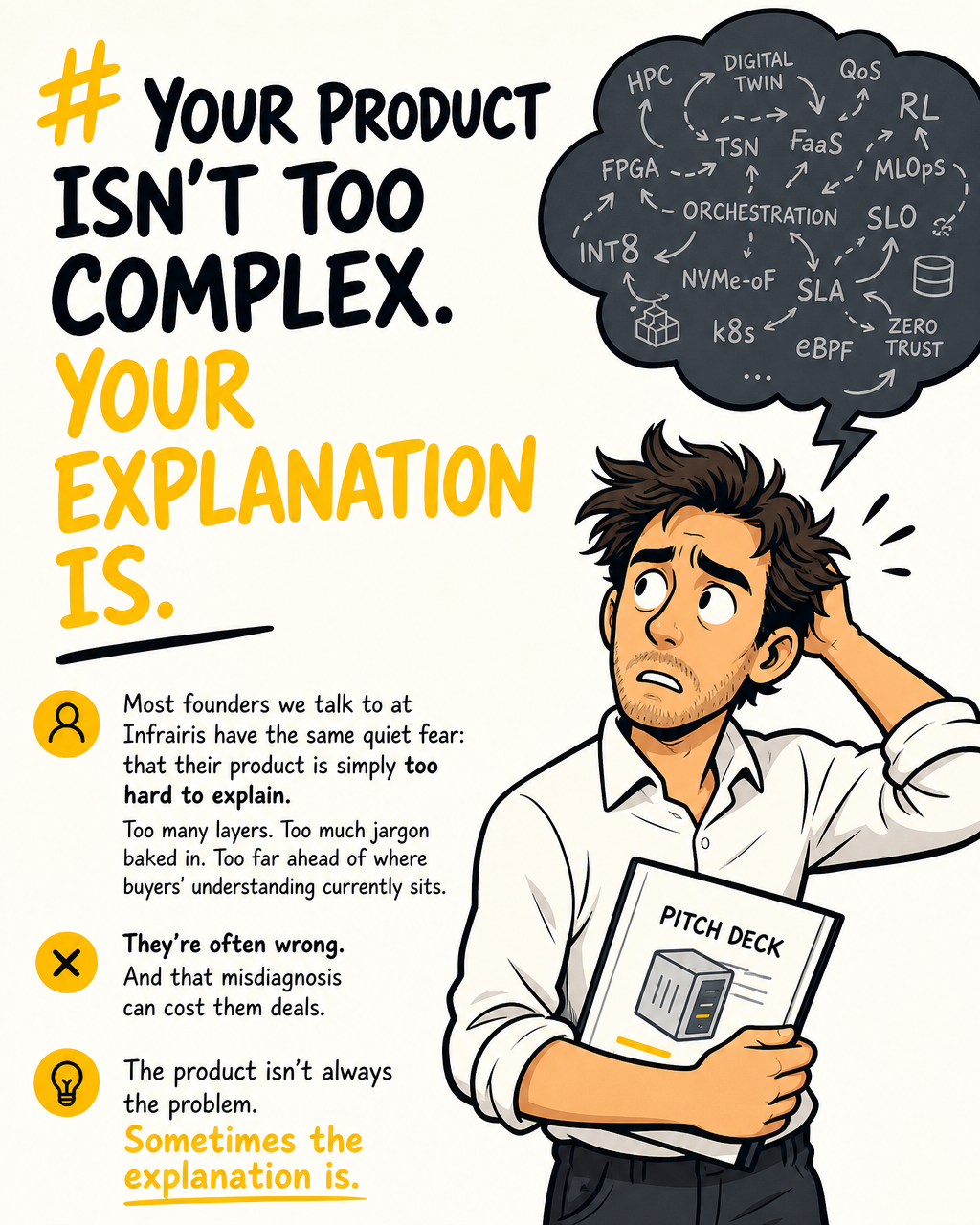
If your current explanation of your product requires 45 minutes of context to land, a full committee review, and a founder on the call to answer questions in real time, then the explanation is the bottleneck. Not the product, not the sales team, not the market timing.
The explanation.
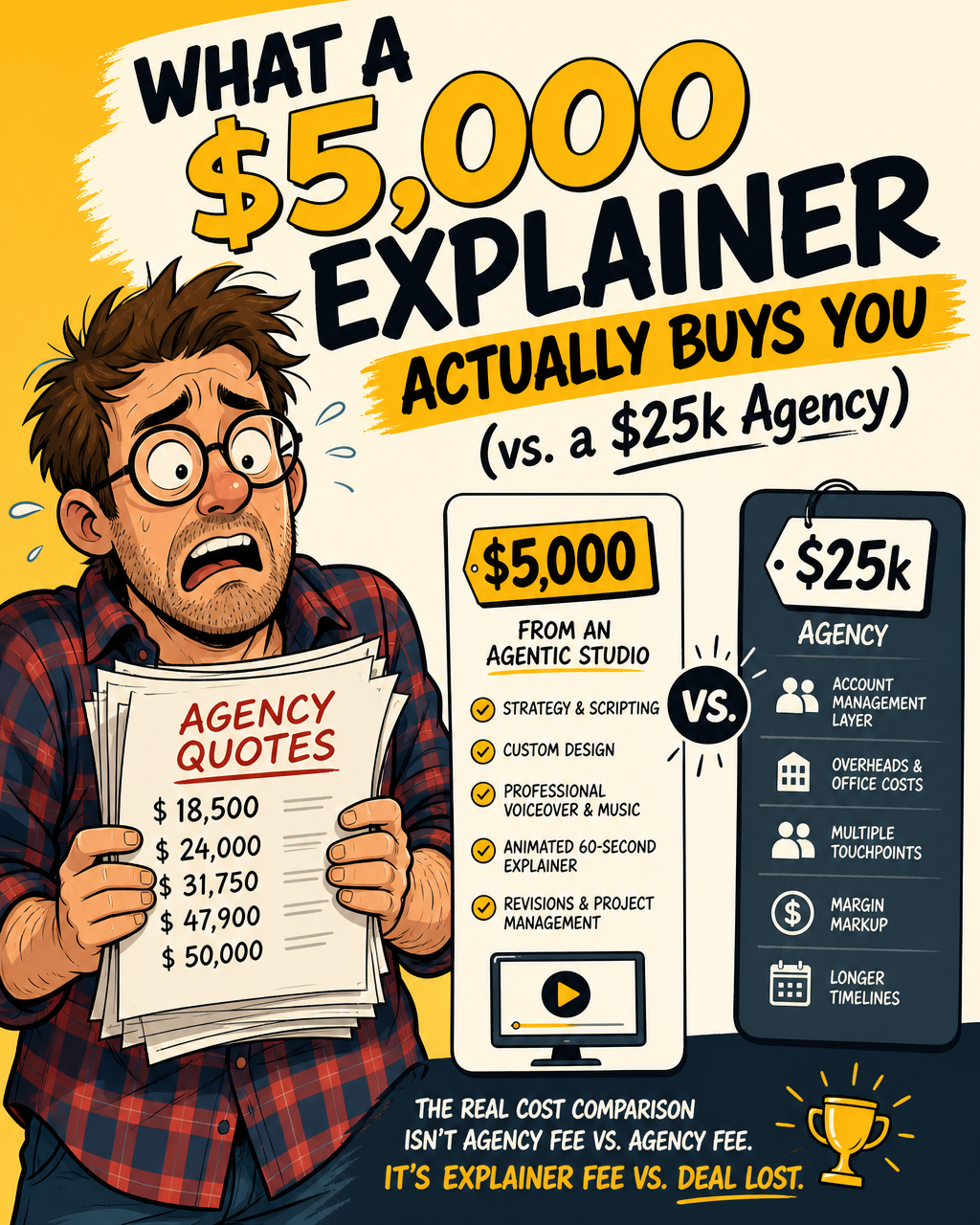
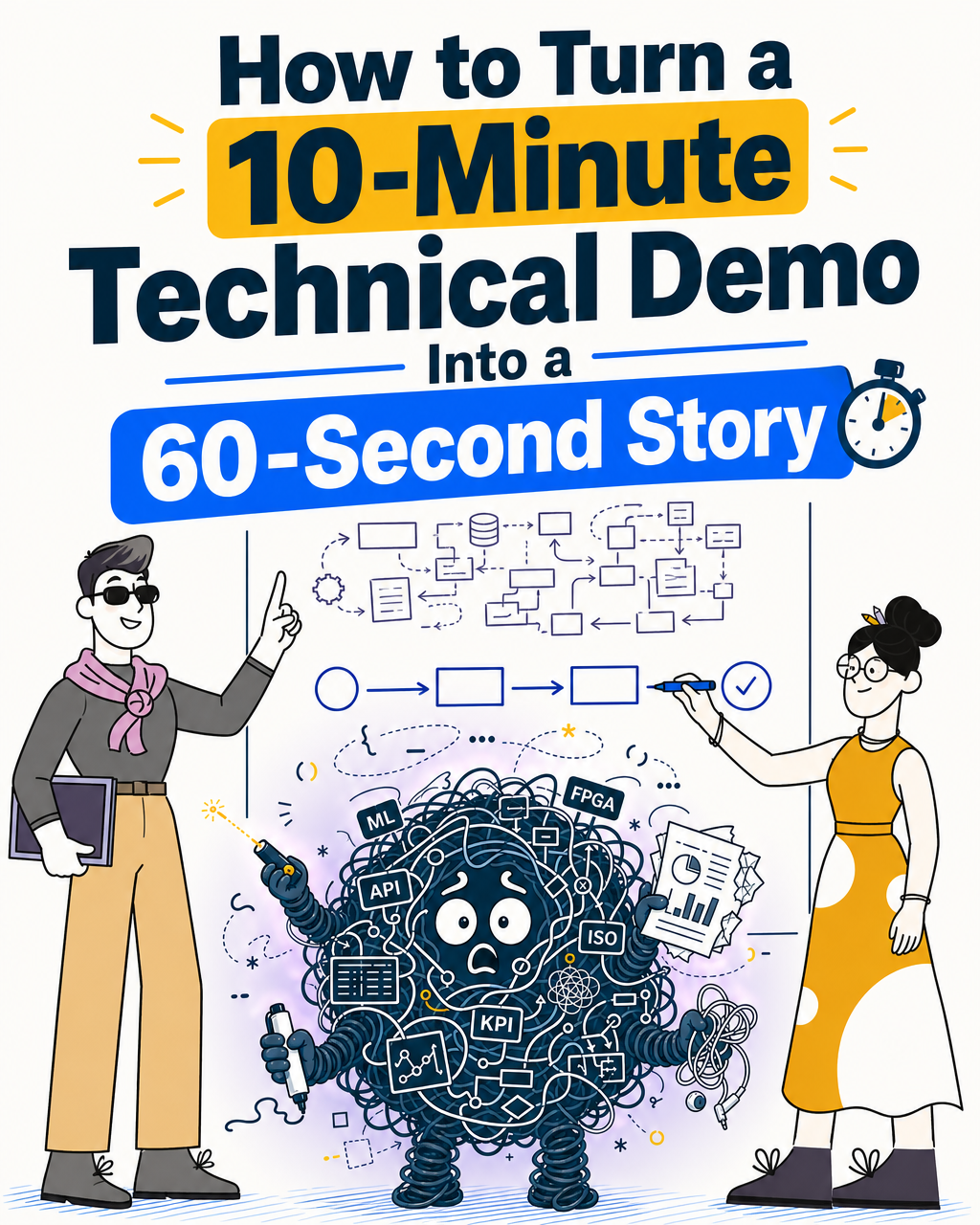
At Infrairis, this is the problem we work on. We work with deep tech, B2B SaaS, biotech, and fintech companies in ANZ whose products are genuinely complex to explain. We pair a senior creative director who has shipped tech with our agentic production stack, and we turn a 30-minute technical briefing into a 60-second explainer your champion can use in every room you'll never be in.
Typical turnaround is 2–3 weeks.

Infrairis
Your complex product. In 60 seconds. Clearly.
Your complex product. In 60 seconds. Clearly.
Learn more about Infrairis and get started today.
Visit Infrairis